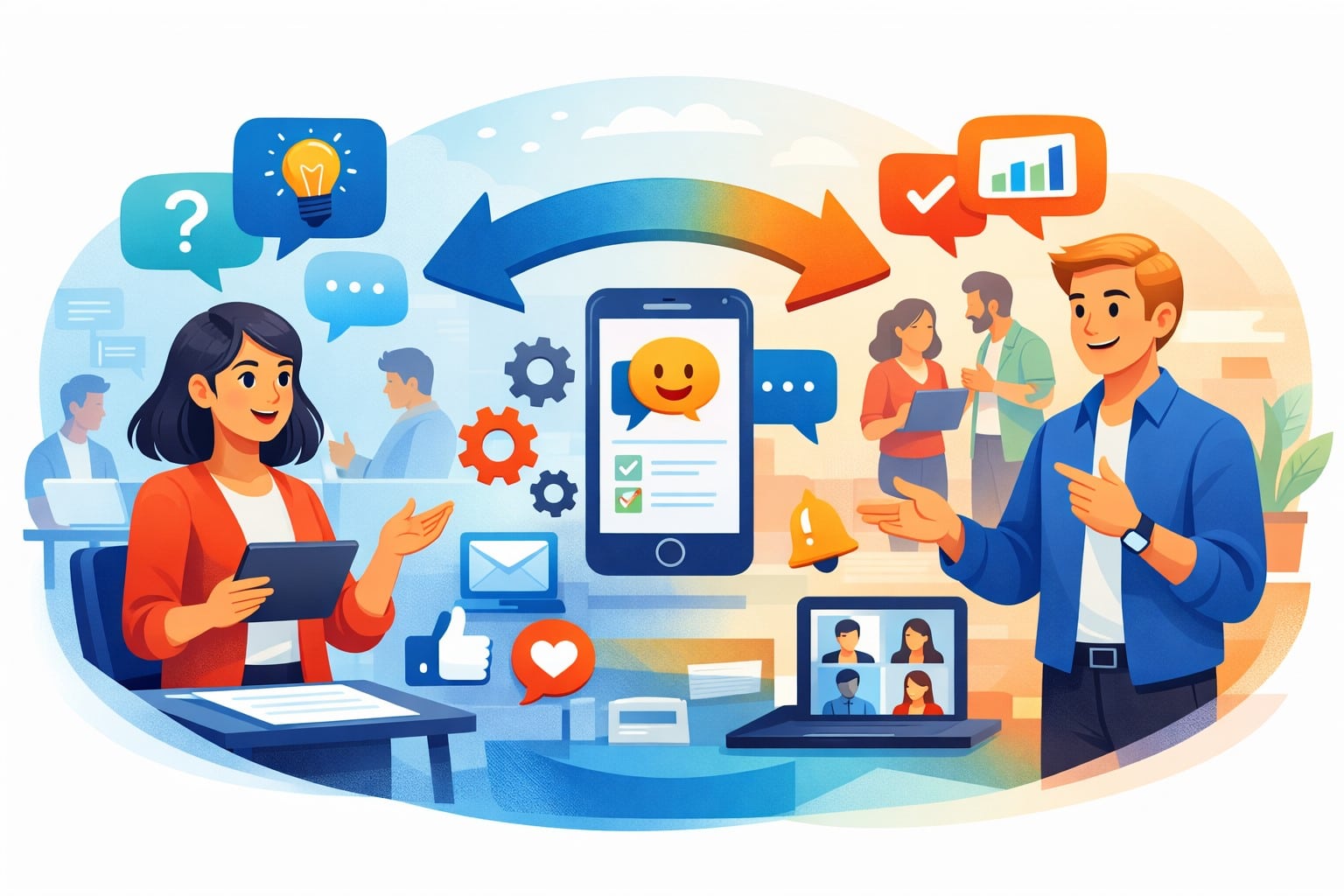
Good communication is no longer a one-way thing as organizations that grow well are the ones that actively listen, respond, and adapt. This is where two way communication becomes very important.
As companies grow and teams become more distributed, having a strong employee communication platform helps in making sure the messages do not just flow top-down but also bottom-up and among the team members.
In this guide, we will walk you through the importance of two way communication, how it works, and the systems or tools that help companies create a more engaged and connected team.

Key Takeaways
- Two way communication gives a continuous flow of information, response, and discussions in all levels of the organization.
- It has a very important role in increasing employee engagement, trust, and clear flow of information in the workplace.
- A strong two way communication system helps organizations in making better as well as faster decisions.
- Modern two way communication software makes it easy to increase communication over different teams.
- Asking for feedback, active listening, and open discussions helps in creating a more connected and productive work environment.
What is Two-Way Communication?
Two way communication is a process where information goes in both directions i.e. between sender and receiver. Unlike one-way communication, which only pushes out information, a two way communication system makes the discussion, feedback, and communication better.
In the office, this means employees not just get information but they can also share their thoughts on it. Leaders share updates, and employees can reply with feedback, ideas, and any questions if they have any.
Why Two-Way Communication matters in the workplace?
The importance of two way communication at work is more than just giving information as it increases trust, more connectivity, and engagement.
As per Forbes, employees who feel heard are 4.6 times more likely to do their work better. This shows how important an open discussion is for a successful teamwork.
With two way communication, companies can increase engagement as well as be more transparent with the team. Using the right systems and tools, companies can work on the feedback, stay more connected, and create a better workforce.
Strong strategic communications ways depend a lot on the feedback loops so that they are very effective.
Key elements of effective Two-Way Communication
Active Listening
Effective two way communication starts with listening. Leaders must choose more than just hearing words. They need to understand the goal, emotions, and context.
Clear Message Delivery
Sending simple and clear messages make sure that they are easy to understand. Whether it is updates from management or any activity for the team, communication should be simple and with the right information.
Feedback and Response
Feedback is the base of a two way communication system which makes sure that the communication is not just sent but noticed and taken in action.
How Two-Way Communication works in the workplace?
In modern workplaces, two way communication is done with the help of different channels like meetings, surveys, chats, and digital apps. Below is a simple process that shows how it is done:
- Leadership gives a new update
- Employees give response by surveys or comments
- Managers study them and take the right action
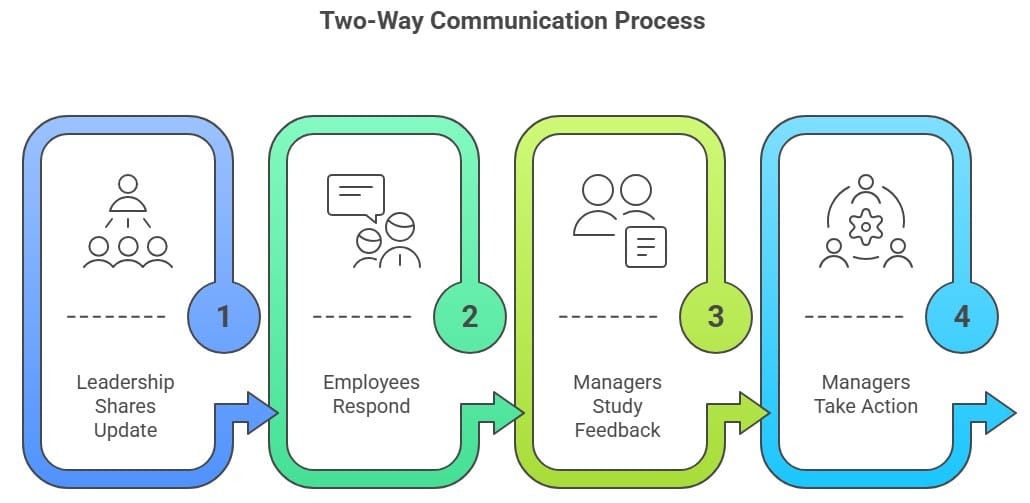
This non-stop process brings in better connectivity and transparency by making sure that the information is not only shared but also understood clearly by the team.
It helps in filling the gaps between the leaders and employees which builds trust, keeps everyone on the same page within the company. Modern internal communication tools make it easy to make this process better over large team in following ways:
- Gives real-time messaging and quick feedback loops over different team members
- Keeping all communication channels at one point to decrease information storage
- Gives analytics and insights to check the engagement as well as the response
- Support multi-channel delivery like mobile, web, email to reach employees
- Automate surveys, polls, and notifications to keep continuous activity
Ways to encourage Two-Way Communication in Organizations
To create a culture of open communication, companies to use need the correct method that fits their goals such as:
- Open-door policies – Create a culture where employees feel safe talking to the leaders with ideas, questions, and response with confidence.
- Unknown feedback channels – Allow employees to give honest answers without fear to solve problems that are making communication gaps.
- Do regular surveys – Get quick, and regular insights of what employees feel which will help in finding patterns and take action quickly.
- Train leaders to communicate better – Good communication happens by proper listening and responding positively to create good discussion.
- Study and act on employee feedback – Show your team that their voice matters by understanding them and taking the right action on it.
By having the right two way communication software, these methods become easy to use and make it better.
Benefits of Two-Way Communication for Employee Engagement
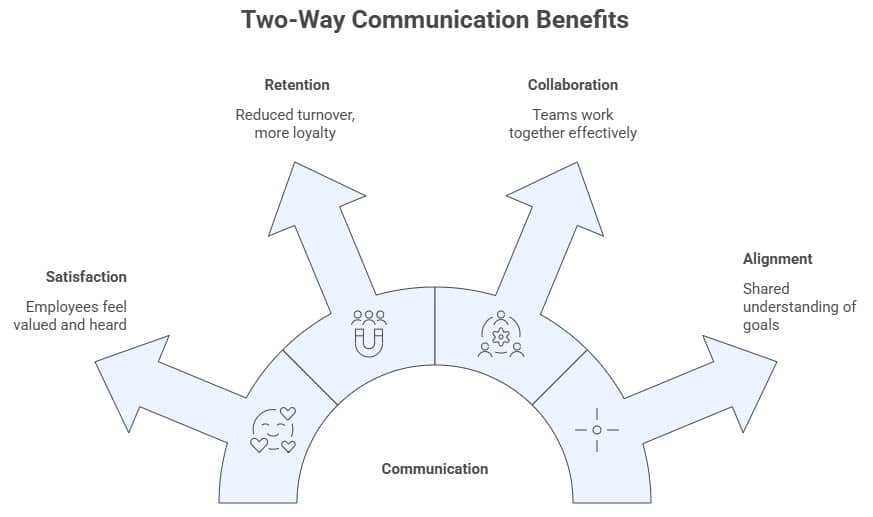
The impact of communicating two ways directly reflects in employee engagement levels. Key benefits include:
- Higher employee satisfaction
- Improved retention rates
- Better collaboration across teams
- Stronger alignment with company goals
Corporate communications strategies that include employee voice tend to be more authentic and impactful.
Challenges that prevent effective Two-Way Communication & how to improve It
Despite its importance, many organizations struggle with implementing effective ways to communicate. Below is a quick overview of common challenges in two way communication., their impact on team and how organizations can overcome them:
| Challenge | Impact on Workplace Communication | How to Improve It |
| Hierarchical barriers | Limits open dialogue as employees may hesitate to share feedback with senior leadership | Encourage open culture, to promote leadership accessibility |
| Lack of trust | Employees avoid sharing honest opinions, reducing transparency and engagement | Build psychological safety and act consistently on employee feedback |
| Poor communication tools | Leads to fragmented as well as missed messages across teams | Invest in modern two way communication software that centralizes and streamlines communication |
| Information overload | Employees feel overwhelmed, causing important messages to be ignored | Simplify messaging as well as prioritize key updates |
| Delayed responses | Breaks feedback loops and reduces employee confidence | Enable real-time channels and set clear response expectations |
Two-Way Communication examples in the workplace
| Two-Way Communication Example | How It Works in the Workplace | Business Impact |
| Manager–Employee Conversations | Regular one-on-one meetings where employees share concerns, ideas, and receive personalized guidance | Builds trust, improves performance, and strengthens manager-employee relationships |
| Team Meetings and Discussions | Interactive team sessions that encourage open dialogue, brainstorming, and collaborative problem-solving | Enhances teamwork, innovation, and alignment on goals |
| Employee Surveys and Polls | Pulse surveys and quick polls used to gather real-time feedback and measure employee sentiment | Provides actionable insights and supports data-driven decision-making |
| Internal Communication Platforms | Digital platforms that enable real-time messaging, feedback, recognition, and collaboration across teams | Improves engagement across distributed workforces |
Use HubEngage to strengthen Employee Feedback and dialogue
At HubEngage, we understand that good ability of communicate is the foundation of employee engagement. Our platform brings together multi-channel communication, instant messaging, social hub, and surveys hub into one unified experience. This integrated approach enables seamless two way communication across the organization, helping teams stay connected, share insights in real time, and collaborate more effectively which ultimately improves both employee engagement and overall productivity. With HubEngage, companies can:
| Capability | How It Supports | Outcome |
| Capture employee voice | Gather real-time feedback from employees | Better decisions and higher engagement |
| Leadership visibility | Access employee insights and feedback trends | Faster responses and improved trust |
| Cross-team collaboration | Enable shared communication across departments | Stronger teamwork and productivity |
| Transparency and trust | Promote open dialogue and visible action | Higher accountability and engagement |
Conclusion
Two way communication is not just an option anymore as it has become an important way of increasing engagement, trust, and performance in modern workplaces. When companies create a good feedback system and give an option of open discussions then, teams stay connected and take part actively.
If you are looking how to bring this to life then you should get a demo of HubEngage to see how an employee experience platform can help with a more connected team.
Two Way Communication FAQs
What are the main characteristics of two-way communication?
Two way communication contains active listening, clear messaging, regular feedback, and continuous discussions. It makes sure both sender and receiver participate well which makes better understanding, stronger relations, and a more connected workplace.
How does two-way communication improve workplace transparency?
By giving better transparency as well as open discussions between employees and leaders. It allows questions, feedback, and clarifications, which makes sure the information is shared clearly over all levels of the company.
What role does feedback play in two-way communication?
Feedback plays a very important role in understanding as well as identifying gaps. This makes sure the discussion gets better with each feedback, making the workplace as per the company’s goals.
What are the most common barriers to two-way communication?
Low trust, large organization structures, bad tools, and too much information are some common gaps which can decrease open discussions, and feedback process that has a negative effect on the engagement as well as teamwork.
How can companies create an environment that supports open communication?
Companies can create open communication if they are more transparent, take up feedback, and train leaders to listen actively. Creating safe spaces and using the right tools helps employees share ideas well.
Which workplace tools help facilitate two-way communication?
Tools such as employee communication platforms, messaging apps, surveys, and collaboration software helps with two way communication as they give real-time discussions, structured feedback, and one stop discussion platform for teams.
How can employee communication platforms improve dialogue between teams?
Employee communication platforms make better dialogue by giving an option of real-time messaging at one place. This can help in decreasing information load as well as make sure the communication goes well to the team.
Related Links:
Employee Communication Platform | Internal Communication Tools | Strategic Communications | Corporate Communications