Strategic communications is the practice of tying every message an organization sends to a specific business outcome. It is planned as a long–term strategy, and leaders track its success through shifts in audience behavior and decisions. In our blog we will break down what strategic communications is and how organizations can turn it into a lasting competitive advantage.
Key Takeaways
- Strategic communications connects every message to one organizational goal.
- A strong strategic communications framework supports every new initiative.
- Employee engagement is at its lowest point in years, and organizations that take leadership communication seriously see far better odds of executing their strategy.

What is Strategic Communications?
Strategic communications is the function that decides what audiences need to hear and through which channels. It sits above any single announcement or campaign, and every message serves the same underlying business goal.
In practice, most organizations manage this internally through a centralized system instead of scattered emails and one-off town halls. Communications teams plan and send messages to employees on one platform, then measure how they land, without managing each channel separately.
For teams comparing options, our guide on internal communication tools covers the best software, along with free options businesses can try before investing in a more advanced solution.
The Importance of Strategic Communications
Clear, deliberate communication speeds up decisions and extends trust across the organization. When it is missing, even the right call falls flat because nobody can understand the reasoning behind it. A well-executed communication plan helps organizations:
- Build trust through transparency, so employees don’t have to guess leadership’s intent.
- Speed up decision-making, since teams spend less time chasing clarification.
- Reduce misinformation when updates are unclear or delayed.
- Improve employee engagement and alignment, so people stay invested in the company’s growth
According to Gallup’s 2026 State of the Global Workplace report, employee engagement has dropped to 20%, down from its 2022 peak of 23%. Organizations with disengaged employees see lower profitability. That gap is exactly why strategic communications matters and can make a measurable difference.
Core Components of Strategic Communications
Strategic communications rests on four components that separate organizations that communicate well from those that do not. Here is what each one means and why treating them separately can affect the overall business outcomes.
1. Business alignment
A clear business alignment ties every message to a measurable outcome, such as revenue growth or stronger employee retention. A well-written message has no strategic value if it doesn’t match the company’s goals.
2. Audience segmentation
Audience segmentation starts with understanding who is receiving a message and what decision it should influence. An executive and a frontline employee often need the same update framed differently, or the message loses meaning for one of them.
3. Message consistency
Consistent messaging keeps core narratives and language coherent across channels as tactics evolve. Without it, employees end up hearing conflicting versions of the same update, which can undercut the outcomes business alignment was meant to drive.
If your organization is looking for a more structured approach, our guide on building an internal communication strategy explains how to set priorities and assign ownership as the business scales.
4. Measurement and feedback
Teams that track sentiment and behavior change can identify a message that is not landing and refine it. A feedback loop like this is what separates a strategy that gets sharper with each campaign from one that repeats the same guesswork every quarter.
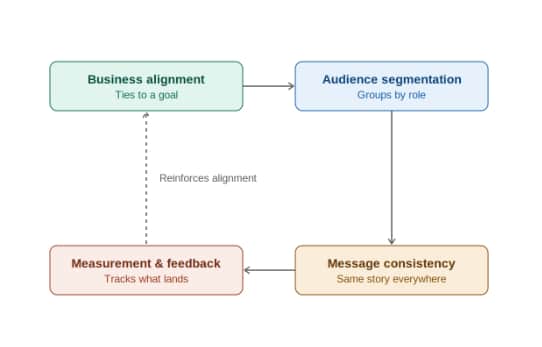
Fig-1: The diagram shows the four components working as a cycle, each one feeding into the next.
Building a Strategic Communications Framework
A strong strategic communications framework allows organizations to scale without losing alignment or intent. It takes the core components covered above and adds three operational pieces that put them into practice.
1. Channel strategy and cadence
Channel strategy and cadence decide which medium best reaches each audience, and how often updates go out before a message loses relevance. A policy change may need an all-hands email followed by manager-led team discussions, while a routine update may only require a single intranet post.
2. Governance and ownership
Governance decides who signs off before a message goes out, and who answers for it if the message misses its mark. Without a named owner, reviews can stall and potentially delay the business goal the message was meant to support.
3. Templates and reusable assets
A shared library of approved language and format gives teams a starting point, so nobody drafts each message from scratch. It also means a new hire can produce written copy almost as fast as someone more experienced.
Creating a Communication Strategy Plan
Start with a small number of clearly defined outcomes. Trying to communicate everything at once is where most plans lose focus. Unlike the framework, which gets built once, developing a communication strategy for a single initiative means answering these five questions each time something new comes up.
| Question | What it determines |
| What are we trying to influence? | A concrete result, such as faster adoption of a new tool or fewer employees opting out of a benefit |
| Who needs to act or think differently? | A team lead or specific department whose behavior drives the result, not everyone |
| What do they need to know to move forward? | The information gap standing in their way, whether that is an unclear deadline or an unexplained reason for a change |
| Where and when should this communication show up? | A specific channel and moment, such as a manager briefing before a company-wide email |
| How will we know if it worked? | A measurable indicator like tool usage increase or opt-outs dropping |
Strategic Messaging Architecture
Strategic messaging architecture keeps messages aligned even when different teams create content independently. The content format changes, but the underlying message stays the same.
1. Central narrative
A central narrative names who the organization is and where it is headed. This is the starting point for any corporate communication strategy a team builds. An email and a new-hire onboarding guide can be well written and still leave the audience with no clear sense of who is actually speaking.
2. Supporting themes
Supporting themes break the central narrative into a few recurring ideas tied to specific business priorities. Themes like innovation and customer impact can show up in a product launch and a quarterly earnings summary for an organization expanding into new markets.
3. Proof points
Proof points are quantifiable evidence that makes a claim credible. Saying a new process “improves efficiency” asks the reader to take the organization’s word for it, while “cut approval time from five days to one” gives them a number they can hold the organization to.
4. Tone and brand guidelines
Tone and brand guidelines set the boundaries for how something gets said, so the same organization sounds consistent no matter who is writing. A memo about layoffs and a post celebrating a product launch call for different tones, but shared brand elements like familiar phrasing keep them instantly recognizable.
Strategic Communications for Leadership Alignment
Leadership alignment means every leader presents a strategy the same way, regardless of audience. Drift between leaders and the contradictions it creates can weaken employees’ trust and impact the company’s image.
According to McKinsey’s 2025 research, leaders who treat culture and communication with the same rigor as financial performance more than double their odds of running a successful strategy.
This is where tools like our employee communication platform prove valuable, giving leaders one shared system to reach every level of the organization instead of relaying updates through separate emails or meetings across locations and roles.
Strategic Communications in Change Management
Employees support a change when they understand why it is happening. Organizations that skip this step and lead with details like logistics or new processes often face pushback that has less to do with the change and more to do with feeling blindsided.
Many businesses bring in strategic communications consulting during a major transformation to keep communication transparent and ensure employees aren’t an afterthought in management decisions.
Common Strategic Communication Pitfalls
Most communication pitfalls come from habits repeated across multiple messages that quietly erode trust and clarity over time. A few of the common ones are as follows.
1. Late employee involvement.
Leadership often finalizes a decision, then loops employees in only once everything has settled, turning communication into an announcement instead of a conversation.
2. Information overload.
Too many updates at once bury the point that actually mattered.
3. Assuming the message landed.
Many organizations send a message and never check whether anyone understood or acted on it.
According to Edelman’s Trust Barometer, employer trust slipped three points to 75% globally in 2025, though it still ranks above trust in government and media. That makes internal communication one of an organization’s most credible channels, and these pitfalls put the broader corporate communication strategy at risk.
Best Practices for High-Impact Strategic Communications
High-impact communication comes from a small set of practices applied consistently across every message. The table below shows what those practices look like and why each one matters.
| Best practice | Why it matters |
| Check the priority before drafting, not after | A message drafted first and justified later is usually the one that drifts from the real goal |
| Write in plain language | Jargon might sound polished internally, but it makes the reader work harder to understand what they actually need to do |
| Repeat the message more than once | People rarely absorb something the first time they hear it, especially during a busy week |
Seeing these practices in action makes them easier to apply. Our article on internal communications examples offers practical templates showing how organizations use different channels and tools to connect with their employees.
Turning Strategic Communications Into a Lasting Advantage
Strategic communications works when every message ties back to a clear business goal. Organizations that build this discipline into their operations make faster decisions and earn their people’s trust. Strategic communications consulting often makes the path easier, especially for first-timers.
HubEngage gives leaders a single system to send consistent messages across every level of the organization. Book a demo now to see how the platform could work for your team.
FAQs for Strategic Communications
1. What is strategic communications?
Strategic communications is the practice of tying every message an organization sends to a specific business outcome. It covers how a message is shaped and delivered so it moves a real decision or behavior.
2. How is strategic communications different from PR?
PR focuses mainly on external reputation and media relationships. Strategic communications is broader, covering internal alignment and how every message connects back to the business.
3. How do I create a strategic communications plan?
Start by defining the business outcome the message needs to influence, then identify who actually needs to act on it. From there, a communication strategy comes down to choosing the right channel and defining how you’ll measure success.
4. What channels work best for strategic communications?
The right channel depends on the audience and the message’s objective. Many organizations rely on a mix, from email and intranet pages to in-person meetings, depending on what the moment calls for.
5. How does strategic communication support business goals?
Strategic communication helps organizations align teams around priorities and build trust. When people understand the reasoning behind a business decision, they act on it faster and with less resistance.
6. What skills does strategic communications require?
Key skills include audience analysis and the ability to translate complex strategy into clear, everyday language. Applying feedback is also important to determine whether a message actually worked or needs to change.
7. How do you measure strategic communication success?
Success is measured against the outcome it was meant to influence. That could mean tracking engagement data and sentiment, or business outcomes like productivity and adoption rates.
8. How does strategic communication stay consistent during change?
Consistency during change comes from clear governance and a shared messaging framework, reinforced by leaders who stay aligned on the same priorities.
Related Links:
Employee Communication Platform | Internal Communication Tools | Internal Communication Strategy | Internal Communications Examples