Asynchronous communication has become a foundational way modern teams collaborate, especially in remote and hybrid environments. We see this shift firsthand as organizations look for ways to work with more focus, flexibility, and less meeting overload. But why has this approach become so critical to productivity, focus, and scalability at work?
This guide explains the concept of asynchronous communication, what it means in practical terms, and how it differs from real-time interactions. We walk through the meaning, benefits, challenges, and real-world applications teams rely on today.
You will learn the meaning of asynchronous communication, how asynchronous and synchronous communication compare, and when each approach works best. We also cover employee communication platform, workflows, examples, and metrics to help organizations design effective async comms strategies that reduce meetings, improve clarity, and support distributed teams.
Key Takeaways
- Enables flexibility and deep work by removing the need for real-time responses.
- Essential for remote and hybrid teams working across different time zones.
- Reduces meetings and interruptions, improving overall productivity.
- Improves documentation and clarity by capturing discussions and decisions.
- Requires clear guidelines and structured workflows to avoid delays and confusion.
- Works best for updates and collaboration, while real-time is better for urgent matters.

Understanding Asynchronous Communication
At its core, asynchronous communication refers to the exchange of information where participants do not need to be present or respond at the same time. When people ask about asynchronous communication, they are usually trying to understand how messages, updates, or requests can be shared without requiring an immediate reply.
To clearly answer what is the meaning of asynchronous communication, it means communication that happens across time, not in real time. One person sends a message, and the recipient responds later, when it fits their schedule. This is fundamentally different from live conversations such as phone calls or meetings.
If you are wondering what does asynchronous communication mean in practical terms, think of emails, recorded video updates, project management comments, or knowledge base articles. These formats allow information to flow without interrupting deep work.
In modern organizations, we find that understanding asynchronous communication becomes essential as teams span time zones, work remotely, and operate on flexible schedules.
How Asynchronous Communication works?
To understand how asynchronous communication works in practice, it helps to look at how information is created, stored, and consumed. Asynchronous communication relies on documented messages that live in shared systems rather than fleeting conversations.
Here is how asynchronous communication typically works:
| Step | Description |
|---|---|
| Message creation | A sender writes or records a message with sufficient context |
| Delivery | The message is posted to a shared channel or platform |
| Consumption | Recipients review the message at a convenient time |
| Response | Replies are thoughtful, documented, and time-flexible |
Because responses are delayed by design, clarity and structure are critical. This is why teams that master what is the meaning of asynchronous communication invest heavily in documentation and standards.
Asynchronous vs. Synchronous Communication
A common question is what is asynchronous and synchronous communication, and how they differ in day-to-day work. In practice, most organizations use a mix of both. The challenge is that many teams default to synchronous communication even when it is not necessary, leading to calendar overload and constant interruptions.
Understanding what does synchronous communication mean, and how it contrasts with async, allows teams to be more intentional. Real-time conversations are valuable for fast decisions and sensitive topics, while asynchronous communication works better for updates, documentation, and thoughtful collaboration.
| Aspect | Asynchronous Communication | Synchronous Communication |
|---|---|---|
| Timing | Delayed responses | Real-time interaction |
| Availability | Participants respond when ready | Participants must be present |
| Examples | Email, project comments, recorded video | Meetings, calls, live chat |
| Focus impact | Supports deep work | Often interrupts workflow |
Understanding what does synchronous communication mean is just as important. Synchronous communication requires all participants to engage at the same time, such as a live meeting, workshop, or phone call.
When teams clearly define asynchronous and synchronous communication, they can intentionally choose the right mode instead of defaulting to meetings.
Benefits of Asynchronous Communication for Modern Teams
Once teams understand how asynchronous communication works, the benefits become clear, especially when we look at how work actually gets done day to day. Asynchronous communication reshapes how teams plan, share updates, and make decisions by removing the constant pressure to be available at the same time. Instead of reacting in the moment, people can focus, reflect, and respond with more intent.
- Improved productivity
Async work reduces interruptions and meeting overload. - Time zone flexibility
Global teams collaborate without scheduling constraints. - Better documentation
Decisions and discussions are captured for future reference. - Inclusive communication
Everyone has time to think and contribute. - Reduced burnout
Fewer urgent interruptions support healthier work rhythms.
Research from McKinsey shows that excessive meetings reduce productivity and employee satisfaction. Asynchronous workflows help counter this by shifting work away from constant real-time demands.
Challenges of Asynchronous Communication
While understanding asynchronous communication highlights many benefits, it is not without trade-offs. When teams move away from real-time conversations, new risks emerge around clarity, alignment, and decision speed. Without strong norms, async communication can feel slow, fragmented, or overwhelming.
We often see these challenges surface when teams adopt async tools but do not adjust expectations around response times, message quality, or ownership. The key is not to avoid asynchronous communication, but to anticipate these challenges and design guardrails that keep work moving smoothly.
| Challenge | Why It Happens | How to Address It |
|---|---|---|
| Delayed decisions | Responses are not instant | Define response-time SLAs |
| Misinterpretation | Lack of tone or context | Write clearly and use templates |
| Information overload | Too many async messages | Strong channel governance |
| Reduced urgency | Everything feels equal | Clear priority labeling |
Teams that understand asynchronous communications learn to design guardrails rather than abandoning async entirely.
Core Principles of Effective Asynchronous Communication
To incorporate asynchronous communication effectively, teams need more than tools. They need shared principles that guide how messages are written, where information lives, and how quickly people are expected to respond. These principles create consistency and prevent async work from becoming fragmented or confusing.
Teams should follow core principles:
- Clarity over brevity – Provide full context upfront
- Default to documentation – Write things down once
- Explicit ownership – Assign clear owners and deadlines
- Defined response expectations – Set norms for urgency
- Searchable systems – Make information easy to find
These principles ensure async communication scales without confusion.
Best Use Cases for Asynchronous Communication
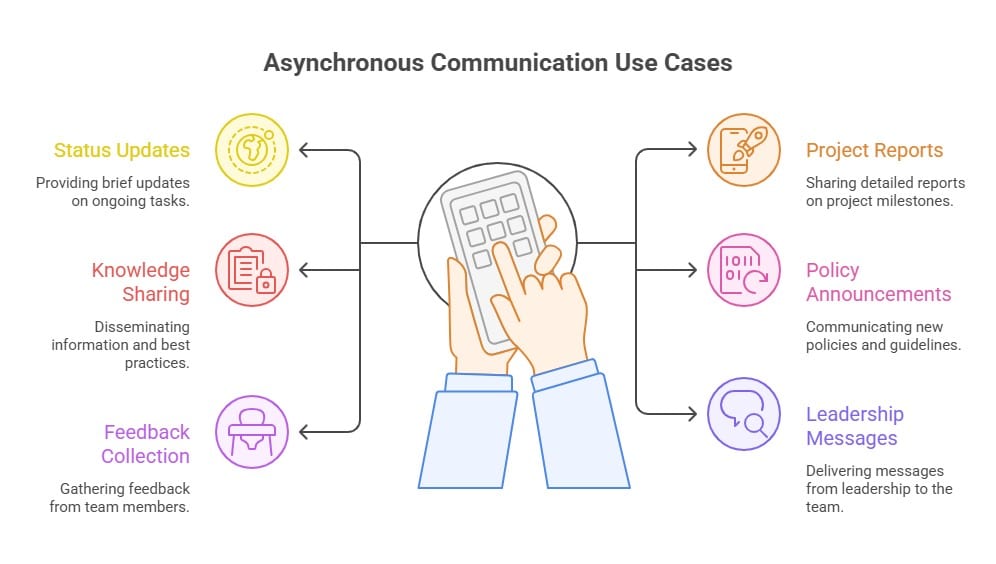
Understanding asynchronous communication helps teams decide when to use it and, just as importantly, when not to. Async communication works best when information needs to be shared broadly, documented for later reference, or reviewed thoughtfully rather than discussed immediately. Best async use cases include:
- Status updates
- Project progress reports
- Knowledge sharing
- Policy announcements
- Feedback collection
- Leadership messages
Asynchronous Communication in Remote & Hybrid Workplaces
Remote and hybrid teams rely heavily on async workflows, and we increasingly see asynchronous communication replace many meetings and real-time check-ins. In distributed environments, overlapping work hours may be limited, making real-time collaboration difficult or inefficient.
For example, a global team may share weekly updates through recorded videos and written status posts rather than live meetings. Team members review updates when they start their workday, add comments or questions asynchronously, and decisions are documented for everyone to reference later. This approach keeps teams aligned without forcing attendance across time zones. Knowing what does asynchronous communication mean becomes critical when teams rarely overlap in working hours.
Gallup research shows that flexible work arrangements improve engagement when supported by strong communication practices:
Async communication allows remote teams to stay aligned without forcing everyone into the same schedule or workday.
Tools that enable Asynchronous Communication
Modern teams use a combination of platforms to support async work. A unified employee communication platform helps centralize messages, updates, and feedback.
Other categories include:
| Tool Type | Purpose |
|---|---|
| Knowledge bases | Store long-term information |
| Project management tools | Track work asynchronously |
| Internal social platforms | Share updates and discussions |
| Survey & feedback tools | Collect input without meetings |
👉 Explore a broader list of internal communication tools.
Workflows & processes for smooth Asynchronous Communication
To operationalize async comms, teams need repeatable workflows that make async the default rather than an afterthought. Clear processes help employees know where updates belong, how decisions are recorded, and what level of response is expected without constant clarification. Examples include:
- Weekly async status updates
- Documented decision logs
- Recorded leadership updates
- Structured feedback cycles
👉 Make sure to align your workflows with your overall internal communication strategy.
Examples of Asynchronous Communication in organizations
Concrete examples help reinforce what is the meaning of asynchronous communication and how it shows up in real organizational workflows. In practice, async communication supports everything from leadership alignment to frontline feedback without relying on live meetings.
| Scenario | Async Example |
|---|---|
| Leadership updates | Recorded video message |
| Project reviews | Comments in project tools |
| Employee feedback | Anonymous survey |
| Knowledge sharing | Internal wiki articles |
👉 You can review more internal communications examples.
How to transition from synchronous to Asynchronous Work?
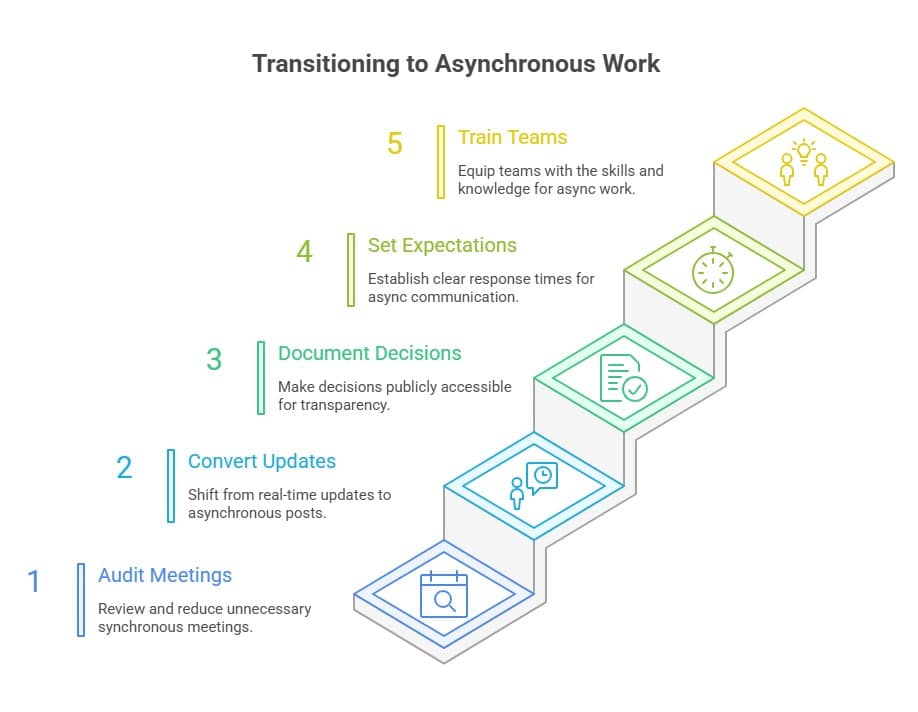
Teams shifting away from meeting-heavy cultures should start gradually. Moving too fast can create confusion or resistance, especially if employees are used to solving everything in real time. A thoughtful transition helps teams understand asynchronous and synchronous communication and how both can coexist. Steps include:
- Audit recurring meetings
- Convert updates to async posts
- Document decisions publicly
- Set response-time expectations
- Train teams on async best practices
Understanding asynchronous and synchronous communication helps teams avoid eliminating real-time interaction entirely.
Metrics to measure Asynchronous Communication success
To evaluate the effectiveness of async communications, organizations need clear metrics that go beyond simple message volume. The goal is not to communicate more, but to communicate better with less friction and fewer interruptions.
- Reduction in meetings
- Response-time consistency
- Content engagement rates
- Knowledge reuse
- Employee satisfaction
Effective communication is directly tied to productivity and trust.
Mistakes to avoid in Asynchronous Communication
Even teams that understand asynchronous communication can fall into common traps. These mistakes usually stem from unclear expectations or using async in situations where real-time interaction would be more effective.
- Overusing async for urgent issues
- Poorly written messages
- Lack of accountability
- Too many channels
Knowing what does synchronous communication mean helps teams recognize when real-time interaction is necessary and when async is the better default.
HubEngage for Asynchronous Communication
HubEngage offers a modern internal communications app as part of its employee experience and engagement platform, enabling organizations to streamline communication across distributed teams. It combines organizational communication (top-down), social engagement (peer-to-peer), and team communication (real-time messaging) in a single platform which helps employees stay informed, aligned, and connected across in-office, remote, and frontline environments.
Designed for today’s workplaces, HubEngage enables targeted announcements, personalized content delivery, and interactive social feeds, while also supporting real-time team communication through built-in instant messaging, group chats, and collaboration channels. This ensures both organizational updates and everyday team conversations happen smoothly in one place, reducing communication silos and improving overall collaboration.
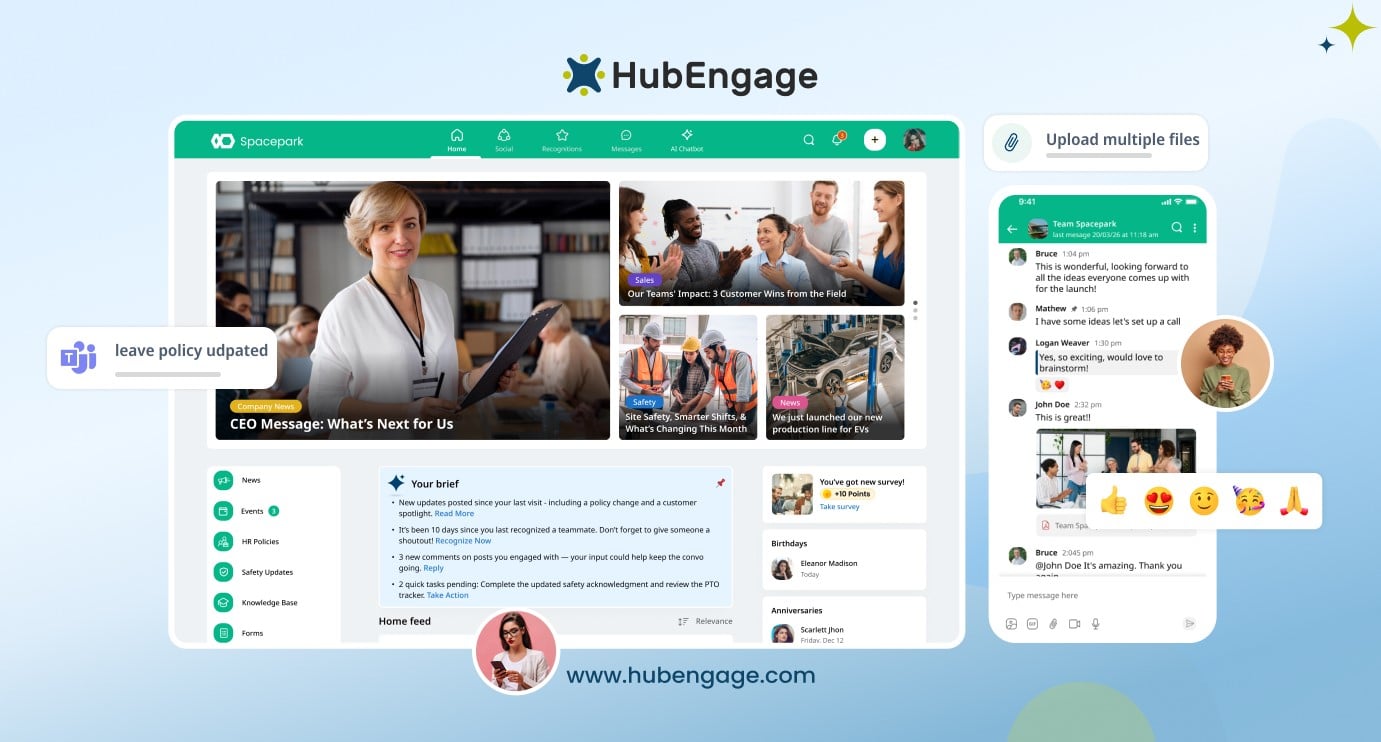
With integrations into HRIS and enterprise systems, along with SSO-based access, HubEngage keeps employee data automatically synced, simplifying onboarding and communication management. It also supports multi-channel delivery across mobile apps, web, email, SMS, digital signage, Microsoft Teams, and Slack thereby ensuring employees are reached wherever they work.
Built with enterprise-grade security and compliance standards such as SOC 2, ISO 27001, GDPR, and HIPAA, HubEngage meets the needs of modern enterprises. Also, it can be modified with additional modules such as recognition, surveys, intranet, social feeds, and an AI-powered chatbot that helps organizations bring internal communication, engagement, and team collaboration together at scale.
Key Features:
- Multi-channel internal communications (mobile, web, email, SMS, signage, Teams, Slack)
- Real-time 1:1 and group messaging for team collaboration
- Social intranet with feeds, likes, comments, and peer engagement
- Targeted announcements and segmented communication by role, location, or department
- HRIS and payroll integrations with SSO for seamless user management
- AI-powered HR chatbot for employee queries and knowledge access
- Enterprise-grade security and compliance (SOC 2, ISO 27001, GDPR, HIPAA)
Best for:
Brings together top-down communication, peer engagement, and team messaging into one unified employee experience platform, eliminating the need for multiple disconnected tools
Conclusion
Understanding asynchronous communication is no longer optional for modern organizations. When used intentionally alongside synchronous communication, async workflows help teams reduce interruptions, improve clarity, and scale collaboration across time zones. By setting clear expectations, choosing the right tools, and reinforcing strong communication principles, teams can build healthier, more productive ways of working that support both focus and flexibility.
Asynchronous Communication FAQs
What is asynchronous communication?
What is asynchronous communication? It is communication that does not require participants to respond at the same time, allowing flexibility and focus.
How does asynchronous communication differ from synchronous communication?
Understanding asynchronous and synchronous communication comes down to timing. Async allows delayed responses, while synchronous requires real-time interaction.
Why is asynchronous communication important for remote teams?
Async communication supports time zone differences, reduces meeting overload, and improves documentation for distributed teams.
What are examples of asynchronous communication tools?
Examples include email, project management platforms, internal knowledge bases, and employee communication platforms.
How do I decide when to use async vs. real-time communication?
If the issue is urgent or emotionally complex, synchronous communication works best. Otherwise, async is usually more efficient.
How can organizations improve asynchronous communication?
By setting clear guidelines, investing in the right tools, and training employees on writing effective async messages.
What challenges come with asynchronous communication?
Challenges include delayed responses, misinterpretation, and information overload if not managed well.
How do you measure the effectiveness of asynchronous communication?
Effectiveness is measured through productivity gains, reduced meetings, engagement metrics, and employee feedback.
Related Links:
Employee Communication Platform | Internal Communication Tools | Slack vs Teams | Internal Communication Strategy | Internal Communications Examples | Crisis Communication Software | Internal Communication Software Template | Worker Communication Tools