
Effective communication has become a critical foundation for organizational success than just a support function. As workplaces become more digital, distributed, and fast-moving, the ability to communicate clearly and consistently can directly impact employee engagement, productivity, and business outcomes.
Yet, many organizations continue to struggle with various corporate communication challenges that prevent messages from reaching, resonating, and driving meaningful action. As organizations scale, adopt hybrid work models, and introduce new tools, communication complexity increases.
Without the right systems in place such as a centralized employee communication platform, important messages get lost, employees feel disconnected, and leadership loses visibility into workforce sentiment.
In this guide, we will explore the most common corporate communication problems, their impact, and proven strategies to overcome them using modern corporate communication best practices.
Key Takeaways
- Poor communication reduces productivity, engagement, and alignment across teams and leadership.
- Multiple disconnected tools and channels create confusion and limit message effectiveness.
- Clear communication frameworks ensure consistency, clarity, and alignment with business goals.
- Personalization, feedback, and accessibility improve employee’s participation as well as trust.
- Employee experience platforms unify communication, collaboration, and engagement into a seamless experience.
The impact of poor Corporate Communication
Poor communication doesn’t just create confusion as it directly affects business outcomes. Recent research highlights the growing cost of poor communication. As per Microsoft Work Trend Index 2023 found employees spend nearly 57% of their time communicating across emails, chats, and meetings.
These inefficiencies are often the result of hidden corporate communication barriers, such as fragmented tools, unclear messaging, and lack of transparency. When communication breaks down, organizations experience:
- Reduced employee engagement and morale
- Misalignment between leadership and teams
- Slower decision-making and execution
- Increased turnover and workplace frustration
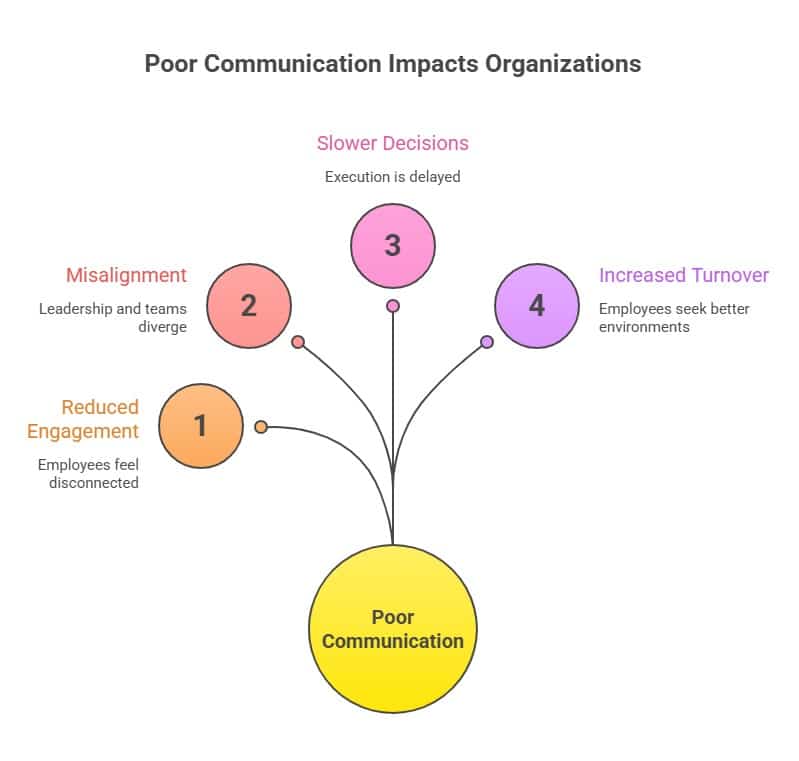
Addressing these challenges isn’t just about improving messaging, it is about creating a connected employee experience.
10 Corporate Communication Challenges and how to overcome them?
1. Information overload in workplace communication
Employees are overwhelmed with emails, chats, and notifications, making it difficult to identify what truly matters.
How to overcome it:
- Prioritize messages based on urgency and relevance
- Use segmentation to deliver targeted communications
- Consolidate messages through centralized platforms
2. Using ineffective or outdated communication channels
Relying solely on email or legacy systems limits reach and engagement, especially for frontline and deskless workers.
How to overcome it:
- Adopt modern tools for team communication
- Enable multi-channel delivery (mobile, email, SMS, intranet)
- Ensure accessibility across all employee types
3. Lack of a clear corporate communication strategy
Without a structured approach, communication becomes reactive and inconsistent.
How to overcome it:
- Develop a clear framework for strategic communications
- Define goals, audiences, and messaging guidelines
- Align communication with business objectives
4. Communication silos between teams and departments
Departments often operate in isolation, leading to duplication and misalignment.
How to overcome it:
- Encourage cross-functional collaboration
- Use shared communication platforms
- Break down silos through transparent information sharing
5. Limited employee feedback and participation
When employees lack a voice, communication becomes one-sided and ineffective.
How to overcome it:
- Implement surveys and feedback tools
- Encourage two-way communication
- Act on employee insights to build trust
6. Unclear or poorly structured messages
Ambiguous communication leads to confusion and errors.
How to overcome it:
- Use clear, concise language
- Structure messages for readability
- Standardize communication formats
7. Inconsistent communication from leadership
Mixed messages from leadership reduce credibility and trust.
How to overcome it:
- Establish leadership communication guidelines
- Align messaging across executives
- Maintain regular and predictable updates
8. Low employee engagement with company communications
Even well-crafted messages fail if employees don’t engage with them.
How to overcome it:
- Personalize content based on roles and interests
- Use interactive formats (polls, videos, social feeds)
- Recognize and reward participation
9. Communication gaps in remote and hybrid workplaces
Distributed teams often experience disconnect and misalignment.
How to overcome it:
- Use real-time collaboration tools
- Maintain consistent communication cadence
- Provide equal access to information across locations
10. Lack of transparency and trust in corporate communication
Employees disengage when they feel information is withheld or unclear.
How to overcome it:
- Communicate openly and frequently
- Share updates on company performance and decisions
- Build a culture of transparency and accountability
How organizations can improve Corporate Communication?
Improving communication requires a combination of strategy, technology, and culture. Organizations can address corporate communication challenges by:
- Using centralized platforms: With the help of good internal communication tools you can unify different communication channels, ensuring consistent messaging, reducing duplication, and improving accessibility across organizations.
- Establishing clear governance: Defined policies create consistency, set expectations, and ensure accountability, helping organizations maintain clarity and alignment across all communication initiatives.
- Training leaders and managers: Equipping leaders with communication skills ensures messages are clear, consistent, and aligned, while fostering trust, transparency, and stronger team relationships.
- Analytics to measure effectiveness: Analytics provide insights into engagement, reach, and impact, enabling organizations to optimize messaging strategies and continuously improve communication outcomes.
- Gathering employee feedbacks: Regular feedback loops help organizations understand employee needs, identify gaps, and build trust by demonstrating that employee voices influence decisions.
Summary of Corporate Communication Best Practices
| Corporate Communication Best Practice | Key Benefit for Organizations |
| Centralized communication platforms | Improves consistency, and reduces fragmentation. |
| Clear governance and policies | Establishes structure, accountability, and alignment. |
| Leadership communication training | Strengthens clarity, trust, and alignment. |
| Communication analytics | Helps measure engagement, and optimize messaging strategies |
| Employee feedback mechanisms | Two-way communication, identifies gaps, and builds trust |
Modern corporate communications strategies go beyond information sharing as they focus on creating meaningful employee experiences that drive engagement and performance.
How HubEngage solves Corporate Communication Challenges?
We understand that solving corporate communication problems requires more than just tools. It requires a unified approach to employee experience.
Hence, we created HubEngage, an employee experience platform that brings together communication, engagement, recognition, learning, and operations tools into one unified system. It helps organizations create a connected, informed, and motivated workforce.
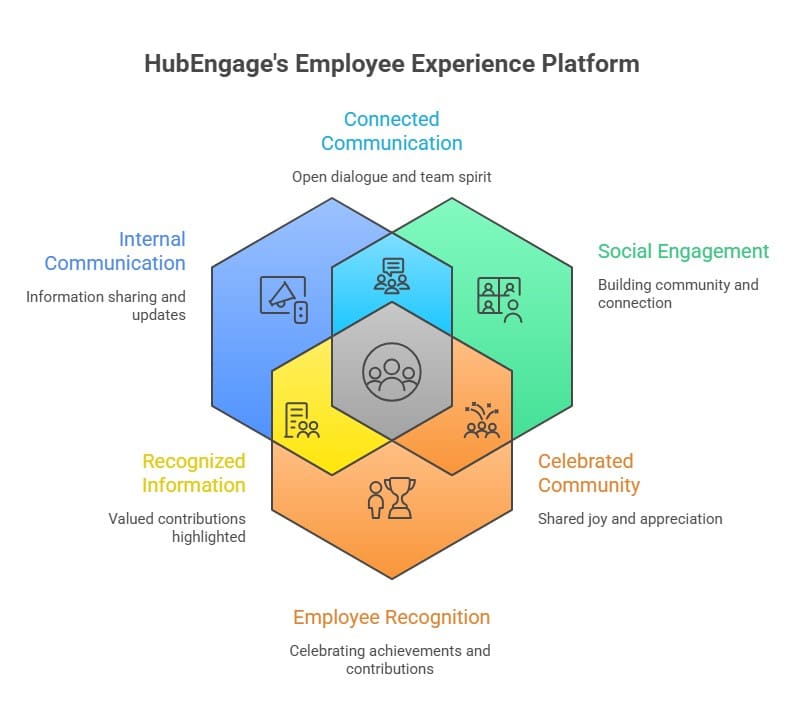
The platform combines internal communication, social engagement, surveys, recognition, and AI-powered tools to improve employee satisfaction, participation and execute business operations with high productivity. With multi-channel delivery, employees can access information and engage with the organization from anywhere.
By unifying multiple tools into a single platform, HubEngage reduces fragmentation and improves overall employee experience. Organizations can scale the platform with additional modules as their needs grow.
Key Features:
- Scheduling solution for planning shifts across teams and locations
- Time tracking for attendance, work hours, and productivity insights
- Learning platform for training, upskilling, and knowledge sharing
- Task management to assign, track, and complete work efficiently
- Multi-channel access across mobile, web, email, SMS, and signage
- Real-time collaboration, messaging, and task workflows improve team productivity
- AI-powered chatbot delivers support, answers, and knowledge across modules
- Scalable modules expand capabilities as organization and workforce needs grow
Best for:
Organizations looking to improve employee engagement, communication, and overall experience through a unified digital workplace.
By consolidating multiple tools into one platform, HubEngage eliminates the communication gaps as one of the biggest corporate communication barriers to create a seamless digital workplace.
Whether you are a CHRO, internal communications leader, or executive, this robust platform helps you build a connected, informed, and engaged workforce.
Conclusion
Overcoming corporate communication challenges requires a deliberate, strategic approach. By addressing common barriers and adopting modern tools and practices, organizations can transform communication into a competitive advantage.
When communication works well, you will see positive outcomes such as better alignment, higher engagement, and efficient business workflow.
The key is to move from fragmented, reactive communication to a unified, employee-centric experience given by a platform. Sign-up for a free demo to discover more about our platform.
Corporate Communication Challenges FAQs
What are the biggest barriers to effective corporate communication?
The most common corporate communication barriers include information overload, unclear strategy, siloed teams, outdated tools, inconsistent leadership messaging, and limited feedback mechanisms that reduce clarity and alignment.
How can organizations identify gaps in their internal communication?
Organizations can identify gaps by using employee surveys, engagement analytics, and feedback tools to measure reach, clarity, participation, and alignment across teams and communication channels.
What role does leadership play in overcoming communication challenges?
Leadership plays a critical role by setting communication standards, modeling transparency, aligning messaging across teams, and reinforcing trust through consistent, timely, and authentic organizational updates.
How can companies prevent miscommunication across teams?
Companies can prevent miscommunication by standardizing processes, using centralized platforms, aligning messaging frameworks, and promoting cross-functional collaboration to ensure clarity, consistency, and shared understanding.
What are the signs that corporate communication is not working effectively?
Common signs include low engagement, frequent misunderstandings, duplicated work, missed deadlines, lack of alignment, and employees feeling disconnected from leadership, goals, and organizational priorities.
How can organizations improve communication with frontline employees?
Organizations can improve frontline communication by using mobile-first platforms, SMS, and digital signage to deliver timely, relevant, and easily accessible information regardless of location or device.
How can technology help resolve corporate communication challenges?
Technology helps by enabling centralized communication, real-time collaboration, analytics, automation, and personalization, making it easier to deliver targeted messages and improve overall communication effectiveness.
What strategies help maintain consistent communication across departments?
Consistency can be maintained through clear governance, standardized messaging frameworks, shared platforms, and regular coordination between teams to ensure alignment, accuracy, and uniform communication across the organization.
Related Links:
Employee Communication Platform | Internal Communication Tools | Strategic Communications | Corporate Communications