Employee engagement programs have become the backbone of successful organizations across manufacturing, healthcare, and hospitality industries. It is a comprehensive strategy designed to foster emotional connection, commitment, and motivation among workers at every level of an organization.
According to Gallup, organizations with highly engaged employees experience 23% higher profitability and lower turnover compared to disengaged workplaces.
If you are managing teams in demanding sectors like manufacturing plants, hospital systems, or hotel operations, you can understand the challenges of maintaining high engagement levels.
Our blog explains exactly what employee engagement programs are, how they function, and why they have become essential for organizational success.
Key Takeaways
- Employee engagement programs help organizations improve productivity, employee retention, communication, and workplace satisfaction.
- Strong employee engagement strategies combine communication, recognition, feedback, wellness, and employee development initiatives.
- Engaged employees are more motivated, deliver better customer experiences, and contribute to stronger business performance.
- Employee engagement platforms help organizations simplify workforce communication, surveys, recognition, and engagement management.
- Measuring employee engagement through surveys, analytics, and feedback helps organizations improve workforce performance and employee experience.
- AI-powered employee engagement tools are helping businesses automate communication, personalize experiences, and improve workforce insights.
What is an Employee Engagement Program?
An employee engagement program is a systematic approach to creating workplace conditions that encourage employees to be fully invested in their work and committed to organizational goals. These programs combine communication strategies, recognition systems, professional development opportunities, and feedback mechanisms to build stronger connections between employees and their workplace.
Unlike traditional HR initiatives that address specific issues reactively, engagement programs take a proactive approach to workplace culture. They create ongoing touchpoints between management and staff, establish clear communication channels, and provide regular opportunities for employee input and recognition.
The most effective employee engagement strategy addresses three core elements: emotional engagement , cognitive engagement , and physical engagement.
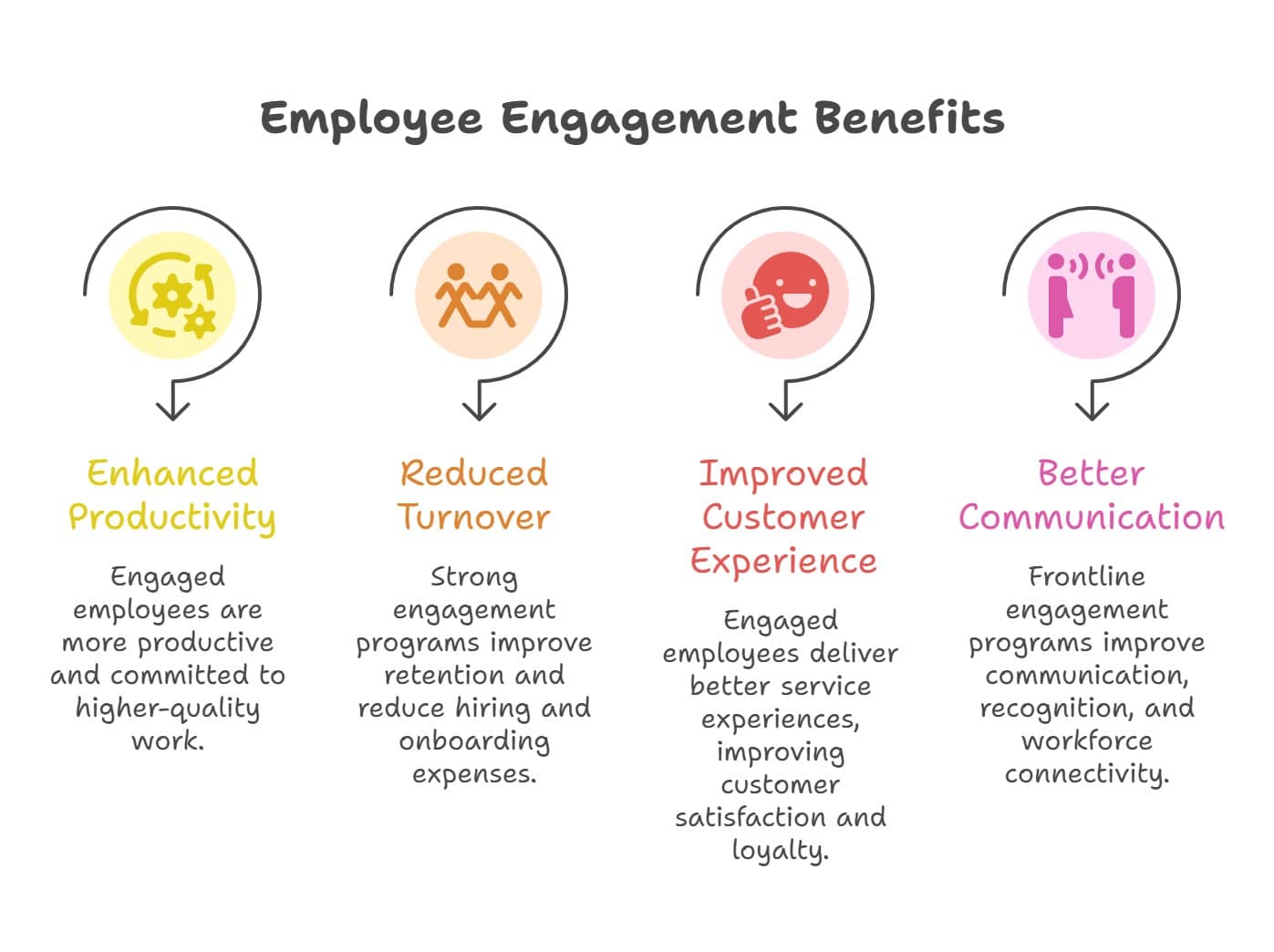
Benefits of Employee Engagement Programs
Discover how employee engagement programs improve productivity, retention, communication, collaboration, and customer experience while helping organizations build a more connected and motivated workforce.
Enhanced Productivity and Performance
Engaged employees are more productive, focused, and committed to delivering higher-quality work.
Reduced Turnover and Recruitment Costs
Strong engagement programs help organizations improve retention and reduce hiring and onboarding expenses.
Improved Customer Experience
Engaged employees deliver better service experiences that improve customer satisfaction and loyalty.
Better Communication and Collaboration
Frontline engagement programs improve communication, recognition, and workforce connectivity for deskless and operational employees.
You can also explore our complete guide on Frontline Employee Engagement That Works
Key Components of Effective Engagement Programs
Successful employee engagement programs share several fundamental components that work together to create a comprehensive engagement strategy.
Communication and Feedback Systems
Strong communication helps frontline and deskless employees stay informed, connected, and aligned across departments and locations.
Modern engagement programs use surveys, mobile apps, and real-time feedback tools to improve communication, employee participation, and workforce collaboration.
Recognition and Rewards Programs
Gamification is one such reward program that improves employee participation through points, badges, rewards, and leaderboards that encourage ongoing engagement and workplace collaboration.
Recognition programs help employees feel valued by celebrating achievements, improving motivation, and strengthening workplace culture.
Learn more on this by checking out our Gamification In Employee Engagement: A Comparison Guide
Professional Development Opportunities
Employee engagement programs include structured learning and growth opportunities. This encompasses employee engagement courses, mentorship programs, cross-training initiatives, and leadership development tracks. Healthcare organizations often emphasize clinical skill development, while manufacturing companies focus on technical certifications and safety training.
Wellness and Work-Life Balance Initiatives
Comprehensive engagement programs address employee wellbeing through wellness programs, flexible scheduling options, and mental health resources. These components are particularly crucial in high-stress environments like hospitals and manufacturing facilities where burnout rates can be significant.
Employee Engagement Program Tools and Platforms
Explore the best employee engagement tools and platforms that will help you conduct employee engagement programs easily.
HubEngage
Our modern workforce experience platform brings employee communications, engagement, and workforce operations together in one centralized solution. HubEngage combines intranet, recognition, surveys, social engagement, AI chatbot, scheduling, task management, and time tracking into a connected digital workplace that supports both desk-based and frontline employees.
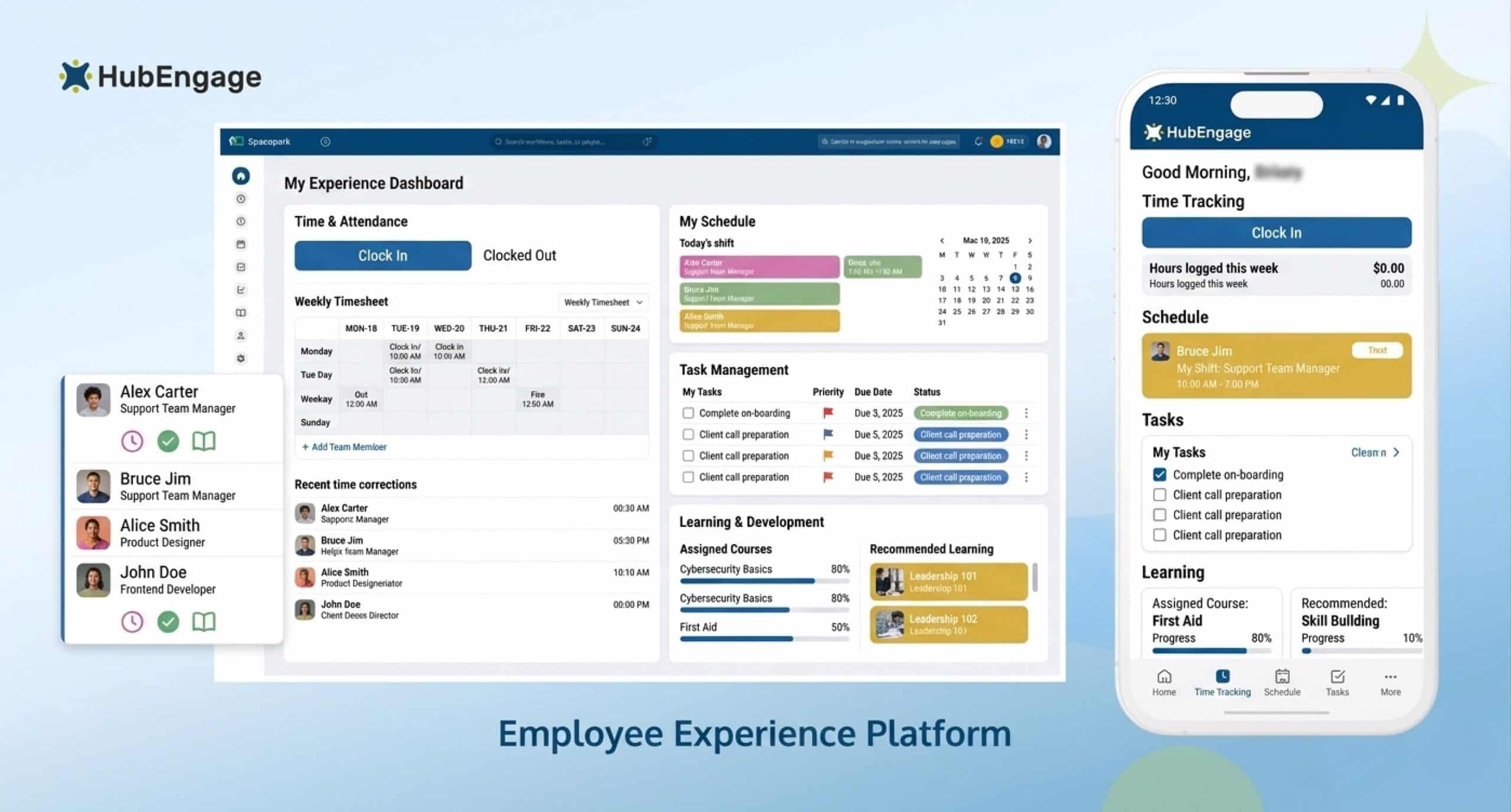
Built around communication, operations, and engagement, HubEngage delivers a connected employee experience across mobile apps, web, email, SMS, Microsoft Teams, Slack, and digital signage. Its modular structure also allows organizations to start with selected features and expand into a complete workforce experience platform over time.
Key Features:
- Unified workforce experience platform: Centralize communication, engagement, and workforce operations in one scalable platform.
- Employee engagement tools: Includes recognition, gamification, social feeds, surveys, and rewards to improve participation and morale.
- Workforce operations management: Supports scheduling, time tracking, task management, and workforce coordination.
- AI-powered automation: AI chatbot, smart search, and automated surveys simplify employee support and feedback collection.
- Multi-channel communication: Reach employees through mobile, web, email, SMS, Teams, Slack, and digital signage.
- Enterprise-grade security: Supports HIPAA, GDPR, and enterprise compliance requirements.
Other Notable Platforms
| Platform | Primary Focus | Common Limitation | Suitable For |
| Motivosity | Employee recognition and appreciation | Limited advanced analytics capabilities | Recognition-focused teams |
| Nectar | Peer-to-peer recognition and rewards | Requires additional tools for broader engagement needs | Distributed workforces |
| Lattice | Feedback and performance management | Complex adoption for frontline environments | HR and performance teams |
| Awardco | Employee rewards and incentives | Limited communication functionality | Global workforce recognition |
| Mitratech Perform | Employee surveys and workforce analytics | Limited engagement and collaboration tools | Workforce analytics initiatives |
| ThriveSparrow | Real-time engagement analytics | Limited communication capabilities | Employee feedback programs |
| Cooleaf | Virtual recognition and engagement activities | Requires external communication tools | Culture and engagement initiatives |
| Paylocity | HR management and collaboration | Engagement features may feel secondary | HR-focused organizations |
| Confetti | Virtual team-building experiences | Not designed for full engagement management | Remote team engagement activities |
Learn more about these platform in detail by exploring our guide on Top Employee Engagement Platforms That Deliver
How to measure Employee Engagement?
Measuring engagement requires a combination of different feedback to provide a complete picture of employee sentiment and commitment.
Comparison of Engagement Measurement Methods
| Method | Frequency | Best For | Key Advantage |
| Pulse Surveys | Monthly/Quarterly | Real-time feedback | Quick response identification |
| Annual Surveys | Yearly | Comprehensive assessment | Detailed trend analysis |
| Focus Groups | Quarterly | Qualitative insights | Deep understanding |
| Exit Interviews | As needed | Departure reasons | Improvement opportunities |
| Performance Metrics | Ongoing | Objective measurement | Business impact correlation |
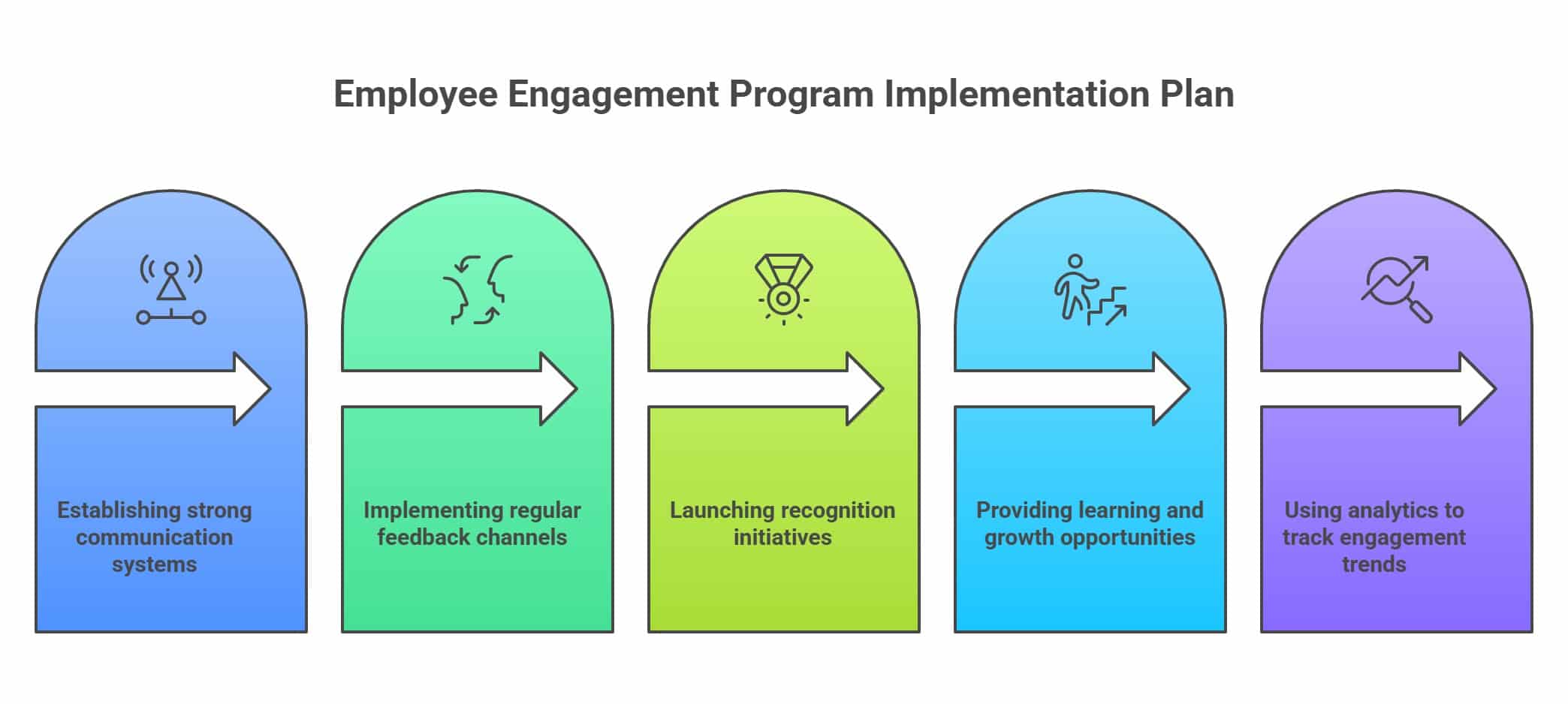
Employee Engagement Program Implementation Plan
Organizations achieve stronger engagement outcomes when they follow a structured employee engagement plan. Effective engagement plans define clear goals, communication strategies, leadership responsibilities, employee feedback processes, and long-term measurement frameworks.
Successful employee engagement program implementation requires careful planning, adequate resources, and realistic timeline expectations. Most organizations benefit from phased implementation approaches that allow for testing and refinement.
Phase 1: Communication Infrastructure
Strong communication systems help employees stay informed, connected, and aligned with organizational goals.
Phase 2: Feedback Mechanisms
Regular feedback channels help organizations identify employee concerns and improve workplace experiences.
Phase 3: Recognition Programs
Recognition initiatives improve employee motivation, appreciation, and long-term engagement.
Phase 4: Development Opportunities
Learning and growth opportunities help employees build skills and stay invested in their careers.
Phase 5: Advanced Analytics and Optimization
Analytics tools help organizations track engagement trends and make data-driven workforce decisions.
For a detailed overview, check out our blog on Employee Engagement Plan: What Actually Works
Employee Engagement Program ROI
Organizations that invest in employee engagement programs often see measurable ROI through improved productivity, stronger employee retention, reduced absenteeism, and better customer experiences.
| Employee Engagement Benefit | Business Impact | ROI Outcome |
| Improved Employee Communication | Better workforce alignment and faster updates | Increased productivity |
| Higher Employee Retention | Reduced hiring and onboarding costs | Lower turnover expenses |
| Stronger Employee Recognition | Higher employee morale and participation | Improved performance |
| Better Frontline Engagement | More connected and informed workforce | Better customer experiences |
| Continuous Employee Feedback | Faster issue identification and resolution | Improved operational efficiency |
AI in Employee Engagement
Artificial intelligence is transforming employee engagement programs by helping organizations automate communication, personalize employee experiences, analyze engagement data, and predict workforce trends. AI-powered engagement tools can improve survey analysis, automate recognition workflows, and provide leaders with actionable workforce insights.
Also, explore our blog on AI In Employee Engagement: Tools, Strategy & ROI
Employee Engagement Program Best Practices
Implementing successful engagement programs requires following proven best practices that have demonstrated effectiveness across different industries.
Regular Measurement and Assessment
Effective programs include consistent measurement through employee surveys, focus groups, and performance metrics. Organizations should conduct quarterly pulse surveys and annual comprehensive engagement assessments. The data collected should directly inform program adjustments and improvements.
Leadership Commitment and Modeling
Engagement programs succeed when leadership demonstrates genuine commitment through their actions and communication. Managers at every level must actively participate in engagement initiatives and model the behaviors they want to see from their teams.
Customization for Different Employee Groups
One-size-fits-all approaches rarely succeed in employee engagement. Programs must account for different roles, departments, and employee demographics. Manufacturing workers may prefer different communication methods than office-based employees. Healthcare professionals have unique engagement needs compared to administrative staff.
Integration with Business Objectives
The most effective engagement programs align directly with organizational goals and business outcomes. Engagement initiatives should support broader business strategies and demonstrate clear connections between employee engagement and company performance.
Common Employee Engagement Ideas
Organizations often improve participation and morale by introducing creative employee engagement ideas that encourage collaboration and recognition.
Wellness Challenges
Wellness initiatives encourage healthier work habits, reduce burnout, and improve employee morale across teams.
Peer Recognition Programs
Peer-to-peer recognition helps employees feel valued and strengthens workplace relationships and collaboration.
Milestone Celebrations
Celebrating work anniversaries and achievements improves employee appreciation and long-term retention.
Gamified Learning Experiences
Gamification increases participation in training, communication, and engagement activities through interactive experiences.
Employee Contests and Activities
Friendly competitions and engagement activities create excitement, teamwork, and stronger employee participation.
Team-Building Initiatives
Team-building activities strengthen workplace relationships, improve collaboration, and build a more connected workforce.
Consistently refreshing engagement initiatives helps maintain long-term employee interest and participation. For more such ideas, feel free to explore our blog on Employee Engagement Ideas
Conclusion
Employee engagement programs represent strategic investments in organizational culture and performance. These comprehensive initiatives create emotional connections between workers and their organizations, leading to improved productivity, reduced turnover, and enhanced customer experiences across manufacturing, healthcare, and hospitality industries.
HubEngage employee experience platform helps organizations strengthen employee engagement programs through unified communication, recognition, surveys, mobile engagement, and workforce collaboration tools designed for frontline and operational industries.
Ready to take the next step? Sign up for a demo session to learn more on how our platform can help you in conducting employee engagement programs.
Employee Engagement Programs FAQs
How Long Does It Take to See Results From an Employee Engagement Program?
Most organizations begin seeing initial improvements in employee sentiment within 3-6 months of program launch. However, significant cultural changes and measurable business impact typically require 12-18 months of consistent program implementation. Early indicators include increased survey participation rates and improved communication between management and staff.
What Is the Difference Between Employee Satisfaction and Employee Engagement?
Employee satisfaction measures how content workers are with their current conditions, while employee engagement measures emotional commitment and willingness to contribute extra effort. Satisfied employees may perform adequately, but engaged employees actively seek ways to improve their work and support organizational goals. Engagement programs focus on building emotional connections rather than simply addressing workplace complaints.
How Do You Maintain Engagement Program Momentum Over Time?
Sustaining engagement requires continuous program evolution and fresh initiatives. Successful organizations regularly introduce new recognition methods, update communication channels, and expand development opportunities. Leadership must consistently reinforce program importance through their actions and resource allocation decisions. Regular program assessment and employee feedback help identify areas needing refreshment.
Can Small Organizations Implement Effective Engagement Programs?
Small organizations can absolutely create effective engagement programs, often with greater flexibility than larger companies. Small businesses can implement personalized recognition, direct communication with leadership, and rapid response to employee feedback. The key is focusing on meaningful initiatives rather than expensive technology solutions. Simple programs that demonstrate genuine care for employees often produce excellent results.
How Do You Measure Engagement in Remote or Distributed Teams?
Remote engagement measurement requires adapted approaches including more frequent digital check-ins, virtual team-building activities, and technology-enabled feedback systems. Organizations use video calls for personal connection, collaborative platforms for team engagement, and digital recognition tools for peer appreciation. Success metrics focus on communication frequency, project collaboration quality, and virtual event participation rates.
Related Links:
employee engagement program | employee engagement platforms | employee engagement gamification