
With more digitally connected workplaces around, interdepartmental communication is no longer just an option but it is essential for organizational success.
As teams grow more specialized and distributed, ensuring seamless collaboration across departments becomes a top priority for leaders.
We have seen that organizations that invest in a unified employee communication platform are better equipped to break down silos and align teams toward shared goals.
In this guide, we’ll explore what interdepartmental communication means, why it matters, and how to improve collaboration between teams with practical strategies.
Key Takeaways
- Interdepartmental communication is important for better teamwork, increasing efficiency, and giving better results for the business.
- Strong interdepartmental collaboration helps in decreasing data load, duplication, and make sure departments work on common goals.
- Common challenges like multiple tools, unclear goals, and less transparency can decrease productivity as well as coordination.
- Using methods such as standard processes, defined goals, and regular communication improves cross departmental communication.
- Leveraging the right technology platform enables seamless interdepartmental coordination, especially in distributed and hybrid work environments.

What is Interdepartmental Communication?
Interdepartmental communication refers to the structured exchange of information, ideas, updates, and feedback between different teams or departments within an organization. It plays a critical role in connecting functions such as HR, marketing, operations, IT, and finance, ensuring that each team is not working in isolation but contributing to a unified business strategy.
When done effectively, it enables departments to stay aligned on priorities, coordinate workflows, and collaborate on shared initiatives without friction. Strong interdepartmental collaboration goes beyond simple information sharing; it creates a continuous flow of context, insights, and accountability across teams.
With this, your team can reduce misunderstandings, eliminate duplicate work, and improve overall operational efficiency. Ultimately, effective cross departmental communication ensures that every department moves in sync, supporting faster decision-making and better organizational outcomes.
Why is Interdepartmental Communication important for organizations?
Strong cross departmental communication is critical for organizations aiming to scale efficiently. When departments operate in isolation, it leads to misalignment, delays, and missed opportunities.
According to a report by McKinsey, companies that improve communication and collaboration through digital tools can increase productivity by up to 20-25%.
Improving communication between departments drives strategic alignment faster decision making, stronger employee engagement and enhanced customer experience across the organization. Without effective interdepartmental coordination, even the best strategies can fail during execution.
Key components of effective Interdepartmental Communication
To build strong interdepartmental communication, organizations must focus on the following components:
- Clarity: Clear messaging reduces ambiguity and ensures teams understand expectations
- Consistency: Regular and predictable communication builds trust
- Accessibility: Information should be easy to access for all relevant stakeholders
- Transparency: Open sharing of updates prevents information bottlenecks
- Collaboration tools: Leveraging modern internal communication tools enables seamless interaction
| Component | What It Means | Business Impact |
| Clarity | Clear, structured messaging across teams | Reduces confusion and rework |
| Consistency | Regular and standardized communication | Builds trust and reliability |
| Accessibility | Easy access to information and updates | Improves speed of execution |
| Transparency | Open sharing across departments | Prevents silos and misalignment |
| Collaboration Tools | Centralized platforms for communication | Enables seamless interdepartmental collaboration |
These elements form the foundation of effective interdepartmental collaboration.
Benefits of Strong Interdepartmental Communication
Organizations that prioritize interdepartmental communication experience several benefits:
- Faster decision-making due to aligned teams
- Improved project execution and fewer delays
- Enhanced innovation through diverse input
- Stronger employee engagement and trust
- Better customer outcomes through coordinated efforts
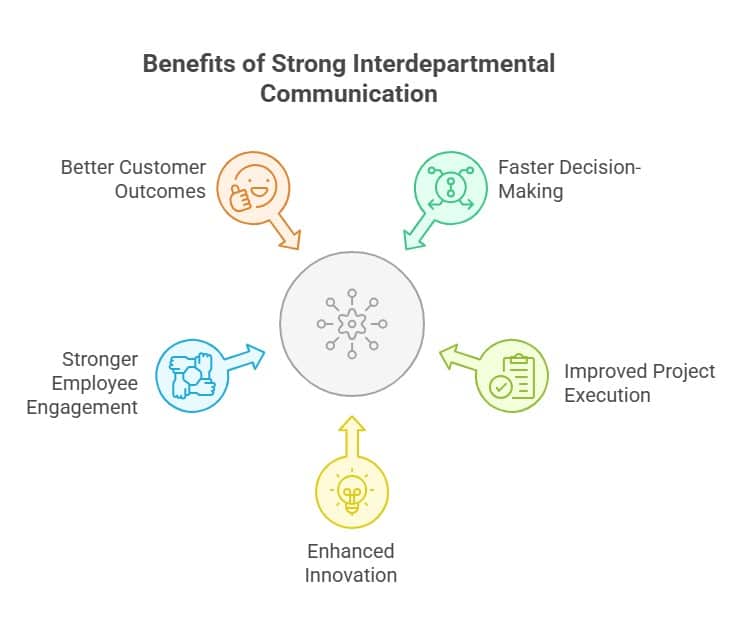
When teams communicate effectively, interdepartmental coordination becomes a competitive advantage.
Common Interdepartmental Communication Challenges
Despite its importance, many organizations struggle with cross departmental communication due to:
- Communication silos between teams
- Lack of standardized processes
- Misaligned goals across departments
- Over-reliance on fragmented tools
- Limited visibility into other teams’ work
| Challenge | Impact |
| Communication silos | Creates disconnect between teams and slows collaboration |
| Lack of standardized processes | Leads to confusion inconsistencies and inefficiencies |
| Misaligned goals | Causes conflicting priorities and poor execution |
| Fragmented tools | Reduces visibility and creates communication gaps |
| Limited visibility | Delays decisions and reduces team alignment |
These challenges highlight the need for structured approaches to improving communication between departments.
How to improve Interdepartmental Communication in your organization?
1. Establish clear communication guidelines across departments
Define how and when teams should communicate to ensure consistency across departments using standardized channels schedules and expectations for clarity.
2. Define roles and responsibilities for every team
Ensure each team understands roles, responsibilities and ownership clearly to reduce confusion, duplication and accountability gaps across departments effectively overall.
3. Create shared organizational goals
Create shared goals and KPIs that align departments encourage collaboration, improve accountability and drive unified business outcomes across teams effectively.
4. Encourage cross-department collaboration
Encourage teams to work together on cross-functional projects, initiatives and tasks to improve collaboration innovation and shared ownership across departments.
5. Schedule regular interdepartmental meetings
Schedule regular meetings across departments to share updates, align priorities, address issues and maintain transparency and collaboration among teams consistently.
6. Use centralized communication platforms
Use a centralized communication platform to streamline messaging, reduce fragmentation, improve visibility and ensure all employees access the same information.
7. Improve information transparency across teams
Encourage open sharing of updates dashboards reports and insights to improve transparency, trust and alignment between teams and departments effectively.
8. Encourage knowledge sharing between departments
Build systems that enable teams to share knowledge, best practices insights and lessons learned across departments regularly and efficiently.
9. Reduce communication silos in the organization
Break down communication silos by enabling open channels collaboration tools and cross-team interactions that connect departments and improve alignment organization-wide.
10. Standardize communication processes
Standardize communication processes using templates, workflows and guidelines to ensure consistency, clarity, efficiency and repeatability across departments and teams organization-wide.
11. Provide collaboration and communication tools
Provide teams with modern collaboration and communication tools that support real-time messaging file sharing and seamless coordination across departments effectively.
12. Encourage leadership support for cross-team communication
Encourage leadership to actively support and promote cross-team communication initiatives ensuring adoption alignment accountability and sustained collaboration across departments organization-wide.
13. Promote a culture of open communication
Foster a culture of open communication where employees feel comfortable sharing ideas, feedback concerns and insights across departments without barriers.
14. Implement feedback loops between departments
Implement structured feedback loops between departments to continuously gather insights, improve processes, enhance collaboration and strengthen alignment across teams effectively.
15. Measure and improve communication effectiveness
Measure communication effectiveness using metrics like engagement response times, collaboration outcomes and feedback to improve cross-department communication strategies and performance.
Learn more about these by exploring our blog on corporate communication strategies that you can use for improving communication between different departments.
How HubEngage supports Interdepartmental Communication?
HubEngage offers a modern internal communications app as part of its employee experience and engagement platform, enabling organizations to streamline communication across distributed teams. It combines organizational communication (top-down), social engagement (peer-to-peer), and team communication (real-time messaging) in a single platform which helps employees stay informed, aligned, and connected across in-office, remote, and frontline environments.
Designed for today’s workplaces, HubEngage enables targeted announcements, personalized content delivery, and interactive social feeds, while also supporting real-time team communication through built-in instant messaging, group chats, and collaboration channels. This ensures both organizational updates and everyday team conversations happen smoothly in one place, reducing communication silos and improving overall collaboration.
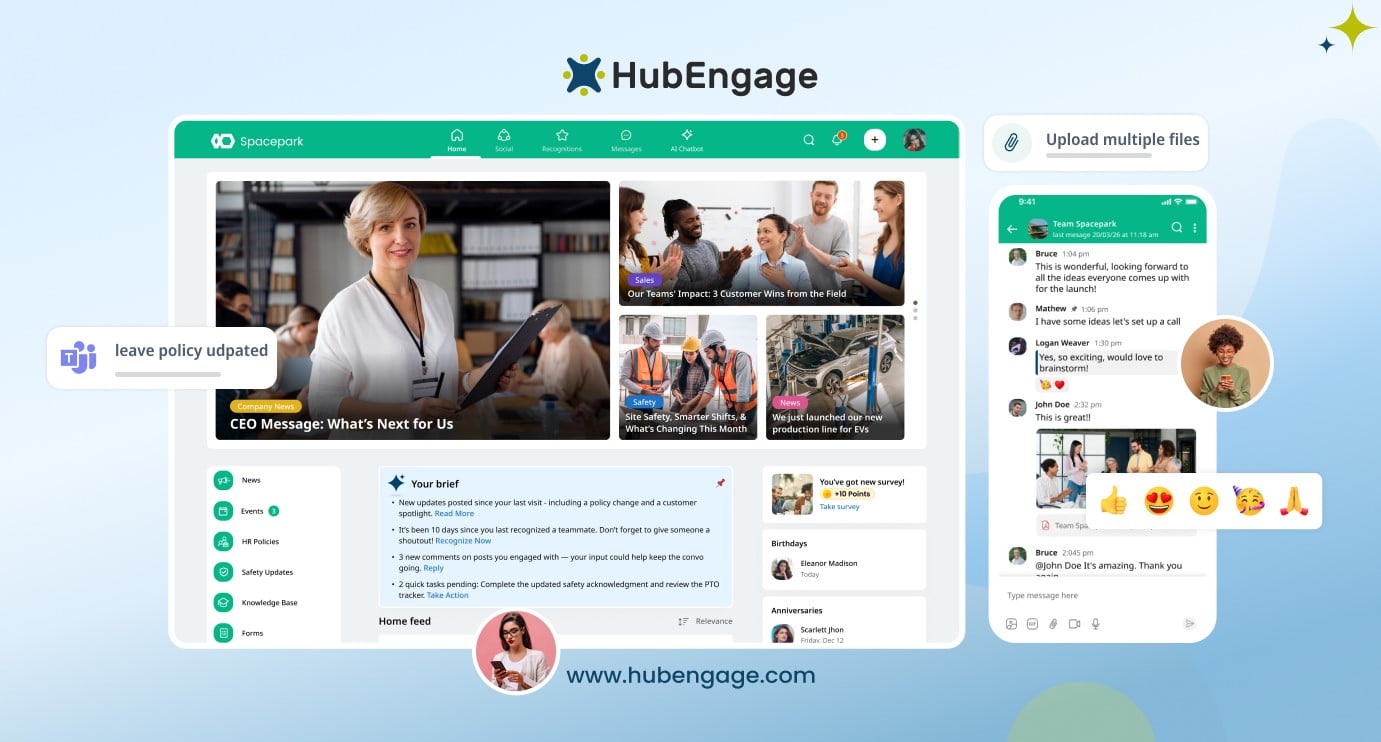
Built with enterprise-grade security and compliance standards such as SOC 2, ISO 27001, GDPR, and HIPAA, HubEngage meets the needs of modern enterprises. Also, it can be modified with additional modules such as recognition, surveys, intranet, social feeds, and an AI-powered chatbot that helps organizations bring internal communication, engagement, and team collaboration together at scale.
Key Features:
- Multi-channel internal communications (mobile, web, email, SMS, signage, Teams, Slack)
- Real-time 1:1 and group messaging for team collaboration
- Social intranet with feeds, likes, comments, and peer engagement
- Targeted announcements and segmented communication by role, location, or department
- HRIS and payroll integrations with SSO for seamless user management
- AI-powered HR chatbot for employee queries and knowledge access
- Enterprise-grade security and compliance (SOC 2, ISO 27001, GDPR, HIPAA)
Best for:
Brings together top-down communication, peer engagement, and team messaging into one unified employee experience platform, eliminating the need for multiple disconnected tools.
Conclusion
Strong interdepartmental communication is the foundation of aligned teams, faster execution, and better business outcomes. By breaking down silos, standardizing processes, and enabling transparent collaboration, organizations can significantly improve efficiency and employee experience.
As teams become more distributed, having the right platform becomes critical. If you’re exploring ways to strengthen collaboration, you can take a demo of HubEngage’s Employee Experience Platform to see how it helps address interdepartmental communication challenges in a practical, scalable way.
Interdepartmental Communication FAQs
How does poor interdepartmental communication affect project timelines?
Poor communication leads to delays, duplicated efforts, and misaligned priorities, which can significantly extend project timelines.
What are the early signs of communication breakdown between departments?
Common signs include missed deadlines, conflicting information, lack of accountability, and reduced collaboration.
How can managers ensure alignment between different departments?
Managers can align teams by setting shared goals for regular communication, and using centralized platforms.
What role does technology play in improving collaboration between teams?
Technology gives real-time communication, centralized information sharing, and better visibility over departments.
How can organizations encourage knowledge sharing across departments?
Organizations can implement knowledge hubs, internal communities, and collaboration tools to facilitate sharing.
What practices help reduce misunderstandings between teams?
Clear communication guidelines, defined processes, and regular check-ups helps in decreasing misunderstandings.
How can companies improve communication between remote departments?
Companies can use softwares, multi-channel communication, and workflows to make sure remote teams stay connected.
Related Links:
Employee Communication Platform | Internal Communication Tools | Corporate Communications