What would people outside your organization say if they had to explain your latest announcement without looking it up? Their answer is a useful test of external communication. Every customer email, service update, social post, and executive statement contributes to how the organization is understood. When those messages are clear and aligned, people know what to expect. Otherwise, trust can slip quickly. Our guide explains the external communication definition, the common types and channels, and how to build an external communications plan that supports a credible, consistent brand.
Key Takeaways
- External communication shapes the story people tell about your organization. It influences whether customers buy, partners stay aligned, investors remain confident, and the public sees the brand as credible.
- Every external touchpoint carries weight. Product updates, support replies, executive interviews, social posts, press releases, and service alerts can all strengthen or weaken trust.
- One core message should travel well. The facts must stay consistent, but the framing should reflect what each audience needs. Customers want to know what changes for them; partners need operational clarity; media need verified context.
- Your employees are part of the external experience. When teams receive clear information early, they can answer questions confidently instead of reacting to news they first encountered online.


External communications definition
External communication is the information an organization exchanges with people outside its workforce. It covers planned messages, such as a product launch or customer newsletter, as well as responses to questions, feedback, and public issues.
In simple terms, external communication describes how a company communicates with the outside world. External corporate communication may also include reputation management, investor updates, media relations, customer notices, partner coordination, and public accountability.
Why External Communication Matters?
External communication influences how easily people can work with, buy from, recommend, or trust an organization. It shapes expectations before a customer makes a purchase and becomes even more important when something changes or goes wrong. It helps organizations:
- Give customers and partners timely, useful information.
- Explain decisions in a way that reduces confusion.
- Maintain a recognizable voice across public channels.
- Address concerns before rumors or inaccurate information take hold.
- Support long-term trust with investors, communities, and other stakeholders.
The need for clear communication is growing as trust becomes more fragile. Edelman’s 2026 Trust Barometer reports that 70% of people globally are unwilling or hesitant to trust someone whose values, facts, approaches, or cultural background differ from their own. Organizations cannot resolve that divide with slogans alone. They need clear claims, reliable evidence, and communication that matches their actions.
The infographic below shows how a clear message moves through the right channels, prompts action, captures feedback, and informs stronger communication the next time.
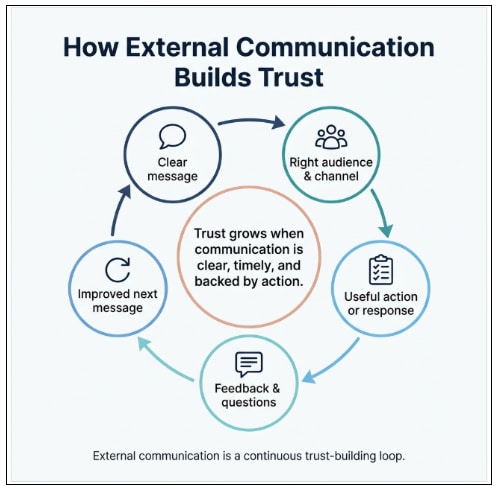
Strong external communication doesn’t end once a message is published. Audience reactions, customer questions, support requests, and partner feedback can reveal where people need more detail or reassurance.
Core Principles of Effective External Communication
Effective external communication gives people the information they need in a clear, credible form. Strong external communication depends on a few core principles that help teams create messages people can understand and respond to. The table below outlines each principle and how to apply it in day-to-day communication.
| Principle | In practice |
| Clarity | Lead with the main point, use plain language, and make the next step easy to understand. |
| Consistency | Ensure leaders, sales teams, support staff, social channels, and the website communicate the same essential facts. |
| Relevance | Adjust the level of detail, framing, and call to action to suit the audience’s needs and relationship with the organization. |
| Transparency | Share verified information, be upfront about what is still under review, and avoid commitments the organization cannot meet. |
| Timeliness | Communicate while the information is still useful, rather than allowing incomplete updates or speculation to fill the gap. |
| Responsiveness | Monitor questions and feedback, identify recurring points of confusion, and provide useful clarification quickly. |
Used consistently, these principles help communications teams stay clear-headed when the stakes are high, whether they are sharing a routine update, announcing a major change, or responding to an issue in real time.
Types of External Communication
Tailor external communication to the audience and the message’s purpose. A service update may need to tell customers what action to take, while investors may look for business context and data insights. Whatever the audience, the external communication must answer their question from the start. The table below outlines the main types of external communication.
| Type | Primary purpose | Example of external communication |
| Corporate communication | Share organizational direction, milestones, and major decisions | A leadership announcement about entering a new market or completing an acquisition |
| Marketing communication | Build awareness, generate interest, and encourage demand | A campaign, product page, webinar, or product-launch email |
| Customer communication | Inform, support, and retain customers throughout their relationship with the organization | A billing notice, product update, onboarding email, or service-status message |
| Public relations | Build public visibility and maintain relationships with journalists and media outlets | A press release, media briefing, executive interview, or company statement |
| Investor communication | Share material financial results, business performance, and strategic updates | An earnings release, shareholder letter, or investor presentation |
| Partner communication | Coordinate shared activity and maintain strong commercial relationships | A co-marketing announcement, reseller update, or supplier policy notice |
| Community and regulatory communication | Meet public-interest, compliance, and stakeholder-information obligations | A consultation notice, public statement, regulatory filing, or local community update |
One development can quickly affect several audiences, so external communication cannot be managed in silos. A policy change, for example, may require an internal briefing, customer guidance, an updated website notice, partner instructions, and prepared media messaging, all built around the same verified facts.
Key Channels for External Communication
The best channel depends on urgency, audience preference, and how much detail people need. Important information should be easy to find in a reliable location, even if it is first shared through email, social media, or a spokesperson. The table below highlights common external communication channels.
| Channel | Best use | Consideration |
| Website or newsroom | Publish official statements, policies, product details, company news, and FAQs | Review and update pages regularly so outdated information does not contradict current messaging. |
| Send account-specific notices, newsletters, product updates, and partner communications | Segment audiences carefully so recipients receive timely, relevant information. | |
| Social media | Engage communities, share timely updates, strengthen brand visibility, and respond publicly | Monitor replies closely and establish an escalation process for sensitive issues or misinformation. |
| Media relations | Support newsworthy announcements, executive visibility, and thought-leadership opportunities | Provide journalists with useful facts, supporting context, and access to an appropriate spokesperson. |
| SMS and push notifications | Deliver urgent alerts or time-sensitive, action-oriented updates | Use these channels sparingly and only when recipients need immediate attention or action. |
| Events and webinars | Educate audiences, build relationships, introduce new ideas, and create two-way discussion | Plan post-event follow-up, including resource sharing, attendee questions, and ownership of next steps. |
| Sales and support conversations | Address individual questions, provide reassurance, and collect direct customer feedback | Keep customer-facing teams updated with approved talking points, current FAQs, and clear escalation routes. |
For most major announcements, the website should serve as the source of truth. Other channels can then guide audiences to the complete, current information.
How External Communication Shapes Brand Perception?
A brand is defined by the experience people have when they need information, help, or an honest explanation. Over time, brand perception is influenced by whether the organization:
- Makes accurate information easy to find.
- Replies to concerns with a useful answer rather than a scripted response.
- Explains difficult decisions in a credible human voice.
- Delivers on the expectations created by its public messages.
Every external interaction leaves an impression. When an organization communicates with clarity and responds thoughtfully when people need answers, it gives audiences a reason to believe in the brand.
Role of Leadership in External Communication
Leadership communication is most visible during major changes, but trust is built through regular habits. Credible leaders explain the context, take responsibility for what the organization can control, and avoid overstating certainty.
The infographic below shows how leadership messages move from internal alignment to consistent communication
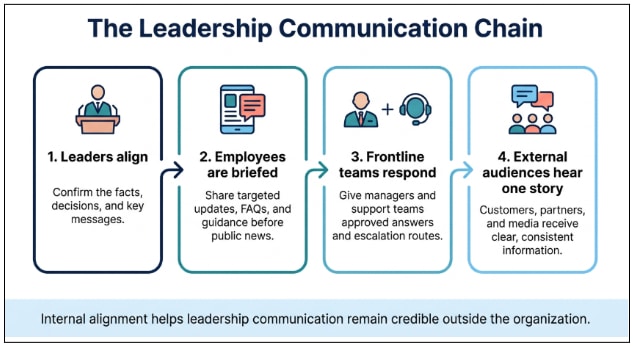
An employee communication platform can help leaders share a targeted internal briefing before releasing external news. This gives managers, support teams, and customer-facing employees the facts, FAQs, and escalation routes they need to respond consistently.
External Communication in Crisis Situations
Crisis communication requires urgency, but it also requires control. The first message should be prompt and factual, not speculative. A practical response includes six steps:
- Verify the situation: Confirm the facts, identify unknowns, and nominate a single source for updates.
- Acknowledge the issue: Tell affected audiences that the matter is known and being addressed.
- Explain the immediate impact: State who is affected, what they should do, and where they can seek help.
- Set an update schedule: Give a realistic time for the next update, even if there is no material change.
- Brief employee: Provide internal FAQs, approved language, and escalation contacts before questions reach frontline teams.
- Review the response: After resolution, assess message accuracy, response times, feedback, and any process gaps.
Once the immediate situation is resolved, reviewing the response helps teams identify gaps, update their process, and communicate more effectively when the next issue arises. For a deeper internal-readiness framework, see HubEngage’s guide to crisis communications.
Importance and Benefits of External Communication
External communication creates value by making uncertainty easier to manage. Employees can answer questions, and leaders can respond to concerns before they become more damaging. The table below shows the benefits of a modern external communication system:
| Benefit | Business value |
| Trust | Reliable, useful communication gives customers, partners, and other stakeholders more confidence in the organization, particularly when circumstances change. |
| Reputation | Consistent messages and follow-through make the brand easier to understand, remember, and recommend. |
| Stronger relationships | Two-way communication gives organizations a clearer view of stakeholder concerns, expectations, and emerging opportunities. |
| Employee confidence | Well-informed employees can answer questions more accurately and are less likely to give customers or partners conflicting information. |
| Partner coordination | Timely updates help suppliers, resellers, and strategic partners prepare for changes that may affect shared work or customers. |
| Crisis readiness | Clear roles, approved channels, and established response processes help teams communicate faster and with greater control under pressure. |
These benefits grow over time when organizations treat external communication as a regular business practice rather than something reserved for campaigns or crises. The aim is to give people a reliable place to find accurate information and a reason to trust it.
External Communications Tools
External communications tools help teams plan messages, deliver updates, monitor feedback, and measure results. The right mix depends on the organization’s audience, size, industry, and risk profile. The table below outlines the tools that support different external communication needs.
| Communication need | Typical tools | Useful capabilities |
| Customer updates | Email platforms, SMS, push alerts, and help centers | Audience segmentation, delivery controls, consent management, and clear self-service information. |
| Public communication | Website CMS, online newsroom, and media database | Fast publishing, accessible content, and defined review and approval workflows. |
| Social engagement | Social media scheduling and listening platforms | Conversation monitoring, response assignments, sentiment tracking, and issue escalation. |
| Partner communication | Partner portals, webinars, email, and shared resource hubs | Permission controls, current materials, easy document access, and feedback options. |
| Internal alignment | Intranet, employee app, internal email, and mobile notifications | Targeted delivery, read acknowledgments, searchable updates, and engagement analytics. |
| Measurement | Web analytics, CRM, surveys, social analytics, and media-monitoring tools | Metrics connected to a specific communication objective, such as engagement, response time, or support demand. |
An employee communication platform supports external corporate communication by helping employees understand and act on important information before they face questions from outside audiences.
Tips for Developing an External Communications Plan
A good external communications plan should be practical enough to use on a busy day. It does not have to be lengthy, but it should make ownership, messaging, and escalation clear.
- Identify priority audiences. Define the groups affected by the message and what each group needs to know.
- Choose the objective. Decide whether the communication should inform, reassure, drive action, generate awareness, or resolve a concern.
- Create message pillars. Set out the few facts or themes that must remain consistent across every channel.
- Select channels deliberately. Match the channel to the urgency, level of detail, and audience preference.
- Assign responsibilities. Name the people responsible for drafting, fact-checking, approving, publishing, and monitoring responses.
- Prepare internal teams. Share a concise briefing with affected employees before, or at the same time as, an external announcement. A documented internal communication strategy makes this easier to repeat.
- Measure and adjust. Track the few metrics that show whether the communication worked, then use the findings to improve future messages.
Useful measures may include visits to an information page, email click-through rates, customer-support contact volume, response times, webinar attendance, partner feedback, media coverage quality, and sentiment trends. The metric should always connect to a decision, not simply fill a dashboard.
External vs. Internal Communication
External and internal communication have different audiences, but they should support the same organizational reality. A public promise about customer care will fall flat if employees have not been told about the policy or process behind it.
| Aspect | External communication | Internal communication |
| Audience | Customers, partners, investors, media, regulators, and the public | Employees, managers, contractors, and internal teams |
| Purpose | Build trust, explain decisions, manage expectations, and maintain public-facing relationships | Align employees, support day-to-day execution, and strengthen workplace connection |
| Common channels | Website, email, social media, press outreach, events, webinars, and SMS | Intranet, employee app, internal email, chat tools, mobile notifications, and town halls |
| Tone | Audience-aware, public-facing, and conscious of brand reputation | Contextual, operational, and focused on helping employees understand and act |
| Risk of poor communication | Confusion, lost trust, negative public perception, and reputational harm | Misinformation, employee disengagement, inconsistent customer experiences, and reduced confidence in leadership |
External messaging sets expectations with the outside world. Internal communication equips employees to meet them. Explore these internal communications examples for practical ways to make important company information clearer and easier to use.
Build Trust Through Better External Communication
External communication is how an organization earns understanding beyond its walls. It works best when messages are clear, timely, audience-aware, and supported by employees who know what is happening.
Build the plan before the next major announcement or unexpected issue. Align the facts, prepare the people who will be asked about them, and make it easy for every audience to find the information they need. Book a demo today to see how HubEngage can help your teams align around important messages before they reach external audiences.
FAQs On External Communication
1. What is external communication?
External communication is the exchange of information between an organization and audiences outside it, including customers, partners, suppliers, investors, journalists, regulators, and the public. It includes messages the organization sends and the feedback it receives.
2. What are examples of external communication?
Examples include customer emails, product announcements, press releases, media interviews, service-status notices, social media posts, investor presentations, partner updates, and public statements from company leaders.
3. Why is external communication important for organizations?
It helps organizations build trust, manage expectations, explain decisions, protect reputation, and maintain constructive relationships with customers, partners, investors, and the public.
4. What are the main types of external communication?
The main types include corporate communication, marketing communication, customer communication, public relations, investor communication, partner communication, and community or regulatory communication.
5. How does external communication differ from internal communication?
External communication addresses people outside the organization and focuses on public-facing relationships and reputation. Internal communication supports employees and teams by helping them understand priorities, coordinate work, and deliver consistent experiences.
6. How can companies improve their external communication strategy?
Define the audience and objective first. Then create clear message pillars, choose appropriate channels, establish approval and response processes, brief employees, and review performance against the intended outcome.
7. What channels are most effective for external communication?
The most effective channel depends on the audience and purpose. Websites work for official information, email for direct updates, social media for conversation, SMS for urgent alerts, and media relations to extend the reach of newsworthy announcements.
8. How do you measure external communication success?
Measure against the communication objective. Useful indicators can include website visits, email engagement, support-contact volume, response times, event attendance, media coverage quality, audience feedback, sentiment, and completion of a desired action.
9. How should companies communicate with customers and partners?
Explain what is changing, why it matters, and what the audience should do next. Use a channel they are likely to see, offer a clear support route, and keep core information consistent across sales, support, and public channels.
10. What role does external communication play during a crisis?
It gives affected audiences verified information, practical guidance, and a clear timetable for further updates. It also reduces speculation and demonstrates accountability while the organization works to resolve the issue.
Related Links:
Employee Communication Platform | Internal Communication Tools | Internal Communication Strategy | Internal Communications Examples