Most workplace problems do not begin with a major failure. They begin when an employee cannot find a policy, a frontline worker misses an important update, a manager struggles to cover a shift, or a team continues working through exhaustion without anyone noticing. These everyday problems reveal the importance of workforce experience, because the quality of work depends partly on how easily people can access information, receive support, and complete their responsibilities.
For CHROs and business leaders, workforce experience is more than an employee engagement initiative. It reflects how policies, communication, leadership, processes, and workplace technology come together during the working day. When these elements function well, employees can focus on their responsibilities. When they do not, small frustrations can become operational risks.
The challenge is that workforce experience is rarely controlled by one department or one system. HR may own policies, internal communications may manage announcements, operations may oversee schedules, and technology teams may introduce new tools. However, employees experience the combined result, not the organizational chart. That is why leaders need to examine the connections between these everyday workplace moments.
1. Policy Access Is a Business Issue, Not Just an Administrative Task
An employee handbook may contain the correct attendance policy, leave rules, safety procedures, and workplace expectations. Yet the existence of a document does not guarantee that employees can find, understand, or apply it when they need it.
The article on how policy management software supports distributed workforces highlights this practical challenge. Policies become difficult to manage when documents are scattered across shared drives, email attachments, and outdated files. Employees may follow an older version simply because it is easier to find.
For HR leaders, the implications extend beyond document management. Inconsistent policy access can lead to repeated questions, uneven application of rules, avoidable administrative work, and uncertainty about the correct procedure.
Make the correct answer easy to find
Start by examining the employee’s actual experience. When someone wants to understand a leave entitlement, check a safety procedure, or confirm an attendance rule, how many steps are required to find the answer?
A useful policy management process should include:
- One reliable location for approved, current policies.
- Clear ownership, review dates, and version control.
- Searchable information that works on mobile devices.
- Targeted communication when a policy changes.
- Acknowledgment tracking when confirmation is required.
- A clear route to HR when interpretation or individual guidance is necessary.
These measures are particularly important for distributed teams. Employees working across locations, shifts, and job types may not have regular access to a desktop or an HR representative.
AI can also make approved information easier to access through natural-language questions. However, it should support, not replace, policy governance. HR must retain ownership of official guidance, approvals, and updates.
The leadership question is therefore straightforward: are policies merely published, or can employees reliably use them?
2. Frontline Communication Must Work Where Employees Work
Policy access connects directly to another challenge: internal communication. Employees cannot act on information they never receive or cannot access at the right moment.
In If They Can’t Access It, It Doesn’t Exist: Rethinking Comms for the Deskless Majority, PR Daily argues that communication problems often stem from accessibility rather than message quality. The article describes how desktop-first tools, scattered channels, and excessive messages can prevent frontline employees from seeing important information.
This matters because deskless employees work differently from office-based colleagues. A warehouse employee, restaurant worker, field technician, or retail associate may not regularly check corporate email. Sending another email does not necessarily solve the problem.
Measure access, not just distribution
Internal communications teams often track whether announcements were sent, emails were opened, or campaigns reached their intended audience. Those measures can be useful, but they do not establish whether employees understood the message or knew what action to take.
A stronger approach asks four questions:
- Could every relevant employee access the message?
- Was the information easy to understand quickly?
- Did the employee know whether the message required action?
- Could leaders confirm that important instructions were understood?
The answers should influence channel selection. Mobile communication, employee apps, SMS, digital signage, manager briefings, and an accessible intranet can serve different purposes. The objective is not to use every available channel. It is to select the appropriate channel for the audience, urgency, and action required.
For example, an urgent shift change may require a direct notification, while a detailed policy revision may need a searchable reference and an acknowledgment process.
HubEngage’s omnichannel communication strategy provides a relevant starting point for thinking about coordinated communication. The important principle is consistency: employees should not have to reconcile conflicting messages across separate systems.
3. Burnout Is an Early Workforce Risk Signal
Communication gaps create confusion, but persistent pressure creates another problem. Employees may continue meeting immediate demands even when workloads, staffing shortages, or working patterns become difficult to sustain.
The FEDweek article on why burnout should be a workforce risk management concern makes the case for viewing burnout beyond individual wellbeing. Its central message is that leaders should pay attention to how work is organized, staffing pressure, manager support, and patterns of absence.
For CHROs, this changes the discussion. Instead of treating burnout exclusively as a wellness topic, organizations can examine the conditions that may be contributing to it.
Look for patterns before problems escalate
No single signal proves that an employee is experiencing burnout. However, repeated changes in working patterns can prompt a supportive conversation.
Leaders should pay attention to:
- Frequent overtime or repeated requests to cover additional shifts.
- Persistent fatigue, missed deadlines, or unusual mistakes.
- Changes in participation, motivation, or work quality.
- Increasing absence patterns or repeated complaints about workload.
- Teams that consistently operate without sufficient recovery time.
These indicators require context, not automatic conclusions. Managers should speak privately with employees, ask open questions, review work demands, and determine what support is appropriate.
Organizations must also handle employee information responsibly. Workforce analytics should support decisions about staffing and working conditions, not become an excuse for intrusive monitoring or unsupported judgments about individuals.
Make prevention part of normal management
A practical response may involve reviewing workload priorities, clarifying responsibilities, improving staffing coverage, addressing scheduling conflicts, or giving employees greater control over available options.
This is where workforce experience connects with workforce management. An employee cannot be expected to maintain sustainable performance if operational systems repeatedly create avoidable pressure.
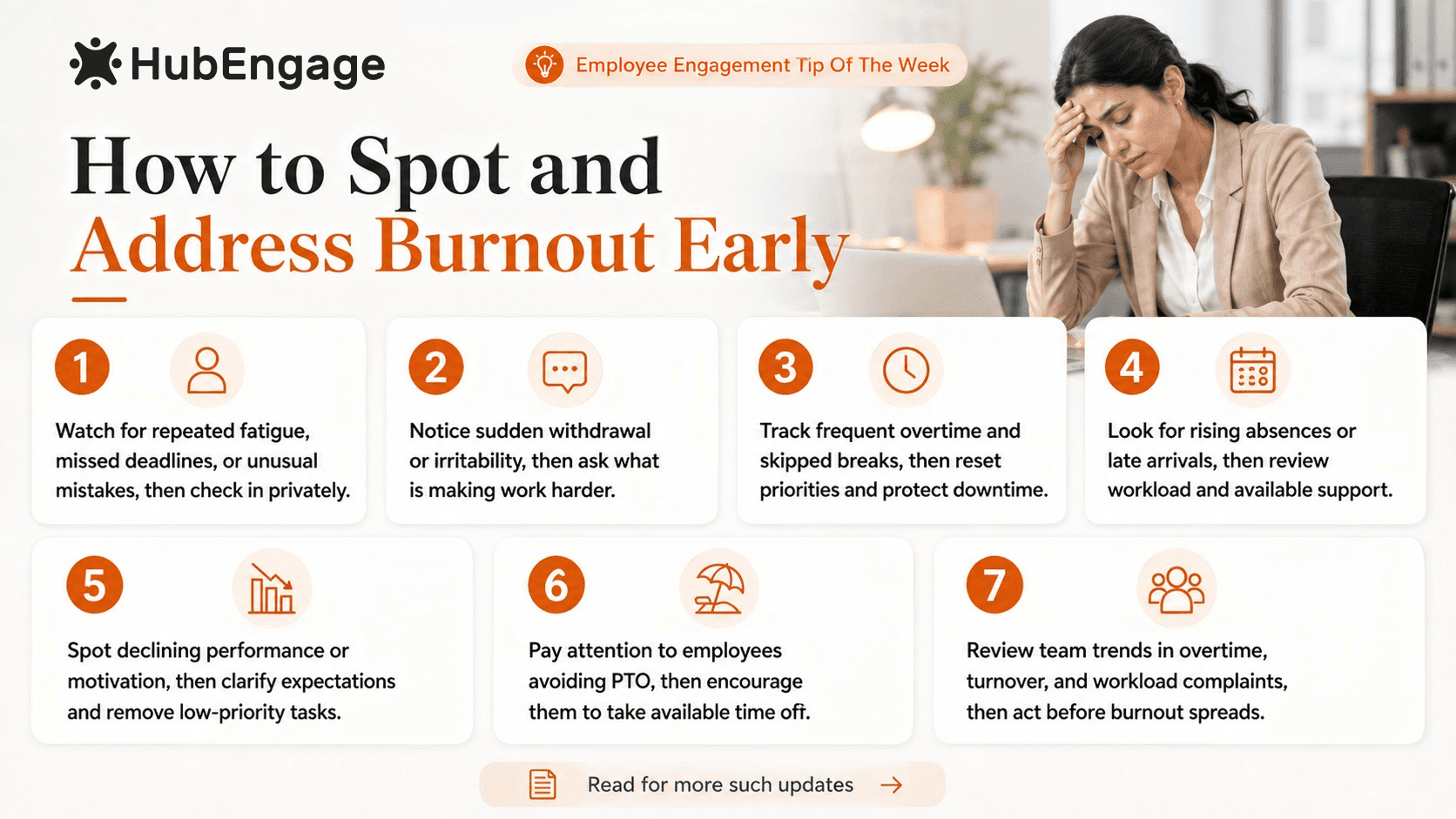
The graphic reinforces an important management habit: notice warning signs, investigate them respectfully, and address the underlying work conditions. For HR leaders, the goal is not simply to recognize exhaustion. It is to create working arrangements that make preventable exhaustion less likely.
4. Scheduling Is Part of the Employee Experience
The relationship between workload and employee wellbeing becomes particularly visible in shift-based environments. When a restaurant manager must rebuild a schedule after a last-minute absence, the consequences affect both operations and employees.
HubEngage’s guide to restaurant employee scheduling tools discusses capabilities such as mobile schedule access, shift swaps, availability management, time-off requests, notifications, labor forecasting, and integrations.
These capabilities address a practical reality: scheduling is not simply about filling vacant shifts. It determines whether employees know when they are expected to work, whether managers can respond to changes, and whether staffing plans reflect operational requirements.
Evaluate the whole scheduling process
A useful review should examine several stages.
Planning: Are staffing decisions aligned with anticipated demand, employee availability, and required skills?
Communication: Can employees see their schedules and receive timely updates when changes occur?
Flexibility: Is there a clear process for requesting leave, updating availability, or requesting shift swaps?
Time management: Can managers review attendance and working hours without relying on disconnected records?
Oversight: Are overtime, coverage gaps, and recurring scheduling problems visible to the people responsible for resolving them?
The appropriate technology depends on the organization’s size, workforce, industry, and existing systems. Nevertheless, the evaluation should consider the employee’s experience alongside operational efficiency.
For instance, a scheduling tool may produce a roster, but employees also need reliable notifications and a clear way to raise conflicts. Similarly, a time-tracking system may record hours, but managers still need to investigate recurring workload problems.
Connected workforce management makes these relationships easier to examine. Scheduling, time tracking, leave management, and task coordination are most useful when they support a coherent operating process rather than creating separate administrative burdens.
5. Uncertainty Requires Clear Leadership Communication
Even well-organized workplaces experience uncertainty. Business restructuring, changing priorities, new technology, leadership transitions, and shifts in customer demand can leave employees unsure about what happens next.
The Human Resources Director article on how HR leaders can turn uncertainty into a strategic advantage emphasizes the value of clear communication, honest updates, manager support, and employee listening when circumstances are changing.
The lesson is not that leaders must have every answer. Rather, they should communicate what is known, explain what remains unresolved, and clarify when employees can expect another update.
Give managers a consistent communication framework
Managers often become the first people employees approach when organizational changes create questions. If managers receive incomplete information, they may unintentionally offer conflicting explanations or leave concerns unanswered.
HR can reduce this risk by preparing managers to communicate consistently.
A useful framework covers three points:
- What we know: Share confirmed information and explain its immediate implications.
- What remains uncertain: Be transparent about unanswered questions rather than presenting assumptions as facts.
- What happens next: Explain the next decision, action, or planned communication, including timing when it is known.
Employee listening matters just as much. Leaders should create appropriate opportunities for questions, feedback, and concerns, then explain what action follows.
For example, if a new operating process changes responsibilities, employees need more than an announcement. They need to understand what changes in their daily work, where to find updated instructions, whom to contact, and how the organization will address problems during implementation.
This is where internal communications, leadership behavior, and workforce experience converge. Trust is influenced not only by the content of an announcement, but also by whether leaders communicate consistently and follow through.
6. HR Technology Needs Strong Foundations Before AI Can Scale
The preceding challenges may encourage organizations to invest in new technology. Yet buying another platform does not automatically resolve fragmented processes or unclear ownership.
The Economic Times HRTech article, Overcoming the Real Bottlenecks in HR Tech: Why Governance and Data Matter More Than AI, highlights the importance of reliable data, defined responsibilities, consistent processes, and change management when organizations scale HR technology.
Its message is especially relevant as businesses consider AI for employee support, workforce planning, learning, and HR operations. A promising pilot may encounter difficulties when expanded across locations or departments if the underlying information is inconsistent.
Start with the business problem
Before selecting a tool, leaders should define the problem they need to solve.
Is HR spending too much time answering repetitive policy questions? Are frontline employees missing important updates? Are managers coordinating shifts through separate spreadsheets and messages? Do employees struggle to locate training materials or understand operational instructions?
Each problem requires a clear outcome and an accountable owner.
Next, examine the information the solution will use. Policies need approval and version control. Workforce records need defined ownership and appropriate access. Scheduling data must reflect current availability. AI-generated responses must be grounded in approved information and reviewed according to the risk involved.
Leaders should also consider:
- Data quality and integration with existing systems.
- Access permissions, privacy, and security requirements.
- Human review for sensitive or consequential decisions.
- Employee training and change management.
- Adoption, accuracy, and operational measures after implementation.
AI can reduce effort in suitable workflows, but it cannot compensate for every process weakness. If employees receive conflicting answers because policy ownership is unclear, adding an AI interface may simply make inconsistent information easier to retrieve.
A sound technology strategy therefore begins with governance and practical use cases. Automation should follow a clear understanding of the process, not substitute for it.
7. Bring Everyday Employee Moments Into One Workforce Experience Strategy
Taken together, the six articles point toward a connected management challenge. Policy access, frontline communication, burnout prevention, scheduling, leadership communication, and HR technology are different subjects, but employees encounter them as parts of the same working environment.
A worker who cannot find a policy may interrupt a manager for help. That manager may already be handling a shift shortage. The employee may then miss an update about a changed procedure. If similar friction occurs repeatedly, the organization creates unnecessary effort for both employees and managers.
This is why workforce experience deserves attention as an operating priority rather than a collection of disconnected HR initiatives.
Evaluate technology around the employee journey
A unified workforce experience approach connects relevant information, communication, employee support, and operational processes around how people actually work.
For example, a frontline employee might need to check a shift, confirm a policy, complete an assigned task, receive an announcement, and request time off. When those activities are scattered across unrelated tools, the employee must remember where each process lives and which information is current.
A connected approach aims to reduce that friction while preserving appropriate controls and clear ownership.
Organizations evaluating workforce technology should ask whether employees can access essential information on the devices they use, whether managers can coordinate operational work efficiently, and whether HR can communicate changes without creating unnecessary duplication.
They should also consider how recognition, learning, and employee feedback fit into the same experience. Operational clarity matters, but employees also need opportunities to build skills, understand expectations, contribute ideas, and see that their work is valued.
8. How HubEngage Fits Into This Approach
HubEngage positions itself as an AI-powered workforce experience and operations platform for frontline and distributed teams. Its relevance to this discussion lies in the connection between employee communication, engagement, information access, and everyday workforce operations.
Different organizations will need different capabilities. However, a connected platform can provide a useful foundation when the current environment requires employees and managers to navigate too many disconnected processes.
For example, policy management can make approved workplace information easier to access. Internal communication tools can support coordinated announcements. Employee intranet and AI chatbot capabilities can help employees locate information and get answers based on approved sources. Scheduling, time tracking, leave management, and task management can support operational coordination where those capabilities fit the organization’s requirements.
Employee recognition, learning resources, and engagement activities address another part of the experience: helping people stay connected to their teams, understand their contribution, and participate in workplace culture.
The value depends on implementation. Leaders still need clear process owners, accurate data, sensible permissions, manager involvement, and employee feedback. No platform can independently resolve unclear policies, unrealistic workloads, or inconsistent leadership behavior.
For organizations with substantial frontline or deskless workforces, the relevant question is whether communication and operational tools work together in ways employees can use easily.
9. Turn Small Improvements Into Measurable Progress
Leaders do not need to redesign every workplace process at once. A more practical approach is to identify recurring friction, understand its causes, and address the problems that matter most to employees and operations.
Begin by asking employees and managers where they lose time, which questions repeatedly require assistance, and what information is difficult to access. Compare these observations with available operational data, such as scheduling changes, overtime patterns, repeated HR queries, policy acknowledgments, and communication reach.
Choose a manageable improvement, assign ownership, and establish a baseline before introducing a solution. Then review whether the change makes the process easier, improves access, reduces avoidable work, or helps managers respond more effectively.
For instance, an organization could begin by centralizing frequently used policies and making approved guidance searchable. It could then examine whether repeat questions decrease and whether employees report greater confidence in finding current information.
Another organization might begin with shift communication, evaluating whether employees receive schedule changes reliably and whether managers spend less time coordinating updates manually.
The important point is to connect technology adoption with observable workplace outcomes. A new feature is not evidence of improvement by itself. The organization needs to understand whether employees can use it, whether the process has become clearer, and whether the original problem has been addressed.
Take Away
Workplace gaps become business risks when small difficulties repeatedly interfere with employees’ ability to work effectively. The six articles show why policy access, frontline communication, burnout prevention, scheduling, leadership clarity, and responsible HR technology deserve attention together.
For CHROs and senior leaders, the priority is to identify where everyday friction originates, strengthen the processes behind it, and make essential information and support easier to access. The most useful technology decisions begin with real employee and operational needs, supported by sound governance and clear accountability.
Ultimately, workforce experience is shaped by the working day employees actually encounter. When policies are accessible, communication is relevant, workloads receive attention, schedules are clear, and technology supports rather than complicates work, organizations create a stronger foundation for engagement and operational effectiveness.
The practical starting point is simple: find the everyday gaps, listen to the people affected, and address the causes before they become larger problems.
FAQs
1. What is workforce experience, and why does it matter?
Workforce experience describes how employees interact with workplace information, communication, processes, leadership, and technology. It matters because these everyday interactions influence how easily people can perform their responsibilities and obtain the support they need.
2. How can HR leaders identify workplace gaps?
Review recurring employee questions, communication access, policy usage, scheduling difficulties, overtime patterns, absence trends, and feedback from managers and employees. Interpret these indicators in context, protect employee privacy, and investigate the underlying causes before choosing an intervention.
3. How can organizations improve frontline employee communication?
Make essential information accessible through channels suited to employees’ working environments. Use clear messages, centralized information, mobile access where appropriate, targeted notifications, and confirmation processes for important updates. Evaluate whether employees can access and act on information, not only whether messages were sent.
4. Why are governance and data quality important when implementing AI in HR?
AI systems depend on reliable information, clear ownership, appropriate access, and consistent processes. Strong governance helps organizations maintain accurate guidance, protect sensitive information, and ensure that human oversight remains in place for decisions requiring judgment.