Communication has become a business priority because it influences how employees understand decisions, use technology, respond to change and contribute to organizational goals. A strong internal communication strategy helps connect leadership intentions with employees’ everyday experiences. Without that connection, even sensible business decisions can create confusion, inconsistent execution and unnecessary frustration.
For CHROs and business leaders, an effective internal communication strategy is not simply about sending announcements. It is about making information useful, accessible and actionable. Employees need to understand what is changing, why it matters and what they should do next. They also need opportunities to ask questions and share concerns.
An effective internal communication strategy must therefore connect three things: what leaders say, what employees experience and how the organization responds. This becomes particularly important as businesses introduce artificial intelligence, improve digital workplaces and navigate organizational change. Six recent articles offer useful perspectives on these connected challenges and what leaders can do about them.
1. Internal Communication Must Lead to Action
Employees receive information through emails, meetings, messaging applications, intranets, employee apps and conversations with managers. However, the availability of multiple channels does not guarantee understanding.
The practical question is whether employees can find the information they need, understand its relevance and act on it without unnecessary effort.
HubEngage’s guide to internal communication email best practices highlights the importance of clear messages, relevant audiences, reusable templates and communication analytics. These fundamentals matter because employees should not have to interpret lengthy announcements to understand a policy change or determine whether an action applies to them.
Make every message answer three questions
Before sending an internal announcement, communications and HR teams should establish:
- Why does this matter? Explain the business context or employee impact.
- What should employees do? State the action, deadline or decision clearly.
- Where can employees get help? Provide a reliable place to find details or ask questions.
For example, announcing a new leave policy is only the first step. Employees also need to understand the changes, know where to submit requests and understand whom to contact when their circumstances are unclear.
Likewise, a leadership update about business priorities should explain what those priorities mean for individual teams.
For CHROs, this creates a useful distinction between communication activity and communication effectiveness. The number of emails sent is an output. Employee understanding, appropriate action and reduced confusion are more meaningful indicators of whether communication is working.
2. The Intelligent Workplace Must Reduce Friction
The next challenge is making information and support available within the flow of work.
In The Intelligent Workplace: Technology’s Next Transformation of Work, ITPro examines how AI assistants, automation and connected workplace platforms are changing the employee experience. The article emphasizes that adding technology is not enough if employees still navigate disconnected systems and repetitive processes.
This is an important consideration for HR leaders evaluating their technology environment.
An employee might receive a policy update by email, search an intranet for instructions, ask a manager for clarification and then open another system to complete the required task. Each individual tool may serve a purpose, yet the overall experience remains unnecessarily complicated.
Connect communication with everyday work
A more useful workplace experience allows employees to move from information to action with fewer obstacles.
Consider a shift change. Employees need to understand the updated schedule, know whether they must acknowledge it and have a clear route to ask questions. Supervisors need visibility into staffing requirements and outstanding actions.
Similarly, a new learning initiative should connect the announcement with relevant learning materials, instructions and opportunities to apply the knowledge.
These examples demonstrate why internal communication should not be designed in isolation from workforce operations.
For leaders, the evaluation criteria should include ease of access, mobile usability, integration with existing systems and the effort required to complete common tasks. Technology should simplify the employee journey rather than introduce another destination employees must remember.
It is also important to involve employees in evaluating new tools. Their feedback can reveal duplicated work, confusing processes and practical barriers that may not be apparent during procurement.
3. Digital Employee Experience Is an Operational Issue
Technology problems are often measured through IT tickets, system availability and resolution times. However, those measures do not necessarily capture the full effect of poor digital experiences on employees.
The article Why Digital Employee Experience (DEX) Is Critical for Healthcare IT explains how device and application performance can affect healthcare employees working in demanding environments.
Its central relevance extends beyond healthcare: when essential tools perform poorly, employees can lose time, struggle to complete tasks and experience frustration that conventional support metrics may not fully reveal.
For healthcare professionals, the consequences can affect workflows supporting patient care. In other industries, similar friction may disrupt customer service, production, field operations or administrative work.
Look beyond whether a system is available
A system can be technically operational while still being difficult to use.
Employees may encounter slow applications, unclear navigation, repeated logins or difficulty locating current procedures. Each problem may appear minor, but together they can make routine work harder.
HR, IT and operations leaders should therefore evaluate digital employee experience alongside broader workforce experience.
Useful questions include:
- Can employees access essential information from their actual work environment?
- Are the tools appropriate for office-based, remote and frontline employees?
- Can employees find answers without repeatedly contacting HR or their managers?
- Are recurring technology complaints being investigated for underlying process issues?
- Do employees have a straightforward way to report friction and see what happens next?
These questions help leaders connect technology performance with employee productivity and satisfaction.
They also reinforce the importance of shared ownership. IT may manage technical reliability, but HR understands employee needs, communications teams manage information access, and operations leaders understand the realities of daily work.
A coordinated approach makes it easier to address problems at their source rather than treating every complaint as an isolated incident.
4. AI Can Support HR, but Human Judgment Remains Essential
AI offers opportunities to reduce repetitive work, organize information and support faster analysis. However, its usefulness depends on the task, the quality of its inputs and the safeguards surrounding its use.
The article What Generative AI Can and Cannot Do for HR, According to a Cornell Professor draws attention to an important distinction: AI can assist with information processing, but people remain responsible for interpretation, context and consequential decisions.
This matters because HR works with decisions that directly affect employees’ opportunities, careers and working relationships.
Separate administrative support from people decisions
AI may help summarize policy documents, retrieve information, organize employee feedback or prepare a first draft of an internal announcement. These applications can reduce administrative effort when the outputs are reviewed appropriately.
However, recruitment, performance evaluation, promotion and employee relations require particular care. Historical workforce data can contain existing biases, and automated recommendations can reproduce or amplify them.
Human oversight should therefore be meaningful, not merely a final approval step.
HR leaders should establish clear boundaries around:
- Which tasks AI can perform independently and which require review.
- What employee data can be accessed and how it may be used.
- How employees can question or appeal consequential decisions.
- Who remains accountable for decisions supported by AI.
- How the organization will check accuracy, fairness and unintended effects.
Protect the capabilities HR needs for the future
There is another consideration. If AI handles more routine analysis, HR professionals need stronger skills in interpreting evidence, designing work, understanding employee concerns and advising leaders.
Automation should create capacity for better judgment, not replace the development of judgment itself.
The most useful question is not whether HR can automate a task. It is whether automation improves the outcome while preserving accountability, employee trust and professional expertise.
5. Internal Newsletters Need a Clear Purpose
Communication overload is not solved by sending fewer messages alone. Organizations must also make the messages they do send more relevant.
A well-designed employee newsletter can bring important updates, leadership messages, learning resources and organizational priorities together in one accessible format. However, it becomes less useful when it is simply a collection of announcements that employees must sort through themselves.
HubEngage’s guide to internal newsletter software discusses capabilities such as audience segmentation, personalization, analytics and multi-channel distribution. These features can support a more deliberate communication approach, particularly when organizations need to reach employees across different locations and roles.
Design around employee needs
An effective newsletter begins with an editorial purpose.
For example, a weekly edition might explain a business priority, share a relevant policy update, recognize a team contribution and direct employees to a useful learning resource. Each item should have a clear reason for inclusion.
Audience relevance matters as well. A frontline supervisor and a corporate finance professional may need different information, even when both work for the same organization.
Segmentation helps reduce irrelevant messages, while mobile-friendly formats make information easier to access for employees who do not spend their working day at a desk.
Measurement should go beyond open rates. Clicks, feedback, employee questions and the completion of requested actions can help communications teams understand whether the content is useful.
Nevertheless, metrics need context. A message with a low click rate may still have achieved its purpose if it provided a straightforward update that required no further action.
The goal is not to maximize engagement with every message. It is to make communication valuable enough that employees can recognize what matters and respond appropriately.
6. Communication Builds Organizational Resilience
Change tests the quality of an organization’s communication.
During restructuring, new technology implementation, operational disruption or shifting business priorities, employees need timely information and clear expectations. When information is limited, speculation can fill the gaps.
The article 6 Big Ways Good Communication Will Support Organizational Resilience explains how open communication supports coordination, trust and an organization’s ability to respond to challenges.
For HR leaders, resilience is not simply an employee’s ability to cope with pressure. It also depends on whether the organization provides clear direction, listens to concerns and helps teams coordinate their response.
Communicate what is known, what is changing and what comes next
Leaders do not always have complete answers during a difficult situation. However, they can explain what is known, acknowledge what remains uncertain and establish when employees can expect another update.
This approach is more useful than remaining silent until every detail is finalized.
Managers also need consistent information. If different teams receive conflicting explanations, employees may lose confidence in the process and make decisions based on incomplete assumptions.
A practical change communication plan should include:
- A clear explanation of the change and its purpose.
- Specific information about who is affected and how.
- Opportunities for employees to ask questions and raise concerns.
- Guidance for managers who must explain the change to their teams.
- Regular updates when information or timelines change.
- Follow-up showing how employee feedback influenced decisions, where appropriate.
Communication also needs to work in both directions. Employees often notice operational risks, customer concerns and process failures before those issues reach senior leadership.
When leaders make it safe to raise concerns, they gain access to information that can support better decisions. When they respond constructively, they reinforce the value of speaking up.
Put Psychological Safety into Everyday Meetings
Trust is not built through announcements alone. It develops through everyday interactions, particularly when employees disagree, admit mistakes or suggest improvements.
A team meeting provides a practical opportunity to make communication more open. However, asking employees to speak freely is not enough if they expect their ideas to be dismissed or their mistakes to be held against them.
Leaders can make a difference through small, consistent behaviours.
They can give employees time to share their views before making a decision, ask what information may be missing and respond respectfully when someone challenges an assumption. They can also acknowledge contributions and explain why a suggestion cannot be implemented when circumstances prevent it.
These actions help employees understand that participation is meaningful.
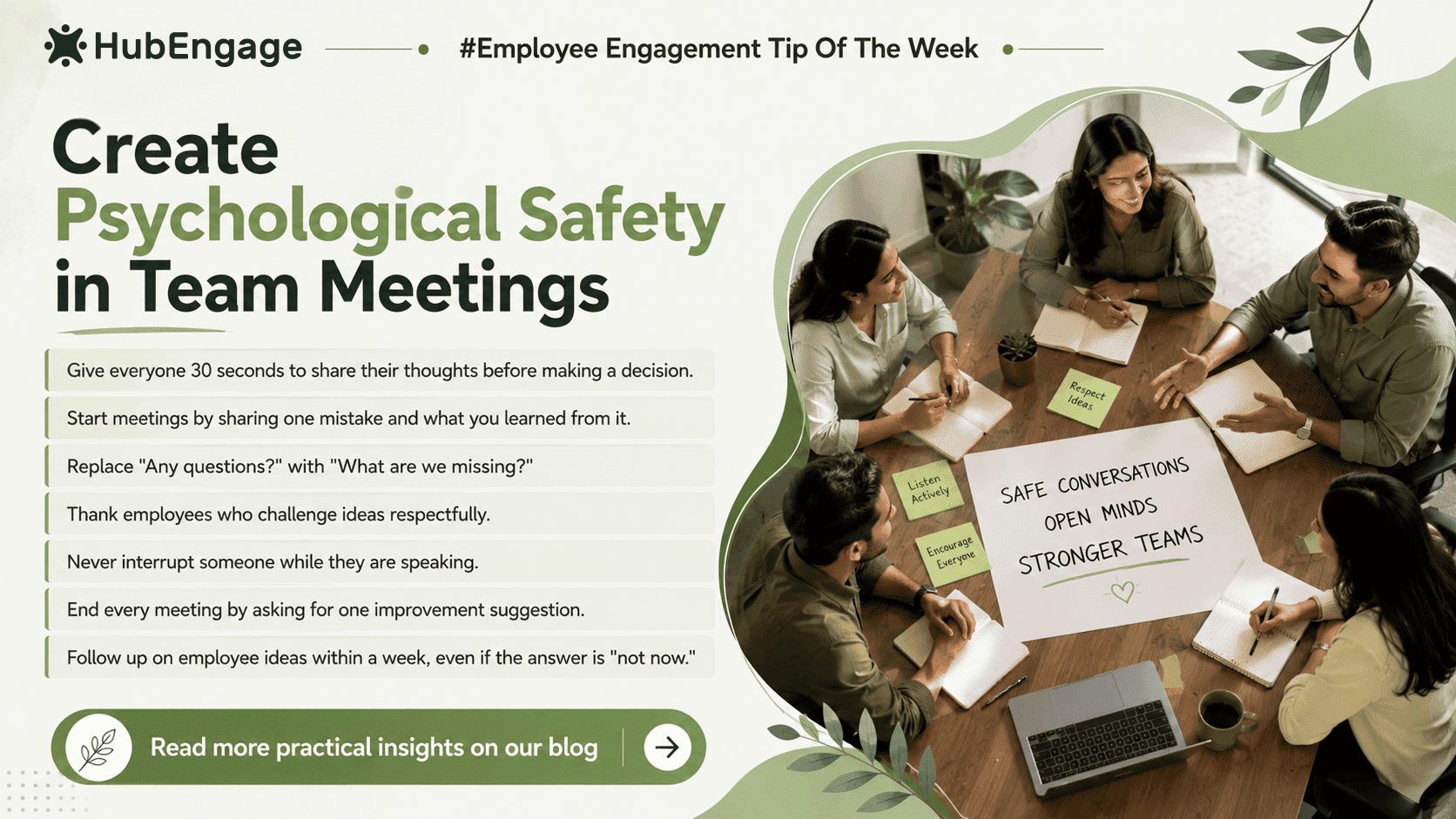
The value of these practices lies in their consistency. A single meeting will not transform workplace culture, but repeated opportunities to speak and receive a thoughtful response can help establish better habits.
For CHROs, the next step is to examine whether managers have the skills and support to sustain these behaviours. Employee surveys, feedback conversations and meeting reviews can reveal whether people feel heard and whether their input leads to action.
Equally important, leaders should close the feedback loop. If employees repeatedly share suggestions but never hear what happened, they may stop contributing. Even when an idea cannot be implemented, a clear explanation demonstrates respect for the person who raised it.
Connect Communication, Technology and Employee Experience
The six articles point toward a shared management challenge. Communication must be clear, digital tools must reduce friction, AI must be used responsibly, and employees must have ways to participate in decisions that affect their work.
These responsibilities often sit across different departments. HR manages employee policies and people processes. Internal communications manages messaging. IT manages systems and access. Operations manages daily execution. Leadership establishes priorities and accountability.
When these activities operate independently, employees may experience fragmented information and disconnected processes.
A connected workforce experience approach brings the employee perspective into the design of communication, technology and operations. It asks whether employees can access the information, support and tools required to do their jobs effectively.
What should leaders evaluate?
Before investing in another platform or launching another communication initiative, assess the current employee journey.
Start with a few common scenarios: finding a policy, requesting leave, checking a shift, completing an assigned task, accessing learning materials or asking HR a question.
Map the steps involved and identify where employees must switch systems, repeat information, wait for answers or rely on informal workarounds.
Then consider whether better integration, clearer communication or a simpler process would address the underlying problem.
A connected approach may involve an employee intranet for accessible information, internal email and newsletters for structured updates, employee recognition to reinforce positive contributions, and scheduling or task management tools to support frontline operations.
AI-powered HR helpdesk capabilities may also help employees find answers to routine questions, provided information is accurate, sensitive cases are handled appropriately and access to human support remains available.
The right combination depends on the organization’s workforce, existing systems and operational requirements. Not every organization needs every capability. The priority is to remove unnecessary friction and make essential work easier.
Where HubEngage Fits into the Conversation
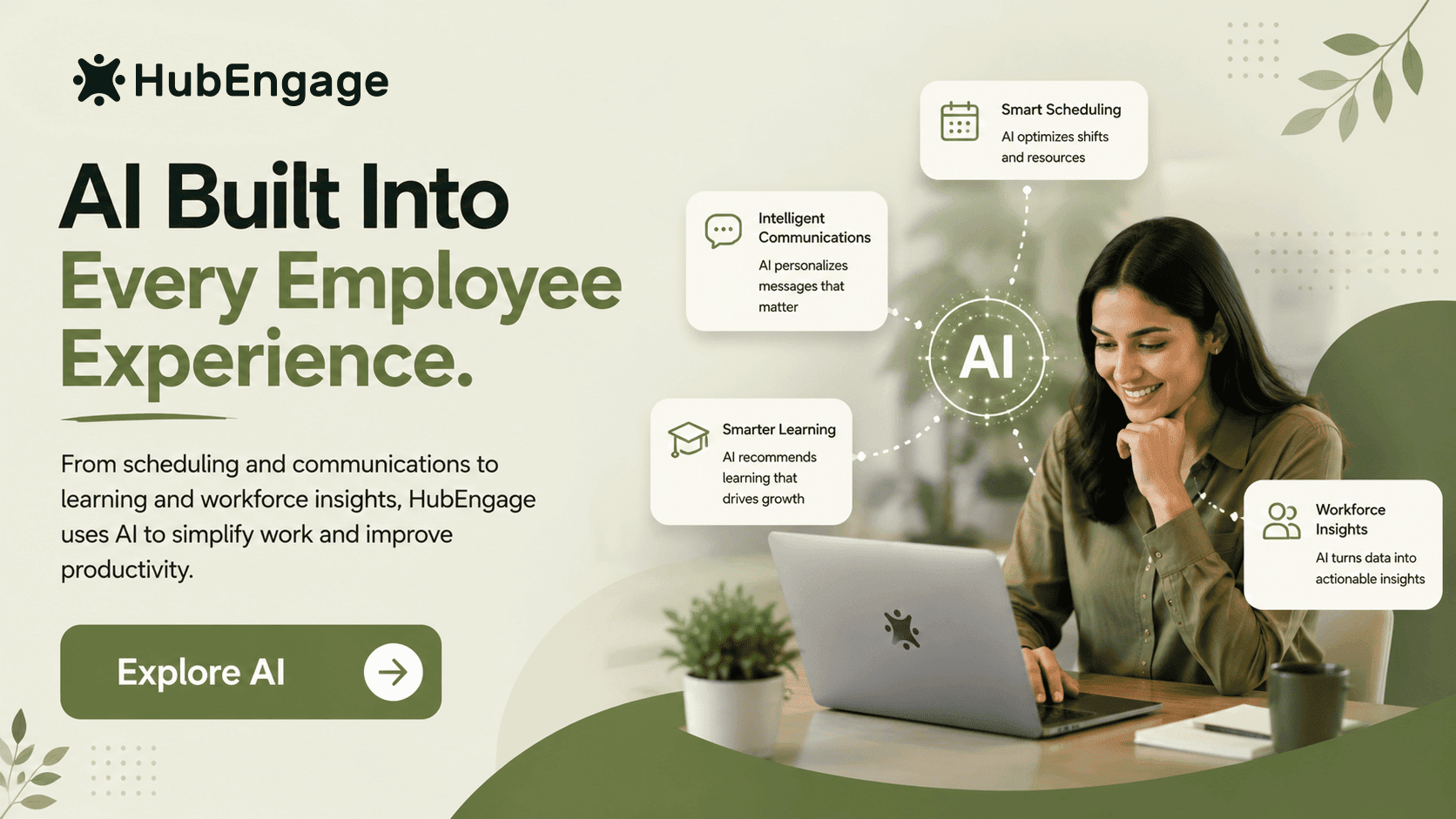
HubEngage positions itself as an AI-powered workforce experience and operations platform for frontline and distributed teams. Its relevance to this discussion is the connection between employee communication and the everyday processes through which people experience their workplace.
For example, internal communications capabilities can support targeted employee emails and newsletters. An employee intranet can provide a central place for important information, while employee texting and digital signage can help reach people who may not regularly use corporate email.
Recognition and feedback capabilities can support participation and reinforce desired behaviours. Workforce management features, including shift scheduling, time tracking, leave management and task management, address practical aspects of daily work.
AI capabilities can support information access and routine assistance where appropriate, while learning and knowledge resources can help employees understand processes and develop skills.
These capabilities are most useful when selected around a clear employee or operational need, rather than implemented simply because the technology is available.
Leaders evaluating a workforce experience platform should examine how well it fits their existing systems, supports different employee groups, protects employee information and provides meaningful ways to measure outcomes.
They should also involve employees in testing and evaluating the experience. A platform that looks comprehensive during a demonstration may still create friction if it does not fit the way people actually work.
What HR Leaders Should Do Next
Communication becomes a business asset when employees can understand priorities, access support, contribute ideas and act with confidence.
The six articles offer complementary perspectives on that objective. Clear internal messages improve understanding. Connected technology can reduce unnecessary effort. Digital employee experience highlights the importance of reliable tools. Responsible AI preserves human judgment. Purposeful newsletters make information more relevant. Open communication helps organizations respond to change.
For CHROs and senior leaders, the practical next step is to review the employee experience as a connected system.
Identify where information gets lost, where processes create unnecessary effort and where employees hesitate to raise concerns. Choose one or two important friction points, agree on measurable outcomes and work across HR, communications, IT and operations to address them.
Then ask employees whether the experience has improved. Their feedback should inform the next round of decisions.
The central lesson is straightforward: communication is not complete when a message is delivered. It is effective when people understand what matters, know what to do and can raise concerns without unnecessary barriers. Combined with thoughtful technology and accountable leadership, that approach gives organizations a stronger foundation for engagement, effective execution and resilience.
FAQs
1. Why is internal communication important for HR leaders?
Internal communication helps employees understand business priorities, workplace policies and changes that affect their work. Clear, two-way communication can reduce confusion, support coordination and give leaders better visibility into employee concerns.
2. How can organizations improve digital employee experience?
Organizations should identify friction in everyday tasks, improve access to essential information, assess the reliability and usability of workplace technology, and involve employees in evaluating solutions. HR, IT and operations should work together to address the causes of recurring problems.
3. How should HR teams use AI responsibly?
HR teams should use AI for appropriate tasks such as summarizing information and supporting routine queries, while maintaining human oversight of consequential people decisions. Clear data governance, accuracy checks, accountability and opportunities for employees to question decisions are essential.
4. How can employee newsletters improve engagement?
Employee newsletters are more useful when they contain relevant, clearly structured information, serve a defined purpose and reach employees through appropriate channels. Organizations should evaluate feedback and meaningful actions alongside open and click rates to understand their effectiveness.