Social network for enterprise have evolved rapidly over the last few years. As per Nature internal social platforms can significantly improve communication, collaboration, and employee engagement when implemented well.
What started as simple internal social feeds has become a critical layer of the modern digital workplace. Today, a social network for enterprise connects distributed teams, frontline employees, and leadership through a secure, company‑owned platform designed for collaboration, knowledge sharing, and culture building.
As remote, hybrid, and frontline‑heavy workforces continue to grow, we’re seeing organizations move away from fragmented tools and toward unified experiences. A modern corporate social network now sits alongside intranets, employee apps, chat tools, and collaboration software as a core system for internal engagement.
Our guide will explain what an enterprise social network (ESN)is, key benefits, common use cases, and how it can help organizations improve communication, collaboration, and employee engagement.
Key Takeaways:
- ESNs improve cross-team collaboration by connecting employees through communities, discussions, activity feeds, and shared content.
- Organizations use social network for enterprise to reduce communication silos, improve knowledge sharing, and keep remote, hybrid, and frontline employees connected.
- Unlike chat tools, such networks provide searchable and long-term conversations that help preserve organizational knowledge.
- Social network for enterprise supports employee engagement through recognition, feedback, leadership communication, and two-way conversations.
- When integrated with intranets, employee apps, and workplace tools, social network for enterprise becomes a central hub for communication, collaboration, and workplace culture.

What is an Enterprise Social Network?
It is a private, internal social platform designed exclusively for employees. Unlike public social media, a social network for enterprise is owned and governed by the organization.
An internal social platform enables employees to communicate, collaborate, and share knowledge using familiar social interactions such as posts, comments, likes, groups, and activity feeds.
As work becomes more asynchronous and distributed, the value of an internal social collaboration platform has only increased.
Why do organizations need Enterprise Social Networks?
Companies use corporate social networks to support leadership communication, project collaboration, employee recognition, frontline updates, and continuous feedback. Here are some common use cases we see in practice
- Internal communications: Leadership updates, change communications, and local/site news with two-way conversation.
- Team collaboration: Project groups where updates, decisions, and resources stay visible and searchable.
- Communities of practice: Groups built around disciplines (HR, safety, sales enablement, engineering) to share templates and best practices.
- Communities of interest: Hobby and affinity groups that strengthen connection and belonging.
- Onboarding and learning: A guided path for new hires to find people, resources, and answers quickly.
- Knowledge sharing and Q&A: Crowdsource answers and locate specialists across locations.
Enterprise Social Network vs Public Social Networks
| Factor | Social Network For Enterprise | Public Social Network |
| Purpose | Employee collaboration, and knowledge sharing | Social networking, marketing, and public engagement |
| Audience | Employees, teams, and approved users | General public, customers, and brands |
| Security & Control | Private, secure, and organization-managed | Public or semi-public with limited organizational control |
Core Components of Enterprise Social Network Software
Let us understand the building blocks which makes an social network for enterprise feel like a system they actually want to use.
Collaboration and Communities
A social network for enterprise creates shared spaces for teams, departments, and interests. These communities reduce silos and make collaboration more visible and inclusive across the organization.
Content and Knowledge Sharing
Corporate social networks serve as living knowledge hubs. Employees can share updates, documents, videos, and best practices in context, making information easier to find and reuse over time.
Communication and Engagement
Unlike one‑way broadcast tools, a corporate social network supports two‑way and multi‑directional communication. Leadership updates, frontline feedback, and peer‑to‑peer conversations at one place.
Key Characteristics of an Enterprise Social Network
When we evaluate social network for enterprise, we look for a few characteristics that separate a true ESN from “social features” bolted onto another tool.

Common Features in Enterprise Social Network Software
Most social network for employees include the following core features:
- Employee profiles and directory to find people, skills, and expertise
- Activity feed for updates, announcements, and discussions
- Groups and communities for projects, departments, and interests
- Mentions, hashtags, and reactions to increase reach and engagement
- File and content sharing (docs, images, video) with searchability
- Search across people and content so knowledge is easy to rediscover
- Mobile access to reach frontline and deskless employees
- Analytics and insights on adoption, engagement, and content performance
- Optional intelligence/personalization to surface relevant content and experts based on role, location, and behavior
Benefits of using an Enterprise Social Network
Organizations adopt corporate social networks for more than convenience. Let us explore what benefits a social network for enterprise can bring.
Stronger Collaboration and Engagement
Employees collaborate more easily in one shared space. Teams can exchange ideas, ask questions, and work together across locations, helping everyone stay connected and engaged.
Reduced Tool Sprawl
Using a social network for enterprise brings conversations, updates, and content into one platform. This reduces reliance on multiple tools and makes communication simpler and more organized.
Better Knowledge Flow and Expertise Discovery
A social network for enterprise make knowledge easier to find and share. Employees can access resources, discover experts, ask questions, and learn from colleagues across the organization.
Improved Culture, Transparency, and Trust
Social network for enterprise encourage open communication, employee recognition, and shared experiences. Visible conversations help build trust, strengthen workplace culture, and improve transparency across teams.
Stronger Support for Remote and Frontline Employees
As hybrid and remote work becomes the norm, companies need to maintain social connection, collaboration, and performance across locations.
How to set up and implement an Enterprise Social Network for your company?
Successfully launching an internal social platform requires more than turning on a tool. Communication, collaboration, engagement, and knowledge sharing so the platform has a clear purpose from day one.
Executive participation is critical. When leaders actively communicate, recognize employees, and respond to feedback in the social network for enterprise, adoption accelerates and usage becomes part of daily work rather than an extra task.
Getting Started With Enterprise Social Networking
The most effective platforms fit how employees already work, rather than forcing new habits. Over time, community managers and champions can help nurture conversations, surface valuable content, and keep the network healthy.
A Practical Implementation Roadmap
Here is the rollout approach we have seen work best for a social network for enterprise use:

How can enterprise social networks and intranets work together?
A modern intranet is often the source of truth for structured content like policies, handbooks, and formal resources. A social network for enterprise complements that structure with conversation and community. In practice, we see the best results when:
- The intranet hosts the official content (policies, procedures, benefits, hubs.
- Social network for enterprise drives discussion, feedback, and real-world context around that content.
- Key intranet pages are shared into ESN groups, and questions/answers are captured where others can reuse them.
This pairing keeps information accurate while making engagement more human and interactive.
Should all companies implement enterprise social networks ?
Not always, because a social network for enterprise tends to work best when there’s a real collaboration or communication challenge to solve, teams are distributed, or knowledge is spread across departments and locations.
If leadership isn’t willing to participate, or the organization has no plan for governance and community management, adoption can stall. In those cases, it’s better to clarify objectives and readiness first, then launch with a clear purpose.
Common challenges in Enterprise Social Networking and how to overcome them?
Even the best employee social platform software can underperform. Here are the most common issues we see, and what to do instead.
1: Launching without a clear purpose
When employees themselves don’t understand why the internal social platform exists instead.
What to do instead: Define 2–3 primary use cases like leadership updates with Q&A and then create simple posting guidelines that map each type of message to a home.
2: Treating the ESN like a broadcast channel
When the platform becomes a one-way stream of announcements, employees stop engaging.
What to do instead: Use prompts that invite participation like questions, polls, share a win, “what did we learn” etc. Also highlight employee stories, and encourage managers to comment and respond.
3: No leadership presence
Employees watch what leaders do. If leadership never shows up, the social network for enterprise feels optional.
What to do instead: Set a lightweight leadership cadence like weekly post, monthly ask me anything, quarterly town hall recap so that leaders can easily recognize their teams.
4: Too many groups
A flood of overlapping communities creates confusion and dilutes engagement.
What to do instead: Start with a simple taxonomy: a few company-wide communities, a handful of core departments, and a limited set of project groups. Expand based on demand and usage data.
5: Weak governance or unclear etiquette
Without basic governance, employees may hesitate to post, and the social network for enterprise can drift into noise.
What to do instead: Publish clear, friendly guidelines, confidentiality, respectful behavior, and assign community owners or moderators.
6: Poor mobile or frontline experience
If frontline teams can’t easily access the social network for enterprise then, the organization creates a digital divide.
What to do instead: Prioritize mobile-first access, simple sign-in, targeted notifications, and workflows that work without corporate email identities when needed.
7: No integration into daily workflows
If employees must leave their tools to participate, usage declines.
What to do instead: Connect the social network for enterprise to the tools employees already use like document repositories, HR systems, collaboration suites
8: Not measuring what matters
Teams often track vanity metrics such as posts, likes without linking the social network for enterprise to outcomes.
What to do instead: Track active users, responsiveness (questions answered), search and content engagement.
Enterprise Social Networking Future Trends
As workplace communication continues to evolve, social network for enterprise are becoming smarter, more connected, and employee-centric. Here are some key trends shaping the future of social network for enterprise
AI-Powered Personalization
Uses AI to deliver relevant content, recommendations, and notifications, improving engagement and information discovery.
Greater Frontline Employee Inclusion
Supports frontline workers through mobile access, multilingual communication, and easier participation across teams.
Enhanced Employee Experience Platforms
Combines communication, recognition, surveys, and learning tools into one connected employee platform.
Better Analytics and Insights
Provides engagement data and collaboration insights to help improve workplace communication strategies.
Stronger Security and Compliance
Enhances privacy, governance, and compliance controls to protect organizational data and communications.
More Community-Driven Collaboration
Encourages knowledge sharing, relationship building, and collaboration through employee communities and groups.
Introducing HubEngage Enterprise Social Network
We offer a secured social network for enterprise that brings together collaboration, communication, recognition, and employee engagement in one connected platform.
Designed for modern organizations, Social Hub helps employees share updates, join communities, recognize peers, participate in discussions, and stay connected across departments, locations, and roles.
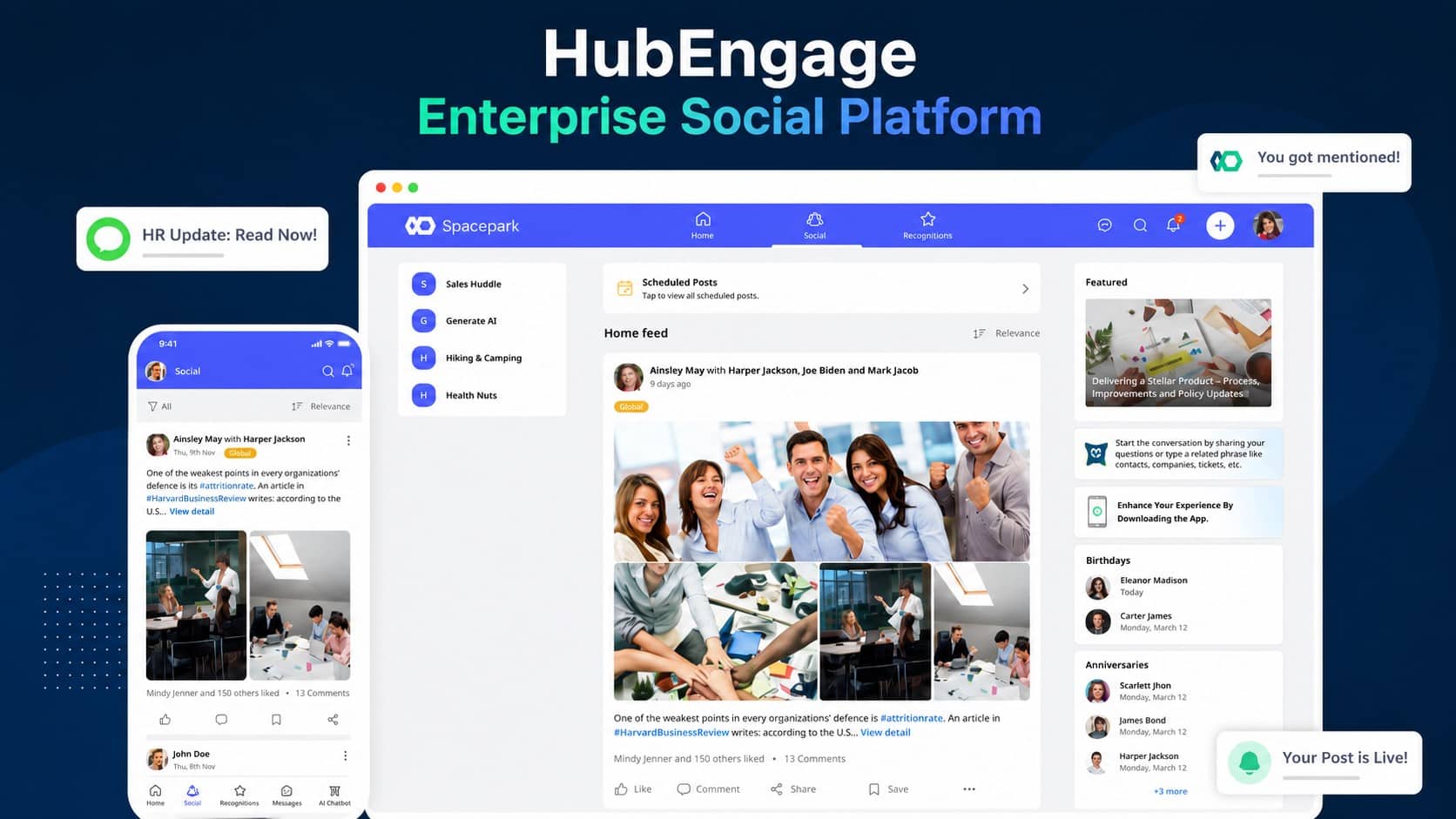
Rather than treating social networking as a standalone tool, HubEngage integrates social collaboration with employee communications, surveys, recognition programs, rewards, and employee apps to create a unified digital workplace experience.
With personalized activity feeds, communities, mobile access, and seamless integrations, organizations can reduce tool sprawl, strengthen culture, improve knowledge sharing, and keep employees engaged wherever they work.
Key Features:
- Enterprise social networking: Activity feeds, profiles, discussions, comments, and reactions.
- Communities and collaboration: Department, project, leadership, and interest-based groups.
- Recognition and engagement: Recognition, rewards, surveys, and polls in one platform.
- Personalized experience: Relevant content based on roles, locations, and interests.
- Mobile-first access: Mobile apps, web access, and push notifications.
- Unified workplace: Integrates with intranets, Teams, Slack, and workplace tools.
- Enterprise security: Governance, compliance, and role-based access controls.
Watch this review from Bret W, CEO in a US Government Administration explaining why he chose HubEngage over other solutions.
“I really like the Social Hub in HubEngage because it keeps employees engaged by giving them a place to share updates about their work and daily experiences. Instead of using platforms like Facebook, we now have a dedicated space for internal communication and collaboration. The translation feature has also been very helpful since our employees work in different locations and speak different languages. It makes it easier for everyone to understand one another and communicate comfortably in the language they prefer.”
Discover more such success stories of our customers and what they say about HubEngage’s employee experience platform.
Conclusion
A social network for enterprise has become a very important part of the modern digital workplace. By connecting employees across locations, departments, and roles, organizations improve communication, collaboration, knowledge sharing, and employee engagement.
When implemented with clear goals and strong leadership support, an ESN can drive lasting business value and strengthen workplace culture. To see how this can work for your organization, explore the HubEngage Employee Experience Platform by scheduling a free demo session.
Enterprise Social Network FAQs
How does an enterprise social network improve cross-department collaboration?
Having a social network for enterprise improves cross-department collaboration by connecting employees through shared communities, discussions, and knowledge sharing. It breaks down organizational silos, increases visibility across teams, and helps employees work together more effectively.
Can an enterprise social network support remote, hybrid, and frontline employees?
Social network for enterprise supports remote, hybrid, and frontline employees by providing mobile-friendly access to company updates, collaboration tools, and communities. It helps all employees stay informed, connected, and engaged regardless of location.
How do enterprise social networks help reduce internal communication silos?
Social network for enterprises reduce communication silos by creating a centralized space where employees can share information, ask questions, and collaborate openly. This improves transparency, encourages knowledge sharing, and ensures important information reaches more people.
Can enterprise social networks be used for leadership announcements and updates?
Yes by providing an effective channel for leadership announcements, company updates, and strategic communications. Employees can engage through comments, reactions, and discussions, creating greater transparency and stronger connections with leadership.
How do enterprise social networks improve employee engagement and participation?
A social network for enterprise improve employee engagement by encouraging conversations, recognition, feedback, and collaboration. Interactive features such as comments, reactions, polls, and communities make it easier for employees to participate and feel connected.
Are enterprise social networks scalable for large, global organizations?
Most of these solutions are designed to scale across large, global organizations. They support multiple locations, languages, departments, and user groups while providing consistent communication, collaboration, governance, and knowledge-sharing capabilities worldwide.
How do enterprise social networks support real-time communication across teams?
A social network for enterprise support real-time communication through activity feeds, notifications, group discussions, and instant updates. Employees can quickly share information, collaborate on projects, and stay aligned without relying solely on email.
What role does an enterprise social network play in change management initiatives?
It helps organizations manage change by providing a central place for updates, discussions, training resources, and employee feedback. It improves transparency, addresses concerns quickly, and encourages employee participation during transitions.
How do enterprise social networks improve information visibility and reach?
By distributing content through activity feeds, communities, notifications, and search features. Important updates become easier to discover, helping employees access relevant information when they need it.
Can enterprise social networks support employee feedback and two-way communication?
Absolutely, they support two-way communication by allowing employees to share feedback, ask questions, participate in discussions, and respond to leadership updates. This creates a more inclusive workplace and strengthens employee trust.