Passive listening is a communication behavior that happens in offices, classrooms, and everyday discussions. While most of us think that just hearing will do the understanding part, in real life people generally hear information while they are not active .
In this article, we will explain what passive listening means, its characteristics, common examples, and how companies can decrease this problem with the help of modern team communication apps for better communication and teamwork.
Key Takeaways
- Passive listening occurs when individuals hear information without actively engaging or responding.
- It commonly appears in workplaces, classrooms, and daily conversations, reducing communication effectiveness significantly.
- Lack of feedback, minimal engagement, and no clarifying questions are some of the common signs.
- Passive listening leads to misunderstandings, lower productivity, and weakened team collaboration across organizations.
- Distractions, low motivation, and emotional disconnect are major causes of this behavior.
Passive Listening Definition
What Passive Listening Means?
It is an act of hearing a speaker without actively engaging, interpreting, or responding to the message being communicated. In simple terms, a listener receives information but does not provide feedback, ask questions, or demonstrate understanding.
In workplace communication, this generally happens during meetings, presentations, or training sessions where employees may hear instructions but do not fully process or respond to them.
According to Gallup, companies with low employee engagement experience 18% lower productivity and 15% lower profitability, often driven by poor communication and lack of meaningful interaction between employees and leadership.
When communication becomes one‑way and employees fall into passive listening habits, important information is missed and collaboration suffers.
The passive listening definition highlights a key difference between hearing and listening. Hearing is a physiological process, while listening requires cognitive engagement and interpretation.

How Passive Listening Differs from Active Listening?
Let us understand how these terms are different with the help of the comparison table added below.
| Active Listening | Passive Listening |
| Actively focuses on the speaker and message | Hears the speaker but shows minimal engagement |
| Asks questions and clarifies information | Rarely asks questions or seeks clarification |
| Provides verbal or non‑verbal feedback | Gives little or no feedback |
| Improves understanding and collaboration | Often leads to misunderstandings |
| Encourages two‑way communication | Usually results in one‑way communication |
Organizations that rely heavily on digital communication tool such as instant messaging software often see improved engagement because employees can react, respond, and ask questions in real time.
Why Passive Listening Happens?
Understanding why passive listening occurs is essential for addressing it.
Distractions and Multitasking
One of the most common causes of passive listening is multitasking. Employees often divide attention between meetings, emails, and other tasks.
Emotional Distance
When employees feel disconnected from the topic or speaker, they are more likely to listen passively rather than engage in discussion.
Lack of Interest or Motivation
If employees perceive information as irrelevant, they may disengage and listen passively.
Characteristics of Passive Listening
Understanding the characteristics of passive listening helps managers and HR leaders identify communication gaps within teams.
Minimal Engagement
One of the most noticeable traits of passive listening is minimal engagement. The listener may appear attentive but does not actively participate in the conversation.
In workplace environments, this might occur when employees sit through meetings without contributing ideas or acknowledging key points.
Lack of Feedback or Response
Another defining characteristic of passive listening is the absence of feedback. The listener does not provide verbal or nonverbal cues that indicate comprehension.
Feedback is essential in workplace communication because it confirms that information has been received and understood.
Absence of Clarifying Questions
Listeners who engage passively rarely ask clarifying questions. Without questions, misunderstandings are more likely to occur.
In contrast, strong passive listening skills awareness allows employees to recognize when they are disengaged and shift toward more active communication.
Passive Listening Examples
With common examples, organizations can understand how this behavior happens in real-world situations.
Workplace Passive Listening Scenarios
Consider a team meeting where a manager explains a new project deadline. Employees nod along but do not ask questions or confirm expectations. Later, tasks are completed incorrectly because the instructions were not fully understood.
Another common example occurs when employees read company announcements but do not respond or engage with the information.
Organizations that implement instant messaging for business are able to solve these problems easily because employees can immediately ask questions and clarify instructions.
Classroom and Training Examples
In classroom and training environments, passive listening often occurs when students or employees sit through lectures, onboarding sessions, or workshops without actively participating.
Participants may listen to the instructor or trainer but avoid taking notes, asking questions, or contributing to discussions. For example, during a corporate training session, employees might quietly watch a presentation on new tools or policies but fail to clarify how the information applies to their daily work.
Interactive training such as discussions, Q&A sessions, and collaborative exercises improves understanding and memory retention compared to one‑way lectures. This is why many modern training programs encourage engagement through activities, quizzes, and feedback loops rather than relying solely on passive listening.
Everyday Communication Examples
Passive listening also appears in everyday conversations. For example, someone may listen to a friend describe a problem but offer no feedback, questions, or emotional response.
These examples illustrate how communication can break down when engagement is missing.
Passive Listening Definition and Examples Compared
Understanding a clear definition with some common examples together provides a clearer picture of how this behavior affects communication outcomes.
Practical Insights from Real Situations
In real workplace scenarios, passive listening often occurs when employees feel their input is not valued. Over time, this behavior can become habitual. According to research published by Gallup, only a minority of employees feel strongly engaged at work, highlighting how disengagement can influence communication behaviors.
Common Outcomes of Passive Listening
Below are common challenges in communication such as:
- Misunderstood instructions
- Reduced collaboration
- Lower employee engagement
- Increased workplace errors
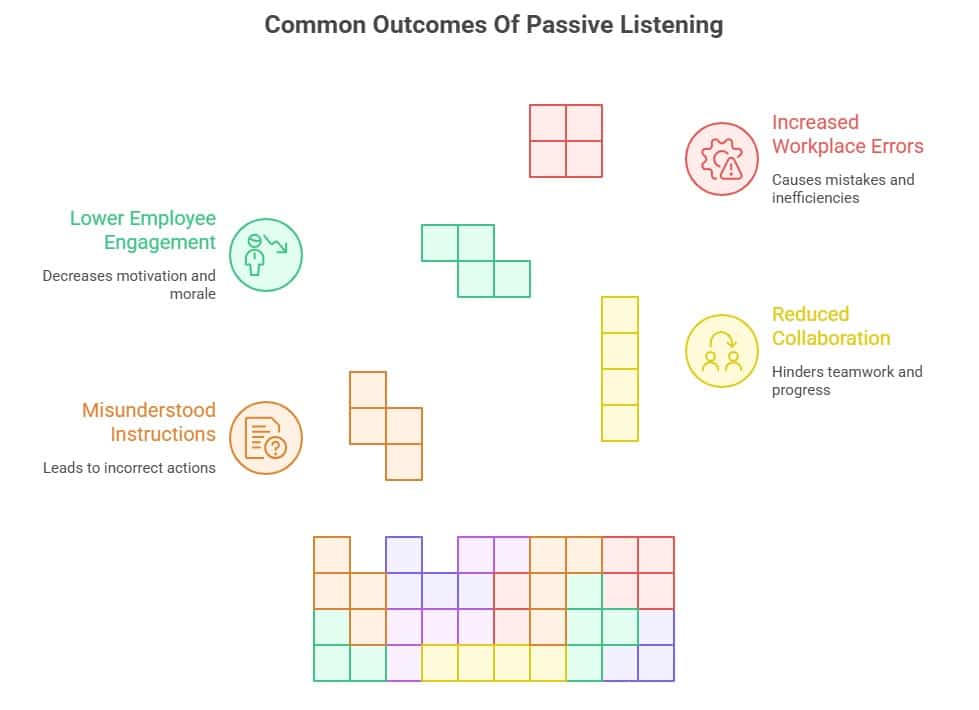
These outcomes demonstrate why leaders must actively encourage participation in discussions.
Effects of Passive Listening
Impact on Understanding
When passive listening dominates conversations, information retention decreases significantly. Without interaction, listeners may miss important details or fail to interpret context.
Impact on Relationships
Workplace relationships becomes weak when individuals feel unheard or ignored which ultimately decreases trust and connection.
Impact on Team Collaboration
Collaboration relies on active participation. Passive listening prevents teams from sharing ideas, solving problems collectively, and building consensus.
Modern tools like office chat platforms can solve these problems by enabling ongoing dialogue between team members.
How to Reduce Passive Listening?
Organizations can reduce it by creating communication environments that encourage participation.
Techniques for Better Engagement
Managers can improve engagement by encouraging discussion, inviting feedback, and creating opportunities for employees to contribute ideas.
Asking Better Questions
Open-ended questions encourage deeper thinking and interaction, helping listeners transition from passive to active participation.
Tools to Encourage Participation
Modern team communication apps enable employees to interact with messages, ask questions, and share ideas quickly. These tools make communication more dynamic and reduce the likelihood of passive listening.
How HubEngage Can Help You Listen to Your Employees?
HubEngage helps organizations reduce passive listening by creating an interactive communication environment where employees can actively participate in conversations.
Through a unified workforce experience platform, organizations can easily connect employees through announcements, surveys, feedback tools, and communication channels.
Employees can respond to messages, share feedback, and engage in discussions rather than simply receiving information. This helps leadership teams understand employee sentiment.
It becomes easy to ensure that communication becomes two‑way rather than one‑directional. Also, with measurable insights into engagement levels, making it easier to identify when communication becomes passive.
Conclusion
Effective communication is essential for modern organizations and with the help of team communication apps, they can improve communication by creating structured channels where employees can actively participate rather than passively consume information.
FAQs
What are the most common signs of passive listening?
Less or no feedback, less participation and less engagement during discussions are the most common signs you can easily see.
What is an example of passive listening in the workplace?
An employee in a meeting with no questions, feedback, and not giving proper instructions are some of the common examples in the workplace.
Why do people engage in passive listening?
People engage in passive listening because of less focus, low motivation, and communication environments which decrease their way of taking part in any discussion.
How is passive listening different from active listening?
Passive listening is about hearing information with no engagement. Whereas, active listening needs feedback, questions, and communication to make sure there is a good understanding.
Can passive listening be useful in any situation?
Yes, it can be useful in cases where the person just needs to get information without asking any question in between such as during a speech.
Related Links
team communication apps | instant messaging software | instant messaging for business | office chat | best team chat app