Active listening is one of the most overlooked yet powerful communication skills we see in the workplace and a foundational skill behind effective team communication apps. When people feel genuinely heard, trust increases, misunderstandings decrease, and collaboration improves across teams. In this article, we will explain the active listening meaning in practical terms, breaks down proven active listening techniques, and shares real-world active listening examples we regularly see applied in meetings, one-on-ones, and everyday workplace conversations. You will also learn how active listening supports stronger leadership, healthier workplace relationships, and more effective communication at scale.
Key Takeaways
-
Active listening enhances workplace communication by building trust, reducing misunderstandings, and improving collaboration outcomes.
-
It involves focused attention, empathy, clarification, and thoughtful responses to understand both message and intent.
-
Different listening types like critical, empathetic, and informational serve specific workplace communication needs effectively.
-
Practical techniques such as paraphrasing, asking questions, and avoiding interruptions significantly improve conversation quality.
-
Consistent active listening leads to higher employee engagement, faster conflict resolution, and better decision-making.
-
Combining real-time communication tools with structured feedback systems enables effective listening at organizational scale.
What Is Active Listening?
Active listening is the intentional and conscious process of fully concentrating on, understanding, and responding thoughtfully to what someone else is saying. Unlike passive hearing, where sound registers without engagement, active listening requires attention to both verbal and non-verbal cues, reflection, and feedback.
Harvard Business Review shows that employees who feel listened to are significantly more engaged and more likely to contribute ideas openly, which directly affects performance and retention, as outlined in its analysis on how listening drives results.
In practical terms, active listening means being fully present, resisting the urge to interrupt, and striving to understand both the message and the intent behind it. We see this show up most clearly in leadership conversations, performance discussions, and moments of change where clarity matters most.
This distinction matters in the workplace, where unclear communication is estimated to cost U.S. businesses hundreds of billions of dollars annually due to errors, rework, and lost productivity. Poor communication and low engagement directly contribute to these losses, reinforcing the link between listening, engagement, and business performance in its work.
Types of Active Listening
Active listening is not one-size-fits-all, and we see different listening styles surface depending on role, context, and urgency. It is one of the most critical leadership competencies for high-performing managers. Different workplace situations require different listening approaches, each serving a distinct purpose:
- Critical listening – Evaluating information to make decisions or assess risks, commonly used in leadership reviews and strategic discussions.
- Informational listening – Absorbing facts, instructions, or new knowledge, especially during onboarding or training sessions.
- Empathetic listening – Understanding emotions and perspectives, which is essential during feedback conversations, conflict resolution, and change management.
- Appreciative listening – Listening for encouragement or inspiration, often seen in recognition and team-building moments.
- Discriminative listening – Picking up on tone, pace, and non-verbal signals, which can reveal unspoken concerns.
| Type of Listening | Simple Meaning | Common Situations |
|---|---|---|
| Critical Listening | Evaluating information to make decisions or assess risks | Leadership reviews, strategic discussions |
| Informational Listening | Listening to understand facts, instructions, or knowledge | Onboarding, training sessions |
| Empathetic Listening | Understanding emotions and perspectives | Feedback talks, conflict resolution, change management |
| Appreciative Listening | Listening for motivation, encouragement, or inspiration | Recognition, team-building moments |
| Discriminative Listening | Noticing tone, pace, and non-verbal signals | Detecting unspoken concerns |
Key Components of Active Listening
Strong active listening is built on a set of foundational components that work together to create clarity and trust:
- Focused attention – Giving the speaker your full presence without distractions.
- Reflection – Paraphrasing or summarizing to confirm understanding and reduce misinterpretation.
- Clarification – Asking thoughtful questions to avoid assumptions and surface details early.
- Non-verbal cues – Eye contact, nodding, and open posture, which account for a large portion of perceived attentiveness.
- Intentional response – Responding with relevance, empathy, and respect rather than reacting emotionally.
Together, these components turn everyday conversations into productive exchanges that move work forward, especially in fast-paced environments where teams rely on clarity to stay aligned.
Essential Active Listening Techniques
Effective active listening techniques are practical behaviors that can be learned and applied consistently. These include pausing before responding, paraphrasing key points, asking open-ended questions, and acknowledging emotions explicitly.
Teams that regularly practice reflective listening experience fewer misunderstandings and faster conflict resolution, positioning listening as an underrated but high-impact skill. When practiced consistently, active listening techniques improve communication quality across teams and leadership levels.

Examples of Active Listening in Real Conversations
Team meeting example: A team member raises concerns about a project deadline. Instead of defending the plan, the manager responds, “It sounds like you’re worried the timeline doesn’t account for current workload. Is that right?” This confirms understanding and opens a constructive discussion.
One-on-one example: During a performance conversation, a leader listens without interrupting, summarizes the employee’s concerns, and asks follow-up questions. This approach reduces defensiveness and builds trust.
These active listening examples reflect situations we commonly see across teams, showing how small behavioral shifts can dramatically improve communication outcomes.
Benefits of Active Listening in the Workplace
From our experience working with growing and distributed teams, practicing active listening consistently delivers measurable business and people outcomes:
- Reduced misunderstandings and costly rework
- Higher employee satisfaction and engagement
- Stronger collaboration and trust
- Faster conflict resolution
- More effective decision-making
8 Powerful Active Listening Skills Every Professional Should Master
Maintain Full Attention During Conversations
Maintaining full attention means giving the speaker your undivided focus, both mentally and physically. This involves eliminating distractions such as notifications, multitasking, or side conversations, and intentionally staying present throughout the discussion. When people sense your attention is divided, trust and openness decline, even if the words you say are supportive.
Use Clarifying Questions to Reduce Miscommunication
Clarifying questions help ensure you understand the message before reacting or making decisions. By asking open-ended questions like “Can you help me understand that better?” or “What does success look like from your perspective?”, you reduce assumptions and prevent small misunderstandings from escalating into larger issues.
Practice Paraphrasing to Confirm Understanding
Paraphrasing involves restating what you heard in your own words to confirm alignment. This technique not only verifies accuracy but also signals respect and engagement. Simple phrases such as “What I’m hearing is…” or “Let me make sure I understand…” can significantly improve clarity in conversations.
Demonstrate Engagement Through Positive Body Language
Non-verbal cues play a major role in how messages are received. Eye contact, nodding, and an open posture reinforce that you are actively engaged. Even in virtual settings, facial expressions and posture communicate attentiveness and influence how comfortable others feel sharing openly.
Apply Empathy to Strengthen Workplace Relationships
Empathy in active listening means recognizing emotions alongside facts. Acknowledging how someone feels even when you may not agree, builds psychological safety and trust. Statements like “That sounds frustrating” or “I can see why that matters to you” help people feel understood and valued.
Avoid Interruptions to Encourage Open Dialogue
Interrupting can unintentionally signal impatience or dismissal. Allowing speakers to fully express their thoughts creates space for more honest dialogue and often reveals important context that would otherwise be missed. Pausing before responding also leads to more thoughtful and balanced conversations.
Provide Constructive and Timely Responses
Active listening does not end when the speaker finishes talking. Providing timely, relevant responses shows that their input was taken seriously. Constructive responses focus on solutions, next steps, or clarity rather than defensiveness or immediate judgment.
Recognize and Manage Bias to Improve Listening Accuracy
Everyone brings assumptions and biases into conversations, which can distort how messages are interpreted. Effective listeners actively check these biases by separating facts from opinions and seeking clarification when something challenges their expectations. This self-awareness leads to more accurate understanding and fairer communication.
How to Practice Active Listening Daily?
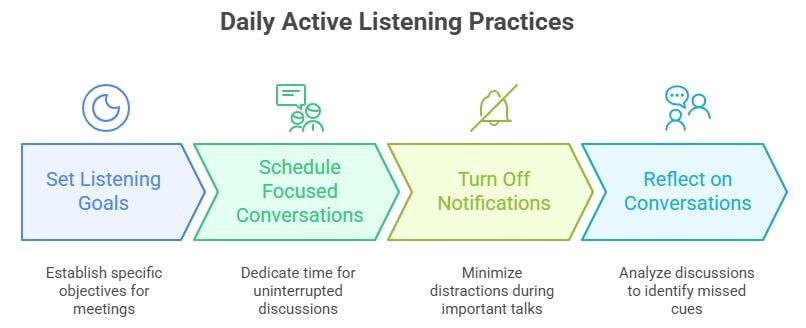
Active listening improves with intentional, repeatable habits. Small daily practices can make a significant difference:
- Set listening goals for meetings, such as summarizing before responding
- Schedule focused one-on-one conversations without multitasking
- Turn off notifications during important discussions
- Reflect on conversations afterward to identify missed cues
Common Barriers to Active Listening & Solutions
Even with the best intentions, active listening can break down due to common habits, environmental factors, or cognitive biases. Recognizing these barriers early helps individuals and teams take practical steps to improve listening quality and maintain consistent, productive communication.
| Barrier | Solution |
|---|---|
| Distractions | Remove devices and reduce interruptions |
| Impatience | Pause and listen without planning your response |
| Bias | Question assumptions and seek clarity |
| Multitasking | Focus on one conversation at a time |
Addressing these barriers is essential for improving listening consistency across teams.
Active Listening vs Effective Communication
Active listening is a core pillar of effective communication. While communication includes speaking and writing, listening ensures messages are understood correctly. Without active listening, even well-crafted messages can lead to confusion or conflict.
Teams with strong listening cultures reported higher trust, faster decision-making, and stronger engagement during periods of change, reinforcing the role of listening as a strategic capability rather than a soft skill.
Active Listening In Remote & Hybrid Work Settings
In our experience, remote and hybrid teams feel the impact of poor listening even faster than co-located teams because context and tone are easier to miss.
Remote and hybrid work environments introduce new challenges for active listening, including digital distractions, delayed responses, and reduced non-verbal cues. Without intentional listening, messages can easily be misinterpreted.
Meeting overload and digital fatigue significantly reduce attention spans in virtual settings. Video calls, intentional pauses, and structured turn-taking can help maintain listening quality.
Digital tools such as team communication apps and instant messaging software support real-time collaboration, but strong listening habits remain essential even in text-based communication. In practice, teams that complement chat with regular surveys tend to capture more balanced and honest feedback.
Active Listening Examples
- Repeating a colleague’s concern before proposing a solution
- Asking clarifying questions during project updates
- Validating emotions during difficult conversations
These active listening examples demonstrate how listening drives clarity and trust.
How HubEngage Enables Active Listening at Scale?
Active listening does not happen in a single channel. In our experience, it happens best when organizations combine real-time conversation with structured opportunities for employees to share input thoughtfully.
Instant messaging and chat tools play an important role in day-to-day listening. They enable quick clarification, immediate feedback, and ongoing dialogue. Using the method of instant messaging for business, teams can respond in the moment, ask follow-up questions, and keep conversations moving without unnecessary delays.
However, we consistently see deeper, more honest listening emerge through structured feedback through employee survey tools. Surveys give employees the space to reflect, share perspectives without interruption, and provide input they may not feel comfortable raising in live conversations. This makes surveys especially powerful for understanding sentiment, trust, and engagement at scale.
HubEngage offers the best team chat app which brings these approaches together in one platform, allowing organizations to listen in real time through chat and listen at scale through surveys and feedback loops. By reducing communication silos and improving visibility, teams gain a more complete picture of what employees are saying, feeling, and needing. Having this balanced approach often leads to fewer escalations, clearer expectations, and more confident employee participation.
Conclusion:
Active listening does not happen in a single channel. In our experience, it happens best when organizations combine real-time conversation with structured opportunities for employees to share input thoughtfully. It is a simple yet powerful skill that strengthens workplace communication.
By paying full attention, asking questions, and responding thoughtfully, teams can reduce misunderstandings and build stronger relationships. Organizations that encourage listening create more engaged employees, healthier workplace conversations, and better teamwork across both in-person and remote environments.
Ready to see how this works in practice? Book a personalized HubEngage demo to explore how unified communication, employee surveys, and real-time feedback tools help your teams listen better, communicate clearly, and stay aligned no matter where they work.
FAQs
Is it better to use employee surveys or chat tools for active listening?
Both play an important role, but they serve different listening needs. Using tools like office chat can support real-time clarification and dialogue, while employee surveys provide space for reflection and more candid input. In our experience, organizations get the best listening outcomes when they combine both approaches rather than relying on a single channel.
What is active listening and why is it important in the workplace?
Active listening is the practice of fully engaging with what others are saying to understand both meaning and intent, rather than simply waiting to respond. In the workplace, it plays a critical role in building trust, reducing miscommunication, and ensuring employees feel valued and heard. Strong active listening supports better collaboration, faster decision-making, and healthier working relationships across teams.
What are the core skills that make someone an active listener?
The core skills of an active listener include focused attention, empathy, reflection, clarification, and thoughtful response. Together, these skills help individuals accurately understand messages, acknowledge emotions, and respond in a way that moves conversations forward rather than creating confusion or conflict.
How does active listening improve team communication and collaboration?
Active listening improves team communication by reducing misunderstandings and encouraging open, respectful dialogue. When team members feel heard, they are more likely to share ideas, raise concerns early, and align quickly around shared goals. This leads to stronger collaboration and more effective teamwork.
How can I practice active listening effectively during meetings?
You can practice active listening during meetings by eliminating distractions, maintaining eye contact, and resisting the urge to multitask. Summarizing key points, asking clarifying questions, and inviting others to share their perspectives also help ensure understanding and participation.
What common mistakes should I avoid when trying to listen actively?
Common mistakes include interrupting, multitasking, making assumptions, or mentally preparing a response before the speaker finishes. These habits signal disengagement and can cause important details or emotions to be missed, weakening communication overall.
How does active listening help resolve workplace conflicts?
Active listening helps resolve conflicts by surfacing underlying concerns and emotions that may not be immediately obvious. By acknowledging different perspectives and confirming understanding, it reduces defensiveness and creates space for constructive problem-solving.
Can active listening improve leadership and manager–employee relationships?
Yes. Leaders who practice active listening are seen as more trustworthy, inclusive, and supportive. This strengthens manager–employee relationships, increases psychological safety, and encourages employees to share feedback, ideas, and concerns more openly.
What is the difference between passive listening and active listening?
Passive listening involves hearing words without fully engaging with their meaning or intent. Active listening, on the other hand, requires attention, reflection, and response, ensuring that messages are understood accurately and thoughtfully.
How does active listening contribute to higher employee engagement and trust?
When employees feel genuinely listened to, they are more likely to trust leadership and feel connected to their work. Gallup research shows that employees who feel heard and engage more are more likely to feel empowered to perform well and has less turnover rate.
Does active listening really impact employee engagement?
Yes active listening has a direct and measurable impact on engagement because it signals respect, inclusion, and psychological safety. When leaders and peers listen attentively, employees are more willing to share ideas, raise concerns early, and participate fully in collaboration. This is one reason effective listening is closely tied to strong engagement scores and healthier workplace cultures.
How can active listening improve communication across teams?
Active listening improves communication across teams by ensuring messages are understood clearly and consistently, especially in fast-paced or hybrid environments. When supported by the right tools, such as modern team communication apps, active listening helps teams reduce friction, stay aligned, and collaborate more effectively.
Related Links:
Team Communication Software | Instant Messaging Software | Instant Messaging For Business | Office Chat | Best Team Chat App | Alternatives To Google Chat | Instant Messaging Vs Email