Hospital Communications: Connecting The Modern Healthcare Workforce
Walk through any hospital and you will notice a familiar pattern across departments and nursing stations. Staff are trying to reach colleagues through outdated channels, important updates are shared on notice boards that go unread, and new employees often struggle to find the right information quickly.
In such a place, even a small delay in communication can create confusion and disrupt care delivery. This reflects a broader issue in hospital communications today.
Many systems were not built for dynamic, shift-based environments, where timely and accurate information sharing is critical. When communication breaks down, it affects not only coordination but also patient safety, staff experience, compliance, and overall operational efficiency.
As healthcare organizations evolve, there is a growing need for an employee communication platform that is easy to access, real-time, and designed for frontline workers.
In this article we will see the common gaps in existing communication approaches and what hospitals need to build a more connected, informed, and responsive workforce.
Key Takeaways
- Hospital communications directly impact patient safety, staff coordination, and operational efficiency.
- Legacy systems like pagers and desktop intranets fail to support today’s mobile, and shift-based workforce.
- Modern hospital communication systems must be mobile-first, real-time, and multi-channel.
- Frontline healthcare workers need instant access to updates without relying on desktops or email.
- Centralized platforms reduce communication silos and improve cross-department collaboration.
- Investing in hospital communication technology helps hospitals deliver better care and improve workforce experience.
The Communication gap in hospitals today
Despite advancements in medical technology, many hospitals still struggle with fragmented communication.
According to the National Library of Medicine, communication failures are a leading root cause in over 70% of sentinel events in healthcare. Hence, there is an urgent need for modern, reliable hospital communication systems.
The reality is that most hospital communication systems were not designed for today’s mobile, shift-based workforce. This gap leads to delays, confusion, and inefficiencies that ultimately affect patient care.
Why Hospital Workforces are often disconnected?
Shift-Based Work and Rotating Schedules
Healthcare workers operate across multiple shifts, often with little overlap. This makes it difficult to ensure consistent messaging and alignment across teams.
Limited Access to Desktop Systems
Frontline workers like nurses, technicians, and support staff rarely sit at desks. Traditional intranets and email systems fail to reach them effectively.
Communication Silos Between Departments
Departments like ER, radiology, and administration often use separate systems, creating silos that hinder collaboration.
Reliance on Legacy Communication Systems
Many hospitals still depend on pagers, bulletin boards, or outdated intranet portals, which are inefficient and difficult to scale.
Common Communication Challenges in Hospitals
Large Hospitals Using Desktop-Only Intranets
Desktop-centric intranets limit access for frontline staff, reducing engagement and awareness.
Limitations of SharePoint-Based Hospital Intranets
While widely used, SharePoint often lacks mobile-first design and real-time communication capabilities required in healthcare environments.
EMR Systems Being Used for Staff Communication
Electronic Medical Records (EMRs) are not designed for internal communication, yet many hospitals rely on them for updates leading to inefficiencies.
Lack of Communication Infrastructure in Smaller Hospitals
Community hospitals often lack the budget or IT resources to implement robust hospital communication tools, leaving staff disconnected.
Key Features of Effective Hospital Communication Software which HubEngage Offers
HubEngage offers a modern internal communications app as a part of its employee experience platform, helping hospitals streamline communication across clinical and non-clinical teams. It unifies top-down communication, peer engagement, and real-time messaging to ensure staff stay informed, aligned, and connected across departments, shifts, and care settings.
Designed for hospital workflows, HubEngage enables targeted announcements, personalized updates, and interactive social feeds, while supporting instant communication through messaging, group chats, and collaboration channels. This ensures that critical hospital updates and everyday coordination happen seamlessly in one place, reducing silos and improving cross-functional collaboration.
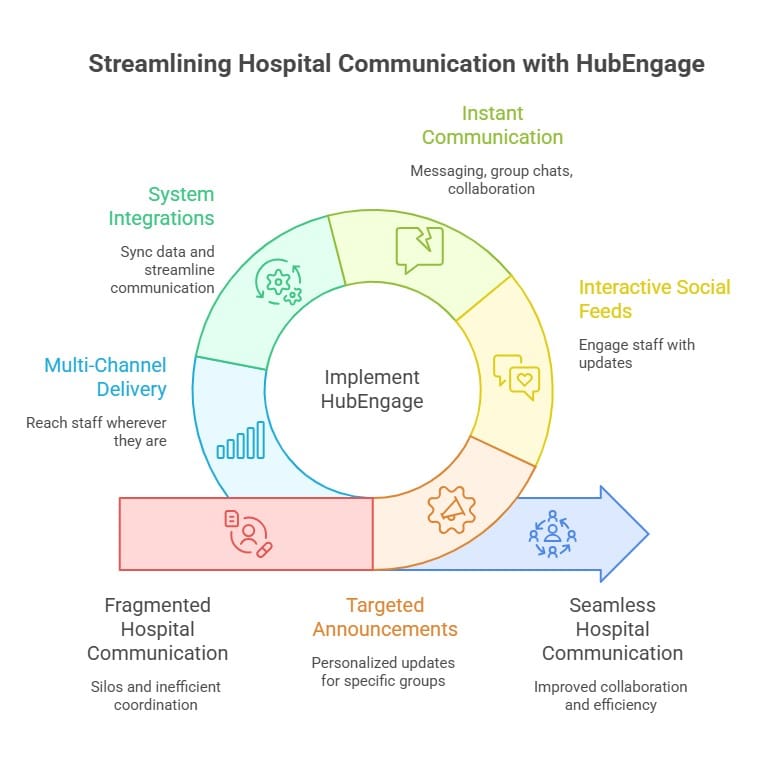
With integrations into HRIS, scheduling, and enterprise systems, along with secure SSO access, HubEngage keeps workforce data synced and communication streamlined. It also delivers messages through mobile apps, web, SMS, email, and workplace tools, ensuring frontline healthcare workers receive timely updates wherever they are on duty.
Built with enterprise-grade security and compliance standards such as SOC 2, ISO 27001, GDPR, and HIPAA, HubEngage is ideal for hospitals. It can be extended with modules like intranet, recognition, surveys, and AI-powered assistants, enabling hospitals to unify communication, engagement, and collaboration at scale for better patient care outcomes.
Mobile-First Access for Frontline Healthcare Workers
Modern hospital communication software must be mobile-first, ensuring that staff can access updates anytime, anywhere.
Multi-Channel Communication Including SMS
From push notifications to SMS and email, multi-channel delivery ensures messages reach every employee. This is especially critical during crisis communications scenarios.
Role-Based and Department-Based Messaging
Targeted messaging ensures relevance, reducing noise and increasing engagement.
Secure and Compliant Messaging
Healthcare communication must meet strict compliance standards such as HIPAA, ensuring patient data and internal messages remain secure.
Centralized Digital Hub for Hospital Updates
A unified platform acts as a single source of truth, consolidating announcements, schedules, and resources.
How Hospital Communication Technology Supports Frontline Workers?
Instant Updates for Nurses and Clinical Staff
Real-time alerts ensure nurses and clinical staff receive critical updates the moment they are issued. Whether it’s patient status changes, emergency codes, or policy updates, timely communication reduces response delays, improves care coordination, and helps teams act with confidence in high-pressure healthcare environments.
Access to Important Information Without Desktop Access
Mobile-first platforms allow frontline workers to access schedules, policies, and announcements without relying on shared or limited desktop systems. This flexibility ensures that staff remain informed during shifts, breaks, or while moving across departments, ultimately improving engagement and reducing communication gaps across the workforce.
Faster Coordination During Operational Changes
During shift adjustments, emergencies, or organizational changes, seamless communication is essential. Modern hospital communication technology enables instant updates across departments, ensuring everyone is aligned. This reduces confusion, minimizes disruptions, and allows healthcare teams to adapt quickly while maintaining continuity in patient care delivery.
| Use Case | Communication Need | Recommended Approach |
| Nurse alerts | Real-time patient updates | Mobile push notifications |
| Shift changes | Instant schedule updates | SMS + in-app alerts |
| Cross-department coordination | Fast information sharing | Role-based messaging |
| Policy updates | Easy access to documents | Centralized digital hub |
| Emergency response | Rapid broadcast communication | Multi-channel alerts |
The Future of Hospital Communications
The future lies in integrated, intelligent systems that combine AI, mobile accessibility, and data-driven insights.
Hospitals adopting modern internal communications examples will be better equipped to handle workforce challenges and improve patient outcomes.
Digital transformation in healthcare can significantly improve operational efficiency and patient satisfaction, making communication a key focus area.
Conclusion
Modernizing hospital communications is not just about technology it is about enabling better care, improving employee experience, and driving operational excellence.
With the right strategy and tools, hospitals can create a connected, informed, and empowered workforce.
Explore HubEngage with a quick demo to improve hospital communication and workforce connectivity.
Hospital Communications FAQs
How can hospitals communicate with frontline workers who do not have email access?
Hospitals can use mobile apps, SMS alerts, and push notifications to reach employees without email access.
Why are traditional intranet systems difficult for hospital staff to use?
They are often desktop type, not mobile-friendly, and lack real-time communication capabilities.
How can hospitals keep staff informed about schedule changes in real time?
By using modern hospital communication tools with real-time notifications and scheduling integration.
What role does mobile technology play in hospital communication?
Mobile technology enables instant, on-the-go access to updates, making it essential for frontline workers.
How can hospitals deliver updates to employees across multiple departments and shifts?
Through role-based messaging and multi-channel communication strategies.
What challenges do community hospitals face with internal communication systems?
Limited budgets, lack of IT infrastructure, and reliance on outdated systems are common challenges.
Related Links:
employee communication platform | crisis communications | Internal communication examples