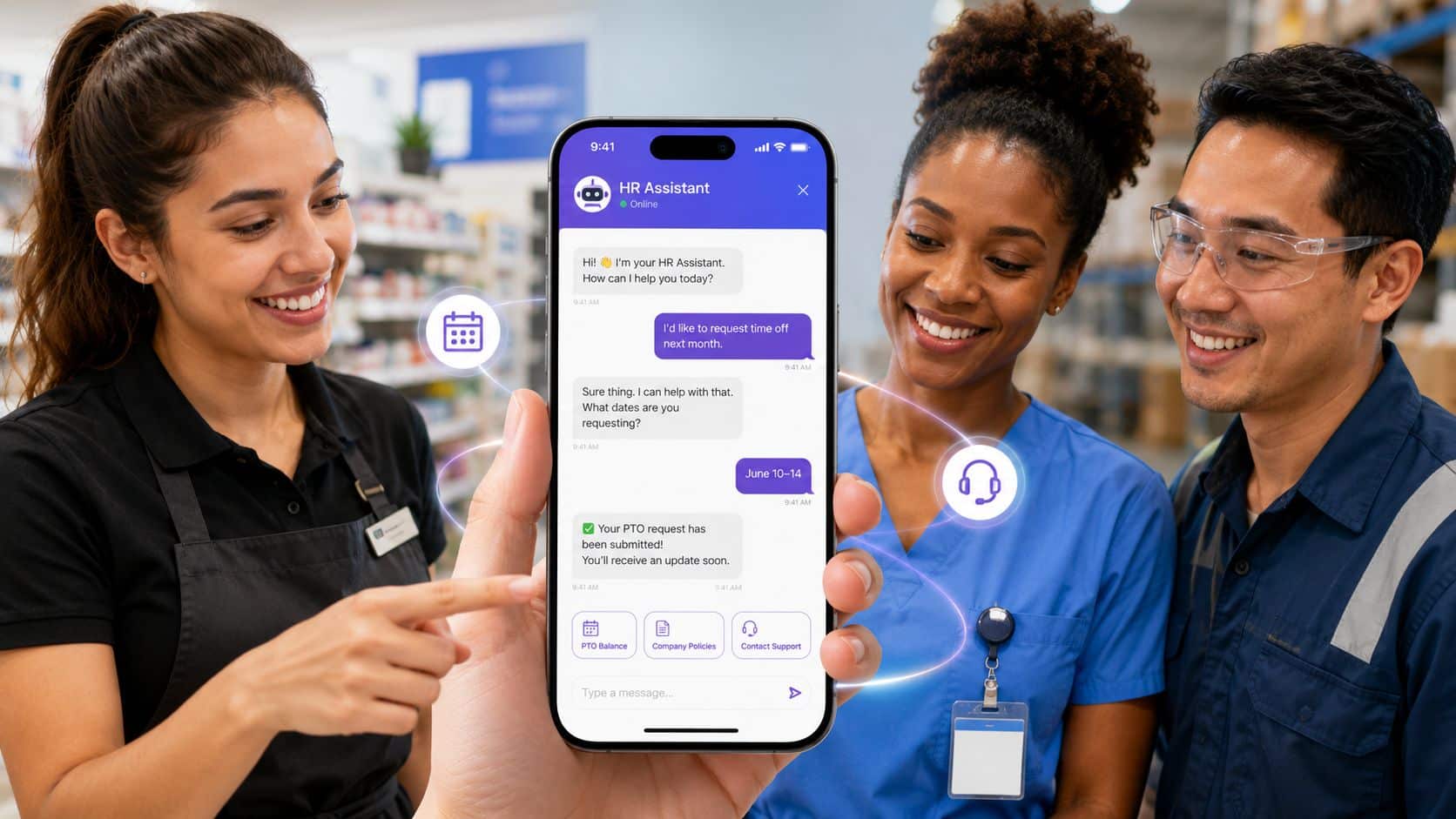
A late-shift employee needs to check the PTO policy before swapping a weekend shift. Their manager is offline. HR has gone home. The handbook sits somewhere in a shared drive that doesn’t load well on a phone, and the employee isn’t sure which version is current anyway.
That’s the support gap many organizations are having at present. For distributed, frontline, hourly, and deskless workforces, employee support can’t depend on email, office hours, or whoever happens to answer first. People need help in the moment, on the device they already have, in language they can understand.
That’s why the HR helpdesk chatbot matters. Not as a novelty, and not just as a ticket deflection tool, but as an always-available support layer that gives employees a trusted place to ask, find, and act.
If you’re already thinking about broader employee experience and self-service then, a hr chatbot sits naturally supports your internal communications, knowledge management, onboarding, and mobile workforce strategy. Our blog will cover why chatbots are helpful for organizations especially frontline and distributed teams.
Key Takeaways
- An HR helpdesk chatbot should make access easy. The biggest benefit for distributed teams is steady support during daily work.
- Mobile-first self-service is important. Frontline and deskless employees often need answers when HR and managers are not available.
- Content quality drives success. A chatbot is only as helpful as the policies, FAQs, forms, and workflows behind it.
- The best bots link systems than just answering questions. They guide people to resources, start tasks, and send sensitive issues to the right place.
- Chatbot data helps HR workflow get better. Common questions often show where policies, onboarding, and manager communication need improvement.
Why Traditional HR support fails a distributed workforce?
Traditional HR support often grows by fixing problems one by one. Emails increase, managers answer more, and policies pile up. For distributed teams, this creates confusion, leaving employees unsure where to go and HR handling everything. For example, a warehouse worker asks about attendance after an emergency, or a new restaurant employee needs onboarding help. These are common questions, that traditional HR support often fails.

Many small businesses and remote teams spend too much time answering repeated HR questions like PTO, pay, and benefits. Information is scattered, so employees struggle to find answers. They need quick, easy access anytime, or support feels unavailable. That’s one reason chatbot adoption keeps rising across business functions.
The rise of HR Helpdesk Chatbots
As per Grand View Research, the global chatbot market reached USD 9.6 billion in 2025 and is projected to grow from USD 11.8 billion in 2026 to USD 41.2 billion by 2033. This shows how organizations are using AI assistants to support employees across distributed environments.
An HR helpdesk chatbot works best when it becomes the front door to approved answers. It can also reinforce larger HR priorities. A simple mobile access strategy can fix this and so companies that invest in these generally see stronger reach across distributed workforces. The support channel has to meet people where they already are.
From Q&A Bot to an Intelligent Employee Support Layer
A modern HR chatbot is more than a FAQ page. It helps employees find answers and complete tasks. It understands simple language, uses trusted information, and can pass questions to a human when needed.

How AI-driven hr chatbots changes the Employee Experience?
A hr helpdesk chatbot becomes more valuable when it connects knowledge, communications, onboarding, learning, and workflow tools. Employees don’t care which system holds the answer. They care whether they can get it in one place.
| Support need | Basic bot | Intelligent support layer |
|---|---|---|
| Policy question | Returns a generic FAQ | Finds the approved policy section and explains it clearly |
| Leave request | Points to a form | Guides the employee to the correct workflow or system action |
| Onboarding help | Shares a checklist link | Responds to “what do I do next?” with role-relevant next steps |
| Sensitive issue | Gives a dead-end answer | Escalates to HR or a manager with context |
This is the reason why AI support works well alongside enterprise search and knowledge discovery. The chatbot becomes the friendly front end for information that already exists across multiple systems.
How to build a smart HR Helpdesk Chatbot with knowledge base framework?
The hardest part of launching an HR chatbot is not integration. It is preparing content. HR information is often scattered across many places, which can lead to unclear and inconsistent answers. Let us see how hr chatbot rollout is done.

1. Find out information sources
Start by reviewing all HR information. Collect policies, guides, and forms. Remove outdated or duplicate files. Assign a responsible owner for each topic to keep information accurate and updated.
2. Build for real employee questions
After cleanup, group content by common employee questions, like time off, pay, policies, onboarding, and contacts. Involve managers and employees early. For sensitive topics, consult an employment attorney before sharing self-service content.
3. Keep updating knowledge base
A small, clear library is better than a big one. Share only approved, current, easy content. Build a simple knowledge base first to avoid confusion when using a chatbot.
Teams that need a stronger foundation often start by building an internal knowledge base before expanding chatbot scope. That approach usually reduces confusion during launch because the bot has fewer conflicting places to pull from.
HR Helpdesk Chatbot use cases for Distributed Team
The value of an HR helpdesk chatbot shows up in our daily lives instead of demos. Below are the practical examples of these chatbots:

- After-hours PTO
An hourly worker asks about time off and call-out rules at night. The bot gives clear policy answers on their phone, so they do not wait. - Day one help
A new hire asks what to do next. The bot shows steps, forms, and contacts. Many HR teams guide new staff to bots for quick information. - Payroll help
An employee sees a payslip issue and asks about a deduction. The bot explains it or shares the right payroll contact if a review is needed. - Manager policy check
A site manager needs the weather closure rule during a storm. The bot gives the latest approved policy fast, without searching emails or calling HR.
These examples show that frequent questions cause problems for HR and employees. Hence, in such cases, using a hr helpdesk chatbot is a great help to employees.
HubEngage AI Chatbot for Distributed Teams
Having a connected platform like HubEngage makes support quick and complete by bringing communication, engagement, operations, and learning into one place.
Our AI-powered chatbot pulls trusted content from HR systems, websites, knowledge bases, learning platforms, SharePoint, Google Drive, and other sources to deliver fast, relevant answers on desktop and mobile at any time they need.
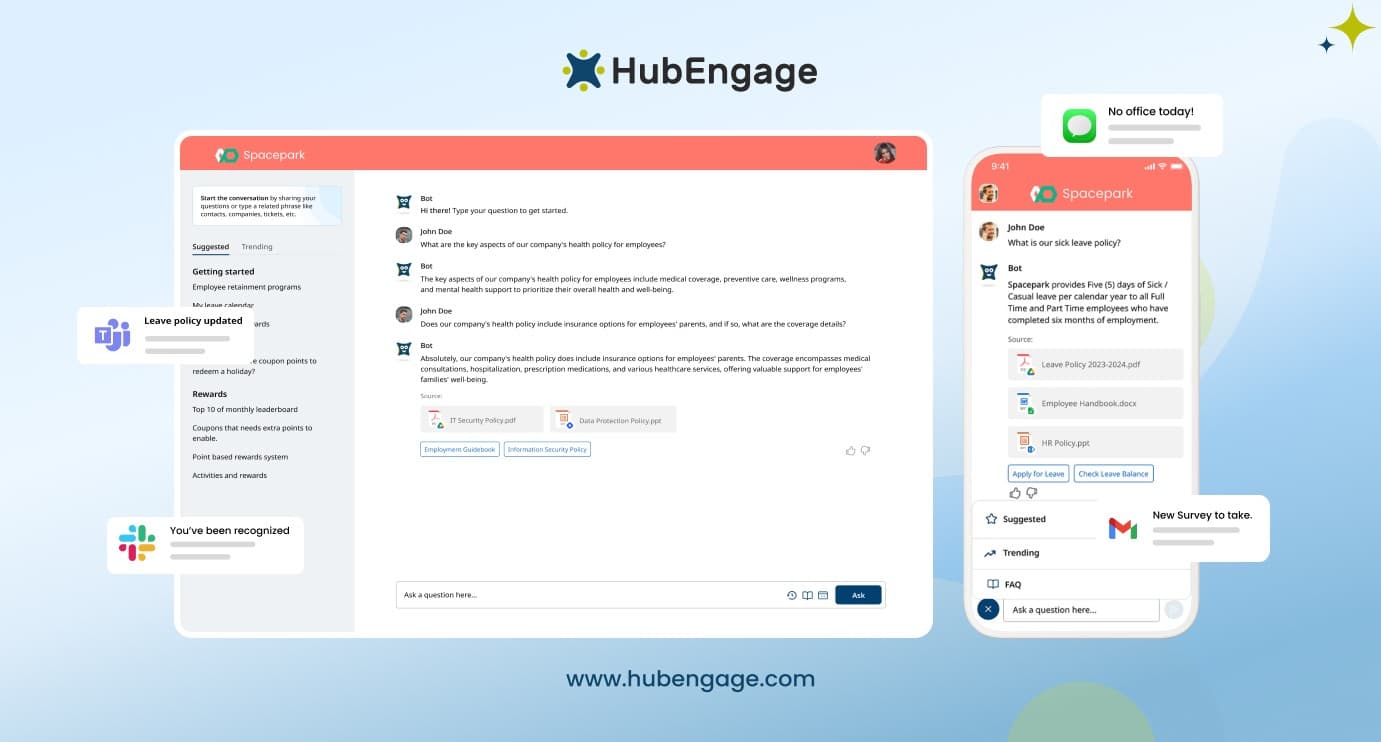
The HR helpdesk chatbot supports multiple languages, follow-up questions, secure access, and actions such as requesting leave, filing tickets, or submitting forms. It works as a standalone tool or inside website and apps.
See simple reports on top users, locations, and departments. View popular sources, questions, and topics. Spot gaps in your data and improve communication. While ISO 27001, SOC 2, HIPAA, GDPR, encryption, and role-based controls help protect data across frontline and distributed teams.
Conclusion
An HR helpdesk chatbot gives employees faster, more reliable support while reducing repetitive work for HR teams. Its real value comes from combining accurate knowledge, mobile access, workflow guidance, and clear human escalation.
If you’re evaluating ways to support your distributed workforce without adding more manual HR load then, HubEngage offers a practical way to bring AI-powered self-service, communications, knowledge access, and workforce engagement into one employee experience platform. If you want to see how that works in practice, you can get a demo and see the platform in action.
FAQs related to HR Helpdesk Chatbot
Is an HR helpdesk chatbot only useful for large enterprises?
No. SMBs often benefit quickly because small HR teams feel repetitive work more sharply. If the same policy and payroll questions keep interrupting HR, a chatbot gives employees a simpler self-service path.
What questions should a chatbot handle first?
Start with routine, repeatable topics. Time off, attendance, payroll basics, benefits questions, onboarding steps, and policy lookups are usually the strongest first candidates.
How do you keep answers accurate?
Use approved HR content only. Remove duplicates, assign content owners, review updates regularly, and test common employee questions before launch. Accuracy depends more on source quality than on bot features.
What should never be fully automated?
Sensitive matters need a human path. Employee relations concerns, harassment reports, grievances, complex accommodation issues, and emotionally charged cases should escalate clearly and quickly.
Can employees use an HR chatbot in the tools they already know?
Yes, if you deploy it where people already work. Chatbots are far more useful when employees can access them through mobile, intranet, messaging, or collaboration channels instead of hunting for a separate portal.
Related Links
AI-powered chatbot | chatbot for internal employees | hr chatbots | enterprise search and knowledge discovery | internal knowledge base |