The increase in use of social intranet software clearly shows today’s change from simple portals to more active and engagement powered digital workplaces. Unlike present intranets which are generally one-way, and have many documents, modern social intranet platforms have a mix of the social media context with enterprise-grade functions to connect people well and make an active community.
With social feeds, team recognition, and smooth communication, they can change the way teams work together, especially in hybrid and remote places. Also, these platforms work well with young people or the new age workforce. Almost 49% of Gen Z employees choose instant messaging over email at work, and generally communicate with emojis, GIFs, and informal tone.
Social intranets are made to improve with time in which users will get a new way to communicate. In this guide, we will tell how these solutions will completely change employee engagement. Also check our intranet software guide to get a deeper understanding of these solutions.
What Is a Social Intranet?
A social intranet is a private internal tool that not only gives news and documents but also goes along with social media-style communication like feeds, commenting, tagging, and peer recognition.
Its goal is to fill in the gaps, increase engagement, and create a culture between the departments, campuses, and time zones.
Unlike traditional intranets which are a one way system, social intranets give a two way system with participation, content creation, and real-time interaction, making them the right place for real connections and communication.
👉 You can check out our blog which tells more about driving effective intranet communications.
Why Social Intranet Platforms Matter?
We think, a Social intranet software makes a workplace better in following ways:
- Boosts engagement and retention by bringing everyone as a team, giving recognition, and voice.
- Improves company culture by making the team fell connected no matter where employees work.
- Breaks down long message line up with two-way chats, file sharing, and community tagging that makes decision making simple.
- Improves productivity and knowledge sharing with smart search, easy file sharing, and making a single tool which saves a lot of time.
- Better impact: Gallup report shows that a team with high engagement can increase profits by up to 23%
Key Features of Social Intranet Software
A modern intranet platform typically has following features like Deep Integrations, Dynamic Social Feeds, Peer Recognition Systems, Groups/Communities, Employee Profiles, Interactive Comments, Tagging and Deep Integrations which boosts team engagement:
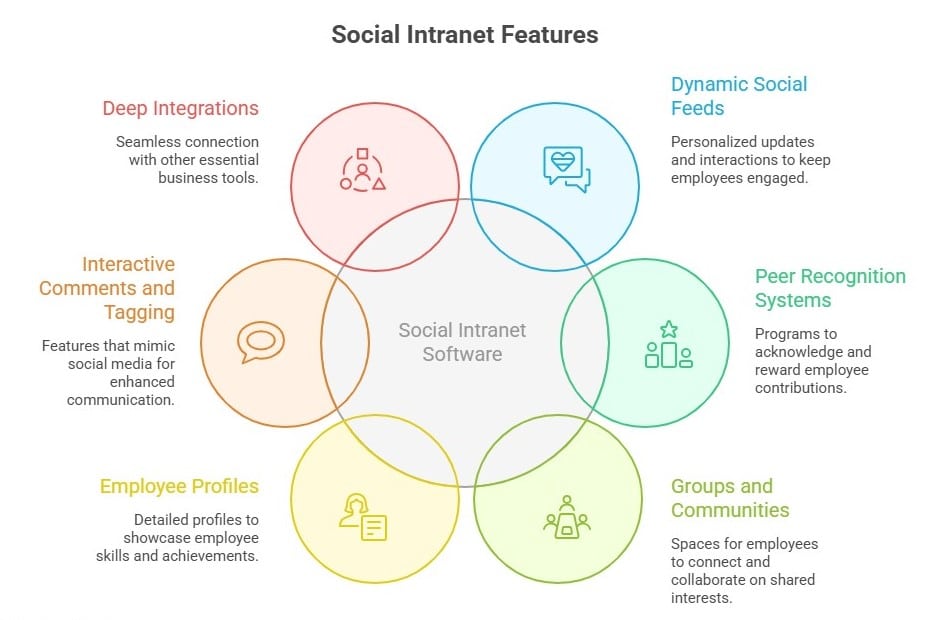
👉 Explore these features in more detail on our blog about HubEngage’s employee intranet platform.
How is a social intranet different from a traditional intranet?
We have seen people get confused by thinking social intranet and traditional intranet as the same. Below we have shown how they are different from each other.
| Feature / Metric | Traditional Intranet | Social Intranet |
|---|---|---|
| Content Flow | Top-down announcements only | Two-way, employee-generated & interactive |
| Engagement | Passive; low adoption | High; designed for participation and feedback |
| Culture & Recognition | Minimal/hidden | Visible peer recognition and community building |
| Tool Integration | Standalone or legacy integrations | Deep, seamless with collaboration & comms tools |
| Search & Navigation | Often inefficient, scattered content | Unified, intuitive, faster to find what’s needed |
| Updates & Upgrades | Slow, resource-heavy | Frequent, agile, future-proof |
| Technology Requirement | Primarily managed by IT | Co-owned by IT + Communications for strategy & adoption |
With social intranet platforms, your workspace becomes more than just a resource library by becoming a living as well as evolving network . Old systems may store documents, but social intranet software improves the culture by making it more user friendly. Employees like using these platforms because they work the way modern teams want to.
How to choose the right Intranet Platform?
Before choosing the right platform, we suggest you to always look for some factors such as engagement tools, mobile user experience, integrations, analytics, ease of use and Governance for better evaluation:

Top-5 Social Intranet Platforms:
Below are the five most popular social intranet apps that you can use in your organization:
| Platform |
Key Strength Summary |
| Workvivo | Known for strong emotional engagement and ease of use, but lacks advanced omnichannel communication capabilities. |
| HubEngage | Combines social intranet, recognition, multi-channel communication, gamification, and ROI-driven analytics into one unified platform, eliminating the need for multiple tools. |
| Staffbase | Excels in broad enterprise communication including email, mobile apps, and push alerts, making it ideal for organizations with diverse communication needs. |
| Simpplr | Recognized as a leader by Gartner, Forrester, and G2 for strong feature completeness and consistent execution. |
| Unily | Offers a highly customizable employee experience platform with strong personalization and engagement capabilities. |
👉 Learn more about broader intranet providers if you’re evaluating vendors.
Social Intranet Platform By HubEngage
When internal communication and employee engagement fall short, organizations need a modern solution that connects people, content, and culture in one place.
HubEngage’s Social Intranet solves this by blending social connectivity with communication, recognition, surveys, messaging, and analytics into a unified platform accessed via web, mobile, email, SMS, and signage. Its modular design lets you tailor tools to your needs while reducing tool fragmentation and improving adoption across teams.
Social Intranet Features in HubEngage
- Interactive Social Feed: Employees share updates, ideas, media, and engage in conversations that foster collaboration.
- Recognition & Rewards: Built-in programs incentivize participation through points, badges, and gift card rewards.
- Multi-Channel Reach: Publish announcements across intranet, mobile app, email, SMS, and digital displays with one click.
- AI-Powered Tools: Smart content creation, search, and analytics enhance engagement and reveal actionable insights.
- Surveys & Feedback: Pulse surveys and forms gather sentiment and help refine communication strategies.
Check out this review by Ramana D which proves HubEngage’s ability to unify communication and engagement, turning a static intranet into a vibrant digital workplace.
Since we started using HubEngage, our internal communication has improved a lot. Updates are easy to share, and employees can really engage with them. We have seen more activity and positive response from teams, which has helped everyone stay connected. The mobile app and push notifications are very useful because employees get updates quickly without depending too much on email. I also like the option to edit content and track engagement from analytics. Another plus point is their customer support team who are always active and quickly respond with great helpful. Overall, HubEngage has made communication in our organization much smoother and more effective.
Ready to see the difference? Book a demo with HubEngage and compare firsthand.
💡 Proof Point: One HubEngage client in hospitality saw its internal survey participation rise by 45% after launching a social intranet, alongside a measurable uplift in Glassdoor ratings. Case studies like these show real ROI.
💡 Proof Point 2: A manufacturing client reduced onboarding time by 30% after adopting HubEngage’s social intranet solution, demonstrating clear business impact beyond engagement.
Real-World Use Cases
Here’s how social intranet platforms play out in practice:
- Peer Recognition Campaigns — Employees give public shout-outs that boost morale and visibility.
- Idea-Sharing Forums — Cross-departmental innovation thrives when teams share suggestions in dedicated groups.
- Project Collaboration Spaces — Teams use group feeds to share files, update statuses, and comment in real time.
- Onboarding Communities — New hires find peer support through welcome groups and searchable knowledge hubs.
👉 See best intranet websites and examples for inspiration.
The Future of Work with Social Intranet
These platforms are rapidly evolving with:
- AI-powered personalization: customized feeds, smart content suggestions
- Smart tagging and micro-learning, delivering bite-size resources to the right people
- Embedded video, real-time collaboration, and live events for richer engagement
Unlike legacy intranets that stagnate, social intranet software is designed to evolve—keeping pace with generational shifts, new workstyles, and AI-driven personalization.
👉 Learn more about AI powered intranet workplaces.
Conclusion:
Social intranet platforms are transforming digital workplaces making them vibrant, inclusive, and collaborative. By offering conversation, recognition, and intuitive tools, they elevate engagement, productivity, and culture. Let HubEngage help you deliver that modern experience. Discover our employee intranet platform today.
FAQs
How does a Social Intranet improve employee engagement?
A Social Intranet improves engagement by giving employees a voice through comments, likes, discussions, and recognition features. It encourages open communication, increases transparency, and builds stronger workplace relationships. By making information accessible and interactive, employees feel more connected, informed, and involved in company initiatives.
Why is a Social Intranet important for remote and hybrid teams?
A Social Intranet centralizes communication and collaboration for distributed teams. It ensures remote employees have equal access to company news, documents, and discussions. By supporting real-time interaction and knowledge sharing, it reduces isolation, improves alignment, and maintains company culture regardless of location.
Can a Social Intranet integrate with other workplace tools?
Yes, modern Social Intranets integrate with tools like Microsoft 365, Google Workspace, Slack, HR systems, and project management platforms. These integrations streamline workflows by centralizing notifications, documents, and tasks. Employees can access multiple tools within a unified digital workplace environment.
How to successfully implement a Social Intranet?
Successful implementation requires clear goals, leadership support, employee training, and ongoing engagement strategies. Organizations should gather employee feedback, promote adoption through internal campaigns, and regularly update content. Measuring usage analytics helps refine the platform and ensure it delivers long-term business value.
What problems does a Social Intranet solve?
A Social Intranet eliminates information silos, reduces email overload, and improves cross-department communication. It centralizes company knowledge, streamlines collaboration, and enhances transparency. By creating a shared digital workspace, organizations reduce confusion, improve productivity, and ensure employees stay aligned with business goals.
How does a Social Intranet improve knowledge management?
A Social Intranet centralizes documents, policies, FAQs, and expertise into a searchable knowledge base. Employees can contribute insights, comment, and update content in real time. This reduces repetitive questions, preserves institutional knowledge, and ensures accurate information is easily accessible.
How long does it take to deploy a Social Intranet?
Deployment timelines vary from a few weeks to several months, depending on customization, integrations, and organizational readiness. Cloud-based platforms typically deploy faster than on-premise systems. Proper planning, stakeholder involvement, and employee training can significantly accelerate implementation.