Allo is a modern AI-powered business phone and communication platform designed to help startups, small businesses, and distributed teams manage calling, messaging, and customer communication workflows from one centralized system. The platform focuses heavily on mobile-first communication experiences, combining VoIP calling, AI-generated call summaries, business texting, call routing, and automation tools into a simplified business communication solution.
Organizations researching Allo are commonly evaluating it alongside platforms like OpenPhone, Aircall, RingCentral, and other cloud-based business phone systems. HR leaders, operations teams, and communication managers often look for solutions that can improve team responsiveness, simplify customer communication, and support flexible remote work environments.
Companies considering Allo are typically searching for a platform that offers AI-powered communication workflows, mobile accessibility, easy setup, and affordable business calling capabilities without requiring traditional phone hardware or complex deployment processes.
However, many buyers still struggle to determine whether Allo offers enough scalability, integration depth, pricing transparency, and long-term flexibility compared to broader employee communication and engagement platforms. Decision-makers also look for clarity around customer support quality, workflow reliability, analytics capabilities, and whether the platform can support growing communication needs beyond business calling.
In this guide, we provide a comprehensive breakdown of Allo, covering its key features, strengths, limitations, pricing structure, verified customer reviews, and best alternatives for organizations evaluating modern communication platforms.
Allo Key Features
Based on information available on the official website and verified review platforms, below are the key features organizations should evaluate when considering Allo:
1. AI Call Summaries
Generates AI-powered summaries after calls, helping teams review conversations quickly and improve follow-up workflows. Users on G2 frequently mention this as one of the platform’s strongest capabilities.
2. Mobile-First Business Calling
The platform is designed primarily around mobile usage, allowing users to manage business calls and texts from smartphones without requiring desk phones or separate hardware.
3. Business Text Messaging
Teams can send and receive business SMS messages directly inside the platform, helping centralize communication workflows for smaller organizations.
4. CRM and Automation Integrations
Allo supports integrations with CRM platforms and automation tools to streamline workflows, though some reviewers report integration reliability issues.
5. AI Receptionist and Call Routing
The system includes AI-assisted call answering and routing capabilities intended to help businesses manage inbound communication more efficiently.
6. Call Recording and Transcriptions
Users can record calls and access transcriptions for coaching, compliance, documentation, and sales follow-up purposes.
Allo Feature Matrix
Based on verified reviews and platform analysis, below is a summary of Allo’s strongest features and the most commonly reported limitations by users.
| Feature | Benefits | Limitations |
| AI Call Summaries | Saves time reviewing conversations | Accuracy may vary depending on call quality |
| Mobile-First VoIP | Flexible for remote and field teams | Less ideal for complex enterprise setups |
| Business SMS | Centralizes customer communication | Limited employee engagement functionality |
| CRM Integrations | Supports workflow automation | Some users report integration failures |
| AI Receptionist | Helps reduce missed calls | Advanced customization appears limited |
| Call Recording | Useful for tracking conversations | Primarily sales-focused use case |
Allo Pricing
Allo offers subscription-based pricing plans designed mainly for startups, small businesses, and growing teams looking for AI-powered business calling and mobile communication tools. According to the allo pricing page, the Starter plan begins at $25 per user monthly, while Pro pricing starts at $35 per user monthly. The platform includes unlimited calling, AI-generated summaries, recordings, business texting, and collaborative phone system capabilities within its plans.
The platform currently offers multiple pricing tiers, including Starter, Pro, and Business plans, with pricing structured per user each month. Higher-tier plans include advanced collaboration tools, integrations, AI workflows, analytics, and additional business communication capabilities for larger teams.
However, organizations evaluating Allo may still find limited clarity around enterprise customization, onboarding services, implementation flexibility, and broader employee engagement functionality compared to more comprehensive workforce communication platforms.
The platform remains primarily focused on AI-powered business phone communication rather than complete employee communication, engagement, or intranet management capabilities. Businesses requiring surveys, recognition programs, social engagement, or multi-channel workforce communication workflows may eventually require additional workplace communication software solutions.
Allo Reviews
Allo reviews are generally positive for AI-powered business calling and mobile communication workflows. However, users also mention responsiveness, integrations, scalability, and workflow reliability concerns.
Positive Reviews
- Quick and simple setup process
- AI summaries improve follow-up workflows
- Clean and easy user interface
- Flexible mobile-first communication experience
Challenging Areas
- Customer support delays reported
- Integration failures mentioned by users
- Platform settings occasionally fail to save
- Limited scalability information for enterprises
- VoIP call quality inconsistencies reported
- More focused on calling than employee engagement
Overall Sentiment
Public review sentiment is generally positive around usability, AI summaries, and affordability for smaller businesses. However, negative reviews repeatedly highlight support responsiveness, workflow reliability, and integration concerns.
Allo Review Summary Table
Below is a summary table of customer feedback from verified review platforms like G2 highlighting common strengths and areas where Allo users report limitations or concerns.
| Source | Rating / Sentiment | Positive Feedback | Common Complaints |
| G2 | 4.6/5 | Easy setup, AI summaries, affordability | Support delays, integration issues |
| Trustpilot | 3.3/5 | Simple usability | Limited review volume, inconsistent experiences |
Allo Alternatives
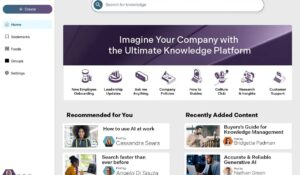
Organizations evaluating Allo often discover they need broader employee communication, engagement, and collaboration capabilities beyond AI-powered business calling. Below are some of the leading internal communication platforms organizations commonly evaluate and compare:
| Software | Key Strength | Best Fit |
| HubEngage | All-in-one employee communication | Enterprises & distributed teams |
| Workvivo | Social-style engagement | Culture-focused teams |
| Staffbase | Strong enterprise communications | Large organizations |
| Blink | Mobile-first frontline communication | Deskless workforce |
| Unily | Highly customizable intranet | Large enterprises |
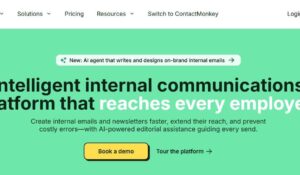
| ContactMonkey | Email analytics and campaigns | Email-focused teams |
| LumApps | Strong personalization | Enterprise teams |
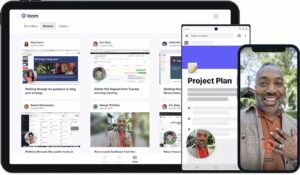
| Loom | Async video communication | Distributed teams |
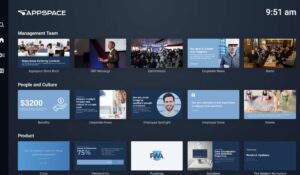
| Appspace | Hybrid workplace tools | Office & hybrid environments |
| Poppulo | Enterprise communication platform | Large distributed organizations |
To learn more about these workplace communication solutions, explore this internal communication software guide.
Why HubEngage is a stronger alternative?
Many business communication platforms struggle to provide long-term flexibility, which often creates challenges for HR leaders and communication teams evaluating scalable workforce communication solutions.
This is where HubEngage provides a stronger advantage for organizations looking for better scalability, modular flexibility, and more comprehensive employee communication management.
Rather than requiring businesses to deploy a complete platform immediately, HubEngage allows organizations to begin with a single module such as employee messaging, surveys, intranet, social engagement, or recognition tools.
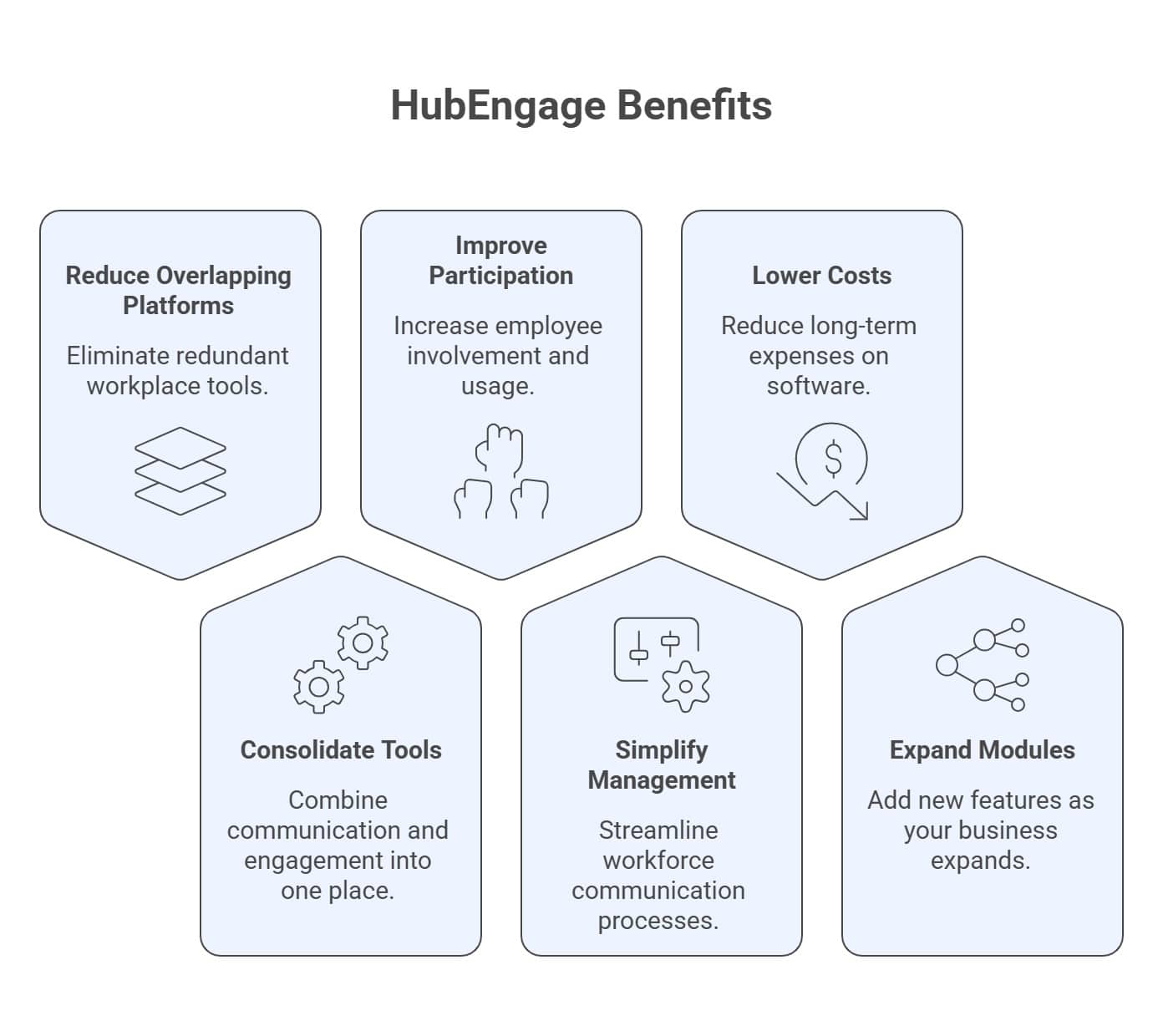
As communication and engagement requirements evolve, companies can gradually expand into a fully connected employee engagement platform without replacing existing systems. This modular approach helps organizations reduce software complexity, improve employee adoption, streamline communication workflows, and consolidate multiple workplace communication tools into one scalable platform.
- Reduce overlapping workplace platforms
- Consolidate communication and engagement tools
- Improve employee participation and adoption
- Simplify workforce communication management
- Lower long-term software costs
- Expand modules as business grows
Allo vs HubEngage Comparison
Below is a simple comparison table highlighting important differences between Allo and HubEngage to help organizations evaluate the right communication platform more effectively.
| Category | Allo | HubEngage |
| Primary Focus | AI business phone system | Employee communications and engagement |
| Best Customer Size | Small businesses and solopreneurs | SMB to enterprise organizations |
| Employee Engagement Tools | Limited | Extensive |
| Intranet Capabilities | No major intranet functionality | Full modern intranet platform |
| Recognition and Rewards | Not core functionality | Included |
| Surveys and Feedback | Limited | Advanced |
| Internal Communications | Primarily voice-focused | Multi-channel communications |
| Mobile Experience | Strong mobile calling | Full employee mobile platform |
| Scalability | SMB-focused | Enterprise-ready |
| Modular Expansion | Limited | Highly modular |
| Cost Consolidation Potential | Lower | High long-term savings |
| AI Features | AI summaries and receptionist | AI-powered communications workflows |
Conclusion
Allo is a modern AI-powered business phone platform designed mainly for startups, solopreneurs, and smaller teams looking for mobile-first communication and AI-assisted calling workflows.
The platform is commonly recognized for its quick setup process, AI-generated call summaries, mobile accessibility, and simplified business communication experience for smaller organizations.
However, companies looking for broader employee communication, engagement, and collaboration capabilities may eventually encounter limitations around scalability, workflow flexibility, and platform consolidation.
Organizations needing employee intranet tools, recognition programs, surveys, analytics, and multi-channel communication workflows often require additional platforms alongside Allo.
For businesses evaluating long-term employee experience strategy, HubEngage provides a more scalable and flexible alternative by combining communications, engagement, intranet, surveys, recognition, and automation into one modular employee engagement platform.
Allo FAQs
What is Allo used for?
Allo is primarily used as an AI-powered business phone and communication platform for startups, freelancers, and small teams managing calls and customer conversations.
Is Allo good for employee communication?
Allo works well for business calling workflows, but it is not a complete employee communication or engagement platform compared to broader solutions like HubEngage.
Does Allo offer transparent pricing?
Allo provides Starter plan begins at $25 per user monthly, while Pro pricing starts at $35 per user monthly.
What are the biggest complaints about Allo?
The most common complaints include less customer support, poor integration, VoIP quality problems, and limitations for large communication environments.
What are the best alternatives to Allo?
Popular alternatives include HubEngage, Staffbase, Blink, Workvivo, RingCentral, and Slack depending on whether organizations prioritize employee engagement, collaboration, or business calling.
Why do companies choose HubEngage over Allo?
Organizations often choose HubEngage because it combines employee communications, intranet, engagement, recognition, surveys, and automation into one platform instead of using many disconnected tools.