MyHub is a well-known cloud-based intranet platform designed to improve internal communication, document management, and team collaboration across organizations. It is commonly evaluated by HR leaders, internal communications teams, and IT decision-makers looking to replace disconnected tools with a centralized digital workplace.
Organizations considering MyHub are typically seeking a solution that combines content management, file sharing, and basic collaboration features in one place. However, many buyers look for clearer insights into pricing transparency, scalability for growing teams, and the platform’s ability to support long-term employee engagement.
Decision-makers also question whether it delivers measurable ROI compared to more flexible, modular platforms. In this guide, we provide a comprehensive breakdown of MyHub, covering features, limitations, pricing, and verified user reviews, along with comparisons to modern intranet solutions that offer better scalability and adoption.
MyHub Features
As per the website of MyHub, below are the common features buyers should look for:
1. Cloud-Based Intranet
MyHub provides a fully cloud-hosted intranet that enables teams to access content, files, and updates from anywhere without complex infrastructure.
2. Content Management System
The platform includes tools for creating and organizing pages, documents, and knowledge bases, making it easier to manage internal information.
3. Document Sharing & Storage
Users can upload, store, and share files within teams, supporting collaboration and centralized document access.
4. Team Collaboration Tools
MyHub supports team collaboration through shared workspaces and communication features, helping teams stay aligned.
5. Branding & Customization
Organizations can customize the intranet with their branding, including logos, colors, and layouts.
6. User Permissions & Access Control
Admins can control who accesses specific content, ensuring secure information sharing across teams.
MyHub Feature Matrix
After using the MyHub software, we have created a list of features that are good and areas to improve
| Feature | Strengths | Limitations |
| Cloud Deployment | Easy to access, no infrastructure needed | Limited control for complex enterprise environments |
| Content Management | Simple page creation and organization | May lack advanced personalization and targeting |
| Document Sharing | Centralized storage and access | Not a full document collaboration suite like SharePoint |
| Collaboration | Basic team collaboration features | Limited engagement tools like surveys or recognition |
| Customization | Branding flexibility | Limited deep customization compared to enterprise platforms |
| Access Control | Secure permissions | May require manual management at scale |
MyHub Pricing
MyHub follows a tiered pricing model, typically based on a per-user, per-month structure, making it accessible for organizations starting with a basic intranet setup.
Publicly available information suggests entry-level pricing begins at around $3 per user per month, with costs increasing as additional features and higher user volumes are added.
However Final costs can vary depending on customization needs, support levels, and overall implementation scope, which may require direct consultation with the vendor.
MyHub is most commonly adopted by small to mid-sized organizations that prioritize simplicity, quick deployment, and ease of use over advanced enterprise-level functionality and scalability.
MyHub Reviews
Feedback from MyHub review platforms show mostly positive responses around modern intranet. While it also shows some concerns about the complex system as well as its cost.
Pros
- Easy setup with minimal technical effort
- Clean, simple, user-friendly interface design
- Suitable for basic intranet use cases
Cons
- Limited advanced features versus modern platforms
- Customization and scalability can be challenging
- Not ideal for complex enterprise requirements
- Limited engagement, feedback, and communication tools
Overall Sentiment
While MyHub works well as a lightweight intranet, it may fall short for organizations seeking a comprehensive employee experience platform.
MyHub Review Summary Table
Below is a summary table of customer reviews on MyHub review sites like G2 showing what all things are good and which ones are the areas of improvement.
| Source | Rating | What Users Like | Common Complaints |
| G2 | ~4.4/5 | Ease of use, quick setup | Limited advanced functionality |
| Software Advice | ~4.7/5 | Simplicity, usability | Customization limitations |
MyHub Alternatives
Here are some of the best modern intranet platforms that you can look for and compare with MyHub software:
| Platform | Best Fit | What Stands Out | Pricing Style |
| HubEngage | SMB to enterprise teams that want communications, engagement, and intranet in one modular platform | Communications, social features, recognition, surveys, automation, AI, and phased adoption | Starts at $1 per user/month |
| Microsoft SharePoint | Enterprises already standardized on Microsoft 365 | Deep Microsoft ecosystem alignment and document collaboration | Enterprise / Microsoft licensing |
| Staffbase | Regulated industries and global enterprises | Employee communications hub, branded mobile app, compliance controls | Quote-based enterprise pricing |
| Simpplr | SMBs and midsize businesses wanting fast intranet rollout | AI-powered intranet, intuitive UI, fast rollout | Per-user/month pricing |
| MangoApps | Enterprises with complex communications needs | Multi-channel messaging orchestration | Custom enterprise pricing |
| Happeo | Midmarket and hybrid organizations | Google Workspace-native experience and social features | Subscription-based |
| Beekeeper | Frontline and deskless industries | Mobile-first workforce reach | Per-user/month |
| Blink | SMB, retail, and hospitality teams | Lightweight communication app with strong mobile adoption | Subscription-based |
| Interact | Organizations needing strong CMS and search | Content publishing, governance, search | Quote-based |
| Workvivo | Enterprises focused on culture and social engagement | Social feeds, recognition, integrations | Subscription-based |
To learn more about these platforms and apps, you should check out this intranet software guide
Why HubEngage is a good option?
Many intranet platforms do not clearly communicate their cost-to-value proposition, often leaving decision-makers uncertain. This is where HubEngage differentiates itself.
Rather than forcing organizations into a full intranet deployment from the start, HubEngage enables companies to begin with a single module such as communications, recognition, or surveys.
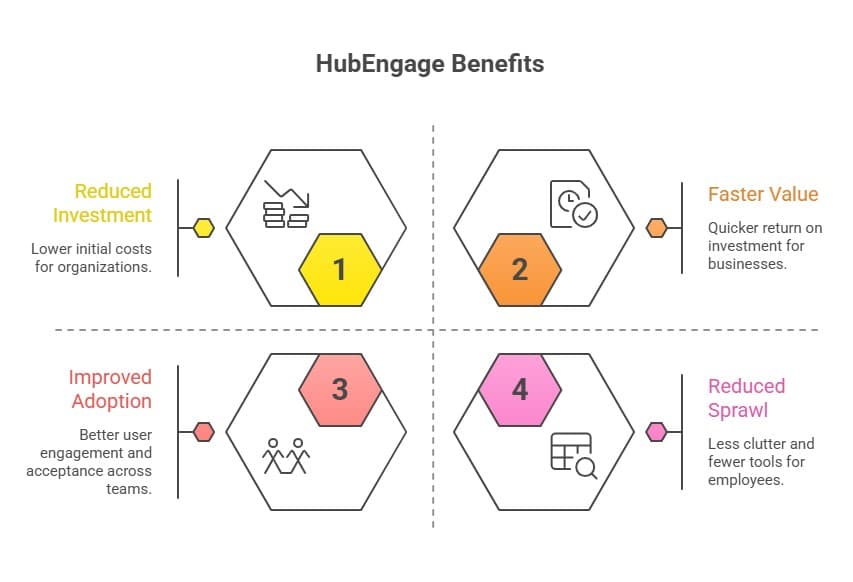
As business needs evolve, organizations can scale into a complete employee experience platform. This modular model offers:
- Reduced upfront investment
- Faster time to value
- Improved adoption across teams
- Reduced tool sprawl
MyHub vs HubEngage Comparison
Here is a simple comparison table based on different factors that will help you in comparing the two platforms easily.
| Criteria | MyHub | HubEngage |
| Platform Type | Basic intranet | Full employee experience platform |
| Pricing Flexibility | Fixed tiers starts at $3/user/month | Starts at $1/user/month, modular scaling |
| Features | Content & document management | Communications, intranet, surveys, recognition, AI |
| Engagement Tools | Limited | Advanced engagement & feedback tools |
| Scalability | SMB-focused | SMB to enterprise scalable |
| Implementation | Simple setup | Flexible phased rollout |
| ROI | Limited consolidation | High ROI through platform consolidation |
Conclusion
MyHub is a solid choice for organizations seeking a simple, easy-to-use intranet solution. It works well for small to mid-sized teams that need basic content management and document sharing capabilities.
However, for organizations looking to unify communication, engagement, and employee experience into a unified digital platform, HubEngage offers a more scalable and cost-effective solution.
With its modular approach, advanced engagement features, and flexible pricing, HubEngage addresses many of the limitations found in traditional intranet tools.
MyHub FAQs
What is MyHub used for?
MyHub is primarily used as a cloud-based intranet platform for managing internal communication, documents, and company knowledge.
Is MyHub pricing transparent?
MyHub provides starting pricing publicly, but full enterprise pricing details may require contacting their team.
What are the best alternatives to MyHub?
Top alternatives include HubEngage, SharePoint, Simpplr, Staffbase, and LumApps.
How does MyHub compare to HubEngage?
MyHub focuses on basic intranet functionality, while HubEngage provides a complete employee experience platform with communication, engagement, and analytics capabilities.
Is MyHub suitable for large enterprises?
MyHub can work for smaller organizations, but enterprises may require more advanced features and scalability offered by platforms like HubEngage.