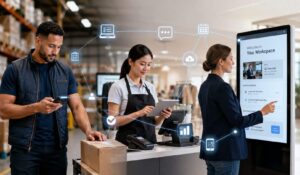
Frontline workers make up roughly 80% of the global workforce, yet most internal communication tools are built for desk employees. The result is a persistent gap — critical information gets delayed, misunderstood, or never reaches the people who need it most.
If you manage teams in manufacturing, healthcare, or hospitality, you already know this problem. Shift changes get missed. Safety updates travel through a broken telephone chain. Employee feedback disappears into a suggestion box nobody reads.
In this article we have covered everything you need to know about messaging frontline workers effectively — from choosing the right platform to measuring real ROI.
What Is Frontline Worker Messaging?
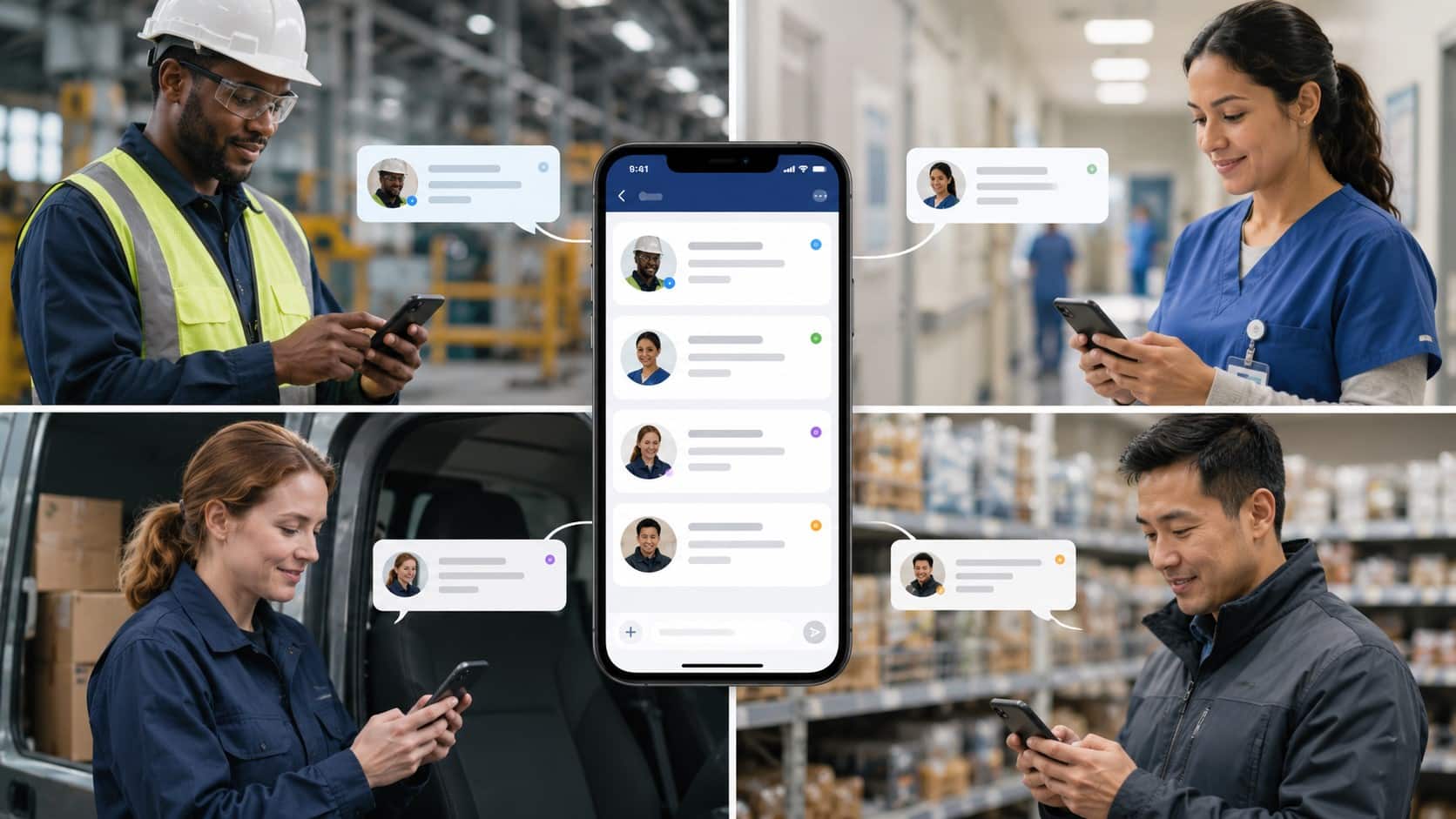
Frontline worker messaging refers to the systems, tools, and strategies organizations use to communicate directly with employees who do not sit at a desk. These workers — nurses, warehouse staff, hotel housekeepers, line operators — are rarely connected to a company email system and often share devices or work rotating shifts.
Messaging frontline workers is fundamentally different from standard internal communications. Traditional channels like email or intranet portals assume employees have personal computers and dedicated work hours to read updates. Frontline workers need information pushed to them in real time, in formats they can consume quickly between tasks.
Key Insight: According to McKinsey, companies that invest in better communication tools for frontline workers can see productivity improvements of 20–25%. The barrier is not motivation — it is access.
Effective messaging frontline workers programs typically include mobile-first apps, SMS-based alerts, digital signage, and group chat functionality designed for shift-based environments. The goal is simple: make sure every employee — regardless of role, location, or device — receives the same critical information at the same time.
Who Counts as a Frontline Worker?
The category is broader than most organizations realize. Frontline workers include:
- Manufacturing: Assembly line operators, quality control technicians, warehouse staff, logistics coordinators
- Healthcare: Nurses, patient care technicians, environmental services staff, pharmacy aides
- Hospitality: Front desk agents, housekeeping teams, kitchen staff, food and beverage servers
Each group has distinct communication needs, but all share the same core challenge: they are disconnected from the tools most organizations use to communicate.
Benefits of Messaging Platforms for Frontline Workforces
When organizations invest in dedicated messaging frontline workers solutions, the impact goes well beyond convenience. The benefits are operational, cultural, and financial.
Faster Information Delivery
Shift-critical updates — schedule changes, safety alerts, policy revisions — reach workers in seconds rather than hours. A hospital that needs to communicate a new infection control protocol cannot wait for a weekly all-hands meeting. Messaging frontline workers directly through a mobile platform closes that gap immediately.
Reduced Turnover and Stronger Engagement
Frontline turnover rates are among the highest across all industries. A 2023 Gallup study found that only 23% of frontline employees feel engaged at work. Poor communication is consistently cited as a top driver of disengagement. When workers feel informed and heard, retention improves.
Messaging frontline workers through two-way channels — where employees can respond, ask questions, and provide feedback — creates a sense of inclusion that one-way broadcasts cannot replicate.
Compliance and Safety
In regulated environments like healthcare and manufacturing, documented communication is not optional. Messaging platforms create an auditable record of who received what information and when. This matters enormously during safety audits, OSHA inspections, and Joint Commission reviews.
Operational Efficiency
When managers spend less time chasing down employees to relay information, they spend more time on the work that actually requires their attention. Messaging frontline workers through automated workflows — shift reminders, task assignments, acknowledgment requests — reduces the administrative burden on supervisors.
The benefits of unified communication platforms extend beyond messaging alone. When scheduling, task management, and communication sit in a single system, the operational gains compound quickly.
Frontline Messaging vs. Traditional Communication Methods
Most organizations still rely on a patchwork of legacy tools when messaging frontline workers. Understanding what you are replacing — and why — is essential before selecting a new platform.
Comparison of Communication Methods for Frontline Teams
| Method | Reach | Speed | Two-Way | Documented | Best For |
|---|---|---|---|---|---|
| Bulletin boards | Low | Slow | No | No | General notices |
| Medium | Medium | Yes | Yes | Desk workers only | |
| SMS/text | High | Fast | Limited | No | Urgent alerts |
| Printed memos | Low | Very slow | No | No | Compliance notices |
| Mobile messaging app | High | Instant | Yes | Yes | All frontline use cases |
| PA system/intercom | High | Instant | No | No | Emergency alerts |
The table above makes the tradeoff clear. Traditional methods like bulletin boards and printed memos score poorly on reach, speed, and documentation. Email performs better but excludes workers without company email accounts — which describes most frontline employees.
Dedicated mobile messaging apps designed for messaging frontline workers address every gap simultaneously. They reach workers on personal or shared devices, deliver messages instantly, enable two-way dialogue, and create a documented communication trail.
The shift away from traditional methods also supports broader change management principles. Organizations that replace fragmented communication tools with a unified platform report fewer miscommunications, faster adoption of new policies, and stronger alignment between leadership and frontline teams.
Key Features to Look for in Frontline Messaging Tools
Not all messaging platforms are built for frontline environments. When evaluating tools for messaging frontline workers, prioritize features that match how these employees actually work.
Must-Have Features
- Mobile-first design: The platform must work on smartphones, including personal devices (BYOD) and shared company devices. Desktop-first tools fail in frontline environments.
- Push notifications: Workers should not need to open an app to know a message arrived. Push notifications ensure time-sensitive updates get seen immediately.
- Multi-language support: In manufacturing and hospitality especially, teams often include workers who speak multiple languages. The platform should support translation or language-specific channels.
- Read receipts and acknowledgments: Knowing who has seen a message is critical for compliance-sensitive communications. Look for confirmation workflows that require employees to acknowledge receipt.
- Offline functionality: Warehouse floors, hospital basements, and kitchen environments often have poor connectivity. The platform should queue messages and sync when connectivity returns.
- Segmentation and targeting: Messaging frontline workers effectively means reaching the right people — not blasting the entire organization with every update. Look for role-based, location-based, and shift-based targeting.
- Integration with scheduling tools: When a shift changes, the communication should update automatically. Platforms that integrate with workforce management systems eliminate duplicate data entry.
Nice-to-Have Features
- Surveys and pulse checks: Short, mobile-optimized surveys let managers collect real-time feedback from frontline teams.
- Digital signage integration: For workers in environments where mobile use is restricted, digital displays in break rooms and common areas extend message reach.
- AI-driven content personalization: Some platforms now use AI-driven scheduling and content delivery to optimize when messages are sent based on individual work patterns.
HubEngage combines these capabilities into a single employee experience platform, giving organizations one place to manage messaging frontline workers alongside engagement, recognition, and workforce operations.
How to Implement a Frontline Messaging Solution?
Implementation is where most organizations stumble. Choosing a platform is the easy part. Getting frontline workers to actually use it requires a structured rollout.
Step-by-Step Implementation Process
- Audit your current communication landscape: Map every channel you currently use for messaging frontline workers. Identify where information gets lost, delayed, or ignored. This audit becomes your baseline for measuring improvement.
- Define your use cases: Not all messaging needs are equal. Separate urgent safety alerts from shift reminders from cultural updates. Each use case may require different delivery methods and urgency settings.
- Choose a platform built for frontline environments: Evaluate vendors specifically on mobile performance, offline functionality, and ease of use for non-desk workers. Involve frontline employees in the evaluation — their feedback on usability matters more than any feature checklist.
- Segment your workforce: Set up role-based, location-based, and shift-based groups before launch. Messaging frontline workers effectively depends on precise targeting. A nurse on the overnight shift does not need the same messages as a day-shift administrator.
- Train managers first: Frontline managers are the bridge between leadership and workers. Train them on the platform before rolling it out to their teams. Give them templates, guidelines, and escalation paths for different message types.
- Run a pilot with one team or location: Test the platform with a single unit before full deployment. Collect feedback on usability, notification timing, and message clarity. Use this data to refine your approach.
- Launch with a clear value proposition for workers: Frontline employees will adopt a new tool if it makes their lives easier. Lead with the benefits — faster schedule updates, direct access to HR, ability to report issues without paperwork.
- Measure and iterate: Track open rates, acknowledgment rates, and employee satisfaction scores. Adjust message frequency, format, and targeting based on what the data shows.
Best Practices for Frontline Worker Engagement
Deploying a messaging platform is not the same as engaging your frontline workforce. The technology enables connection — but the strategy determines whether it works.
Keep Messages Short and Actionable
Frontline workers read messages between tasks, during breaks, or at the start of a shift. Long paragraphs get ignored. When messaging frontline workers, lead with the key information in the first sentence. If an action is required, state it explicitly.
Use the Right Channel for the Right Message
Not every update belongs in a push notification. Establish clear norms for what goes where:
- Urgent safety alerts: Push notification with acknowledgment required
- Shift reminders: Automated SMS or app notification 30 minutes before shift
- Policy updates: In-app message with read receipt, followed by manager confirmation
- Cultural content and recognition: Feed-based posts that workers can engage with at their own pace
Make Two-Way Communication the Default
Messaging frontline workers should not be a one-way broadcast. Platforms that allow workers to respond, ask questions, and flag issues create a fundamentally different relationship between employees and the organization. Managers who respond to frontline questions through the platform signal that the channel is real — not just another top-down announcement board.
Respect Off-Shift Time
One of the fastest ways to undermine a messaging program is to send non-urgent messages outside of working hours. Set notification rules that respect shift schedules. Workers who feel their personal time is being invaded will disable notifications entirely — which defeats the purpose of the platform.
Tie Messaging to Recognition
Messaging frontline workers about achievements, milestones, and team wins builds a culture of recognition. Platforms that combine communication with peer-to-peer recognition features see significantly higher engagement rates than those focused on information delivery alone. The benefits of employee wellness programs extend naturally from this — workers who feel recognized report higher wellbeing and lower burnout.
ROI and Metrics for Frontline Messaging Programs
Measuring the return on investment for messaging frontline workers programs requires tracking both operational and engagement metrics.
Key Metrics to Track
- Message open rate: What percentage of workers open messages within a defined time window? Industry benchmarks for frontline platforms typically range from 65–85%.
- Acknowledgment rate: For compliance-critical messages, what percentage of workers confirm receipt? This is your documentation trail for audits.
- Time to reach: How long does it take for a message to reach 90% of the target audience? Compare this to your baseline before the platform was deployed.
- Turnover rate: Track voluntary turnover quarterly. Organizations that improve communication quality consistently see turnover decline within 6–12 months.
- Employee Net Promoter Score (eNPS): Short pulse surveys through the messaging platform give you real-time visibility into workforce sentiment.
- Incident and error rates: In manufacturing and healthcare especially, poor communication contributes to errors. Track whether incident rates decline after implementing structured messaging frontline workers protocols.
Building the Business Case
When presenting ROI to leadership, translate metrics into financial terms. If reducing turnover by 5 percentage points saves your organization $400,000 annually in recruiting and training costs, that number belongs in the business case alongside engagement scores.
The benefits of a company intranet and frontline messaging are often presented separately, but the strongest business cases combine them. Organizations that unify all employee communication — desk and non-desk — into a single platform report faster ROI and higher adoption rates than those running parallel systems.
Conclusion
Messaging frontline workers is not a technology problem — it is a strategy problem that technology solves. The organizations seeing the strongest results are those that treat frontline communication as a core operational function, not an afterthought.
See how HubEngage connects your frontline workforce — from shift-based messaging and acknowledgment tracking to recognition and real-time engagement data, all in one platform built for the teams who keep your business running. Ready to get started? Visit HubEngage to learn more.
Frontline Worker Messaging FAQs
What is the difference between messaging frontline workers and standard internal communications?
Standard internal communications typically assume employees have corporate email accounts, desktop computers, and scheduled time to read updates. Messaging frontline workers requires mobile-first tools, push notifications, and delivery systems that work during or between physical tasks. The audience, the device, and the timing are all fundamentally different.
Can frontline workers use personal devices for work messaging?
Yes, and most successful frontline messaging programs rely on BYOD (bring your own device) models. The key is choosing a platform that works on any smartphone, protects employee privacy by keeping work and personal data separate, and does not require workers to pay for data usage. Many organizations cover data costs or use Wi-Fi-only notification strategies for cost management.
How do you ensure frontline workers actually read important messages?
Acknowledgment workflows are the most reliable mechanism. When a message requires a response — a simple “I understand” tap — you have documented confirmation of receipt. Pair this with manager follow-up for workers who have not acknowledged within a defined window. For truly critical communications, a multi-channel approach (push notification + SMS + manager verbal confirmation) provides the highest assurance.
What industries benefit most from frontline messaging platforms?
Manufacturing, healthcare, and hospitality see the highest ROI from dedicated messaging frontline workers solutions. These industries share common characteristics: large non-desk workforces, high turnover, shift-based scheduling, and compliance requirements that demand documented communication. Retail, transportation, and field services are also strong candidates.
How do you measure whether a frontline messaging program is working?
Track message open rates, acknowledgment rates, employee satisfaction scores, and turnover data on a quarterly basis. Compare these metrics to your pre-platform baseline. The most telling early indicator is acknowledgment rate — if workers are confirming receipt of critical messages, the channel is functioning. If open rates are high but acknowledgment rates are low, your message design or call-to-action needs adjustment.
Is frontline worker messaging compliant with labor laws regarding off-hours contact?
This depends on jurisdiction and message type. In the United States, the Fair Labor Standards Act governs compensable work time, and requiring employees to read and respond to messages outside their scheduled hours may create wage liability. Most platforms allow administrators to schedule message delivery within shift windows. Always consult legal counsel when designing notification policies for hourly workers. You can also review employee communication rights for broader context on workplace communication standards.