Employee recognition is especially important for small businesses with distributed workforces. When employees work across locations, shifts, or remote teams, they can easily feel disconnected from managers and coworkers. Regular recognition helps people feel valued, improves motivation, and strengthens a sense of belonging.
However, recognition should also support clear business goals. Its value is not limited to rewards or appreciation messages. A strong program can influence employee retention, engagement, productivity, attendance, and workplace culture. Measuring these results helps small businesses understand if their investment is creating real value or not.
By setting clear goals, building benchmarks, using the right employee recognition tool and tracking improvements over time, leaders can connect recognition with business performance. Our blog will tell you how to measure roi of employee recognition and improve its impact effectively.
Key Takeaways
- Employee recognition ROI connects program spending with measurable business outcomes.
- Lower turnover creates major savings in hiring, onboarding, and training.
- Track baseline costs before measuring recognition-driven financial improvements over time.
- Compare total recognition investment against retention, productivity, and attendance savings.
- Separate participation metrics from outcomes that create measurable financial value.
- Use recognition analytics to identify programs delivering the strongest returns.

Factors that impact ROI of Employee Recognition
When employees feel valued, they are more likely to perform well and stay. Employee recognition improves ROI by strengthening retention, engagement, productivity, and workplace culture as shown below
| Area | Impact |
|---|---|
| Retention | Improves loyalty, reduces turnover, lowers hiring costs |
| Engagement | Boosts motivation, involvement, teamwork, and performance |
| Productivity | Reinforces high-performing behaviors, increases focus and output |
| Culture | Builds trust, belonging, and a positive workplace culture |
Key metrics to measure Employee Recognition ROI
You can track below metrics to understand if your recognition program is improving employee experience and business results.

Methods to measure ROI of Employee Recognition
1. Use Engagement and Pulse Surveys
Employee surveys show if staff feel more valued after recognition program. Compare results over time by department, location, or team. If participation and appreciation low, increase usage. If participation is high but people still feel overlooked, improve managers, rewards, praise.
2. Analyze Turnover and Hiring Costs
Calculate employee turnover costs including recruitment ads, interviews, onboarding tools, training, lost productivity, and manager time. Replacing staff costs about 33% of salary, up to 100% for senior roles. Compare with retention gains from recognition.
3. Run a Cost-Benefit Analysis
Compare the total cost of your recognition program with the financial benefits it creates. Include software fees, reward budgets, administration, training, and communication costs. Potential benefits include:
- Lower turnover: Effective recognition programs may reduce voluntary turnover by 31%.
- Reduced absenteeism: Regular praise and recognition may lower absenteeism by 27%.
- Higher productivity: Motivated employees may complete work more efficiently.
- Lower hiring costs: Better retention reduces recruitment and onboarding expenses.
4. Use Recognition Platform Analytics
Recognition software with instant employee pulse and analytics makes it easier to track participation and program growth over time. Important metrics include:
- Number of recognitions sent
- Percentage of employees receiving and giving recognition
- Manager participation rate
- Recognition frequency by team.
Steps to measure ROI Of Employee Recognition?
Measuring ROI means connecting recognition activity with employee and business results.

Calculations to Measure ROI Of Employee Recognition
Sample calculations help leaders understand the financial value of employee recognition. They connect lower turnover, higher productivity, and program costs with a clear ROI estimate.
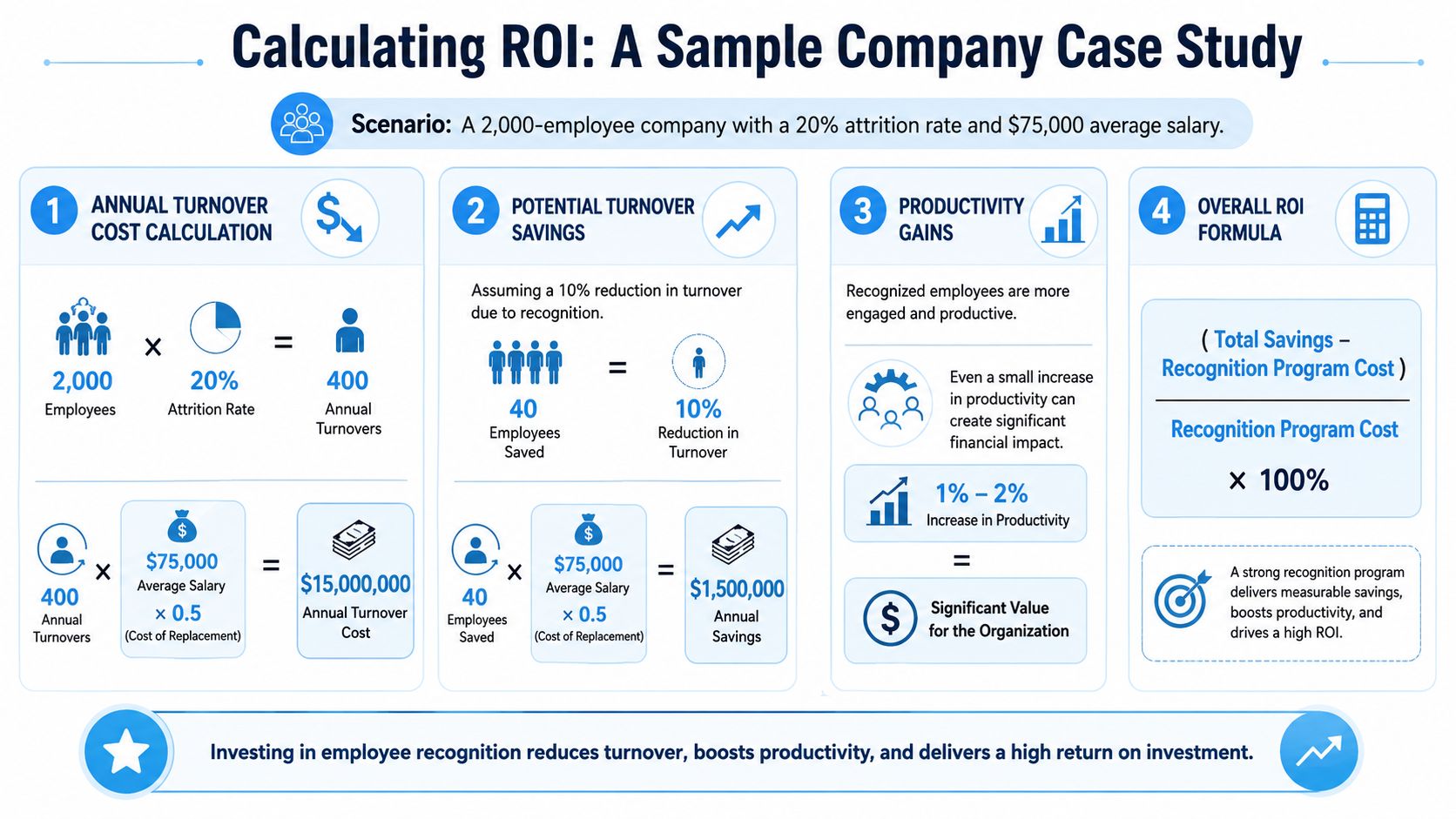
Use a Sample Model to Test Your Assumptions
The image shows a company with:
- 2,000 employees
- 20% annual attrition
- $75,000 average salary
- Replacement cost equal to 50% of salary
This creates 400 employee exits and an estimated annual turnover cost of $15 million. If recognition reduces turnover by 10%, the company could retain 40 employees and save around $1.5 million each year. A further 1% to 2% productivity improvement could add more business value.
Use this formula:
ROI = [(Total Savings − Recognition Program Cost) ÷ Recognition Program Cost] × 100
Challenges of Measuring ROI of Employee Recognition
Measuring Only Short-Term Results
Recognition needs time to influence culture, retention, and performance. Track results regularly and allow at least one year before judging the program’s full business impact.
Ignoring Employee Feedback
Numbers matter, but employee comments and personal recognition stories also show progress. Feeling valued, supported, and connected can reveal meaningful positive changes across workplace culture.
Not Connecting Recognition to Business Goals
Recognition without clear goals produces unclear results. Connect each program to company values and priorities such as retention, safety, productivity, engagement, or customer service outcomes.
Tips to improve the impact of an Employee Recognition Program
Most companies are not worried about giving too much recognition. Here are practical ways to build a stronger recognition culture.
Personalize Recognition Efforts
Employees prefer different types of appreciation. Some may value a personal eCard, while others may prefer public praise, reward points, or recognition during a team meeting. Offering different options makes recognition more meaningful and personal. Explore more in detail on our blog on the power of workplace recognition
Integrate Recognition Into Daily Workflows
Make recognition part of everyday work. Start regular meetings with a quick appreciation moment or send weekly reminders asking employees to recognize recent achievements. This keeps recognition consistent and helps teams focus on what is working, not only on problems.
Leverage AI to measures ROI Of Employee Recognition
AI is most useful in dashboarding when it shortens the path from data to action. Practical uses include:
- Flagging teams with high participation but weak retention improvement
- Summarizing open-text survey themes tied to manager recognition quality
- Showing coverage gaps in frontline groups that rarely see email but respond using mobile and chat channels
Use Unified Platforms with single dashboard
Leaders that want to decrease tool sprawl can use unified platforms that have employee engagement dashboards so that recognition metrics can sit beside communication reach, sentiment, and workforce activity in one place.
Adapt Based on Employee Feedback
Recognition programs should change with employee needs. Ask whether the program is easy to access, fair, relevant, and enjoyable to use. Use employee feedback to improve recognition topics, rewards, communication, and the overall experience.
Combine Recognition and Employee Experience
The employee experience includes daily interactions with colleagues, manager support, learning opportunities, challenging work, and meaningful achievements. A strong recognition program creates positive moments across the organization.
How HubEngage helps you measure and improve ROI Of Employee Recognition?
Our employee recognition software helps you measure and improve employee recognition ROI by connecting recognition activity with participation, rewards, and engagement trends.
You can track peer-to-peer, manager-led, and company-wide recognition, along with nominations, milestone celebrations, points, badges, and leaderboard activity.
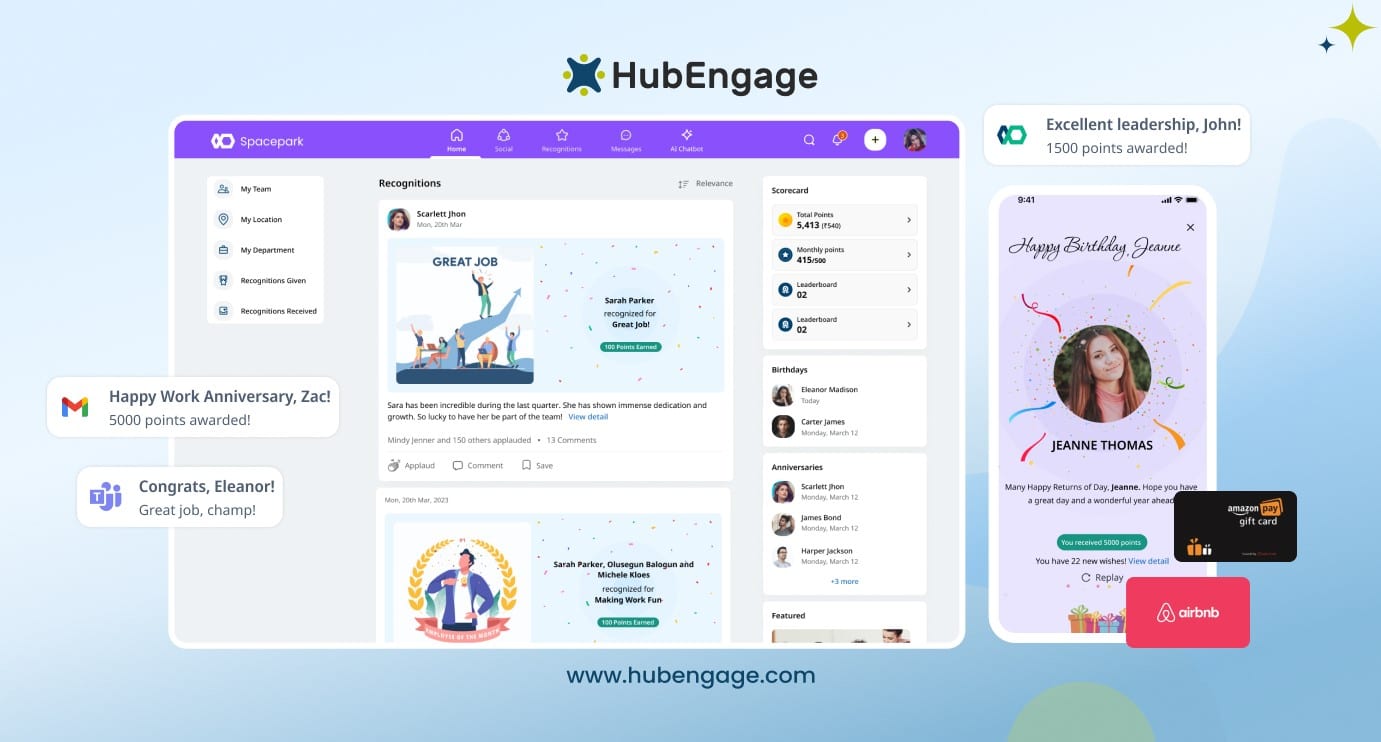
Multi-channel delivery through mobile, web, email, SMS, digital signage, Slack, and Microsoft Teams make easy to access. Reward redemptions and engagement data help leaders identify what works, increase participation, and build recognition programs that support retention and stronger performance across distributed teams like frontline, remote and in-office teams.
Conclusion
Measuring ROI of employee recognition starts with a business problem, not a recognition activity. Establish a credible baseline, separate participation from impact, connect workforce improvements to financial value, and include every program cost.
The strongest measurement models also use operational data from scheduling, onboarding, communication, and task systems. Explore how the HubEngage Employee Experience Platform connects recognition, surveys, analytics, communications, learning, and workforce operations by taking a demo.
FAQs on Measuring ROI Of Employee Recognition
How do you measure ROI of employee recognition?
Start with a business problem such as turnover, absenteeism, or onboarding friction. Build a baseline from historical data, track recognition participation and business outcomes separately, convert improvements into financial value, then compare total value against total program cost.
What is the best KPI to measure employee recognition ROI?
There isn’t one universal KPI. For many frontline organizations, retention is the most financially meaningful because turnover costs are expensive and visible. The best KPI is the one closest to a material workforce problem and easiest to validate financially.
Why is baseline data important in recognition ROI?
Without pre-launch data, leaders can’t tell whether outcomes improved because of recognition or because of unrelated changes such as hiring slowdowns, staffing shifts, or manager turnover. Baseline data makes attribution more credible.
Should participation metrics be included in recognition ROI?
Yes, but only as leading indicators. Metrics like send rate, manager participation, or employee coverage help explain adoption. They shouldn’t be treated as proof of business value on their own.
How can frontline organizations measure recognition ROI more accurately?
Use data from the systems that reflect day-to-day work, not just HR systems. That often means combining HRIS records with scheduling, survey, communication, and task data. Segment results by team, site, role, and manager so hidden patterns don’t disappear in companywide averages.
Can AI help measure ROI of employee recognition?
AI is useful when it automates survey analysis, flags underperforming teams, identifies participation gaps, and reduces manual reporting work. Its practical value is speed, consistency, and better decision support, not replacing leadership judgment.
Related Links
employee recognition platform | employee recognition software | employee engagement dashboards | instant employee pulse and analytics | the power of workplace recognition