There is something we often get wrong about workplace learning. We create a training program, send employees a link, set a deadline, track completion and then move on to the next initiative. On the report, everything looks fine. The completion rate is 92%, the dashboard is green and the program can be marked as successful.
But ask employees a month later what they actually changed because of that training, and the answer may be very different. That is the conversation we need to have about a learning culture at work. It is not about how many courses an organization can offer. It is about whether people are getting better at their jobs, sharing what they know and building the skills the business will need next.
At HubEngage, we are seeing this shift in the conversations we have with workplace leaders. Learning is increasingly being discussed alongside employee engagement, communication, recognition and employee experience because, in reality, employees do not experience these things as separate HR programs. They experience one workplace. And that workplace is changing quickly.
Key Takeaways
- A learning culture focuses on skill application, not course completion.
- Learning should connect with communication, recognition, feedback, and daily work.
- Managers help employees apply and reinforce new skills.
- Track participation, active users, reach, satisfaction, and performance change.
- AI skills should grow alongside communication, leadership, and problem-solving.
- Strong learning cultures improve adaptability, productivity, and workforce capability.

The Skills Employees Need Today May Not Be Enough Tomorrow
The pressure on organizations to keep their workforce current has never been greater. AI is changing how people write, analyze, research, communicate and complete routine work. At the same time, businesses still need employees who can think clearly, solve problems, communicate with customers and colleagues, make decisions and adapt when plans change.
The World Economic Forum’s Future of Jobs Report 2025 estimates that 39% of workers’ existing skill sets are expected to be transformed or become outdated between 2025 and 2030. Analytical thinking, resilience, flexibility, leadership and social influence continue to rank among the skills employers value.
That creates a problem for organizations that still think about learning in annual cycles. You cannot wait until the next training calendar to address a capability gap that is affecting the business today.
The same research reinforces this point, with problem-solving, adaptability, collaboration, motivation and other life skills continuing to matter alongside AI capability. That is an important distinction.
We do not need to choose between teaching people technology and developing human skills. We need to do both. A useful learning culture at work should help an employee become better with the tools available to them while also becoming better at thinking, communicating, collaborating and making decisions.
The Employee Experience Has Changed Too
Learning does not happen in a vacuum. Think about an employee’s normal day. They receive messages from their manager, emails from different departments, updates from leadership, tasks from their team and information from multiple systems. Somewhere in the middle of all that, we expect them to find time for learning.
It is easy to see why traditional learning programs can struggle. If employees cannot easily find the information they need, do not understand why a learning program matters or receive little support from their manager, another training course is unlikely to solve the problem.
Designing the employee experience in the AI era makes organizations to rethink employee experience as technology changes how people work, while leadership, manager capability and culture remain critical.
For us, this is where the idea of a learning culture at work becomes more practical. Learning should be part of the employee experience. It should be easy to access, relevant to the employee’s role and reinforced through the normal ways people communicate and work.
If learning requires employees to leave their everyday workflow, log into another system, find a course and remember to come back later, adoption will always be harder than it needs to be.
A Completion Rate Does Not Tell You the Whole Story
Let’s take a simple example. A company launches a manager development program for 500 people. Four hundred and fifty complete it. The organization reports a 90% completion rate.
That sounds good. But what do we know? We know that 450 people completed something. We do not know whether they used what they learned, whether their teams noticed a difference, whether managers became more confident or whether employee satisfaction improved.
This is where learning measurement needs to mature. Completion is useful. It tells us whether people participated in an activity. But it should be the beginning of the conversation, not the end.
We should also be asking how many employees remained active, whether they found the content useful, whether they applied it, whether managers reinforced it and whether anything changed afterward. That is a much better way to judge a learning culture at work.
What Does a Real Learning Culture Look Like?
You can usually recognize a learning culture by what happens between formal training programs. Employees ask questions without feeling that they are admitting weakness. Managers talk about development during regular one-on-ones rather than waiting for annual reviews. Teams share what they have learned from projects, mistakes and customer interactions.
There is also less dependence on a central HR team to push every learning activity. People start finding and sharing knowledge themselves. That is the point where learning becomes part of the way work gets done.
Start With the Problem, Not the Course
One of the easiest ways to make workplace learning irrelevant is to start by asking, “What training should we offer?” Start with the business problem instead. If managers are struggling with difficult employee conversations, give them practical support for those conversations.
If customer complaints are increasing, focus learning on the skills that can improve the customer experience. If the company is introducing AI, teach employees how to use it in the context of their actual roles.
The closer learning is to the work, the easier it is for employees to see its value. We do not need employees to become professional learners. We need them to become better at the work they are responsible for.
Managers Have a Bigger Role Than Most Learning Programs Give Them
A manager can make a good learning program useful or forgettable. Consider what happens after an employee completes a course. If nothing is discussed, there is a good chance the learning disappears into the background. But if the manager asks, “What did you take away from this?” or “Where can we use this with the team?”, the employee has a reason to think about it again.
That conversation does not need to be formal. It can happen during a team meeting, a one-on-one or while reviewing a project. Managers are also dealing with their own challenges.
Gallup’s latest global workplace research found that manager engagement fell significantly in recent years, making manager capability an important part of the broader engagement conversation. A company cannot expect managers to create a learning environment for their teams without giving managers the time, tools and support to do it themselves.
Some of the Best Learning Is Already Inside Your Company
We often look outside the organization for learning content when some of the most useful knowledge is already sitting inside the workforce. Someone in sales knows how to handle a difficult customer objection. Someone in operations has found a faster way to complete a process. A manager has figured out how to have a difficult conversation without damaging trust. A technical employee has solved a problem that another team may face next quarter.
How much of that knowledge is actually shared? A strong learning culture at work creates ways for employees to share these experiences instead of keeping them with the person who happened to learn them first.
That can happen through employee communities, internal posts, discussion spaces, knowledge hubs, recognition or simple peer-to-peer sharing. The technology matters, but the bigger goal is making useful knowledge easier to find and easier to pass on.
Recognition Can Make Learning Visible
There is another piece that deserves more attention: recognition. If someone takes the time to learn something new and then uses that knowledge to solve a problem, help a colleague or improve a process, that behavior is worth noticing.
It does not always require a large reward. Sometimes a manager saying, “This is exactly the kind of behavior we want to see,” can have more impact than another training reminder.
At HubEngage, we see recognition as part of the broader employee experience. Our employee recognition software helps organizations recognize employees through multiple channels and create more visibility around the contributions people make.
The opportunity here is bigger than rewarding course completion.
- Recognize people for using what they learned.
- Recognize employees who help others learn.
- Recognize managers who make development part of their team’s everyday work.
That is how learning starts becoming part of the culture rather than another item on the HR calendar.
Communication Can Make or Break Learning Adoption
A good learning program that nobody sees is not a good learning program. This becomes particularly important for organizations with frontline, deskless, shift-based or distributed employees. Not everyone spends the day sitting in front of a corporate inbox.
This is why the communication strategy around learning matters almost as much as the learning itself. The message needs to reach employees through channels they actually use. It also needs to explain why the learning matters instead of simply saying, “Please complete this course by Friday.”
Our guide on using text messages to communicate with employees looks at how SMS can help organizations reach employees who may not regularly check email or workplace applications.
The same principle applies beyond SMS. Mobile notifications, email, intranet updates, manager conversations and other communication channels can all play a role.
What matters is whether employees actually receive and notice the information. That is why we recommend looking at communication reach and engagement participation together.
If 1,000 employees are eligible for a learning program but only 600 are effectively reached, a 90% completion rate among those 600 does not mean the organization achieved 90% workforce participation.
- The first question should be: Did we reach people?
- The next question is: Did they participate?
- And then comes the more important one: Did anything change?
Learning Also Helps Organizations Deal With Change
Workplace learning is often discussed in terms of skills and careers. There is another side to it that matters just as much: organizational resilience.
Companies are operating in a world where external events can affect employees and business operations very quickly. Economic uncertainty, geopolitical developments, technology changes and major social events can all create questions inside the workforce.
HR leaders need to be able to communicate clearly and help employees understand what is happening.
This is discussed in HR Dive’s guidanceon what HR leaders should do when world events affect the workplace. Clear communication, employee support and preparedness become especially important when employees are dealing with uncertainty.
This connects back to learning.
Employees who are comfortable asking questions, sharing information and developing new skills are generally better positioned to adapt when circumstances change.
A learning culture at work is therefore not just about preparing someone for the next role. It is also about preparing the workforce for the next change.
Five Numbers We Would Watch
There are plenty of learning metrics organizations can track. However, we would rather see leaders focus on a small group of numbers that actually tell a story.
Engagement Participation Rate
Start with participation. How many eligible employees actually took part?
However, always put that number next to the total eligible population. A 70% participation rate means something very different if the communication reached 70% of employees versus 100% of employees.
Active Users
Registrations can look impressive while actual usage remains low.
Look at how many employees return to the platform, access resources, participate in discussions or use learning content after the initial campaign. Active users provide a better indication of whether employees are actually engaging with the experience.
Employee Satisfaction Score
Ask employees whether the learning was relevant and useful. Then go one step further and ask whether it helped them feel more confident or capable in their work.
A learning program that employees enjoy but never use is not necessarily a successful program.
Survey Completion Rate
Surveys are valuable only when enough people respond to make the feedback useful.
If completion is low, do not immediately assume employees are uninterested. The problem could be the length of the survey, the timing, the communication channel or the lack of clarity around why their feedback matters.
Communication Reach
Before judging participation, look at reach.
Did the message reach employees across locations, shifts and employee groups? Did frontline employees receive it? Did remote employees see it?
HubEngage’s employee experience platform brings communication, recognition, surveys and engagement capabilities together across multiple channels.
These numbers become much more useful when viewed together. They can help leaders see whether a learning initiative was visible, whether employees engaged with it and whether the experience actually delivered value.
What This Could Look Like With AI?
Let’s say an organization decides to introduce generative AI across the business.
The easy approach would be to create one AI course and ask everyone to complete it.
We would take a different approach.
First, understand what each function actually needs. A sales team may want to use AI for account research and meeting preparation. HR may need it for analysis and drafting. Marketing may be focused on content workflows. Engineering teams may have completely different requirements.
Then make the learning practical.
Give employees examples they can use in their actual work. Let managers discuss responsible use with their teams. Give employees a place to share what they are trying. Ask them what is working and where they are still uncomfortable.
And when someone finds a useful application, make it visible.
That might be through recognition, a team discussion or an internal success story.
This is what a learning culture at work looks like in practice. It is not “everyone completed AI training.” It is “our people are becoming more capable of using AI effectively in their roles.”
That is a much more meaningful outcome.
Do Not Build an AI Workforce and Forget the Human Part
There is a temptation to make AI the center of every workplace learning conversation.
We should resist that.
The technology will continue to change. The human capabilities required to use that technology well will remain important.
The High Point University research makes this point clearly, with problem-solving, adaptability, collaboration, motivation and other life skills continuing to matter alongside AI capability.
An employee who knows how to use an AI tool but cannot communicate with a customer is still a problem.
A manager who knows the latest AI features but cannot coach their team is still a problem.
A technically strong employee who cannot collaborate effectively can still slow down a project.
The goal should not be to build a workforce that is simply more technical.
The goal is to build a workforce that is more capable.
Employee Experience Has a Direct Business Connection
There is also a bigger business argument here. When employees can find information quickly, understand what is expected of them, access development opportunities and get support from their managers, the impact does not stay inside HR.
It can influence productivity, retention, time to productivity, internal mobility and customer outcomes. We think this is where the conversation around learning needs to go.
Instead of asking whether learning is an HR expense, leaders should ask whether the organization is building the capabilities it needs to execute its strategy.
- If the business is moving into a new market, do employees have the skills required?
- If technology is changing the way work is done, are employees prepared?
- If managers are struggling to lead hybrid or distributed teams, are they getting the right support?
- If the answer to these questions is no, learning is not a side issue.
It is a business issue.
What We Would Do Differently?
If we were helping an organization build a learning culture at work today, we would not begin by asking how many courses it needs.
We would begin with the business.
What capabilities are becoming more important? Where are employees struggling? What skills will the organization need six months from now? What are managers hearing from their teams?
Then we would connect the learning experience to communication, recognition, feedback and everyday work.
We would make learning easier to access and easier to apply. We would give managers a role in reinforcing it. We would create opportunities for employees to share knowledge with one another.
And we would measure more than completion.
Participation matters. Active users matter. Employee satisfaction matters. Survey completion matters. Communication reach matters.
But ultimately, we want to know what changed.
- Did employees become more confident?
- Did managers change how they lead?
- Did teams solve problems faster?
- Did employees apply new skills?
- Did the business get better at something that mattered?
Those are the questions worth taking to the leadership team.
From Training Completion to Workforce Capability
The way we talk about workplace learning needs to change.
For a long time, the conversation was about how much training an organization delivered. Then it became about how many employees completed it.
The next step should be more ambitious.
What can our workforce do now that it could not do before?
That question changes the entire approach. It moves learning away from being a calendar of programs and toward being part of how the business builds capability.
A strong learning culture at work gives employees opportunities to develop, managers a role in reinforcing those skills and leaders a clearer view of whether the investment is making a difference. It also makes the employee experience more connected.
Communication tells people what is happening. Learning helps them build the capability to respond. Recognition shows them which behaviors matter. Feedback tells the organization what is working and what needs to change. These should not feel like four unrelated systems. They are all part of the same employee experience.
At HubEngage, that is the opportunity we see: helping organizations bring these experiences closer together so employees have the information, support, recognition and tools they need to do their best work.
A learning culture at work is not created by launching more courses. It is created when learning becomes part of how people communicate, work, solve problems and grow. That is the culture organizations will need as work continues to change.
Final Thoughts
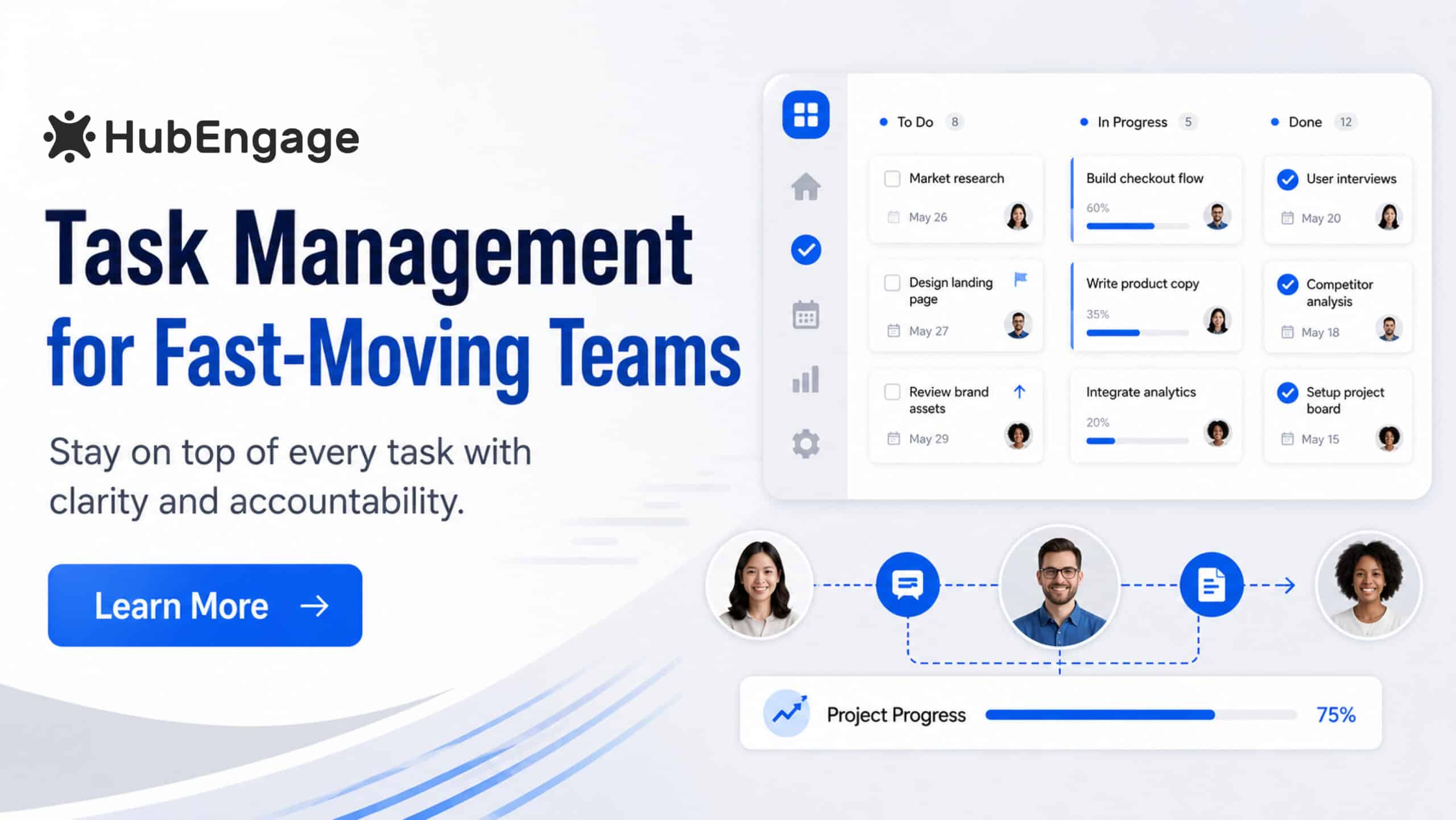
There is one final piece that often gets missed. Learning is useful, but the real value comes when employees put it into practice. Once a team decides what needs to change, someone needs to own the action, a deadline needs to be clear and progress needs to be visible. That is where task management becomes relevant.
With HubEngage Task Management, teams can create, assign and track work while keeping communication and collaboration connected to the tasks that need to get done.
For organizations trying to connect employee engagement with execution, that connection matters. The goal is not simply to communicate more or train more people. The goal is to help employees move from knowing to doing.
If your organization is looking to connect communication, engagement and everyday execution, see how HubEngage can help turn employee engagement into measurable action.