Team Managing shifts across a 200-person manufacturing floor, a 24-hour hospital ward, or a hotel with seasonal demand swings is not something a spreadsheet handles well. Gaps appear, overtime accumulates, and compliance becomes guesswork.
According to ResearchGate, organizations that automate scheduling reduce labor cost overruns by an average of 15–20% compared to those relying on manual methods.
An employee scheduling software solves this problem by replacing manual processes with automated, data-driven workforce planning.
In this blog we will cover what the software actually does, which features matter most, how leading platforms compare, and how to choose the right solution for your organization.
Key Takeaways
- Employee scheduling software automates shift planning, reduces overtime costs, and improves workforce efficiency.
- Modern staff scheduling software improves employee experience with mobile access and shift communication.
- Employee scheduling software reduces manual scheduling time while improving labor cost and compliance visibility.
- Automated scheduling, payroll integrations, and forecasting tools simplify workforce operations and employee management.
- Frontline workers and teams benefit the most from workforce scheduling software solutions.
- Choosing employee scheduling software depends on workforce size, integrations, compliance needs, and scheduling complexity.


What is an Employee Scheduling Software?
Employee scheduling software is a digital platform that automates the creation, management, and distribution of work schedules across an organization. Rather than building rosters in spreadsheets or on paper, managers use this software to assign shifts, track availability, manage time-off requests, and monitor labor costs, everything from a single interface.
The software connects scheduling decisions to real operational data: employee certifications, shift preferences, overtime thresholds, and labor law requirements. This connection is what separates employee scheduling software from a simple calendar tool.
Staff scheduling software is particularly valuable in industries where shift work is the norm. A hospital cannot run short-staffed on a night shift. A hotel cannot leave the front desk uncovered during peak check-in hours. A manufacturing plant cannot miss production targets because the wrong skill set showed up. Employee scheduling software ensures the right people are in the right place at the right time.
Employee Scheduling Software vs Manual Scheduling
The difference between employee scheduling software and manual scheduling is not only just speed. It is the accuracy, compliance, and employee experience that makes the difference.
| Dimension | Manual Scheduling | Employee Scheduling Software |
| Schedule creation time | 4–8 hours per week | 30–60 minutes per week |
| Error rate | High — human oversight misses conflicts | Low — automated conflict detection |
| Compliance tracking | Manual review, reactive | Automated alerts, proactive |
| Employee visibility | Posted on bulletin boards or emailed PDFs | Real-time mobile access |
| Shift swap process | Manager-mediated, slow | Employee-initiated, instant approval |
| Labor cost visibility | After payroll runs | Real-time during scheduling |
| Scalability | Breaks down above 50 employees | Scales to thousands of employees |
| Integration with payroll | Manual data entry | Automated data transfer |
The productivity gap becomes significant at scale. For example, a manufacturing facility with 300 employees running three shifts per day cannot rely on spreadsheets without accepting a meaningful administrative burden and a constant risk of coverage errors. Employee scheduling software eliminates that burden and replaces reactive firefighting with proactive planning.
Manual scheduling also creates an information asymmetry problem. Managers know the schedule; employees find out when someone tells them. Staff scheduling programs close this gap by giving every employee real-time access to their schedule, as well as open shifts
Employee Scheduling Tools Key Features
Not every platform offers the same depth of functionality. Here are the features that distinguish capable employee scheduling software from basic tools.
- Automated shift building: The software generates schedules based on rules you define like minimum coverage , skill requirements, maximum consecutive hours, and employee availability. This removes hours of manual work from the scheduling process.
- Real-time availability and time-off management: Employees submit availability and time-off requests directly in the system. Managers see open slots and conflicts instantly, without chasing people down through text messages.
- Mobile access: Frontline workers in manufacturing, healthcare, and hospitality rarely sit at desks. Staff scheduling software with a mobile app lets employees view schedules, pick up open shifts, and swap shifts from their phones.
- Labor cost forecasting: The software calculates projected labor costs as you build the schedule. You can see overtime risk before it becomes an overtime bill.
- Compliance tracking: Personnel scheduling software tracks hours worked against applicable labor laws, union agreements, and internal policies. Alerts fire before a violation occurs, not after.
- Integrations with payroll and HR systems: Schedule data flows directly into payroll, eliminating manual entry and the errors that come with it.
- Reporting and analytics: Managers can analyze schedule adherence, absenteeism patterns, overtime trends, and labor-to-revenue ratios. This data supports better decisions over time.
AI-driven scheduling is an emerging capability worth noting. Some platforms now use machine learning to predict staffing needs based on historical demand patterns, flagging coverage gaps before they develop. This is especially relevant for field service organizations and healthcare settings where demand fluctuates in predictable cycles.
Top Employee Scheduling Software Solutions
The market for employee work scheduling software is broad. The right platform depends on your industry, workforce size, and the integrations you need. Here is an overview of widely used solutions.
1. HubEngage
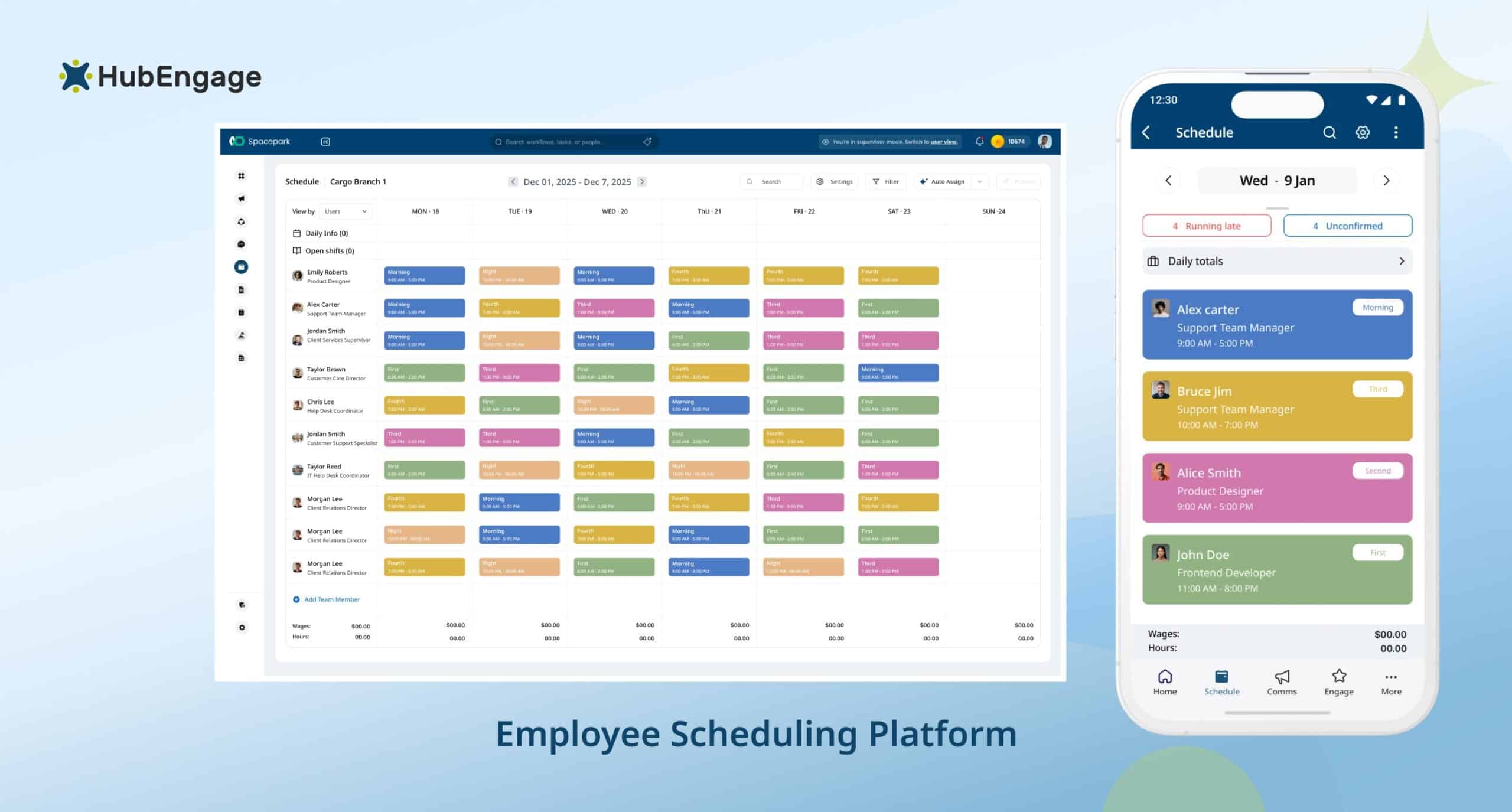
HubEngage provides a modern employee scheduling solution within its broader employee experience platform, helping organizations organize and manage workforce schedules across departments and locations. Managers can easily create, assign, and modify schedules in real time while giving employees clear visibility into shifts, schedules, and daily responsibilities.
Built for today’s workforce, HubEngage offers mobile-first scheduling access for frontline and deskless employees who need schedule visibility anytime and anywhere. Real-time notifications and multi-channel communication ensure employees instantly receive shift updates, helping organizations reduce scheduling confusion, missed shifts, and communication gaps.
Connected with HRIS and employee management systems, HubEngage helps businesses create accurate schedules based on employee roles, locations, and availability. Because scheduling is part of a unified employee engagement platform, organizations can also connect workforce communication, tasks, and engagement tools to improve operational coordination.
Features:
- Build and update employee schedules with real-time visibility across teams.
- Mobile-first access helps frontline workers check schedules from anywhere
- Instant notifications share schedule changes across multiple communication channels
- HRIS integration aligns scheduling with employee roles and availability accurately
- Multi-channel alerts supported through mobile, email, SMS, and signage
Pros:
- Unified employee engagement and workforce scheduling platform
- Strong communication and employee engagement capabilities included
- Scales efficiently for mid-sized businesses and enterprises.
Cons:
- Offers broader features beyond scheduling functionality alone.
- Full platform adoption may require additional onboarding and training
2. Deputy
Deputy is employee scheduling software designed for retail, healthcare, and hospitality businesses managing shift-based teams. The platform helps organizations automate scheduling, track attendance, manage labor law compliance, and improve workforce communication through mobile scheduling tools and payroll integrations.
Deputy is known for its simple interface and automation capabilities, although advanced customization and reporting features may feel limited for larger enterprise operations.
3. When I Work
When I Work is staff scheduling software built for small and mid-sized businesses looking for a simple scheduling solution. It supports employee scheduling, shift swapping, attendance tracking, and team communication through a beginner-friendly interface.
The platform is affordable and easy to implement, making it suitable for growing teams, though it offers fewer advanced analytics and enterprise integrations than larger workforce management platforms.
4. Homebase
Homebase is employee scheduling software created for hourly workers and small businesses in retail, restaurants, and service industries. The platform combines employee scheduling, time tracking, hiring tools, payroll integrations, and communication features into one workforce management solution.
Homebase is popular for its affordability and easy setup, although larger organizations may find its customization and reporting capabilities somewhat limited.
5. Shiftboard
Shiftboard is workforce scheduling software designed for manufacturing, healthcare, and industrial organizations managing complex scheduling environments. The platform supports labor forecasting, compliance tracking, workforce analytics, and enterprise scheduling operations across multiple teams and locations.
Shiftboard works well for businesses with advanced workforce requirements, although its implementation process and interface can feel more complex compared to simpler scheduling tools.
6. ZoomShift
ZoomShift is employee scheduling software focused on small businesses and hourly teams needing straightforward scheduling and attendance management. The platform helps managers create schedules, track employee hours, send automated shift reminders, and manage workforce communication through mobile access.
ZoomShift is easy to use and affordable for smaller organizations, but it offers fewer advanced integrations and analytics features than enterprise workforce scheduling platforms.
7. Sling
Sling is staff scheduling software that combines employee scheduling, communication, and task management into a single platform. Businesses use Sling to manage shifts, track attendance, assign tasks, and improve team coordination through desktop and mobile scheduling tools.
The software is especially useful for small businesses seeking affordable workforce scheduling solutions, although reporting capabilities and advanced customization options remain somewhat limited.
8. Humanity
Humanity is workforce scheduling software designed for organizations requiring advanced forecasting, flexible scheduling, and workforce analytics. The platform helps businesses optimize staffing levels, improve labor planning, and maintain compliance across shift-based operations.
Humanity is recognized for its scheduling flexibility and forecasting capabilities, though smaller businesses may find the pricing and learning curve higher than simpler employee scheduling platforms.
9. Planday
Planday is employee scheduling software developed for hospitality, retail, and service-based businesses managing shift workers across multiple locations. The platform supports workforce scheduling, payroll integrations, labor cost tracking, and employee communication through mobile-friendly tools.
Planday is known for its hospitality-focused scheduling features and compliance support, although customization options and enterprise-level reporting may not suit every large organization.
10. 7shifts
7shifts is restaurant employee scheduling software designed specifically for restaurants and hospitality businesses managing hourly workers. The platform helps restaurant managers control labor costs, create schedules, track attendance, and improve staff communication through industry-specific workforce management tools.
7shifts is highly effective for restaurant operations, though businesses outside hospitality may find its features and customization options more limited.
Employee Scheduling Software Comparison Table
| Software | Best For | Key Strength |
| HubEngage | Manufacturing, healthcare, hospitality | Employee engagement, workforce communication, and scheduling in one platform |
| Deputy | Retail, healthcare, hospitality | Automated scheduling with compliance management tools |
| When I Work | Small and mid-sized businesses | Simple employee scheduling and shift management |
| Homebase | Hourly workers and small businesses | Affordable scheduling with payroll and hiring tools |
| Shiftboard | Manufacturing and industrial operations | Advanced workforce scheduling and compliance tracking |
| ZoomShift | Small businesses and hourly teams | Easy scheduling and attendance management |
| Sling | Small businesses and retail teams | Scheduling combined with communication and task management |
| Humanity | Enterprises and shift-based organizations | Workforce forecasting and labor planning capabilities |
| Planday | Hospitality and retail businesses | Workforce planning with payroll and labor tracking |
| 7shifts | Restaurants and hospitality businesses | Restaurant-focused labor scheduling and workforce management |
Explore this detailed blog on employee scheduling tools and resources to understand key features, pricing differences, workforce management capabilities, and much more to help you pick the right solution for your team.
How to choose the right Scheduling Software?
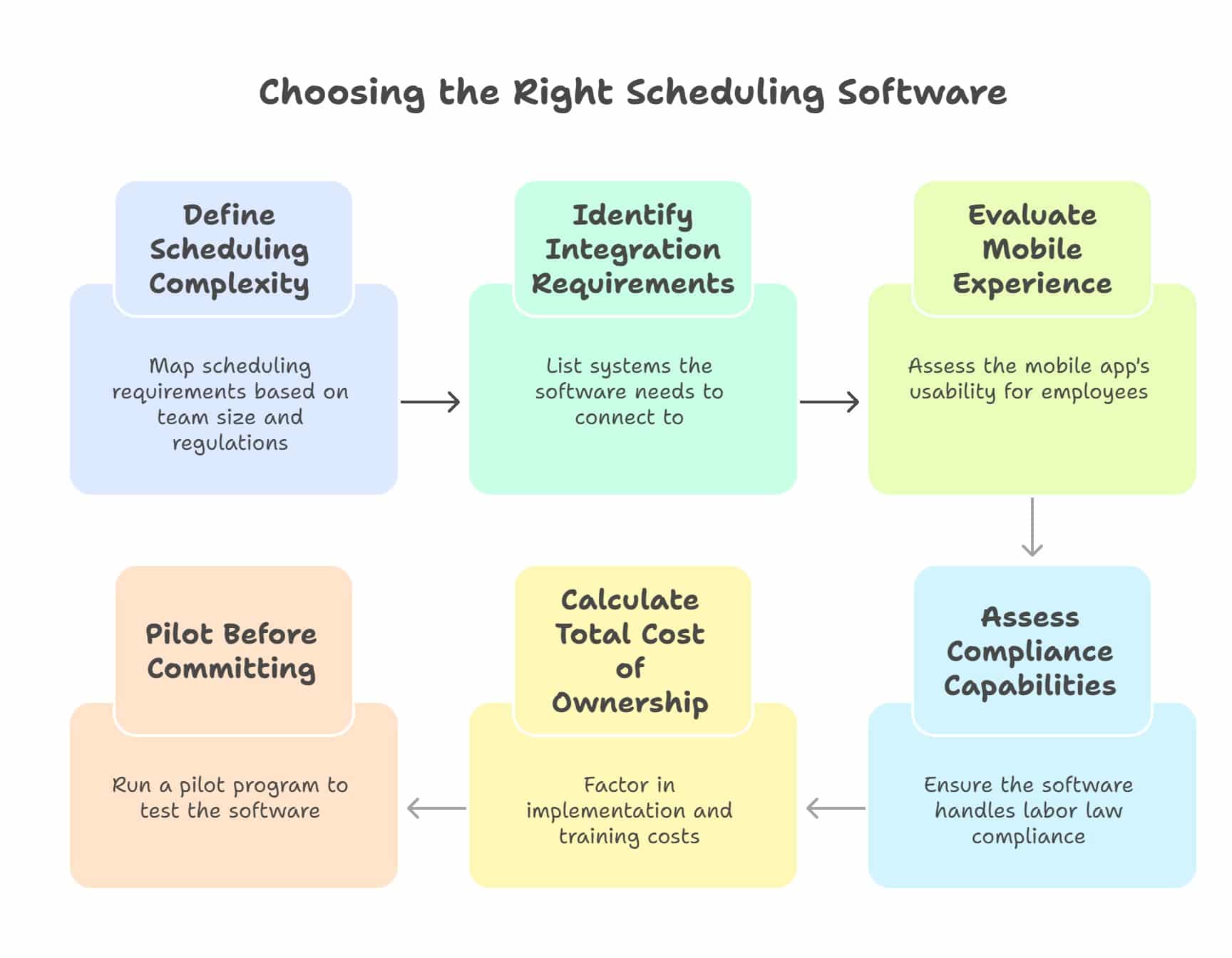
Choosing employee scheduling software is a decision that affects operations, HR, payroll, and every frontline worker in your organization. Here is a structured approach.
1: Define Your Scheduling Complexity
Start by mapping your actual scheduling requirements based on the team size, locations, number of shifts, etc. Also, check what all certifications as well as regulations of the governing bodies you need to follow along. Remember that an employee scheduling software that works for a 40-person restaurant will not handle a 500-person manufacturing plant with three shifts and union rules.
2: Identify Your Integration Requirements
Employee scheduling software that does not connect to your payroll system creates a manual reconciliation problem. Before evaluating platforms, list every system the scheduling tool needs to talk to: your HRIS, payroll provider, time and attendance system, and any industry-specific tools.
3: Evaluate Mobile Experience
In healthcare, manufacturing, and hospitality, most employees do not have regular desk access. If the mobile app is poor, adoption will be poor. Request a demo that shows the employee-facing mobile experience, not just the manager dashboard.
4: Assess Compliance Capabilities
Labor law compliance is not optional. Personnel scheduling software should handle your specific requirements: overtime rules, break requirements, predictive scheduling laws (active in several U.S. states and cities), and any applicable collective bargaining agreements.
5: Calculate Total Cost of Ownership
Contact vendors for a personalized quote based on your headcount and required features. Factor in implementation costs, training time, and any per-user fees that scale with your workforce. The lowest per-seat price does not always produce the lowest total cost.
6: Pilot Before Committing
Run a structured pilot with one department or location before a full rollout. Measure schedule creation time, employee adoption rates, and error frequency. Data from a real pilot is far more reliable than vendor case studies.
Implementation and Integration Considerations
After selecting the right employee scheduling software it is very important that its implementation is properly done. This is where many organizations face challenges. By knowing some common factors, you can reduce that risk significantly. Let us explore some of them:
Start with data cleanup.
Employee scheduling software is only as accurate as the data you put in. Before go-live, audit your employee records: roles, certifications, availability constraints, and employment classifications. Garbage in, garbage out applies here with real operational consequences.
Map your integrations early.
The connection between employee scheduling software and payroll is the most critical integration. Work with your payroll provider and scheduling vendor together before launch. Mismatched data formats and API limitations are easier to solve in pre-implementation than in a live environment.
Train managers first, employees second.
Managers who do not understand the system will revert to spreadsheets. Invest in manager training before rolling out employee-facing features. When managers are confident, employee adoption follows naturally.
Communicate the change clearly.
Employees who have used paper schedules or bulletin boards for years will have questions. A clear communication plan explaining what is changing, why, and what they need to do reduces friction. Remember that the human side of implementation matters as much as the technical side.
Plan for ongoing administration.
Employee scheduling software requires ongoing maintenance: updating employee records, adjusting rules as labor laws change, and refining configurations as your operations evolve. Assign a clear owner for this function before launch.
Employee scheduling software implementation checklist
| Implementation Step | Why It Matters | Impact |
| Data cleanup | Accurate employee data improves scheduling accuracy | Reduces scheduling errors and compliance risks |
| Early integrations | Connects payroll, HR, and scheduling systems smoothly | Prevents payroll and data transfer issues |
| Manager training | Helps managers confidently use scheduling software | Improves employee adoption and efficiency |
| Clear communication | Keeps employees informed about scheduling changes | Reduces confusion and resistance |
| Ongoing administration | Maintains scheduling accuracy as operations evolve | Supports long-term workforce management success |
Before you implement any employee scheduling software, establish a clearly defined scheduling process first. Organizations that already understand their shift structures, staffing requirements,, and scheduling policies are far more successful during implementation.
If you are looking for the right start then, you must explore this guide on creating employee schedules. Use it as a practical roadmap for improving coverage, reducing conflicts, and building more reliable workforce plans.
Employee Scheduling Software ROI and Cost-Benefit Analysis
The business case for employee scheduling software is well-supported by operational data. Organizations should evaluate ROI across four dimensions.
| Factor | Key Impact | Average Business Benefit |
| Labor cost reduction | Automated overtime alerts and optimized scheduling reduce excess labor costs | 10–15% reduction in overtime costs during the first year |
| Administrative time savings | Reduces manual scheduling workload for managers | Cuts scheduling time from 6–10 hours weekly to under 2 hours, saving 200+ management hours annually |
| Reduced absenteeism and turnover | Better schedule visibility improves employee reliability and retention | Schedules shared 1–2 weeks in advance help lower absenteeism and turnover costs of $3,000–$5,000 per employee replacement |
| Compliance risk mitigation | Automatically flags labor law and overtime violations before they occur | Helps avoid costly wage-and-hour penalties that can exceed annual software licensing costs |
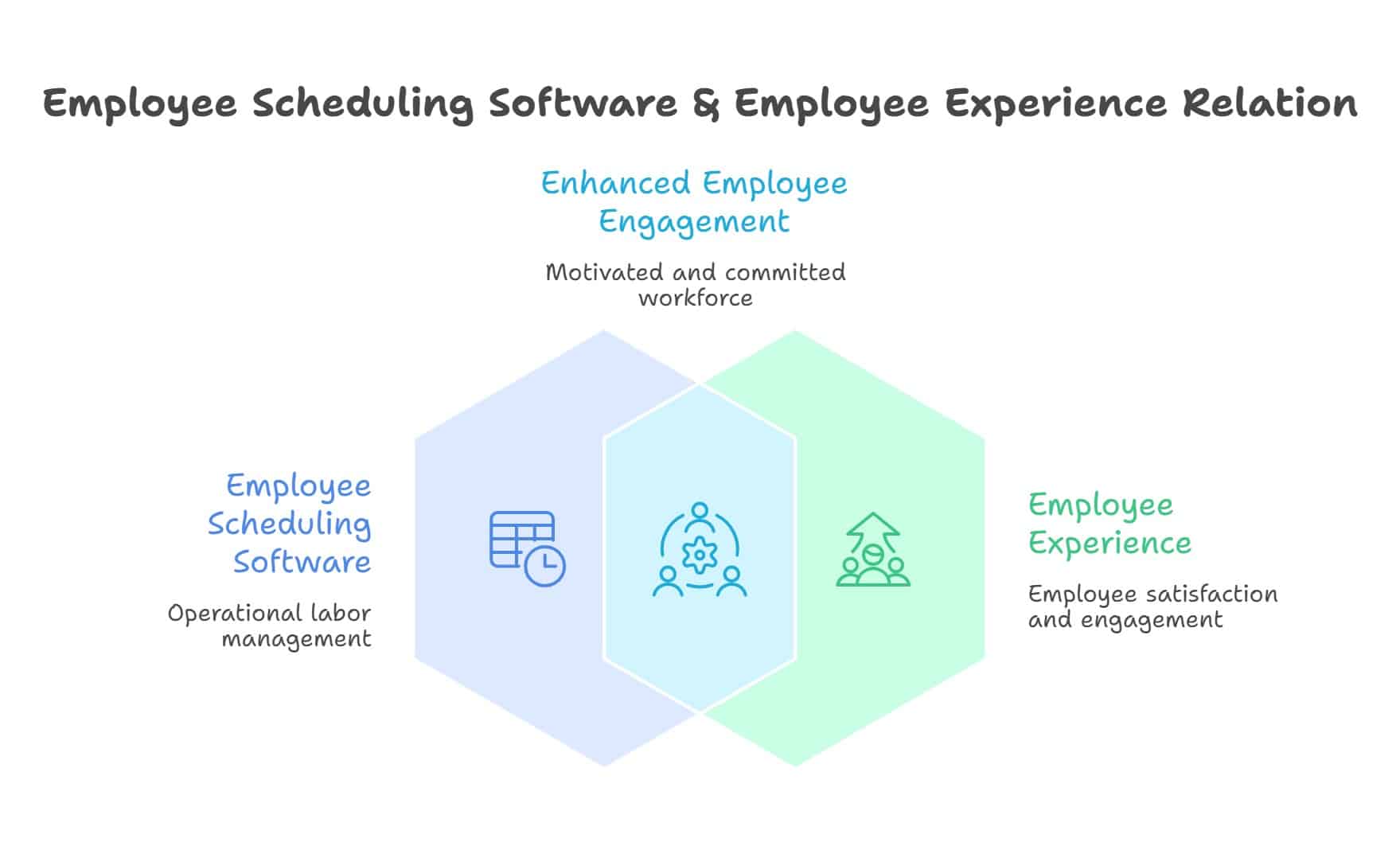
How Employee Scheduling Software Relates to Employee Experience?
Employee scheduling programs are not just an operational tool — they directly affect how employees feel about their work. Unpredictable schedules, last-minute changes, and ignored availability requests are leading drivers of turnover in shift-heavy industries. When labor scheduling software gives employees visibility into their schedules, allows shift swaps, and respects stated preferences, engagement improves measurably. This is why employee scheduling software increasingly sits within broader employee experience platforms rather than as a standalone HR tool.
If you want to explore how these programs improve workforce coordination, employee engagement, and shift management efficiency, check out this blog on employee scheduling programs.
Conclusion
Employee scheduling software is no longer a nice-to-have for shift-heavy industries. It is a core operational tool that affects labor costs, compliance, and employee retention simultaneously. If your organization is still managing schedules manually, the cost of that decision shows up in overtime bills, manager hours, and turnover rates.
See how HubEngage connects scheduling with employee communications and engagement providing unified workforce operations that reduce tool sprawl and improve the employee experience across different frontline teams. Ready to get started? Take the demo session to learn more about the platform.
Employee Scheduling Software FAQs
How long does it take to implement employee scheduling software?
Small businesses typically implement employee scheduling software within two to four weeks, while enterprise organizations with multiple locations, integrations, and union requirements may require three to six months.
Can employee scheduling software handle union rules and collective bargaining agreements?
Yes, enterprise employee scheduling software supports union rules, including seniority-based scheduling, overtime distribution, mandatory rest periods, and compliance requirements through configurable workforce management policies.
Is employee scheduling software suitable for small businesses?
Yes, employee scheduling software works well for small businesses, especially teams managing rotating shifts, part-time employees, multiple job roles, and scheduling conflicts across limited staff.
How does employee scheduling software handle last-minute shift changes?
Employee scheduling software supports instant shift reassignment, employee shift swaps, mobile notifications, and open shift boards that help managers quickly fill unexpected scheduling gaps.
Does employee scheduling software integrate with time and attendance systems?
Yes, most employee scheduling software integrates with time and attendance systems to compare planned schedules with clock-in data, improving payroll accuracy and overtime tracking.
What industries benefit most from employee scheduling software?
Manufacturing, healthcare, hospitality, retail, transportation, and field service industries benefit most from employee scheduling software due to complex shifts, compliance requirements, variable staffing demand, and turnover challenges.
Related Links:
workforce management | employee scheduling programs | shift scheduling app | online employee scheduling software | employee scheduling and time tracking software | shift management software | create employee schedule | staff scheduling software | hotels staff scheduling software | retail employee scheduling software | staff scheduling template | online staff scheduling | staff scheduling app | healthcare staff scheduling software