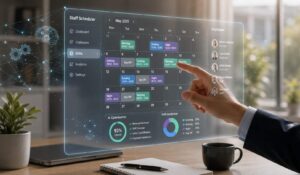
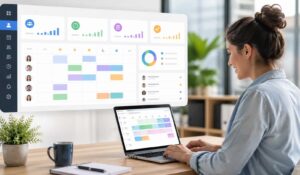
Hotel operations run on tight margins and tighter timelines. When a front desk agent calls out sick at 6 AM or a banquet event suddenly doubles in size, manual scheduling on spreadsheets does not cut it anymore. You need systems that respond in real time, communicate instantly, and keep your workforce aligned.
In this resource guide we will cover the essential tools, frameworks, and best practices for hotels staff scheduling software — so you can evaluate your options, understand what features matter, and make a smarter decision for your property.
Key Takeaways
- Hotel staff scheduling software helps hotels automate shift planning, manage employee availability, and improve workforce communication across departments.
- Modern scheduling tools reduce schedule creation time by up to 70% while helping managers handle last-minute shift changes, overtime, and labor compliance more efficiently.
- Mobile-first scheduling platforms allow hotel employees to view schedules, swap shifts, request time off, and receive instant updates from anywhere.
- Integrating scheduling software with PMS, payroll, HR, and time-tracking systems improves operational efficiency and reduces manual administrative work.
- Automated scheduling helps hotels control labor costs, prevent overstaffing, reduce overtime, and align staffing levels with guest demand and occupancy forecasts.
- The best hotel staff scheduling software combines workforce scheduling, employee communication, and engagement tools to improve staff satisfaction, retention, and overall hotel performance.

What Is Hotel Staff Scheduling Software?
Hotel staff scheduling software is a category of online workforce scheduling software designed specifically to manage shift planning, availability tracking, labor compliance, and team communication for hospitality environments. Unlike generic scheduling tools, hotels staff scheduling software accounts for the unique demands of 24/7 operations, multi-department coordination, and variable guest volumes.
Hotels staff scheduling software connects department heads, HR managers, and frontline staff through a single web-based platform. Managers build and publish schedules digitally. Employees view shifts, request time off, and swap assignments from their phones. The system tracks hours, flags overtime, and often integrates directly with property management systems (PMS) and payroll platforms.
Key Insight: Hotels that switch from manual scheduling to automated online workforce scheduling software report an average reduction of 70% in time spent building weekly schedules, according to workforce management industry benchmarks.
This category of online employee scheduling tools is sometimes called web-based employee scheduling software, and the terms are used interchangeably across the industry.
Key Features for Hospitality Workforce Management
Not all hotels staff scheduling software is built the same. When evaluating platforms, focus on the features that directly address hospitality-specific challenges.
Essential Feature Checklist
- Shift templates by department: Pre-built templates for housekeeping, front desk, food and beverage, and maintenance so you are not rebuilding schedules from scratch every week.
- Real-time availability tracking: Staff can update their availability directly in the system, reducing the back-and-forth that wastes manager time.
- Mobile access for all staff: Frontline hotel employees rarely sit at desks. Mobile-first design is non-negotiable for hotels staff scheduling software.
- Automated overtime alerts: The system flags when a shift assignment will push an employee into overtime before you publish the schedule.
- Multi-location support: Hotel groups managing multiple properties need centralized scheduling visibility across locations.
- Compliance tracking: Labor law rules around breaks, minimum rest periods between shifts, and maximum weekly hours vary by state. Good hotels staff scheduling software enforces these automatically.
- Integrated messaging: Shift notifications, coverage requests, and manager announcements delivered in-app reduce reliance on personal text threads.
Features That Separate Good from Great
| Feature | Basic Tools | Advanced Hotels Staff Scheduling Software |
|---|---|---|
| Schedule building | Manual drag-and-drop | AI-driven scheduling suggestions based on demand |
| Communication | Email notifications only | In-app chat, push notifications, two-way messaging |
| PMS integration | None | Direct sync with Opera, Cloudbeds, or similar |
| Labor cost tracking | Basic hour count | Real-time labor cost vs. budget dashboard |
| Compliance | Manual manager oversight | Automated rule enforcement by jurisdiction |
| Reporting | Shift summary exports | Predictive labor demand reports |
The difference between basic and advanced tools becomes visible during peak season. When occupancy spikes, AI-driven scheduling tools can recommend staffing levels based on historical data, saving hours of manual planning.
How Hotel Scheduling Software improves staff efficiency?
Hotels staff scheduling software improves efficiency at three levels: manager time, staff satisfaction, and labor cost control.
For managers, online staff scheduling eliminates the manual process of calling employees to fill open shifts. Open shifts are posted digitally, and available staff claim them directly. Managers approve with one tap. Studies from the Society for Human Resource Management indicate that managers in hospitality spend an average of 8 hours per week on manual scheduling tasks — time that online employee scheduling software reclaims for guest-facing priorities.
For staff, self-service scheduling tools reduce frustration. Employees can view their schedules from their phones, submit availability changes, and request shift swaps without waiting for a manager callback. This level of transparency directly supports employee satisfaction and retention — a critical concern in an industry with historically high turnover.
For labor costs, hotels staff scheduling software gives finance and operations teams real-time visibility into scheduled hours versus budgeted hours. Managers catch overstaffing before it happens, not after payroll runs.
The connection to broader employee experience is real. When staff feel informed and respected — when scheduling is fair, transparent, and accessible — engagement improves. Platforms like HubEngage extend this further by connecting scheduling data with employee communications and engagement tools, giving hotel leadership a unified view of workforce operations.
Integration with Hotel Management Systems
Hotels staff scheduling software does not operate in isolation. The most effective deployments integrate directly with the systems your property already uses.
Common Integration Points
- Property Management System (PMS): Occupancy data from systems like Opera Cloud or Cloudbeds feeds into the scheduling platform, helping managers staff appropriately for forecasted guest volume.
- Payroll platforms: Approved hours flow directly into payroll systems like ADP, Paychex, or Gusto, eliminating manual data entry and reducing payroll errors.
- Time and attendance systems: Clock-in/clock-out data syncs with the schedule to track actual versus planned hours.
- HR information systems (HRIS): Employee profiles, certifications, and employment status stay current across both systems automatically.
- Communication platforms: For hotels using unified communication tools, scheduling notifications can surface in the same channels employees already use for daily updates. The benefits of unified communication platforms become most visible when scheduling and messaging operate from a single interface.
When evaluating hotels staff scheduling software, ask vendors specifically about their PMS integrations. A system that cannot talk to your property management platform creates data silos that cost time and introduce errors.
Scheduling Software Comparison for Hotels
Evaluating Hotels Staff Scheduling Software Options
The market for hotels staff scheduling software includes purpose-built hospitality tools, general workforce management platforms, and employee experience platforms with scheduling modules. Each category has trade-offs.
| Platform Type | Best For | Key Strength | Key Limitation |
|---|---|---|---|
| Purpose-built hospitality scheduling | Single-property hotels with straightforward scheduling needs | Deep PMS integration | Limited employee engagement features |
| General workforce management | Multi-location hotel groups needing cross-site visibility | Scalability and reporting depth | May require customization for hospitality workflows |
| Employee experience platforms | Hotels prioritizing staff retention alongside scheduling | Combines scheduling, communication, and engagement | Broader feature set requires more onboarding time |
| Spreadsheet-based tools | Very small properties with minimal staff | Zero cost, familiar interface | No automation, no compliance enforcement, no mobile access |
When comparing options, evaluate based on your specific property size, PMS stack, and whether staff retention is a strategic priority alongside operational efficiency.
Implementation Best Practices for Hotel Operations
Switching to new hotels staff scheduling software requires more than a software purchase. The implementation process determines whether adoption succeeds or stalls.
A Practical Implementation Sequence
- Audit your current process: Document how schedules are currently built, communicated, and adjusted. Identify the top three pain points your team experiences.
- Define your requirements: List the integrations you need, the number of employees and departments, and any compliance rules specific to your state or local jurisdiction.
- Involve department heads early: Housekeeping, food and beverage, and front desk managers all have different scheduling patterns. Their input shapes configuration decisions.
- Run a pilot with one department: Launch hotels staff scheduling software in one department first. Gather feedback, fix configuration issues, and build internal advocates before rolling out property-wide.
- Train staff on mobile access: The system only works if employees use it. Run brief, practical training sessions focused on how staff view shifts, submit requests, and communicate with managers.
- Establish a feedback loop: Schedule a 30-day and 60-day review after launch. Measure time spent on scheduling, employee satisfaction with schedule visibility, and any compliance incidents.
Change management is often the hardest part. For guidance on navigating organizational transitions during new system rollouts, reviewing change management principles helps leadership prepare staff for the shift from manual to digital scheduling.
ROI and Cost Savings from Automated Scheduling
Hotels staff scheduling software delivers measurable financial returns. The math is straightforward when you account for all the cost drivers.
Where the Savings Come From
- Reduced overtime: Automated alerts prevent accidental overtime assignments. Hotels typically see a 15–20% reduction in overtime costs within the first quarter of deployment.
- Lower administrative labor: Managers reclaim 5–8 hours per week previously spent on manual scheduling. At a department head salary, that time has real dollar value.
- Reduced turnover costs: The Society for Human Resource Management estimates the average cost to replace a hospitality employee at 50–60% of annual salary. Scheduling tools that improve fairness and transparency contribute directly to retention.
- Compliance cost avoidance: A single wage-and-hour violation can cost tens of thousands of dollars in fines and legal fees. Automated compliance tracking in hotels staff scheduling software prevents these incidents.
- Optimized labor-to-occupancy ratio: When scheduling syncs with PMS occupancy data, hotels avoid both overstaffing during slow periods and understaffing during peak demand.
The U.S. Bureau of Labor Statistics consistently identifies labor as the largest controllable cost in hotel operations — typically 30–35% of total revenue. Hotels staff scheduling software directly targets this cost center.
Conclusion
Hotels staff scheduling software is one of the highest-leverage operational investments a property can make — directly reducing labor costs, improving staff satisfaction, and eliminating compliance risk. The right platform connects your scheduling data with the broader employee experience, not just the shift calendar.
See how HubEngage unifies hotel scheduling, staff communications, and employee engagement — connect your workforce operations in one platform and reduce the time your managers spend on administrative tasks every week.
Hotel Staff Scheduling Software FAQs
What is the difference between online employee scheduling and traditional scheduling?
Online employee scheduling refers to web-based or app-based platforms where schedules are built, published, and managed digitally. Traditional scheduling relies on paper printouts, whiteboards, or spreadsheets. Online staff scheduling gives employees real-time access to their schedules from any device, allows instant updates when changes occur, and automates notifications — none of which are possible with manual methods.
How does hotels staff scheduling software handle last-minute shift changes?
Most hotels staff scheduling software platforms include an open shift board where managers post uncovered shifts. Available employees receive push notifications and can claim the shift directly. Managers approve the change, and the schedule updates automatically. This replaces the manual process of calling through a contact list, which can take an hour or more per open shift.
Can small boutique hotels benefit from scheduling software?
Smaller properties often see the fastest ROI from hotels staff scheduling software because they have fewer administrative resources. A boutique hotel with 15–30 staff members still deals with shift swaps, availability changes, and compliance requirements. Web-based employee scheduling software with a simple interface and affordable pricing scales down effectively for smaller operations.
Does scheduling software replace the need for an HR manager?
Hotels staff scheduling software automates scheduling tasks but does not replace HR functions. HR managers still handle hiring, performance management, benefits administration, and employee relations. The software frees HR and operations managers from repetitive scheduling work so they can focus on higher-value responsibilities.
How long does implementation typically take?
For a single property, most hotels staff scheduling software implementations take two to six weeks from contract signing to full deployment. Multi-property rollouts take longer, typically two to four months, depending on integration complexity and the number of departments involved.