Managing employees efficiently has become one of the biggest priorities for modern businesses. From scheduling to productivity tracking, companies need smarter ways to manage daily operations and keep employees engaged.
Workforce management helps businesses organize employee schedules, track attendance, manage tasks, and improve overall productivity. It ensures the right employees are available at the right time, helping organizations run smoothly and efficiently.
By implementing robust workforce management solutions, companies can align their human resources with organizational goals, for better performance as well as customer satisfaction. In this guide we will cover everything about workforce management like what it is, key benefits, essential tools, and future workplace management trends.
Key Takeaways
- Workforce management helps businesses improve scheduling, productivity, communication, attendance tracking, and overall employee performance.
- Modern workforce management software reduces manual work, improves efficiency, and supports better workforce planning decisions.
- Businesses use workforce management tools to manage remote, frontline, hybrid, and in-office employees effectively.
- Workforce management key features include scheduling, task management, attendance tracking, payroll integration, and workforce analytics.
- Workforce management software improves employee engagement, reduces operational costs, and supports long-term business growth.
- AI, automation, mobile access, and workforce analytics are shaping the future of workforce management solutions.

What is Workforce Management?
Workforce management is the process of managing employees efficiently to improve productivity and business performance. It includes activities such as scheduling, time tracking, tasks management that together helps with seamless workflow as well as business operations.
Businesses use workforce management solutions to ensure the right employees are available at the right time. This helps reduce operational costs, improve employee engagement, and streamline daily operations.
Modern workforce management tools also provide real-time insights and automation, making it easier for organizations to manage teams, improve communication, and adapt to changing business needs.
As workplaces continue to evolve, workforce management has become an essential part of building an efficient and productive workforce.
Challenges faced by traditional Workforce Management approaches
Traditional workforce management methods often encounter several obstacles:
- Manual Processes: Reliance on spreadsheets and paper-based systems can lead to errors and inefficiencies.
- Lack of Real-Time Data: Delayed information hampers timely decision-making and responsiveness.
- Inflexibility: Static schedules fail to adapt to sudden changes in demand or employee availability.
- Compliance Risks: Keeping up with ever-changing labor laws manually increases the risk of non-compliance.
These challenges highlight the necessity for advanced workforce management solutions that offer automation, real-time analytics, and adaptability.
Asana’s report shows that workers spend 60% of their time on tasks like chasing updates, attending unnecessary meetings, and switching between tools. This causes missed deadlines, stress, and less productivity. Manual processes and lack of real-time workforce data often lead to higher labor costs, low employee engagement, and increased turnover.
This is where workforce management becomes essential by helping businesses streamline scheduling, track employee performance, manage attendance, and improve workforce planning.
With better forecasting and automation, organizations can reduce operational costs, improve employee satisfaction, and ensure the right people are available at the right time. An effective workforce management is key to improving productivity, efficiency, and long-term business growth.
The evolution of Workforce Management
The concept of workforce management has evolved significantly over the decades. Initially, businesses used manual methods, recording hours on paper and relying on spreadsheets to track time and attendance. However, the rise of technology and data analytics has transformed this landscape.
Now, companies employ sophisticated software solutions that can predict staffing needs and analyze work patterns. Modern systems integrate various communication channels, like mobile apps, web, email, SMS, and even digital signage, enabling organizations to reach and engage employees effectively.
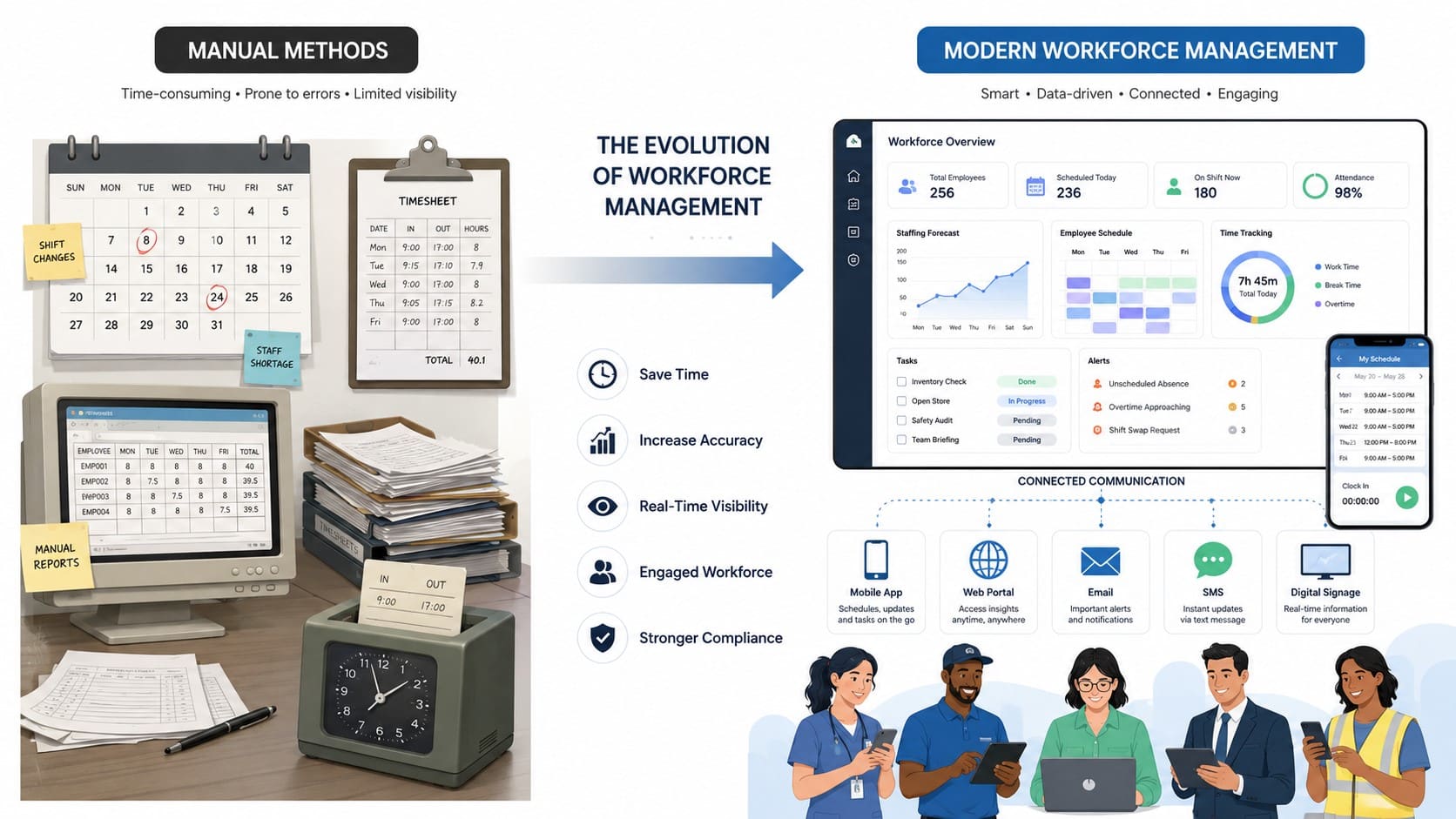
As workforce management continues to advance, the incorporation of artificial intelligence and machine learning has become increasingly prevalent. These technologies allow businesses to forecast demand more accurately, optimize schedules, and even automate routine tasks. For instance, AI can analyze historical data to identify trends in employee performance and attendance, enabling managers to make informed decisions about staffing levels and resource allocation.
Furthermore, the focus on employee well-being and engagement has led to the development of tools that facilitate better work-life balance. Companies are increasingly recognizing the importance of feedback loops, utilizing surveys and analytics to gauge employee satisfaction and adapt their workforce strategies accordingly.
Key components of Workforce Management solutions
Effective Workforce Management solutions encompass several critical components:
- Forecasting and Planning: Predicting future labor requirements based on historical data and market trends.
- Scheduling: Creating optimal work schedules that balance employee availability with organizational needs.
- Time and Attendance Tracking: Monitoring employee work hours to ensure accuracy in payroll and compliance.
- Task Management: Organizing daily tasks, assigning responsibilities, and tracking progress to improve team productivity and workflow efficiency.
- Performance Management: Evaluating employee performance to identify areas for improvement and development.
- Compliance Management: Ensuring adherence to labor laws and regulations to mitigate legal risks.
By integrating these components, organizations can create a cohesive system that streamlines operations and enhances productivity.
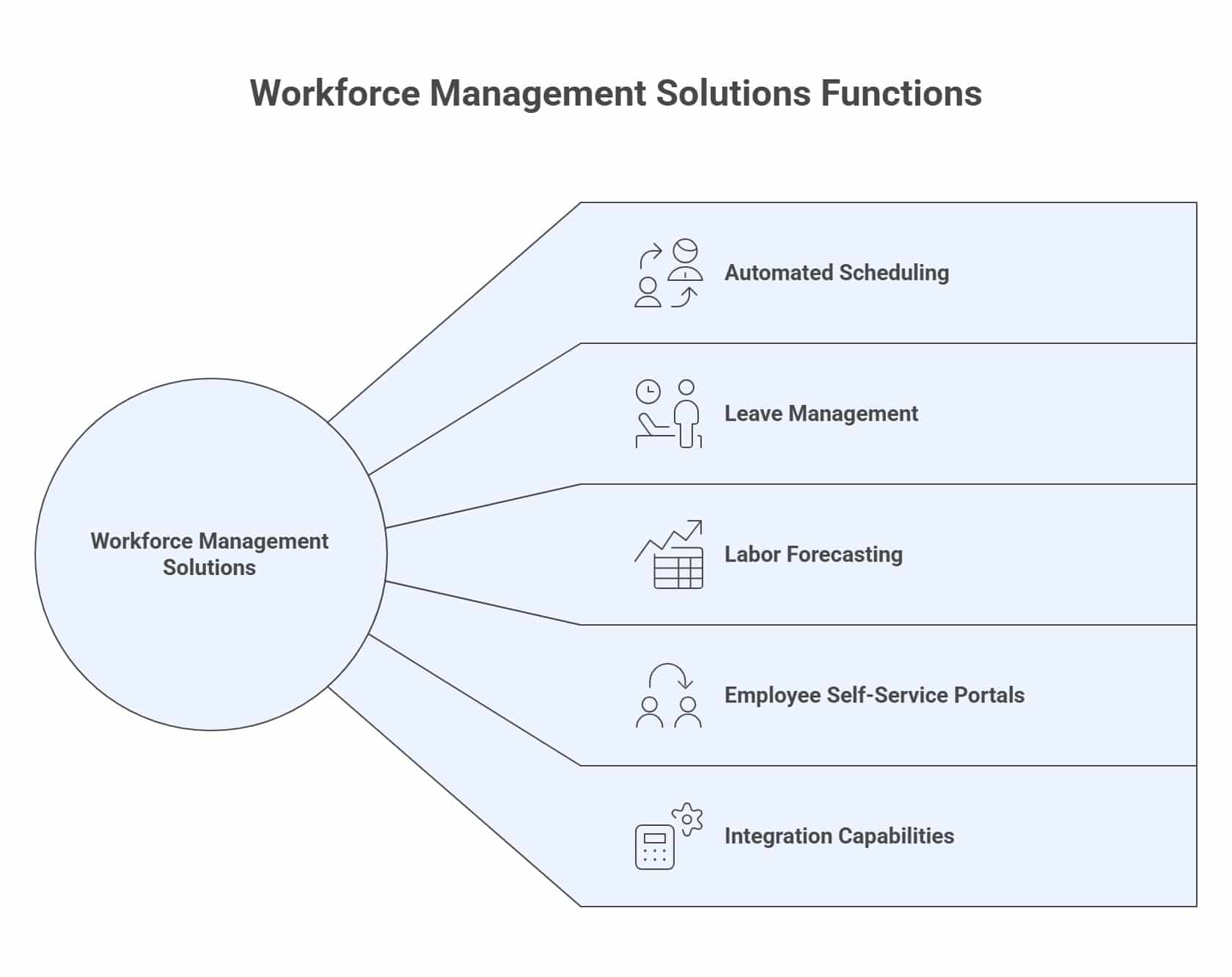
Core functions of Workforce Management solutions
A robust Workforce Management solution should offer the following core functions:
- Automated Scheduling: Tools automatically create employee schedules based on workload and availability. Example: Retail stores adjusting shifts during busy weekends.
- Leave Management: Systems simplify vacation, sick leave, and absence requests for employees and managers. Example: Employees requesting leave directly through a mobile app.
- Labor Forecasting: Predictive tools help businesses estimate future staffing needs accurately. Example: Restaurants increase staff during holiday seasons.
- Employee Self-Service Portals: Employees can check schedules, update availability, and request shift changes easily. Example: Frontline workers swapping shifts online.
- Integration Capabilities: Workforce tools connect with HR, payroll, and communication systems smoothly. Example: Attendance data automatically syncing with payroll software.
These functions collectively ensure that workforce management aligns with both employee needs and organizational objectives.
Benefits of implementing Workforce Management
Adopting a comprehensive Workforce Management system offers numerous advantages:
- Improved Productivity: Streamlined processes enable employees to focus on core tasks.
- Cost Savings: Efficient scheduling reduces overtime and labor costs.
- Enhanced Employee Engagement: Transparent scheduling and performance tracking boost morale.
- Accurate Payroll Processing: Automated time tracking minimizes errors in wage calculations.
- Better Compliance: Automated updates ensure adherence to current labor laws.
- Data-Driven Decision Making: Access to real-time analytics facilitates informed strategies.
- Reduced Absenteeism: Proactive monitoring helps address attendance issues promptly.
- Optimized Resource Allocation: Aligning workforce capabilities with demand improves service delivery.
- Scalability: Modern solutions can grow with the organization, accommodating increased complexity.
- Improved Customer Satisfaction: Efficient operations lead to better service quality.
Workforce Management Benefits Summary Table
| Advantages | Impact |
| Improved Productivity | Helps employees complete tasks faster and improve daily workflow efficiency. |
| Cost Savings | Reduces overtime costs and improves workforce scheduling efficiency. |
| Better Employee Engagement | Keeps employees motivated, connected, and satisfied at work. |
| Accurate Payroll Management | Minimizes payroll errors through automated attendance and time tracking. |
| Better Compliance | Helps businesses follow labor laws and workplace regulations easily. |
| Data-Driven Decisions | Provides real-time workforce insights for smarter business planning. |
| Reduced Absenteeism | Helps monitor attendance and reduce unplanned employee absences. |
| Optimized Resource Allocation | Ensures the right employees handle the right tasks efficiently. |
| Scalability | Supports business growth with flexible workforce management processes. |
| Improved Customer Satisfaction | Improves service quality through better workforce coordination and operations. |
Top 5 Workforce Management Tools
1. HubEngage: Workforce Management Platform
Our software helps businesses simplify scheduling, task management, time tracking, communication, etc from one unified platform. It helps organizations manage daily workforce operations more efficiently while improving employee productivity and collaboration.
The platform combines workforce communication, task tracking, attendance management, surveys, recognition, and AI-powered tools to solve common workforce management challenges like poor communication, disconnected systems, manual processes, and low employee engagement.
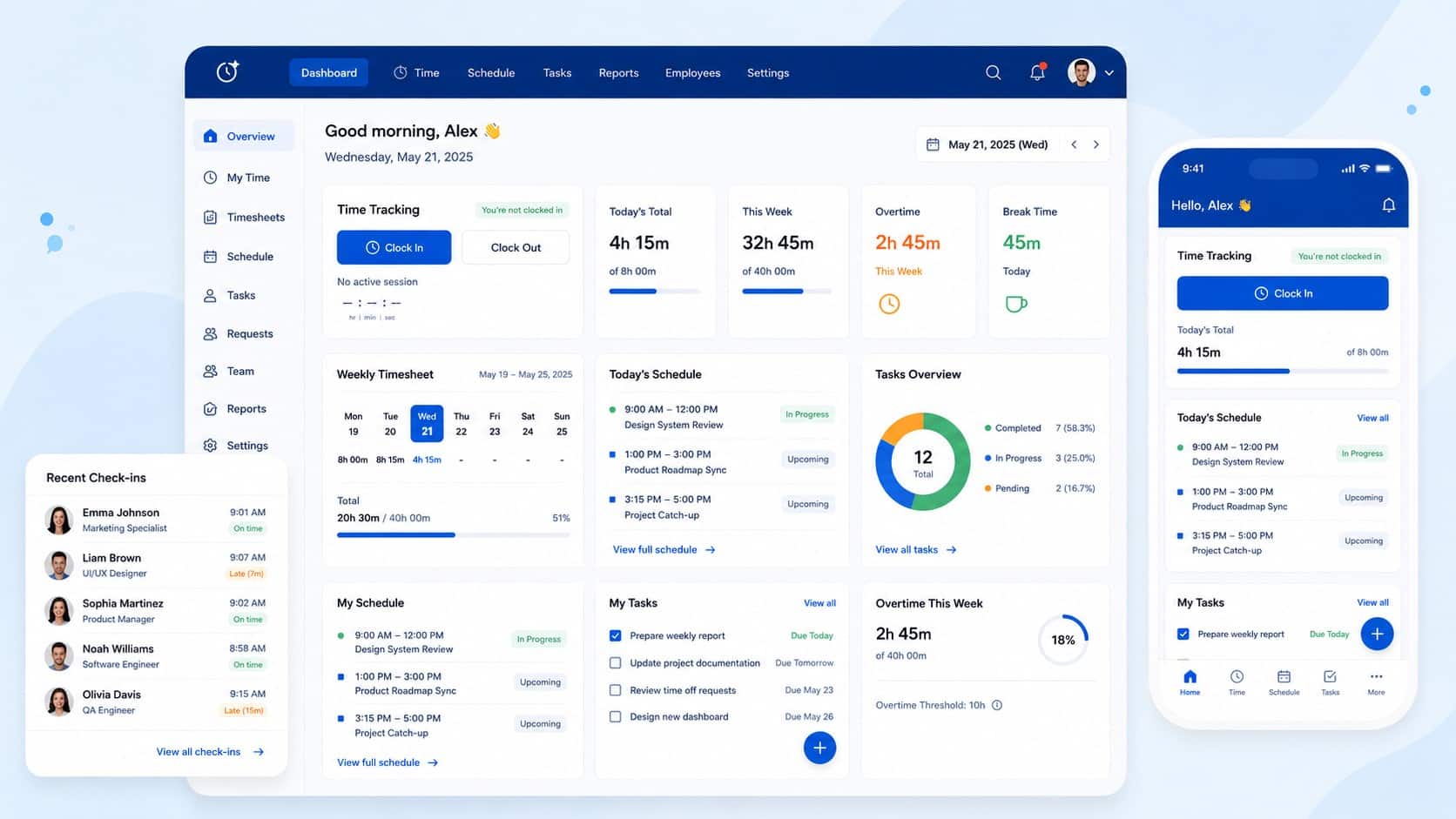
With mobile, web, email, SMS, and digital signage access, employees can stay informed, connected, and productive from anywhere. By bringing multiple workforce management tools into one platform, HubEngage reduces operational complexity and helps businesses improve workforce efficiency at scale.
Key Features:
- Employee scheduling across teams and multiple work locations
- Time tracking for attendance, overtime, and productivity monitoring
- Learning tools for employee training and workforce development
- Task management for assigning and tracking daily work
- Multi-channel access through mobile, web, email, and SMS
- Real-time communication tools for better workforce collaboration
- AI chatbot support for quick employee assistance and updates
- Scalable modules supporting growing workforce management needs
Best for:
Organizations looking to improve workforce productivity, operational efficiency, scheduling, communication, and overall employee performance.
Watch this review from Gareth Young, Director of Health, Safety, Environment, and Quality at EnerCorp, sharing how HubEngage improved their workforce management operations.
“Managing frontline workforce operations across multiple locations was becoming difficult for our teams. After implementing HubEngage, scheduling, task coordination, and workforce communication became much more organized and efficient. It provided a centralized platform to manage updates, improve collaboration, and keep employees aligned daily. Overall, HubEngage helped us improve workforce productivity, operational efficiency, and employee connectivity across the organization.”
Discover more real-world impact as well as success stories of our customers and what they say about HubEngage’s employee experience platform
2. BambooHR
BambooHR offers a comprehensive HRIS designed for small and medium-sized businesses. It streamlines various HR functions, including applicant tracking, onboarding, time-off tracking, and performance management.
3. Gusto
Gusto provides an all-in-one payroll platform that simplifies payroll processing, benefits administration, and compliance management. Designed for small to medium-sized businesses, Gusto automates tax calculations, filings, and offers direct deposit services.
4. Asana
Asana is a leading task management tool that helps teams organize and manage their work effectively. It offers features like project tracking, task assignments, deadlines, and collaboration tools.
5. Lattice
Lattice is a performance management platform that focuses on employee development and organizational alignment. It offers tools for setting goals, conducting performance reviews, and gathering feedback.
Workforce Management Software Comparison Table
| Software | Best For | Key Features | Business |
| HubEngage | Complete Workforce Experience | Employee app, chat, surveys, recognition, social intranet | SMBs to Enterprise |
| BambooHR | HR management | Onboarding, employee records, attendance tracking | Small to Medium Businesses |
| Gusto | Payroll and benefits management | Payroll automation, tax filing, compliance | Small to Medium Businesses |
| Asana | Task and project management | Task tracking, collaboration, workflow management | Startups to Enterprise |
| Lattice | Employee performance management | Goal tracking, reviews, employee feedback | Medium to Enterprise |
How to select an effective Workforce Management solution?
Choosing the right Workforce Management solution requires careful consideration of several factors:
- Scalability: Ensure the system can grow with your organization.
- Customization: The solution should adapt to your specific industry requirements.
- User-Friendly Interface: An intuitive design encourages adoption by all users.
- Integration: Compatibility with existing systems is crucial for seamless operations.
- Vendor Support: Reliable customer service ensures issues are resolved promptly.
Evaluating these factors helps in selecting a solution that not only meets current needs but also supports future growth.
Workforce Management Software Selection Checklist
| Selection Factor | Importance |
| Scalability | Supports future business growth and changing workforce requirements efficiently. |
| Customization | Adapts to industry-specific workforce management and operational business needs. |
| User-Friendly Interface | Makes workforce management tools easier for employees and managers to use. |
| Integration | Connects smoothly with existing HR, payroll, and communication systems. |
| Vendor Support | Provides reliable assistance for technical issues and ongoing platform support. |
Workforce Management future trends
Businesses are rapidly evolving as well as are continuously leveraging technology to build more efficient and engaging workplaces. As companies adapt to these changes, several key trends are shaping the future of workforce management.
1. AI-Powered Workforce Insights
AI helps businesses predict workforce trends, improve planning, and make faster employee management decisions.
2. Remote and Hybrid Workforce Management
Remote workforce tools improve communication, collaboration, and productivity for employees working from different locations.
3. Employee Well-Being and Mental Health Initiatives
Businesses now support employee wellness programs to improve satisfaction, productivity, engagement, and work-life balance.
4. Data-Driven Decision Making
Workforce analytics helps companies track employee performance, productivity trends, and overall workforce efficiency effectively.
5. Mobile-First Workforce Management
Mobile workforce management tools help employees access schedules, updates, and communication anytime from anywhere.
6. Real-Time Employee Communication and Collaboration
Real-time communication tools keep employees connected, informed, and engaged across teams and workplace locations.
7. Gamification and Engagement Strategies
Gamification features increase employee participation, motivation, engagement, and overall workplace productivity through interactive experiences.
8. Automated HR and Payroll Systems
Automation simplifies payroll, reduces errors, saves administrative time, and improves overall HR workflow efficiency daily.
9. Continuous Feedback and Recognition Programs
Regular employee feedback and recognition improve motivation, engagement, job satisfaction, and long-term employee retention.
10. Digital Displays and Smart Office Integrations
Smart office tools and digital displays improve communication, announcements, collaboration, and employee workplace experiences.
Conclusion
Workforce management helps businesses improve productivity, streamline operations, and create better employee experiences. With the right tools, companies can manage schedules, tasks, communication, and workforce planning more efficiently.
Modern workforce management solutions also help reduce operational challenges, improve employee engagement, and support business growth. As workplaces continue to evolve, adopting smarter workforce management strategies has become more important than ever.
Looking for a better way to manage and engage your workforce? Explore how HubEngage can help simplify workforce management for your organization.
Workforce Management FAQs
What is workforce management?
Workforce management is the process of managing employee schedules, attendance, tasks, productivity, and workforce planning efficiently.
What is workforce management software?
Workforce management software helps businesses automate scheduling, attendance tracking, task management, payroll, and workforce communication processes.
Why is workforce management important?
Workforce management improves productivity, reduces operational costs, enhances employee engagement, and helps businesses manage teams efficiently.
What are the benefits of workforce management software?
Improves scheduling, less errors, easier payroll, high productivity, and better employee communication.
What features should workforce management software include?
Scheduling, attendance tracking, task management, reporting, communication, and analytics features are important features.
How does workforce management improve employee productivity?
Such tools streamline daily operations, reduce manual tasks, improve communication, and help employees work efficiently.
What industries use workforce management solutions?
Industries like healthcare, retail, manufacturing, hospitality, and corporate businesses commonly use such solutions daily.
How do workforce management tools support different work environments?
Different teams such as remote as well as frontline teams can communicate, track tasks, manage schedules, and stay connected from anywhere.