
The clearest reason to take workplace transparency seriously is this: Glassdoor’s 2024 Trust Survey found that 86% of executives believe employee trust is high, but only 67% of employees agree. That 19-point gap is where culture problems start. Leaders think they’re being clear. Employees feel they’re being managed at a distance.
In practice, workplace transparency isn’t radical openness. It’s a disciplined system for sharing what people need to know, when they need to know it, in a way they can access and question. For growing organizations, that system should be built early. If you wait until trust drops, attrition rises, or frontline employees stop believing leadership messages, you’re fixing culture under pressure instead of designing it on purpose.
If you’re thinking about broader communication maturity, HubEngage’s perspective on internal communication trends is a useful internal pillar topic to pair with this discussion.
Key Takeaways
- Transparency builds trust when it is operational, not performative. Employees need clarity on decisions, expectations, and follow-through.
- Small and growing companies should build transparent habits early. It’s easier to create a clear culture than to repair a closed one later.
- A multi-channel approach matters. Transparency fails when updates only reach desk-based employees.
- Feedback must be visible. If people share input and never see action, trust drops.
- Leadership behavior sets the ceiling. Employees watch what leaders explain, what they avoid, and how they respond to hard questions.
What is Workplace Transparency and why is it urgent?
Workplace transparency means open, honest, consistent, two-way communication about decisions, expectations, changes, and workplace realities. It includes what leaders share, how employees respond, and whether the organization closes the loop afterward.
The urgency is simple. The trust gap is already visible. Glassdoor’s 2024 Trust Survey found that 86% of executives believe employee trust is high, while only 67% of employees agree, creating a 19-point gap. That gap shows leadership perception and employee experience are often misaligned.
A transparent culture also isn’t the same as sharing everything with everyone. Good organizations explain what can be shared broadly, what stays limited, and why. That distinction matters because employees don’t expect unrestricted access to every detail. They expect fair access to relevant information and a credible explanation when something must remain confidential.
Transparency starts to work when employees can answer three questions without guessing: What’s happening, why is it happening, and how does it affect me?
For smaller organizations, this is one of the best moments to set the standard. A company with fifty people can still drift into opaque habits if information sits with founders, department heads, or informal group chats. Once that pattern hardens, growth makes it worse. New managers add layers. Updates fragment. Employees stop asking because they assume answers won’t come.
The Business Case for Workplace Transparency
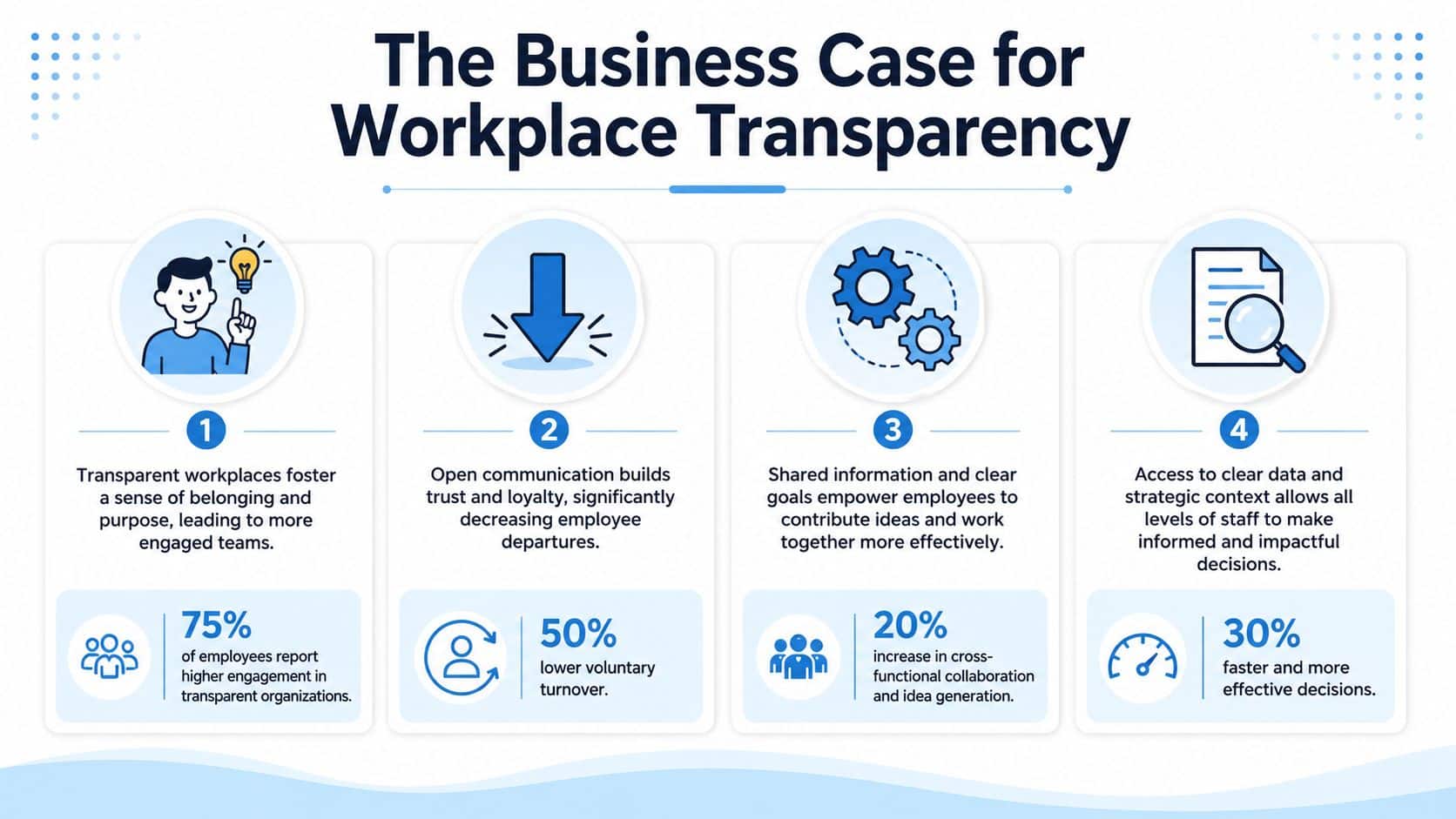
The strongest argument for workplace transparency isn’t moral language. It’s organizational performance.
Deloitte’s 2024 Global Human Capital Trends research found that 86% of surveyed leaders say the more transparent an organization is, the greater the workforce trust it enjoys, reinforcing transparency as a direct driver of loyalty and engagement according to Deloitte’s 2024 transparency research.
Trust changes how work gets done
When people understand the logic behind decisions, they spend less time filling in the blanks. They ask better questions. Managers don’t have to re-explain the same change in five different ways. Teams can move faster because confusion drops.
That’s why transparency should be treated as an operating model. It improves how goals are interpreted, how trade-offs are accepted, and how leaders maintain credibility when conditions change.
A useful way to think about the business case is this:
| Area | What transparent organizations do better |
|---|---|
| Alignment | Connect company decisions to team priorities and day-to-day work |
| Trust | Reduce suspicion created by silence, delay, or inconsistent messaging |
| Retention | Keep employees from assuming the worst when change happens |
| Execution | Help teams act with context instead of waiting for clarification |
It matters to employees before they join
Deloitte’s report also references a Slack study showing that 87% of workers wanted future employers to be transparent. That matters because transparency now affects both internal culture and employer reputation. People don’t separate the two. If they sense selective communication during recruiting, onboarding, or change announcements, they often assume the culture works the same way behind the scenes.
If leadership only speaks when results are good, employees won’t trust leadership when results are mixed.
For executive teams, the point isn’t to chase “perfect openness.” It’s to reduce avoidable ambiguity. Employees can handle difficult news. What they struggle with is partial information, unexplained decisions, and long periods of silence.
That’s also where a business case becomes easier to defend. If you’re evaluating communication infrastructure, a tool like HubEngage’s unified employee platform ROI calculator can help frame transparency work as a measurable operating investment rather than a soft initiative.
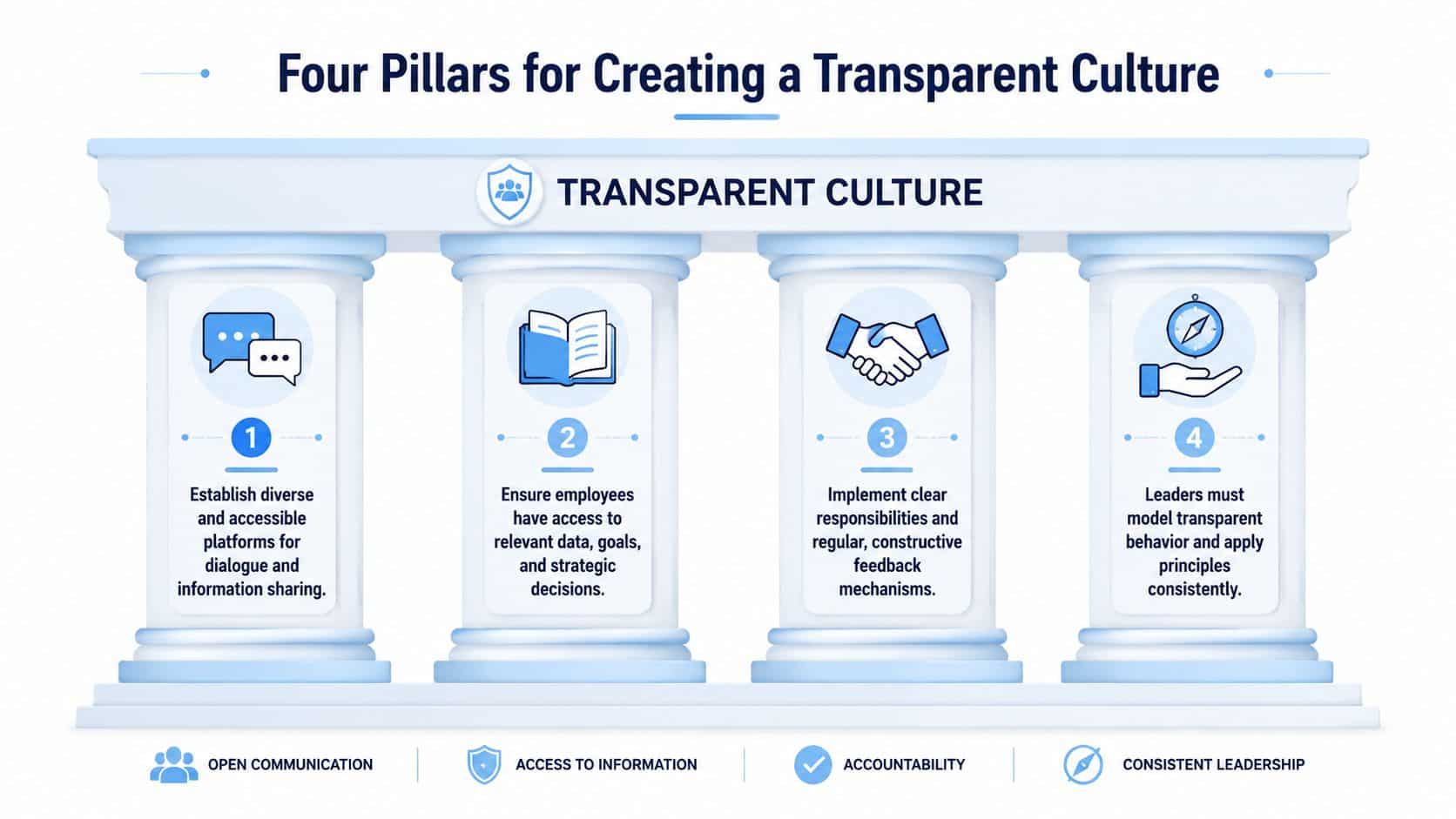
Four Pillars for Creating a Transparent Culture
A transparent culture doesn’t appear because leaders say they have an open-door policy. It shows up in repeated systems. Four pillars matter most.
Proactive communication that allows response
Start with updates. Employees should hear important news from leadership, not from rumor, side conversations, or a manager who got partial information secondhand.
That means using communication channels where employees can do more than read. Let them comment, ask questions, and direct message admins or communicators when they need clarity. Then assign owners to monitor and respond.
What works:
- Publish decision updates with context. Explain what changed, why now, and what employees should do next.
- Keep comment threads open where appropriate. Questions in public often reveal what many employees are thinking.
- Route recurring questions into formal follow-up content. A FAQ, a manager brief, or a short video often closes gaps faster than one-off replies.
What doesn’t work:
- One-way announcements with no discussion path
- Leadership notes that sound polished but avoid specifics
- Posting updates without acknowledging employee reaction
Social channels that reduce distance from leadership
Employees trust what they can see. A social-style internal platform helps because it creates informal visibility. People can post updates, share wins, ask questions, and react in real time. Corporate leaders can also participate without forcing every message into formal executive language.
This matters more than many teams realize. In growing companies, distance forms quickly. New hires may know their direct manager well but have no real contact with senior leaders. A social layer closes some of that distance.
Consider a simple pattern:
- Leadership posts a business update in plain language.
- Employees react and ask practical questions.
- Managers add local context for their teams.
- The organization captures common themes and follows up.
That sequence creates transparency because it combines information, access, and visible accountability.
Survey regularly and publish the results back
A survey alone doesn’t create trust. The trust comes from the return loop.
Use pulse surveys, always-on feedback, and topic-specific surveys to hear what employees are experiencing. Then publish what you learned back to employees, even when the findings are uncomfortable. Tell people what actions will follow, what won’t change yet, and who owns each next step.
Surveying employees without sharing results teaches them that feedback disappears into a private leadership archive.
A practical survey rhythm often includes:
- Pulse checks for current sentiment
- Topic surveys after major changes or policy updates
- Manager-level review so local leaders know what to address
- Company-wide summary so employees can see patterns and planned action
Use AI search and chat data to find hidden transparency gaps
Many transparency failures aren’t visible in comments or surveys. They show up in repeated employee searches and chatbot questions.
If employees keep searching for the same policy, pay explanation, schedule rule, leave process, or safety procedure, that’s a sign the organization hasn’t explained it clearly enough. AI search and AI chat tools can surface these patterns. They can also show whether employees found satisfactory answers or kept asking in different ways.
That’s useful because employees often won’t say, “Leadership lacks transparency.” They’ll say, “I still can’t find the answer.” The fix is often better communication, clearer policy language, or a manager toolkit that explains the issue consistently.
Implementing Transparency for All Workers including Frontline
Most transparency strategies are built for desk workers. That’s a mistake. A major challenge for workplace transparency is reaching frontline and deskless workers, because failures often come from poor reach, not just poor policy, as noted in this discussion of changes affecting the Workplace Transparency Act and communication reach.

Equal access is the real standard
For frontline teams, transparency means more than publishing an update on the intranet. It means employees on every shift, in every location, and in different languages can receive, understand, and respond to the same core information.
That usually requires a channel mix:
- Mobile app notifications for broad updates
- SMS for urgent or time-sensitive alerts
- Digital signage or kiosks in physical workplaces
- Manager toolkits so supervisors don’t improvise the message
- Translated policy and handbook content for multilingual teams
For organizations updating multilingual policies, this guide to 2026 employee handbook translation is useful because it addresses how translated materials support consistent understanding, not just documentation.
Build it early if your company is still growing
Small companies often assume transparency can stay informal. It can’t, at least not for long. Once headcount grows, hallway conversations and founder updates stop reaching everyone evenly.
Here’s a practical setup for a growing company:
| Growth stage reality | Better transparency habit |
|---|---|
| Founders share updates verbally | Publish a weekly summary accessible to all employees |
| Managers explain changes differently | Create a single source of truth for policy and announcements |
| Feedback comes through scattered chats | Consolidate feedback through comments, surveys, and structured channels |
| Frontline workers rely on supervisors | Use mobile, SMS, and posted updates with confirmation tracking |
Audit for reach, not just content
A lot of leaders ask, “Did we send the update?” The better question is, “Did employees receive, understand, and trust the update?”
That means auditing:
- Channel coverage across locations and roles
- Language access for multilingual teams
- Shift access for employees not present during daytime announcements
- Confirmation patterns when policies, safety notices, or pay changes are distributed
- Manager consistency in how updates are reinforced locally
If you manage distributed teams, HubEngage’s guide to frontline worker communication tools is a relevant internal resource because it focuses on the practical challenge of reaching employees who aren’t sitting at a desk all day.
Measuring the impact of your transparency initiatives
If transparency matters, measure it like any other business priority. Don’t reduce it to a vague culture objective.
Start by tracking whether employees engage with communication channels, whether they participate in surveys, whether recurring questions decline after a policy update, and whether managers see fewer misunderstandings after major announcements. Pair those with broader indicators such as retention trends, internal mobility patterns, employer review themes, and issue escalation volume.
What to track in practice?
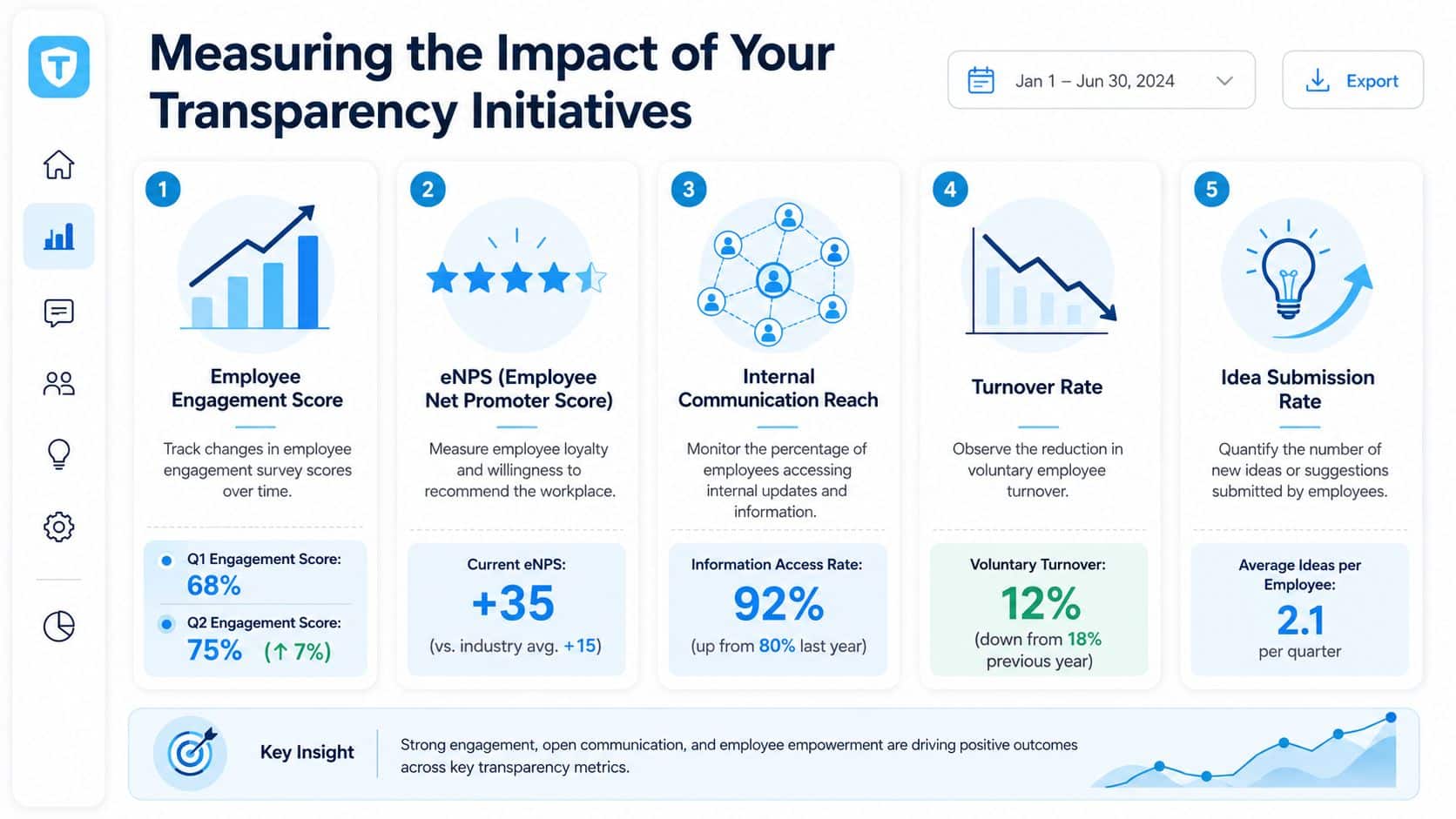
A useful transparency dashboard usually includes a mix of communication, feedback, and trust signals.
- Communication reach measures whether updates reached intended audiences across roles and locations.
- Response quality looks at comments, questions, and whether employees received useful answers.
- Survey participation and themes show whether employees are willing to speak and what they keep raising.
- Search and chatbot trends reveal unresolved confusion that formal channels missed.
- Reputation indicators help leadership see whether internal changes are affecting external perception.
Not every metric needs a numerical target from day one. What matters first is consistency. If you change channels, managers, and survey questions every quarter, you won’t know what improved.
A practical example of visible change
One example from the field is Extended Stay Hotels. After deploying HubEngage to create a direct communication channel with employees across 700 locations, the company’s Glassdoor rating increased from 1.6 to almost 4 in six months. That result matters because it connects transparency work to something leaders can see: employee voice becoming more visible, more direct, and more credible over time.
The clearest proof of transparency isn’t that leadership sent more messages. It’s that employees started trusting the channel enough to engage with it.
Use analytics to look for patterns, not vanity metrics. If a message gets high views but also triggers repeated search queries and manager escalations, it wasn’t as clear as it looked. If survey participation is strong but employees say the same thing every cycle, the problem isn’t listening. It’s follow-through.
For teams that want a tighter measurement layer, employee analytics tools can help connect communication behavior, survey trends, and engagement signals into one reporting view.
How HubEngage powers Workplace Transparency?
A transparency strategy usually breaks down when communications, feedback, search, and engagement sit in separate systems. Employees don’t know where to look. Leaders don’t know where patterns are emerging.
HubEngage, Inc. brings those pieces together through an employee communications hub that supports top-down communications, social engagement, surveys, AI search, and AI chatbots in one environment. That matters because the four pillars discussed earlier need to work together, not as isolated tools.
Where the platform fits operationally
The practical fit is straightforward:
- Top-down communications support structured updates from leadership and internal teams.
- Social engagement gives employees and leaders a shared space to post, comment, and collaborate more informally.
- Surveys help capture sentiment on a recurring basis and make feedback collection systematic.
- AI search and chatbots show what employees are asking for, where answers are weak, and what topics need better communication or policy support.
This also helps with transparency at scale. Feedback doesn’t come from one place anymore. Employees comment on announcements, post in social channels, answer surveys, and ask questions through AI-supported tools. When those signals can be reviewed together, organizations can identify recurring concerns faster.
Balancing openness with moderation
One common reason employers avoid open channels is fear that employees will post something inappropriate, misleading, or confidential. That risk is real, but it’s manageable.
AI moderation can scan comments and posts for problematic content using context rather than simple keyword lists. That makes open participation more practical, especially for organizations with large, multilingual workforces where manual review alone won’t keep up.
The other practical advantage is speed. If AI can surface sentiment and thematic patterns across comments, surveys, and chatbot interactions, teams can act before a communication problem hardens into a trust problem.
Navigating Pitfalls and Legal Considerations
A lot of workplace transparency advice is too simple. It assumes more openness is always better. It isn’t. Poorly designed transparency can create confusion, privacy risk, and legal exposure.
Deloitte recommends data governance by access tier, including clear purpose, opt-in consent where appropriate, limited retention periods, and anonymized or aggregated reporting when individual workers could be identified. It also warns leaders not to collect worker data they don’t intend to act on. That principle is one of the most overlooked parts of modern transparency work.
The common mistakes
Organizations usually get into trouble in four ways:
- They overshare without context. Employees receive raw information but no explanation of what it means.
- They collect feedback and do nothing visible with it. That weakens trust faster than not asking at all.
- They treat confidentiality as a blanket rule. Employees can’t tell what is protected, what is restricted, and what they still have a right to report.
- They ignore access controls. Sensitive workforce data gets shared too broadly or retained too long.
More information doesn’t automatically create more trust. Clear boundaries do.
A good operating model separates information into categories such as broad-share, manager-only, and aggregated reporting. That structure helps HR, legal, and communications teams decide what employees need to know, what managers need to handle, and what must remain limited to protect individuals or investigations.
Legal structure matters
The Illinois Workplace Transparency Act provides a model for structuring transparency programs because it prohibits contracts that stop employees, prospective employees, or former employees from reporting unlawful conduct, while still allowing confidentiality in narrower categories such as HR investigations and participants in ongoing investigations under the Illinois Workplace Transparency Act text.
For leadership teams, the practical implication is this: build disclosure workflows that separate protected reporting from necessary confidentiality. Review contract templates, settlement language, investigation protocols, and reporting channels together. Don’t let one team draft restrictions that another team assumes are standard.
If you’re also reviewing access controls for employee portals and sensitive HR systems, this article on proteggere l’accesso HR dipendenti is a useful reference because it addresses the operational side of securing employee access while maintaining usability.
Conclusion
Workplace transparency is not about sharing everything. It is about creating consistent, accessible, and trustworthy communication that helps employees understand decisions, contribute feedback, and stay aligned with organizational goals.
Companies that build transparent habits early are better positioned to strengthen trust, improve engagement, and support long-term growth.
If you’re looking for a practical way to bring communications, feedback, and employee engagement together, explore the HubEngage Employee Experience Platform and schedule a demo to see it in action.
Workplace Transparency FAQs
How do you start building transparency in a company with a closed culture?
Start small and stay consistent. Pick a few high-visibility habits such as weekly leadership updates, open comment capability, and a commitment to publish survey results back to employees. Don’t promise total openness. Promise clarity, regularity, and follow-through.
What should not be shared in a transparent workplace?
Individual employee data, sensitive investigation details, legally protected information, and material that could identify workers inappropriately should not be broadly shared. Employees usually accept limits when leaders explain those limits clearly and apply them consistently.
Can too much transparency backfire?
Yes. Raw information without context can confuse people. Public feedback channels without moderation can also discourage participation. Structured transparency works better than blanket openness.
Does workplace transparency look different for remote and frontline employees?
Yes. Remote employees often need stronger cadence and documentation. Frontline employees need stronger channel access across mobile, SMS, kiosks, manager communication, language support, and shift coverage. The principle is the same. Equal access to relevant information.