Traditional corporate training often fails for a simple reason. Employees don’t get enough feedback, visible progress, or momentum to stay engaged. That’s why a gamified learning platform deserves a strategic look, not as a novelty, but as a way to make learning participation easier to sustain and easier to measure.
The distinction matters most when learning has to compete with real work. In onboarding, compliance, frontline enablement, and continuous upskilling, people rarely need more content. They need better design, clearer reinforcement, and delivery that fits how they work. If you’re rethinking your learning experience alongside broader employee engagement and communication initiatives, a strong custom eLearning content development guide is a useful companion resource because the mechanics only work when the content itself is designed for action.
Key Takeaways
- A gamified learning platform improves training engagement by using points, badges, progress tracking, and rewards to keep employees motivated and involved.
- Gamification works best when it supports business goals, such as faster onboarding, stronger compliance completion, ongoing skill development, and employee upskilling.
- The most effective platforms focus on behavior change, not just course completion, by providing continuous feedback, visible progress, and meaningful recognition.
- Mobile-first and microlearning experiences are critical for frontline, deskless, and distributed employees who need training that fits into their daily workflows.
- Core gamification features include leaderboards, achievements, milestones, progress bars, challenges, and personalized learning paths that encourage continuous participation.
- Organizations see the greatest results when learning, communication, recognition, and employee engagement are connected in one platform, creating a more seamless and engaging learning experience.
The Engagement Problem in Corporate Learning
Most training programs don’t struggle because the topic is unimportant. They struggle because the experience feels passive, disconnected from the job, and easy to postpone.
That’s where gamification gets oversimplified. Many teams hear the term and think of badges pasted onto an LMS. In practice, a well-designed gamified learning platform changes the rhythm of learning. It gives employees a reason to return, a visible sense of movement, and frequent signals that effort is being noticed.
For HR and L&D leaders, the strategic question isn’t whether game mechanics look modern. It’s whether they help people complete the right learning behaviors more consistently. In strong programs, they do. They turn dead zones in the learner journey into active moments. A quiz becomes a checkpoint. A policy module becomes a mission. A new hire path becomes a progression system rather than a static document library.
Why standard training often stalls?
Three issues show up repeatedly in corporate environments:
- Weak feedback loops. Learners finish a module and get little reinforcement beyond a completion mark.
- Low visibility of progress. Employees can’t easily tell how far they’ve come or what matters next.
- Poor fit with daily work. Long courses and desktop-first experiences don’t match fragmented schedules.
Practical rule: If employees need a manager, reminder email, and calendar block just to finish routine training, the learning design is carrying too much friction.
A gamified learning platform can reduce that friction. But only if the mechanics are tied to outcomes that matter to the business and to the employee.
What Exactly Is a Gamified Learning Platform?
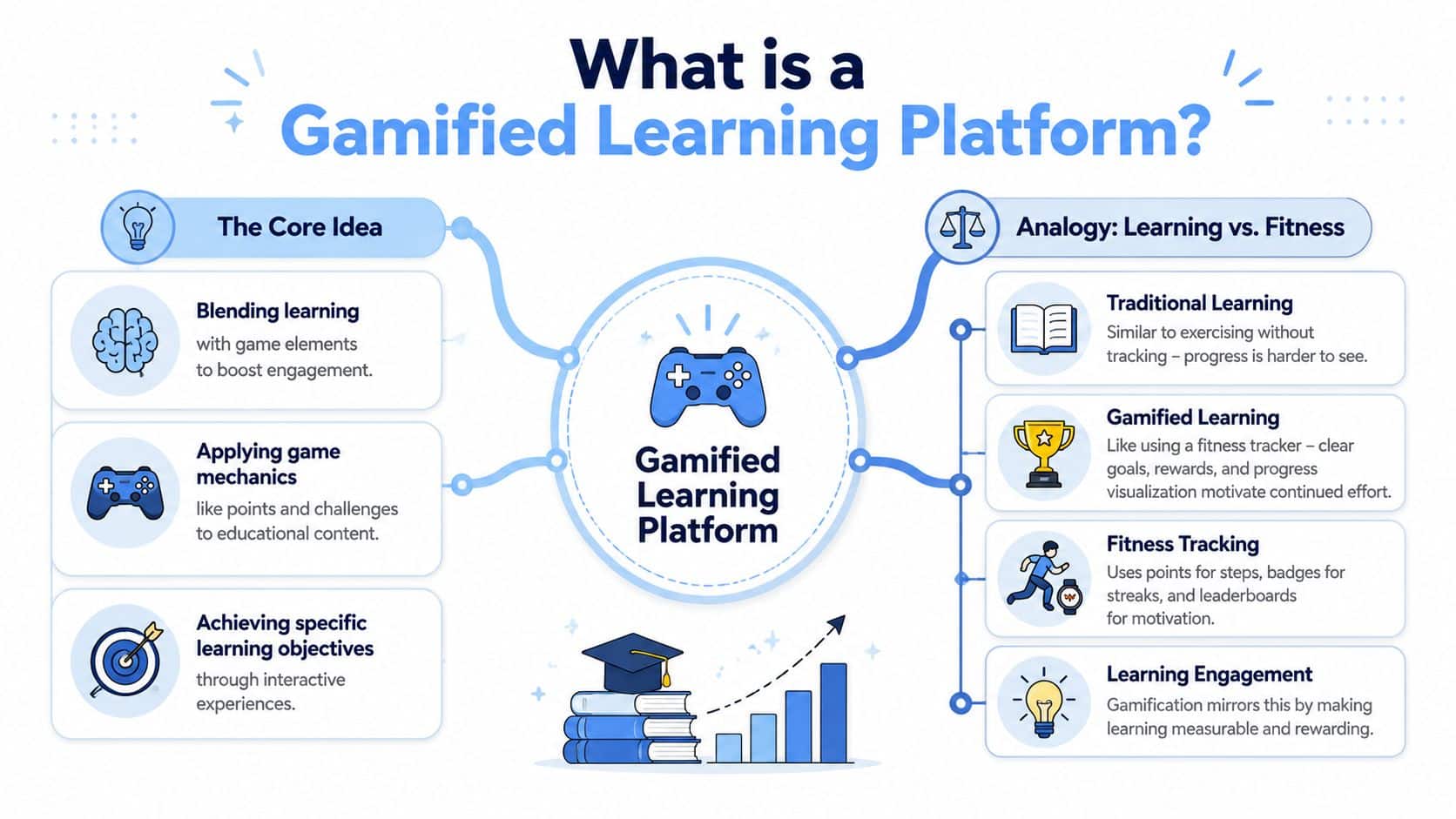
A gamified learning platform is easiest to understand through a familiar comparison. Think about the difference between going for occasional walks and using a fitness app. The activity may be the same, but the app adds streaks, milestones, visible progress, and achievement markers. That structure changes behavior.
A learning platform works the same way. The content may still include lessons, videos, quizzes, or checklists. What changes is the experience wrapped around them.
What makes it different from a standard LMS
A gamified learning platform is technically distinct from a standard LMS because it adds explicit game mechanics such as points, badges, progress bars, level completion, and leaderboards to the learning workflow, with the goal of making achievements visible and creating continuous feedback loops that increase engagement and completion rates, as described in Ciphr’s explanation of gamified learning platforms.
That distinction sounds simple, but it changes how people interact with training.
A standard LMS is often built around storage, delivery, and compliance tracking. A gamified learning platform is built around participation patterns. It asks: what should the learner do next, what reward signal follows, and how do we keep momentum going without creating noise?
Gamification versus game-based learning
These terms get mixed up, and that creates confusion during buying decisions.
| Term | What it means | Example |
|---|---|---|
| Gamification | Adding game mechanics to a non-game learning process | Earning points for finishing modules and unlocking the next path |
| Game-based learning | Teaching through an actual game experience | A simulation or scenario game that teaches product knowledge |
That difference matters because many organizations don’t need to build a game. They need to improve how employees move through training that already exists.
The psychology behind the mechanics
The best platforms use a few simple drivers:
- Progress visibility keeps learners from feeling lost.
- Recognition signals make completion feel meaningful.
- Short feedback cycles help people adjust quickly.
- Choice and progression create a sense of control.
Gamification works best when it makes effort visible, not when it turns learning into a gimmick.
If the mechanics distract from the learning objective, the platform becomes busy but ineffective. If they reinforce the objective, completion feels earned and the learner stays engaged longer.
The Business Case for Gamified Learning
The business case isn’t “training becomes fun.” That’s not enough to justify budget, integration work, or change management. The case is that better learning participation can support faster readiness, more consistent compliance, and stronger day-to-day execution.

Where the value shows up?
In practice, I’ve seen leaders get the most value when they stop treating gamification as a universal layer and start applying it to high-friction moments.
Consider these examples:
- Onboarding journeys. New hires often face document-heavy, fragmented learning. A quest-based path with visible milestones can make early training feel structured instead of overwhelming.
- Compliance programs. Mandatory training rarely suffers from lack of importance. It suffers from low energy. Progress markers, checkpoints, and recognition can increase follow-through.
- Role enablement. Sales, service, operations, and frontline teams benefit when knowledge checks are short, repeated, and connected to visible advancement.
- Continuous learning. Employees are more likely to return to optional learning when there’s a clear sense of progression.
What leaders should actually evaluate?
A smarter business case focuses on operational questions, not novelty. Ask whether the platform helps you:
- Reduce drop-off in required learning paths.
- Shorten the path to readiness for new or changing roles.
- Support repeat reinforcement rather than one-time completion.
- Give managers useful visibility into learner momentum.
Here’s the trap. Some organizations buy a platform because the demo looks energetic. Then they discover the experience doesn’t fit their workforce, content model, or management capacity.
A stronger evaluation lens looks like this:
| Business need | What to look for in the platform |
|---|---|
| Faster onboarding | Guided pathways, milestones, reminders, mobile access |
| Better compliance follow-through | Clear progression, short checkpoints, completion visibility |
| Ongoing skill reinforcement | Microlearning, repeat challenges, adaptive content options |
| Manager visibility | Dashboards, learner activity signals, simple reporting |
What doesn’t work?
Several patterns fail repeatedly:
- Decorative gamification that adds points but no meaningful progression
- Competition-heavy design for audiences that don’t want public ranking
- Long-form learning wrapped in badges without improving usability
- No connection to business workflows, which leaves learning isolated from actual work
The strongest programs treat game mechanics as a behavior design layer. They reward the actions that matter and keep the learning experience moving.
Core Features and Essential Game Mechanics
When buyers evaluate a gamified learning platform, they often focus on what they can see. Points. Badges. Leaderboards. Those matter, but they’re the surface layer.
Underneath, the platform needs rules, triggers, and tracking that connect learner actions to progression in a way that feels fair and useful.
The mechanics users notice
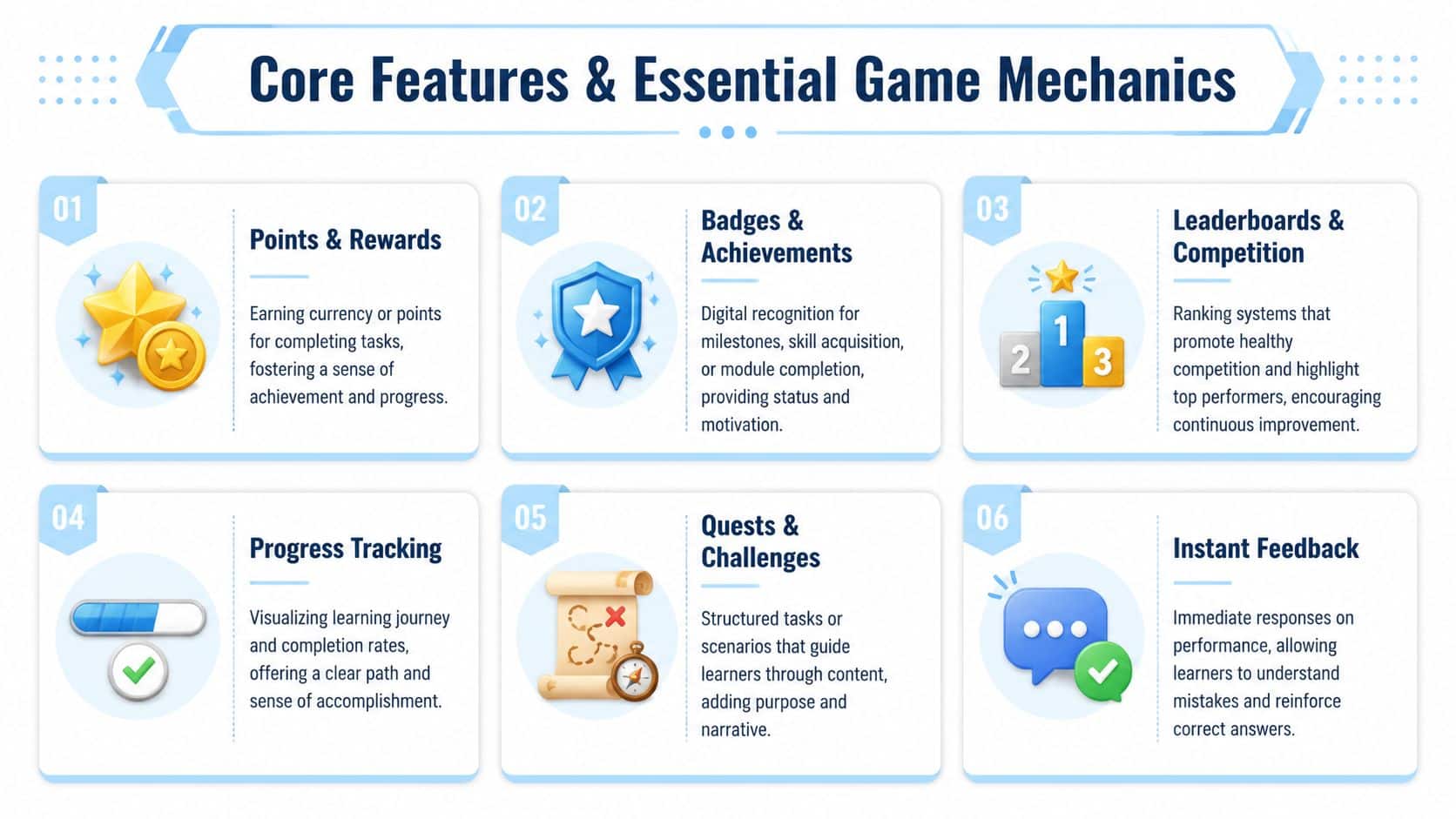
Most employees will interact with a few visible elements:
- Points and XP for completing actions
- Badges and achievements for milestones or skills
- Levels or progression paths that make subsequent steps available
- Leaderboards where competition is appropriate
- Progress bars that reduce uncertainty
- Instant feedback after quizzes or challenges
These features help only when they’re coherent. If employees can’t tell why they earned something, or why someone else advanced faster, trust drops quickly.
The architecture leaders often miss
Effective gamified learning architecture isn’t just cosmetic. It typically requires defined XP logic, reward triggers, progression thresholds, streak and comeback bonuses, and event-level tracking of user actions such as reading, quiz attempts, comments, and shares so the system can map behavior to measurable progression and adaptive content delivery, as outlined in BrainyLab’s guidance on building a gamified learning platform.
If you’re reviewing vendors, ask how the platform handles:
- Action mapping. Which learner behaviors trigger rewards?
- Threshold rules. When does one level end and the next begin?
- Streak recovery. What happens when a learner drops off and returns?
- Content adaptation. Can the platform respond to behavior, not just record it?
A useful way to group features
I usually separate core mechanics into three buckets:
Progression features
These move learners forward.
- Levels
- Quests
- Milestones
- Attainable paths
- Progress bars
Social features
These create visibility and shared momentum.
- Team challenges
- Leaderboards
- Social reactions
- Peer recognition
Reward features
These reinforce effort and completion.
- Points
- Badges
- Redeemable rewards
- Completion recognition
Recognition mechanics also connect naturally to broader employee experience programs. For teams comparing incentive approaches, this overview of employee incentives and recognition badges points rewards or leaderboards is useful because the same design trade-offs apply in learning.
A badge only works when it represents something people understand and value.
Integration matters more than many teams expect
A gamified learning platform shouldn’t sit in isolation. At minimum, it should connect with:
- your HRIS for employee identity and role data
- your communication channels such as Microsoft Teams or Slack for nudges and reminders
- your content systems or LMS if formal training already lives elsewhere
Without those connections, admins end up manually managing users, reminders, and reporting. That’s where enthusiasm fades.
Implementing Your Gamified Learning Strategy
Many organizations either get real value or create a shiny distraction with gamified learning platforms. A gamified learning platform can absolutely improve participation. That doesn’t automatically mean it improves learning quality.
Recent academic analysis is important here. A large meta-analysis in education found gamification has a positive but only moderate overall effect on learning-related outcomes, with stronger gains in motivation and participation than in deeper learning transfer, and another systematic review warns that poorly designed rewards can reduce intrinsic motivation over time, as summarized in this research review on gamification and learning outcomes.
Design for behavior change, not click volume
If the only success metric is completion, teams can end up rewarding speed over mastery. Employees learn how to finish the system instead of learning how to do the job better.
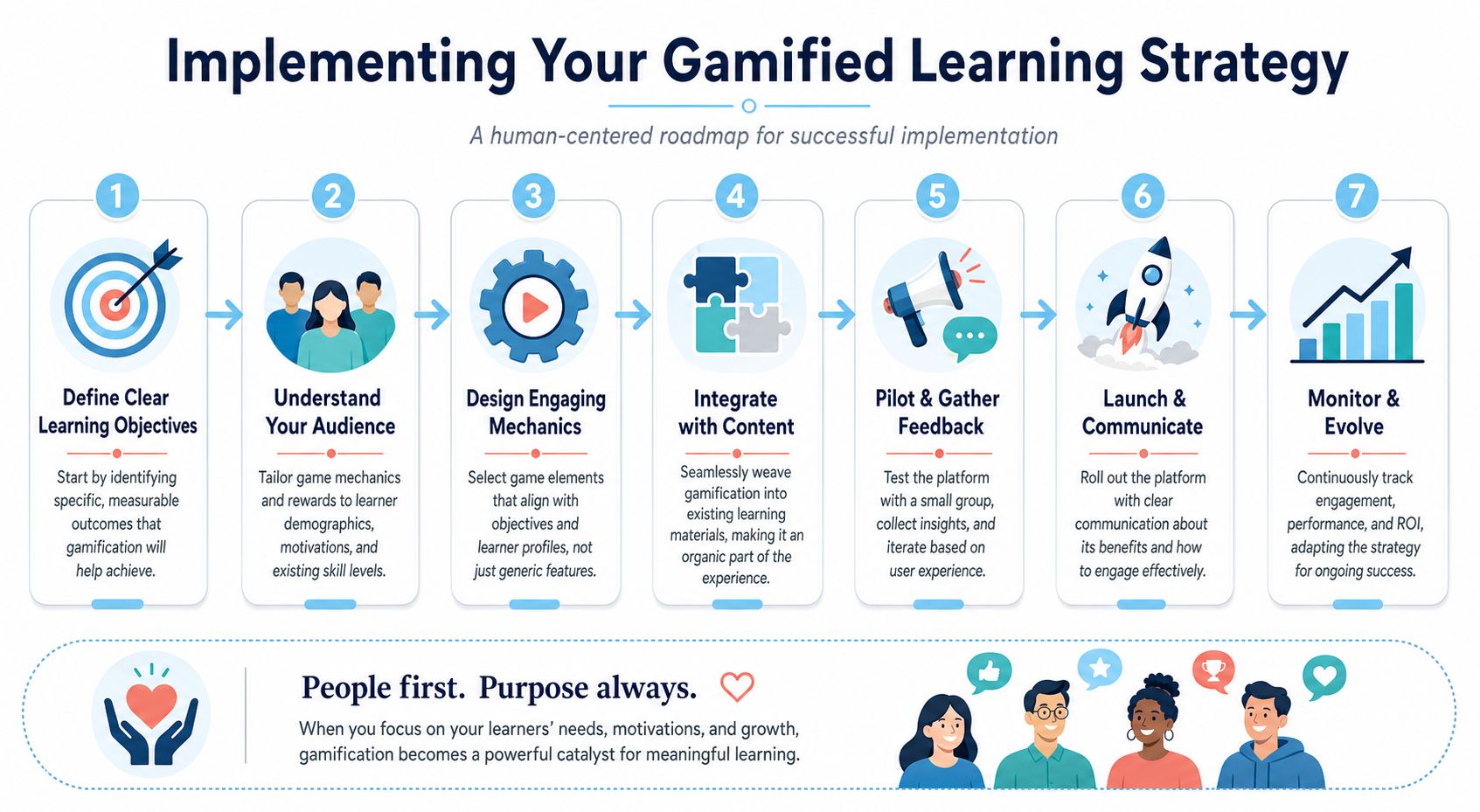
A stronger implementation model starts with questions like these:
- What behavior should change after training?
- What task should employees perform more accurately or more consistently?
- Where do learners struggle today?
- What kind of reinforcement supports actual application?
That changes the design. Instead of awarding points for opening content, you might award progress for passing a short scenario check, contributing a peer answer, or completing a role-specific practice sequence.
Starter playbooks that work in the real world
Here are two practical patterns that tend to translate well.
New hire onboarding quest
Break onboarding into short missions rather than one long curriculum. A practical structure might include:
- welcome and culture module
- manager introduction task
- key policy checkpoint
- role basics quiz
- first-week action checklist
- peer connection or mentor prompt
What makes this effective isn’t the quest label. It’s that each step is visible, finite, and relevant.
Cybersecurity compliance challenge
Most compliance content is forgotten because it’s delivered once and treated as done. A better approach uses:
- short scenario-based checks
- recurring micro-quizzes
- team-based participation where appropriate
- recognition for consistency, not just one-time completion
This keeps the topic active without forcing employees through long repeat courses.
Frontline and distributed workforce design
This is the area where strategy often breaks down. Many learning experiences still assume desk-based users with time for long browser sessions. That’s a mismatch for shift workers, field teams, and distributed operations.
Recent platform guidance and research increasingly frame the stronger use case as mobile-first access, short-form microlearning, and embedded workflows, especially for frontline and distributed workforces, with more emphasis on quizzes, rewards, and progress tracking than long courses, as discussed in SC Training’s perspective on gamified learning platforms.
| Workforce context | Better mechanic choice | Usually a poor choice |
|---|---|---|
| Frontline shift staff | Short quizzes, streaks, quick rewards, mobile prompts | Long modules, complex branching, desktop-only access |
| Distributed field teams | Milestone paths, role-based missions, lightweight challenges | Heavy public competition across unrelated roles |
| Desk-based professionals | Deeper pathways, optional leaderboards, blended formats | Rewarding every minor click |
For teams building short-form delivery, these microlearning tools for employee training are worth reviewing because gamification works better when the learning units are already concise.
Frontline learning fails less from lack of motivation than from friction. If the interaction takes too long, requires the wrong device, or interrupts the shift, the mechanic doesn’t matter.
What to measure after launch?
Don’t stop at participation data. Track signals such as:
- completion by role or team
- return visits to voluntary learning
- quiz performance across repeat attempts
- manager-observed skill application
- adoption by workforce segment
- time between assigned learning and completed learning
The right program makes learning easier to continue and easier to connect to work.
Unifying Learning and Engagement with HubEngage
A common problem in corporate learning isn’t the lack of tools. It’s fragmentation. Training sits in one place, communication in another, recognition somewhere else, and operational workflows somewhere else again. Employees experience that as friction.
That’s why the platform model matters. A unified employee experience environment can connect learning to the channels and habits people already use. This is particularly relevant for frontline and distributed teams, where recent platform guidance emphasizes mobile-first access, short-form microlearning, and embedded workflows instead of long-course dependency.
One example is the HubEngage employee learning hub, which places learning inside a broader workforce experience system spanning communications, engagement, operations, and continuous learning. In practice, that means a company can announce training through targeted communications, reinforce participation with points or recognition, and keep the experience accessible across mobile and other everyday channels.
Why this integrated approach matters?
When learning is connected to the rest of the employee journey, several things get easier:
- Communication improves because employees see training in the same environment as company updates and team information.
- Recognition feels timely because completion and participation can connect to broader engagement programs.
- Operational follow-through improves because learning can align more closely with tasks, schedules, and role needs.
This matters most when the audience is hard to reach through traditional LMS habits. Frontline and distributed employees often won’t go hunting for a separate training tool unless the need is immediate and the experience is simple.
A unified model won’t fix poor content or weak design. But it can remove a lot of the adoption barriers that undermine otherwise solid learning programs.
Final Thoughts
A gamified learning platform is most effective when it supports meaningful behavior change, not just course completion. By combining visible progress, timely recognition, and engaging learning experiences, organizations can improve participation, reinforce knowledge, and make training easier to sustain across diverse workforces. The greatest impact comes when learning is connected to communication, engagement, and everyday work. To see how this approach can work for your organization, explore the HubEngage Employee Experience Platform and schedule a personalized demo today.
Gamified Learning Platform FAQs
Is a gamified learning platform just an LMS with badges?
No. A standard LMS may store content and track completion. A gamified learning platform adds behavior-shaping mechanics such as visible progress, rewards, levels, and feedback loops that change how learners move through the experience.
Does gamification improve real learning or just completion?
It can improve both, but not automatically. Research cited earlier shows stronger gains in motivation and participation than in deep learning transfer. That means the design has to reinforce application, not just activity.
When do leaderboards help, and when do they hurt?
Leaderboards help when the audience is comfortable with visibility and the competition feels fair. They can hurt when roles are too different, participation conditions aren’t equal, or employees feel publicly compared in a way that creates pressure instead of momentum.
A safer option is often team challenges, milestone boards, or role-based leaderboards rather than one company-wide ranking.
How should we design gamification for frontline employees?
Keep it mobile-first, short, and embedded in existing workflows. Frontline employees usually have fragmented attention and limited scheduled training time. Short quizzes, visible progress, lightweight rewards, and quick reminders work better than long modules and complex navigation.
What’s the biggest implementation mistake?
Treating gamification as a visual layer instead of a system. If there’s no clear XP logic, no progression rules, no connection to learning objectives, and no measurement plan, the program becomes decorative.
How do we measure ROI without inventing a complicated model?
Start with the business problem you’re trying to solve. Then compare before and after patterns using your own internal metrics.
Common measures include:
- completion consistency
- speed of onboarding progression
- repeat knowledge check performance
- voluntary learning participation
- manager-reported task readiness
- compliance follow-through by role or location
You don’t need a complex model at first. You need a clean baseline and a small set of metrics that reflect real business outcomes.
What if some employees don’t like competition?
That’s normal. Not every mechanic should be competitive. Many employees respond better to progress bars, personal milestones, earned content, recognition, or team-based goals than to public rankings.
Should every training program be gamified?
No. Use it where motivation, repetition, or follow-through is a problem. High-value use cases include onboarding, compliance reinforcement, practical skill development, and recurring role-based learning. If the content is already urgent, simple, and consistently completed, adding mechanics may not improve much.