Employee experience platforms have transformed how organizations connect with their workforce, moving far beyond traditional HR systems to create comprehensive digital ecosystem.
These platforms integrate communication, engagement tools, and operational workflows into unified solutions that actually improve how employees experience their workplace.
For manufacturing, healthcare, and hospitality organizations struggling with disconnected systems and low engagement, the right platform can fundamentally change workforce dynamics.
In this blog we will explore what employee experience platforms are, key features, and the best platforms. Also, you will understand how they help you improve engagement, streamline operations, and make better technology decisions for your workforce.
Key Takeaways:
- Employee experience platforms combine communication, engagement, and workflows into one unified digital workplace.
- Organizations can increase employee engagement and reduce turnover as employee experience tools provides better connection and visibility.
- Mobile access, real-time messaging, recognition, surveys, and integrations with existing systems are important features of an employee experience platform.
- Employee experience platforms improve onboarding speed, productivity, and deliver measurable ROI within 12–18 months.
- The right platform should match your workforce needs, integrate easily, scale with growth, and be simple to adopt.
What are Employee Experience Platforms?
Employee experience platforms are integrated software solutions that unify communication, engagement, and operational tools to create a seamless digital workplace experience.
Unlike traditional HR software that focuses primarily on administrative tasks, these platforms prioritize the employee journey from onboarding through daily workflows and career development.
As per Deloitte, companies with connected workplace cultures see higher revenue growth rates and 40% lower employee turnover compared to organizations with poor internal communication.
The key distinction lies in their holistic approach where traditional systems operate in silos, employee experience platforms connect every touchpoint an employee has with their organization.
This includes internal communications, task management, recognition programs, learning resources, and feedback mechanisms all accessible through a single interface.
Core components of Employee Experience Platforms
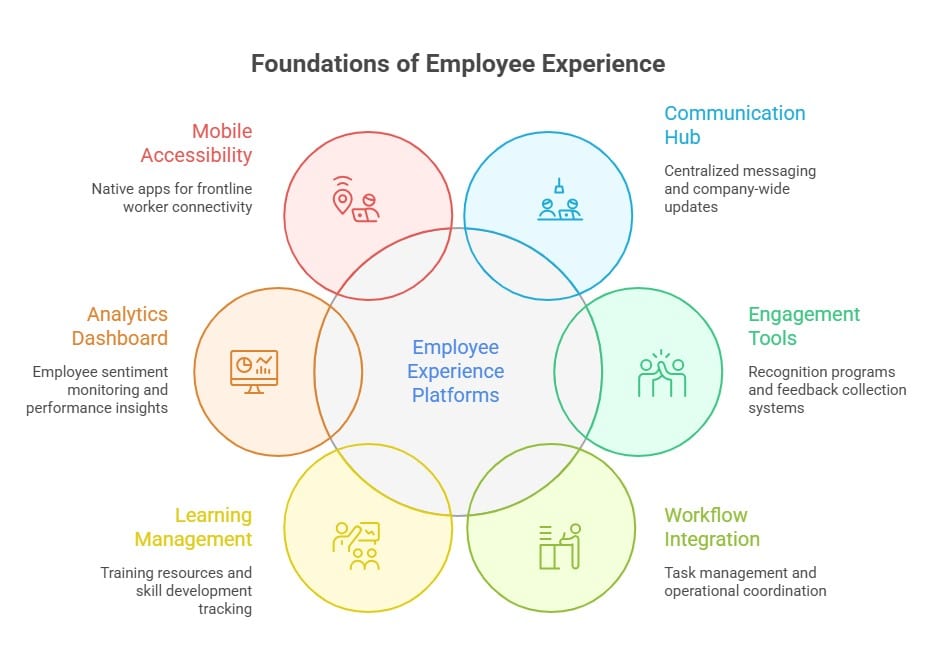
Modern employee experience platforms typically include several integrated modules:
- Communication Hub: Centralized messaging, announcements, and company-wide updates
- Engagement Tools: Recognition programs, surveys, and feedback collection systems
- Workflow Integration: Task management, scheduling, and operational coordination
- Learning Management: Training resources, skill development tracking, and certification programs
- Analytics Dashboard: Employee sentiment monitoring, engagement metrics, and performance insights
- Mobile Accessibility: Native apps ensuring frontline workers stay connected regardless of location
Key Features and Capabilities
Employee experience platforms distinguish themselves through specific capabilities that address modern workforce challenges. Understanding these features helps organizations identify which platforms align with their operational needs.
Communication and Collaboration Features
Effective employee experience platforms excel at breaking down communication barriers within organizations. They provide multiple channels for information sharing, from company-wide announcements to team-specific project updates.
- Real-time messaging: Instantly delivers critical updates for shifts, safety, and operations.
- Document sharing & collaboration: Enables seamless teamwork across locations with shared workspaces.
- Multi-channel communication: Supports announcements, team updates, and targeted messaging.
- Tool integrations: Connects with existing systems to streamline workflows and reduce friction.
Employee Engagement and Recognition
Recognition programs within these platforms go beyond simple peer-to-peer acknowledgments.
- Recognition & milestones: Tracks achievements and automates celebrations to boost morale.
- Performance insights: Gives managers visibility into team engagement and trends.
- Continuous feedback: Enables real-time surveys to identify and fix issues early.
- Social & community features: Builds stronger connections through feeds, events, and groups.
Integration and Workflow Management
The most effective employee experience platforms integrate seamlessly with existing business systems. This includes HR information systems, payroll platforms, scheduling software, and industry-specific operational tools.
- Workflow automation: Reduces admin tasks through automated onboarding, approvals, and routine processes.
- Time savings: Frees up employees and managers to focus on strategic work.
- Custom dashboards: Delivers role-specific updates, tasks, and insights.
- Reduced information overload: Ensures employees see only relevant content and resources.
Top 10 Employee Experience Platforms
Choosing the right employee experience platform helps organizations improve communication, boost engagement, and streamline daily operations across the workforce. Below are some of the top employee experience platforms that enable organizations to build connected, productive, and highly engaged workplaces.
1. HubEngage
It offers a comprehensive employee experience platform that brings together communication, engagement, recognition, learning, and productivity tools into one unified system. It helps organizations create a connected, informed, and motivated workforce.
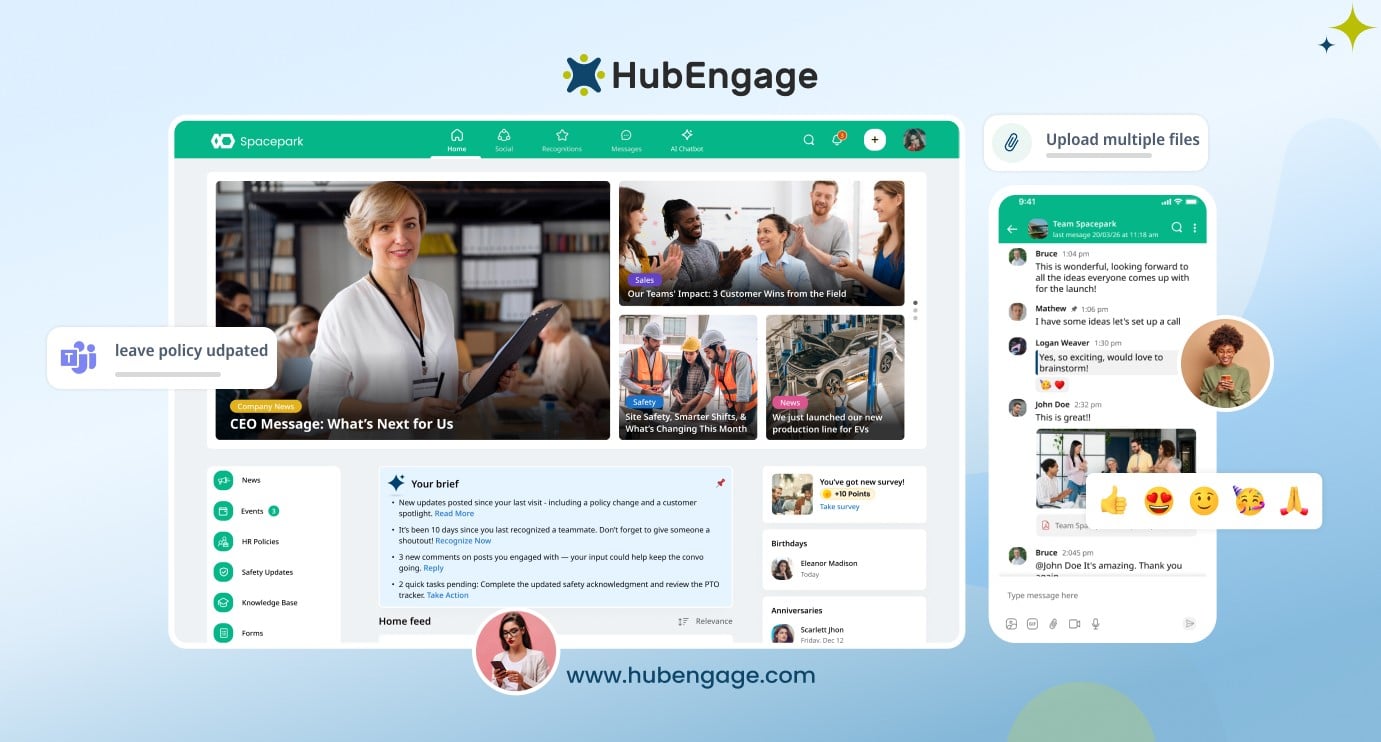
The platform combines internal communication, social engagement, surveys, recognition, and AI-powered tools to improve employee satisfaction and participation. With multi-channel delivery, employees can access information and engage with the organization from anywhere.
By unifying multiple tools into a single platform, HubEngage reduces fragmentation and improves overall employee experience. Organizations can scale the platform with additional modules as their needs grow.
Key Features:
- Scheduling solution for planning shifts across teams and locations
- Time tracking for attendance, work hours, and productivity insights
- Learning platform for training, upskilling, and knowledge sharing
- Task management to assign, track, and complete work efficiently
- Multi-channel access across mobile, web, email, SMS, and signage
- Real-time collaboration, messaging, and task workflows improve team productivity
- AI-powered chatbot delivers support, answers, and knowledge across modules
- Scalable modules expand capabilities as organization and workforce needs grow
Best for:
Organizations looking to improve employee engagement, communication, and overall experience through a unified digital workplace.
HubEngage has a 4.6 out of 5 rating for its adaptability, affordability, and robust engagement tools, making it especially attractive to mid-sized companies seeking enterprise-level features at a more affordable price point.
Check out the real-world impact and success stories, you can hear from our customers describing their experience of how they improved overall employee experience using HubEngage.
2. Microsoft Viva
Offers an enterprise-grade employee experience platform that integrates deeply with Microsoft 365, enabling communication, learning, and employee insights within familiar tools like Teams.
Key Features:
- Microsoft Teams integration
- Employee insights and analytics
- Learning hub and knowledge sharing
- Wellbeing and productivity tools
- Content and topic management
Best For: Large enterprises already using Microsoft 365.
3. Workday Employee Experience
provides a unified platform connecting HR processes with employee interactions, using AI-driven personalization to enhance the employee journey.
Key Features:
- AI-driven personalization
- HR and talent management integration
- Employee journey tracking
- Advanced analytics dashboards
- Workforce planning tools
Best For: Enterprises with complex HR and workforce management needs.
4. Beekeeper
A mobile-first employee experience platform focused on deskless workers, enabling real-time communication and task coordination in operational environments.
Key Features:
- Real-time messaging and updates
- Shift coordination tools
- Mobile-first interface
- Task and workflow management
- Safety and compliance communication
Best For: Retail, hospitality, and manufacturing teams.
5. Simpplr
It delivers a modern employee experience platform centered around an AI-powered intranet, improving internal communication and knowledge sharing.
Key Features:
- AI-powered intranet
- Content and knowledge management
- Employee directory
- Smart search functionality
- Engagement analytics
Best For: Mid-to-large enterprises with desk-based employees.
6. Staffbase
A communication-focused employee experience platform designed to connect distributed teams through mobile apps, intranet, and email.
Key Features:
- Employee communication app
- Email campaign management
- Mobile intranet
- Analytics dashboard
- Content publishing tools
Best For: Large distributed organizations.
7. Workvivo
It combines social networking and employee experience tools to enhance engagement, communication, and company culture.
Key Features:
- Social activity feed
- Recognition and rewards tools
- Communication hub
- Engagement analytics
- Integration capabilities
Best For: Organizations focused on culture and employee engagement.
8. 15Five
It is a performance and engagement platform that emphasizes continuous feedback, goal tracking, and employee development.
Key Features:
- Continuous feedback system
- OKR and goal tracking
- Performance reviews
- Engagement surveys
- Manager effectiveness tools
Best For: Small to mid-sized businesses focused on performance and development.
9. Culture Amp
A data-driven employee experience platform specializing in feedback, engagement surveys, and workplace culture insights.
Key Features:
- Engagement surveys
- Feedback and sentiment analytics
- Benchmarking tools
- Performance management
- Action planning tools
Best For: Enterprises focused on culture, feedback, and employee insights.
10. Qualtrics EmployeeXM
Provides advanced experience management capabilities, helping organizations measure and improve employee sentiment through data-driven insights.
Key Features:
- Experience analytics platform
- Sentiment analysis tools
- Advanced survey capabilities
- AI-driven insights
- Custom dashboards
Best For: Large enterprises focused on experience analytics and research-driven decision-making.
Employee Experience Platforms vs HR Software
Understanding the distinction between employee experience platforms and traditional HR software helps organizations make informed technology decisions. While both serve workforce management needs, their approaches and capabilities differ significantly.
Comparison of platforms
Traditional HR software excels at managing compliance, payroll processing, and record keeping. These systems handle the administrative backbone of workforce management but often provide limited value for day-to-day employee engagement.
Employee experience platforms prioritize the human side of work. They focus on making employees feel connected, informed, and valued while still supporting necessary administrative functions through integrations.
| Aspect | Traditional HR Software | Employee Experience Platforms |
| Primary Focus | Administrative processes | Employee engagement and experience |
| User Interface | Manager and HR-centric | Employee-centric design |
| Communication | Top-down announcements | Multi-directional collaboration |
| Data Usage | Historical reporting | Real-time insights and action |
| Integration | Limited third-party connections | Extensive ecosystem connectivity |
| Mobile Experience | Basic or web-based | Native mobile-first design |
Implementation and Integration Considerations
Successful employee experience platform implementation requires careful planning around technical integration, change management, and user adoption. Organizations that approach implementation strategically see significantly higher adoption rates and faster return on investment.
Technical Integration Planning
- System audit: Evaluate existing HR, communication, scheduling, and operational systems before implementation.
- API compatibility: Ensures smooth integrations and flexibility with current and future tools.
- Data migration: Plan mapping, cleansing, and validation to maintain accurate employee data.
- Single sign-on (SSO): Simplifies access and boosts user adoption with seamless login experiences.
Change Management Strategies
- Demonstrate clear value: Focus on how the platform improves daily work rather than mandating usage.
- Phased rollout: Start with early adopters to identify issues and build internal champions.
- Practical training: Emphasize real benefits over technical features to drive adoption.
- Employee-focused communication: Highlight benefits like better access, recognition, and growth opportunities.
User Adoption Best Practices
- Continuous engagement: Focus on ongoing training, feedback, and platform optimization.
- Manager involvement: Encourage leaders to actively use and promote the platform.
- Incentives & recognition: Reward early adopters to drive engagement momentum.
- Feedback loops: Regularly collect input to improve adoption and user experience.
ROI and Business Impact Metrics
Employee experience platforms generate measurable business value through improved engagement, reduced turnover, and enhanced operational efficiency. Understanding these metrics helps organizations justify platform investments and optimize their implementations.
Structured digital onboarding processes can reduce the time needed for new employees to reach full productivity by 25-35%.
Employee Experience Platform ROI & Business Impact
| Category | Metric | Business Value | |
| Engagement | Employee engagement scores | Higher productivity & morale | |
| Retention | Voluntary turnover | Decrease in hiring & training costs | |
| Onboarding | Time-to-productivity | Faster ramp-up for new hires | |
| Communication | Message reach & response | Improved alignment and faster decision-making | |
| HR Efficiency | Administrative workload | Reduction in manual effort and cost savings | |
| Manager Productivity | Team visibility & insights | Enables proactive decision-making | |
| Compliance | Training & certification tracking | Improves audit readiness and reduces risk | |
| ROI | Time to ROI | Achieved within 12–18 months | |
| Cost Savings | Turnover cost reduction | Saves 50–200% of salary per replaced role | |
| Productivity | Operational performance | Improves output and service quality |
Choosing the right platform for your organization
Platform selection requires careful consideration of organizational needs, workforce characteristics, and technical requirements. The most effective approach involves systematic evaluation of both current challenges and future growth plans.
Organizational Assessment Framework
- Workforce analysis: Assess employee distribution, communication patterns, and tech readiness across frontline and desk-based teams.
- System evaluation: Identify integration needs and decide whether to consolidate or complement existing tools.
- Communication audit: Find gaps in information flow to prioritize features and improve engagement.
- Baseline metrics: Define clear benchmarks to measure platform impact and track improvements.
Feature Prioritization
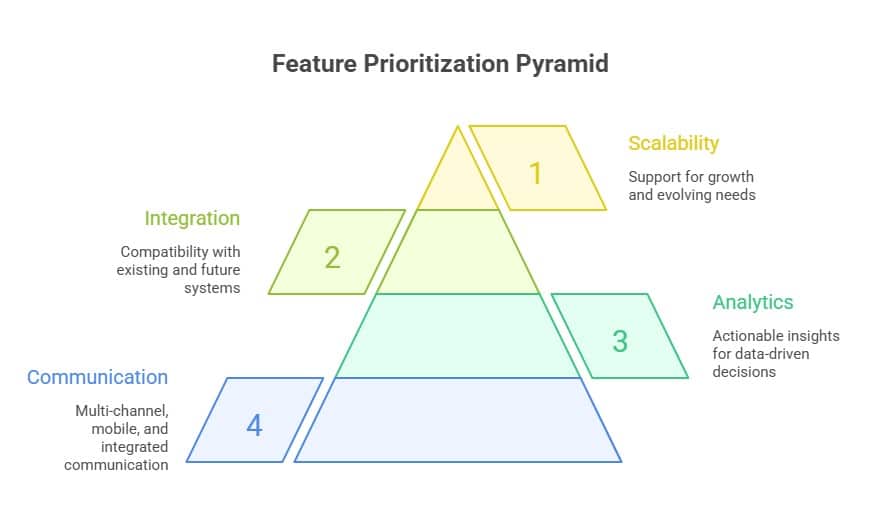
- Communication capabilities: Prioritize multi-channel communication, mobile access, and seamless tool integration.
- Analytics & reporting: Focus on actionable insights for data-driven decision-making.
- Integration flexibility: Ensure compatibility with existing and future business systems.
- Scalability: Choose platforms that support growth, new locations, and evolving needs.
Vendor Evaluation
- Run a pilot program: Test the platform with a small group to validate fit and identify adoption challenges.
- Check customer references: Speak with similar companies to understand real-world performance and support quality.
- Request real-world demos: Ask vendors to show how the platform solves your specific use cases.
- Evaluate support & training: Review onboarding, training resources, and ongoing support models.
- Assess scalability & fit: Ensure the solution can grow with your organization and meet long-term needs.
Conclusion
Employee experience platforms represent a fundamental shift from administrative-focused HR systems to engagement-centered digital workplace solutions.
For organizations in manufacturing, healthcare, hospitality, etc that face workforce engagement challenges, these platforms offer integrated approaches to communication, recognition, and operational coordination that traditional systems cannot match.
Transform your employee experience at HubEngage to unify communications, engagement, and workforce operations in one platform designed specifically for frontline workers. Ready to get started? Take a demo to learn more.
Employee Experience Platforms FAQs
What is the difference between employee experience platforms and employee engagement software?
Employee engagement software typically focuses specifically on measuring and improving engagement through surveys, recognition programs, and feedback collection. Employee experience platforms take a broader approach, integrating engagement tools with communication, workflow management, and operational systems to create comprehensive digital workplace experiences.
How do these platforms work for frontline workers without regular computer access?
Modern employee experience platforms prioritize mobile accessibility specifically to serve frontline workers in manufacturing, healthcare, and hospitality environments. These platforms provide native mobile applications optimized for smartphones and tablets, ensuring accessibility regardless of work location.
Features like offline functionality allow workers to access important information and complete tasks even when internet connectivity is limited. Push notifications ensure critical communications reach workers immediately, while multilingual support accommodates diverse workforce needs.
Integration with existing operational systems like scheduling software and safety management platforms means frontline workers can complete work-related tasks through the same platform they use for communication and engagement activities.
What kind of ROI can organizations expect from employee experience platforms?
Organizations typically see positive ROI within 12-18 months of implementation, primarily through reduced turnover costs and improved operational efficiency. Turnover reduction of 20-40% represents the most significant financial impact, as replacement costs often range from 50-200% of annual salary depending on role complexity.
Additional ROI sources include administrative time savings through workflow automation, improved productivity through better communication and engagement, and reduced compliance risks through automated tracking and training systems.
The specific ROI varies significantly based on organization size, industry, and current engagement levels. Organizations with high turnover rates or significant communication challenges typically see faster and larger returns on platform investments.
How long does implementation typically take?
Implementation timelines vary based on organization size, system complexity, and integration requirements. Basic deployments for small organizations can be completed in 4-6 weeks, while comprehensive implementations for large enterprises may require 3-6 months.
The process typically includes system configuration, data migration, integration setup, user training, and phased rollout. Organizations that invest adequate time in change management and user training see significantly higher adoption rates and faster time-to-value.
Phased implementation approaches often prove more effective than organization-wide launches, allowing teams to identify and address adoption challenges before full deployment.
Can these platforms integrate with existing HR and business systems?
Modern employee experience platforms are designed with integration as a core capability. Most solutions provide pre-built connectors for popular HR information systems, payroll platforms, scheduling software, and productivity tools.
API-based integration allows for custom connections with industry-specific systems and legacy platforms. Organizations should prioritize platforms with robust integration capabilities and strong developer support for ongoing connectivity needs.
Single sign-on (SSO) integration ensures seamless user experience by eliminating additional login requirements. This integration capability significantly impacts user adoption and ongoing engagement with the platform.
What security considerations apply to employee experience platforms?
Employee experience platforms handle sensitive employee information and require comprehensive security measures. Organizations should evaluate platforms based on data encryption, access controls, compliance certifications, and audit capabilities.
Industry-specific compliance requirements like HIPAA for healthcare or SOX for financial services may dictate platform selection criteria. Vendors should provide detailed security documentation and compliance attestations relevant to the organization’s industry.
Data residency requirements, particularly for international organizations, may influence platform selection. Some organizations require data storage within specific geographic regions or countries to meet regulatory requirements.
Related Links:
workforce management | employee experience platform | employee experience tool | digital employee experience platform | employee experience solution | employee experience software | employee engagement vs employee experience | employee experience after covid-19 | employee experience