Most companies launch an intranet with real optimism and watch it go quiet within six months. Employees log in once, find the interface confusing or the content stale, and never return. The platform becomes shelf aware, and leadership wonders what went wrong.
If you are responsible for driving intranet adoption and engagement at your organization, you already know the problem is rarely the technology itself. It is the strategy around it.
In this blog, we will offer you various tips to drive intranet adoption and boost engagement. You will also come across intranet best practices, the right features, and a measurement discipline that keeps momentum going.
Key Takeaways
- Intranet adoption succeeds when employees see clear daily value and can complete important tasks in one place.
- Leadership participation is one of the strongest drivers of employee engagement and long-term intranet usage.
- Mobile-first access, push notifications, and personalized content help increase adoption among deskless and frontline workers.
- Tracking metrics such as monthly active users, content engagement, and survey participation helps improve intranet performance.
- A well-adopted company intranet can improve communication, onboarding, compliance, and overall employee experience.

Intranet Adoption Challenges:
Understanding why adoption fails is the first step toward fixing it. The most common intranet challenges are not technical, they are behavioral and organizational.
| Challenge | What It Means | Impact on Adoption |
| Content goes stale quickly | Outdated org charts, old news, or broken links remain on the intranet | Employees lose trust and stop using the platform |
| Not mobile-friendly | Intranet does not work well on phones for deskless workers | Excludes frontline employees in manufacturing, healthcare, and hospitality |
| No ongoing champions | No leaders or department owners promote the platform after launch | Usage drops quickly after initial rollout |
| Employees don’t know what’s on it | Users are not guided or trained on available features | Low discovery and poor engagement |
Tips to drive Intranet Adoption and Boost Engagement
These tips to drive intranet adoption and boost engagement are organized around the phases most organizations move through pre-launch, launch, and sustained use.
1. Gamification
You can put gamification directly into the action steps to boost employee experience. The points, badges, leaderboards, and achievement milestones, employees are rewarded for meaningful actions such as completing training, participating in surveys, engaging with posts, or recognizing peers. This turns routine communication and HR tasks into interactive experiences that encourage participation and sustained engagement across the organization.
2. Mobile-Friendly Experience
This helps employees to access the intranet anytime, anywhere, on any device. This is especially important for frontline workers in industries like manufacturing, healthcare, retail, and hospitality. The mobile app supports real-time updates, task completion, document access, and surveys, ensuring seamless connectivity and higher engagement across all employee groups.
3. AI-Powered Analytics
With this you get real-time visibility into employee behavior on the intranet and engagement platform. Leaders can track what content performs best, where users drop off, and what information employees search for most. These insights help organizations refine communication strategies, improve content relevance, and continuously optimize the employee experience for stronger adoption and engagement.
4. Multilingual Support
Intranet having an option of multiple languages support will help employees access content in their preferred language. This is critical for global and diverse frontline workforces where language differences can affect understanding. A multilingual intranet software offers content in multiple languages, improves clarity, reduces miscommunication, and ensures employees feel more confident engaging with company communications.
5. User-friendly Design
Keep a simple, intuitive design that makes it easy for employees to navigate without extensive training. The platform must offer clean dashboards, personalized content, and streamlined navigation so users quickly find what they need. This ease of use reduces friction, increases daily engagement, and encourages employees to consistently return to the platform as part of their workflow.
What are the Key Metrics To Measure Intranet Adoption?
You cannot improve what you do not measure. Here are some important metrics you can track:
| Metric | Description |
| Monthly Active Users | Percentage of total workforce logging in at least once per month |
| Engagement Rate | Likes, comments, and shares as a percentage of views |
| Search Rate | Measures whether employees are finding what they are looking for |
| Mobile vs Desktop Usage | Breakdown of usage across mobile and desktop devices |
| Survey Completion Rates | Completion rate of pulse surveys and feedback forms |
HubEngage AI-Powered Intranet that Drives Intranet Adoption and Boost Engagement
Our AI-powered intranet is a core part of the employee experience platform, providing a single, easy-to-use hub for accessing, sharing, and managing information. It replaces outdated internal portals with a modern digital workplace that keeps employees informed, connected, and engaged daily.
With HubEngage, organizations can brings news, policies, documents, and tools in one cloud-based, fully branded platform that can be launched quickly, driving faster adoption and engagement.
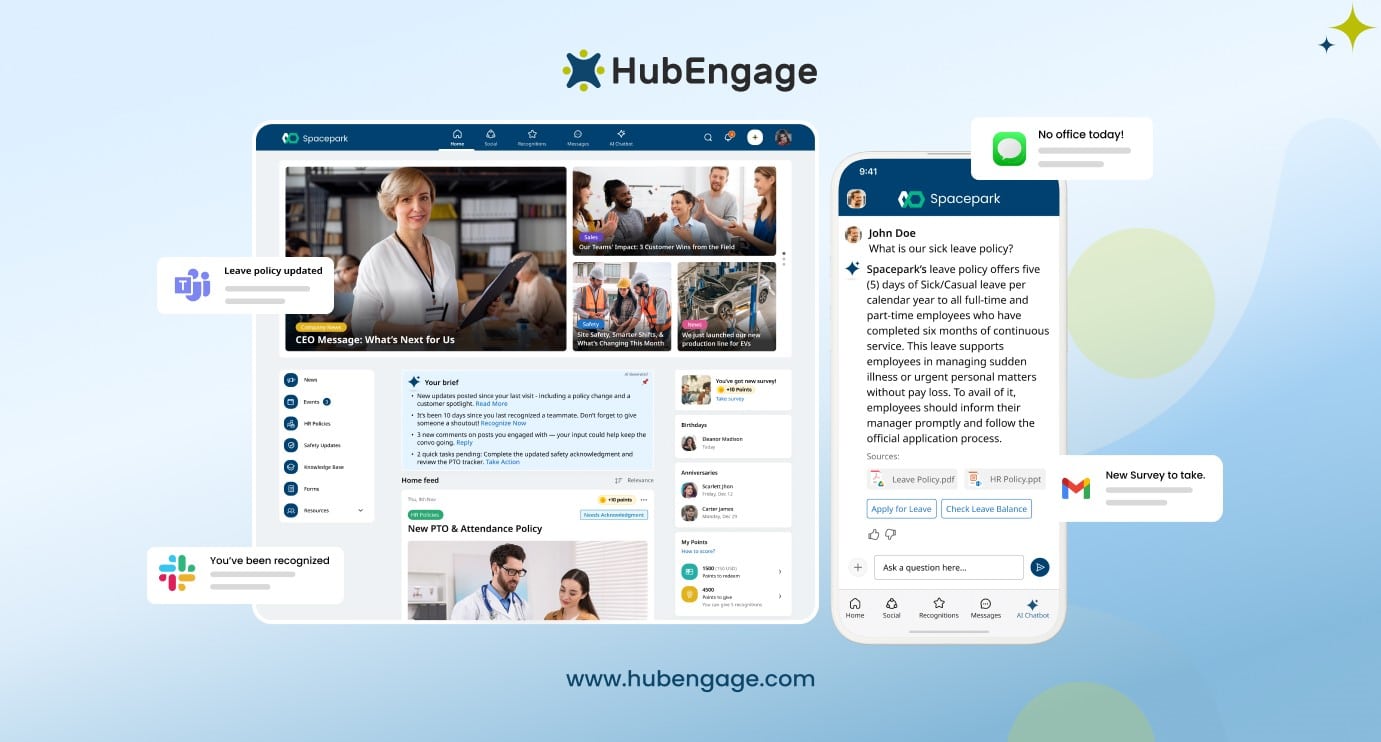
Built-in AI, social feeds, recognition, surveys, and real-time updates create an engaging experience employees actually use. It supports web, mobile, email, SMS, and digital signage, ensuring no one misses key updates. Enterprise-grade security and modular flexibility make this employee intranet platform scalable, secure, and ideal for any organization.
Key Features That Boost User Adoption
Here are some features that have the most measurable impact on adoption rates.
| Feature Category | What It Does | Impact on Adoption | Best For |
| Mobile app access | Brings the intranet to deskless workers on their own devices | Very high, excludes no one | Manufacturing, Healthcare, Hospitality |
| Social Features | Likes, comments, recognition feeds | Medium-high, builds community | Hospitality, Healthcare |
| Personalized Feed | Shows content relevant to role and location | High, reduces noise | Large, distributed organizations |
| AI-Powered Analytics | Shows admins what content performs | Medium, enables optimization | HR, Internal Communications teams |
| Multi-Lingual support | Serves diverse workforces in their language | High for diverse teams | Manufacturing, Hospitality |
Successful Intranet Adoption Examples
Here are three scenarios that reflect common patterns in manufacturing, healthcare, and hospitality the industries where adoption challenges are most acute.
1. Manufacturing: Solving the shift communication problem
A mid-sized automotive parts manufacturer with 1,200 employees across three shifts used bulletin boards, emails, and text messages for updates. Night shift workers often missed important information because messages were posted earlier.
After deploying a mobile-first intranet for manufacturing, 78% of employees activated in 30 days. Supervisors posted shift briefings, giving workers a reason to check each shift and reducing missed updates by more than half.
2. Healthcare: Connecting a dispersed clinical workforce
A regional healthcare network with staff across four campuses struggled with policy compliance. Emails had low open rates, and many employees used outdated procedures during audits, causing safety and consistency issues across departments.
The network implemented a role-based intranet with targeted content feeds. Clinical staff saw only relevant policies, and tracking improved accountability. Policy acknowledgment rates increased from 31% to 89%, improving compliance and reducing audit risks.
3. Hospitality: Building culture across seasonal staff
A resort group with high seasonal turnover struggled to onboard new staff consistently. New employees often lacked understanding of brand culture and service standards, and training varied across properties, affecting guest experience quality.
By building a structured onboarding pathway in the intranet with welcome videos, brand content, and a 30-day survey, the group reduced time-to-confidence from three weeks to nine days. Staff completion improved retention and guest satisfaction
Conclusion
Increasing intranet adoption and boosting engagement comes down to giving employees a reason to engage, designing experiences around their needs, and consistently measuring impact.
When done right, organizations see stronger communication, compliance, and culture outcomes beyond basic intranet software usage. Take the next step and explore our employee experience platform by taking a demo to see how it can boost your workforce engagement.
FAQs On Tips To Drive Intranet Adoption And Boost Engagement FAQs
How long does it take to see good intranet adoption?
Most companies reach good intranet adoption in 3 to 6 months with a strong plan. Without planning, usage drops after 60 days. First 90 days are most important for habits.
What is the most effective thing you can do to boost intranet engagement?
Leadership participation is the most effective way to boost engagement. When leaders post updates and use the intranet, employees follow their behavior. It builds trust and increases daily usage quickly.
How do you ensure a secure intranet?
Good intranet security comes with a role-based access, single sign-on, and encryption. Regular audits, permission checks, and compliance tracking protect data. These steps reduce risk and ensure safe information sharing is always required.
How do you measure intranet ROI for leadership?
Measure intranet ROI by linking it to business results like faster onboarding, better compliance, less email, and higher retention. Show these results together with engagement data for leadership clarity reports.
How do you build an intranet from scratch?
Start by defining clear goals and use cases for the intranet. Map user needs, choose a mobile-friendly platform, integrate systems, and launch in phases with feedback and improvements over time.
How do intranets support distributed teams?
Intranets help distributed teams by centralizing communication in one place. Mobile access, push notifications, and multilingual content ensure everyone gets updates. It reduces confusion and keeps teams aligned everywhere clearly
Related Links
company intranet software | intranet security | intranet best practices | intranet challenges | multilingual intranet software | employee intranet platform | intranet for manufacturing