Skip to content

How Gamification Boosts Employee Engagement In Small Businesses And Distributed Workforce?

Employee engagement rises by 48% in a gamified work experience, while 90% of employees say gamification makes them more productive and 72% say it motivates them to work harder. For organizations trying to keep frontline, deskless, hourly, remote, and distributed teams connected, that is not a novelty stat, it’s a signal that work design itself is changing. HubEngage’s connected approach fits that shift because gamification only works when it sits inside the daily communication, learning, recognition, and workflow system employees use.

The hard part is that most modern teams don’t lack effort, they lack visibility, feedback, and a reason to keep participating. Information gets scattered across apps, managers lose touch with what people have completed, and onboarding or training often feels disconnected from real work. If burnout is already creeping in, a practical starting point is how to prevent employee burnout, because gamification works best when it supports energy and clarity, not pressure.

Key Takeaways

  • Gamification works when it supports real work, not when it adds fluff to already crowded workflows.
  • Motivation is the mechanism, points and badges are only useful if they reinforce progress, recognition, and purpose.
  • Distributed and frontline teams need mobile-friendly experiences, because accessibility drives participation.
  • Programs fail when they chase activity instead of outcomes, so track completion, follow-through, and repeat engagement.
  • Sustainable gamification depends on fit, one leaderboard or reward model won’t work for every team.

The Engagement Crisis in the Modern Workforce

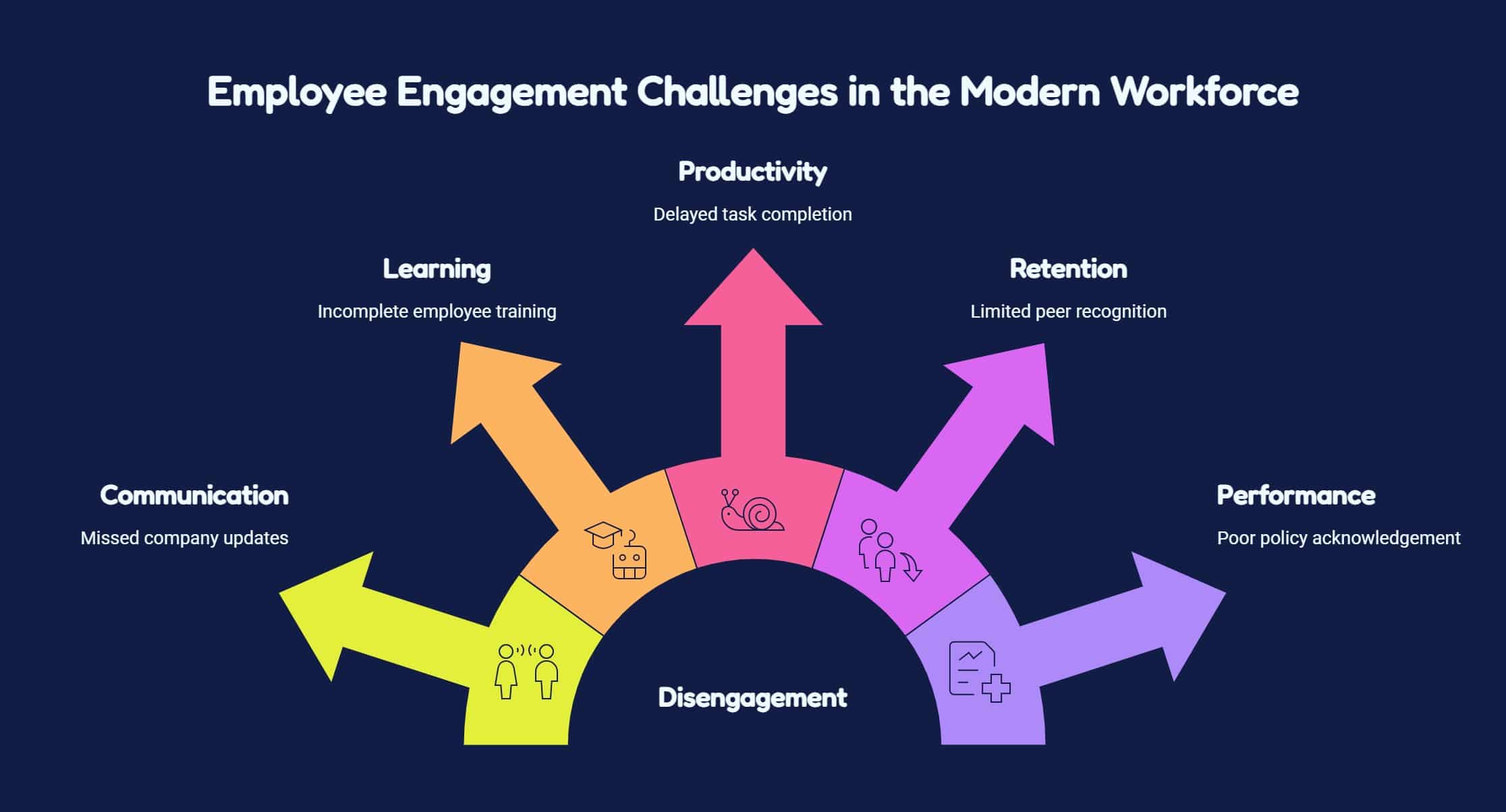
Disengagement is no longer a soft HR issue. In a distributed workforce, it shows up as missed updates, incomplete training, slow task follow-through, and managers constantly chasing acknowledgement that never arrives. When communication is fragmented, employees don’t just feel less connected, they act less consistently.

That is why the employee engagement statistics that reveal the numbers matter to business leaders. Engagement is tied to participation, and participation is what most operational systems depend on, whether the task is finishing onboarding, reading policy updates, submitting feedback, or closing out a frontline checklist. Gamification helps because it turns those invisible actions into visible progress.

Why standard engagement tactics fall short?

Traditional engagement programs often rely on occasional recognition, a survey, or a manager reminder. Those tools help, but they don’t create a feedback loop employees can feel during the workday. That’s especially true for hourly and frontline teams who may not sit at a desk, may not check email often, and may not have time to dig through separate apps.

Gamification is different when it’s used as a participation layer instead of a decoration layer. Points, progress markers, and recognition can make routine work feel more navigable, especially when employees can see how one action leads to the next. The result is less ambiguity, more momentum, and a stronger sense that effort is being noticed.

A key strategic value is that gamification can support communication without making work feel childish. It gives leaders a way to reinforce behaviors consistently across shifts, locations, and roles. For modern organizations, that’s the difference between a campaign and a system.

Understanding Workplace Gamification and Its Core Mechanics

Workplace gamification is the use of game-like mechanics in non-game work settings to shape behavior and improve participation. In practical terms, that means using points, badges, leaderboards, progress bars, challenges, rewards, and recognition to make actions easier to start and easier to repeat. Centrical describes gamification in exactly those terms, and it also points to richer mechanics like social interaction, missions, and status symbols for broader engagement design

The important distinction is that gamification is not about turning work into a game. It’s about making real work more visible, more responsive, and more rewarding. If the behavior you care about is finishing microlearning, acknowledging an update, submitting a survey, or following a workflow, the mechanic should support that behavior directly.

What gamification is and what it is not?

Gamification is not a replacement for good leadership, clear expectations, or strong communication. It can’t rescue a broken culture or fix confusing processes on its own. It works best when the underlying task is already meaningful and the system makes participation easier.

That’s why a leaderboard alone is rarely enough. A leaderboard can create movement, but it won’t create purpose unless employees understand why the action matters. Likewise, a badge means little if it’s detached from a real milestone or skill progression. The strongest designs make the next step obvious and the payoff immediate.

Recognition mechanics work best when they make competence visible, not when they just make participation loud. For example, a frontline team might use progress indicators for onboarding, while a manager audience might see milestone rewards for coaching completion or survey follow-through. In both cases, the mechanic should fit the behavior. That fit is what turns gamification from a feature into a motivation system.

HubEngage’s employee incentives and recognition approach reflects that same idea, because the value isn’t the badge itself, it’s the behavior the badge reinforces. Improving engagement with employee incentives and recognition badges, points, rewards, or leaderboards only works when the structure supports a real business goal.

The Science Behind Engagement Why Gamification Motivates

An infographic illustrating five key psychological drivers of engagement through gamification, including motivation and feedback loops.

Gamification changes how people experience effort, which is why it can drive engagement without relying only on incentives. Points, levels, badges, and leaderboards work when they strengthen employees’ sense of achievement, autonomy, and purpose, the core drivers of intrinsic motivation. That matters more than the visible mechanic itself, because employees do not keep repeating behaviors just to collect rewards. They keep going when the work feels meaningful, manageable, and worth the effort.

Intrinsic motivation drives the long game

The strongest programs do more than hand out prizes. They create a structure where employees can see progress, build mastery, and make decisions that matter. Progression paths, visible milestones, and meaningful goals give the next step real weight. A well-designed challenge shows that effort leads somewhere, and that the effort is recognized.

A 2024 peer-reviewed PubMed Central study found that gamified HRM significantly enhances employee work engagement, with intrinsic motivation partially mediating the effect, and that gaming preference plus perceived organizational support strengthen the relationship. For practitioners, that is a useful design constraint. If employees do not feel supported, the same mechanic can feel flat, forced, or disconnected from the work.

Enjoyment is the bridge, not the endpoint

The practical lesson is straightforward. Build feedback loops that help employees feel seen quickly, especially in distributed and frontline teams where delays are common. Use recognition to reinforce mastery, not just attendance. Segment the experience by audience, because gaming preference and organizational support shape how the mechanic lands. For a closer look at how motivation connects to engagement, see this guide on employee motivation and engagement.

From Engagement to Profitability The Business Impact of Gamification

The business case is stronger now because gamification has moved from experiment to operating strategy. Analysts at OpenLoyalty report that the global gamification market reached $19.42 billion in 2025 and is projected to grow to $92.5 billion by 2030, which signals how quickly organizations are adopting it across workforce and digital engagement programs. That scale matters because it reflects real use in day-to-day operations, not just interest in theory.

An infographic showing five key business impacts of gamification including increased productivity and improved customer satisfaction levels.

What leaders should measure?

The business impact of gamification becomes visible when leaders stop tracking only activity and start tracking behavior change. Training completion, content interaction, task adherence, peer recognition frequency, and survey participation are the kinds of measures that show whether people are engaging with the work system in a way that supports execution.

Industry summaries cited by OpenLoyalty report that companies using gamification can be seven times more profitable than those that do not, and that organizations using gamification in training have seen a 42% increase in employee engagement and a 63% increase in knowledge retention. Treat those figures as directional evidence, not a guarantee, because the result depends on program design, fit, and whether the mechanics match the work.

That kind of result is useful for operations leaders because it shows how the workday experience changes first, then business performance follows when participation becomes easier and more consistent. For teams focused on measuring eNPS and turnover, the key question is whether the program changes the behaviors that sit underneath those outcomes, not whether people click more often.

How to connect engagement to outcomes?

Leaders should ask whether gamification is improving repeated behaviors that matter to the business. If the goal is faster onboarding, track completion and confidence. If the goal is cleaner execution, track adherence and follow-through. If the goal is better manager communication, track acknowledgement and response rates.

For teams that want to model return more formally, a unified employee platform ROI calculator is useful because it frames engagement in terms of operational cost, participation, and tool consolidation. That lens works for gamification too, because the point is not to make a dashboard look busy. The point is to move real business behavior.

Strategic Implementation for a Modern Workforce

A six-step infographic detailing a strategic implementation process for workplace gamification to improve employee engagement.

Gamification succeeds when leaders treat it like a workflow design problem, not a morale campaign. That’s the right mindset for frontline teams, where time is tight and the experience has to be simple to use.

Start with the behavior, not the badge

Before choosing mechanics, define the exact behavior you want to improve. If employees aren’t entering data correctly, a progress-based incentive may help. If they aren’t completing training, a visible milestone path may work better. If they’re missing updates, acknowledgment mechanics may matter more than competition.

The most sustainable programs are aligned to a business outcome and a user experience. They also need to feel fair. If one group can easily earn recognition while another can’t because of shift patterns, access limits, or job design, the program will lose credibility fast.

Design for frontline and deskless realities

Frontline and deskless workers need mobile-first access, short interaction loops, and mechanics that fit around operational rhythms. Long logins, desktop-only dashboards, and complex scoring systems usually fail because they add friction. A simple weekly challenge, a training checkpoint, or a team-based recognition loop can work much better when time is tight.

Fairness matters here too. Research shows gamification’s impact is not uniform, because gaming preference and perceived organizational support change the strength of the relationship with engagement. That means segmentation isn’t optional. Different worker groups need different incentives, visibility, and pacing.

A good implementation cadence looks like this:

  • Define one business goal first. Don’t launch gamification to “improve engagement” in the abstract.
  • Match mechanics to the behavior. Progress bars for completion, recognition for knowledge sharing, challenges for repeat actions.
  • Keep feedback immediate. Slow rewards weaken the connection between action and outcome.
  • Use metrics that matter. For a practical guide to engagement measurement, measuring eNPS and turnover helps leaders connect sentiment to retention.
  • Review for novelty decay. Refresh goals, visuals, or rewards before participation turns stale.

The safest path is to pilot with a single audience, learn from behavior, and refine before scaling. That’s especially true in distributed organizations, where one-size-fits-all systems usually create more noise than momentum.

Unify and Amplify Engagement with HubEngage

Gamification becomes much more practical when it lives inside a connected system instead of another isolated app. HubEngage is built around communications, engagement, operations, and continuous learning, so gamified participation can support recognition, training, surveys, task follow-through, and employee communications in one place. That matters for SMBs that want to replace disconnected tools, and it matters for larger organizations that need orchestration across HRIS, payroll, LMS, and workforce systems.

The platform approach also reduces the common failure point where employees see a badge in one tool, a task in another, and training in a third. When participation, content delivery, and workflow support are aligned, gamification feels like part of the employee experience rather than a separate campaign. HubEngage also includes employee gamification platform capabilities that help leaders drive participation across communication and learning touchpoints.

Where a unified platform helps most?

For frontline teams, the value is consistency. Employees can receive updates, complete microlearning, respond to recognition, and engage with operational tasks in the same system, which lowers friction. For HR and communications teams, that means less manual coordination and more visibility into what people are doing.

For enterprise environments, integration is a key requirement. A gamification layer only scales when employee data, roles, and workflows are synced cleanly with existing systems. Otherwise, managers spend too much time maintaining the program and too little time using the results.

A team of professionals collaborating around a large monitor displaying a digital employee engagement gamification dashboard.

Conclusion

Gamification boosts employee engagement by making progress, achievement, learning, and recognition more visible. Its success depends on connecting mechanics with meaningful work rather than simply adding points or leaderboards.

Organizations should start with a clear behavior, create a fair and accessible employee experience, and measure real business outcomes. For frontline, remote, and distributed teams, mobile access and immediate feedback are especially important.

HubEngage helps organizations connect communication, engagement, operations, recognition, and continuous learning in one workforce experience. Explore our Employee Experience Platform by, requesing a demo and discover how it can turn employee participation into measurable action.

FAQs on How Gamification Boosts Employee Engagement?

What makes gamification different from a reward program?

A reward program provides an incentive after employees achieve an outcome. Gamification shapes the complete journey using feedback, progression, challenges, recognition, and visibility to encourage positive employee behavior over time.

Can workplace gamification feel manipulative?

Gamification can feel manipulative when leaders use points or leaderboards to pressure employees. Transparent rules, meaningful goals, employee choice, fair participation, and relevant rewards help create a more positive experience.

Does gamification work for frontline employees?

Gamification can work well for frontline employees when it offers mobile access, short activities, simple feedback, and team-based recognition. Complicated dashboards or additional steps during busy shifts can reduce adoption.

What is the difference between intrinsic and extrinsic motivation?

Intrinsic motivation comes from meaningful work, achievement, purpose, and mastery. Extrinsic motivation comes from external rewards such as points, badges, prizes, or recognition. Effective gamification uses external mechanics to support internal motivation.

How can a company measure whether gamification is working?

Companies should measure repeat participation, completion rates, training progress, task adherence, employee recognition, survey responses, knowledge retention, and the business outcome the gamification program was created to improve.

Why do some workplace gamification programs lose participation?

Participation declines when challenges become repetitive, rewards lose relevance, or the mechanics are disconnected from employee goals. Regular updates, employee segmentation, meaningful recognition, and fresh challenges can maintain long-term interest.

Should every company use employee gamification?

No. Gamification cannot repair unclear expectations, poor management, or broken workflows. It works best when an organization has identified a specific employee behavior and can make progress toward that behavior visible.

Related Links

employee engagement program | employee gamification platform | employee motivation and engagement | unified employee platform ROI calculator | employee engagement gamification

Get Insights

Subscribe to our weekly newsletter to get more tips on effective employee engagement and communications!

Join Our Community

Join Turn On Engagement (TOE) to interact with other employee engagement and people experience professionals. Share and get new ideas!

An expert content writer specializing in creating comprehensive, insight-driven content for technology and SaaS products. With more than three years of hands-on experience working closely with HR, internal communications, and leadership teams, he helps organizations turn employee engagement challenges into measurable outcomes. His writing is grounded in real customer experiences and focuses on practical strategies that boost productivity, improve communication, and strengthen workplace culture. Known for his ability to simplify complex technology concepts, he translates them into clear, actionable insights that resonate with HR professionals, talent acquisition leaders, and business owners alike. His work consistently reflects a strong commitment to trust, credibility, and people-first innovation, supporting organizations as they navigate employee experience, digital workplace transformation, and modern workforce engagement strategies.

Other posts you might enjoy

Back To Top