Healthcare employees work in highly demanding environments where nurses, physicians, technicians, administrative staff, and frontline workers play an important role. They manage long shifts, urgent situations, and continuous patient care.
To keep them engaged, healthcare organizations need more than occasional appreciation or annual surveys. A structured employee engagement program is essential to support communication, recognition, feedback, development, and employee well-being in daily operations.
A strong strategy helps organizations understand employee needs, improve communication, recognize contributions, and address engagement issues early. In this guide we outline how to build an employee engagement plan for healthcare teams, including key activities, important metrics, and ways to turn feedback into measurable improvements.
Key Takeaways
- An employee engagement plan improves motivation, communication, retention, and workplace culture.
- Clear goals, regular feedback, and manager accountability drive stronger engagement.
- Pulse surveys and recognition programs help track engagement continuously.
- Frontline teams need engagement strategies designed for deskless and shift workers.
- Engagement strategies should support retention, productivity, and workforce performance.
- Acting on employee feedback builds trust and improves long-term retention.

Why Healthcare Teams need an Employee Engagement Plan?
In healthcare, employee engagement is especially important because they often work across different departments, facilities, shifts, and job roles. Here are importance of engaging healthcare teams:

Employee Engagement Ideas for Healthcare Staff
The best employee engagement ideas for healthcare staff fit naturally into daily workflows. Activities should be accessible to both desk-based and frontline employees.
1. Launch Peer-to-Peer Recognition
Allow employees to recognize coworkers for teamwork, patient support, innovation, safety, or living organizational values. Recognition can be shared through a mobile employee platform so teams across locations can participate.
2. Create Employee Communities
Create digital groups around departments, interests, wellness activities, professional development, volunteering, or organizational initiatives. These communities can strengthen connections between employees who rarely work together directly.
3. Run Short Pulse Surveys
Your employee engagement plan should not be just sending annual or short pulse surveys every year. Ask employees about workload, communication, manager support, workplace culture, training, and other relevant topics.
4. Provide Learning Opportunities
Offer accessible training, microlearning, compliance courses, leadership development, and professional skill-building. Mobile learning can be particularly useful for healthcare employees who cannot regularly attend classroom sessions.
5. Make Engagement Interactive
Polls, quizzes, challenges, contests, wellness initiatives, and gamification improves employee engagement. Keep activities voluntary, relevant, and simple enough for employees with limited time.
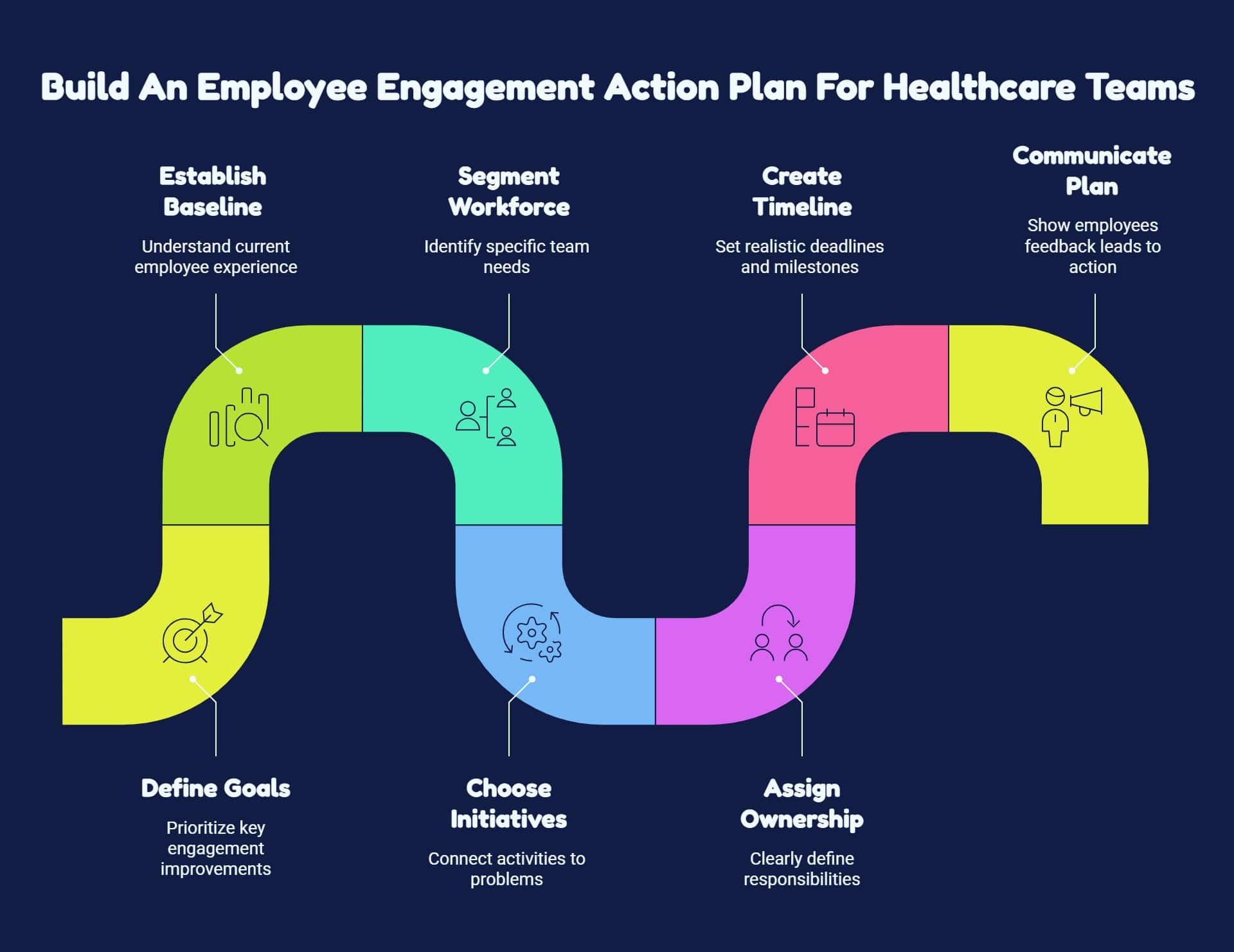
Steps to create an Employee Engagement Action Plan For Healthcare Teams
A successful action plan for employee engagement connects employee feedback with specific improvements. Here is a practical process healthcare organizations can follow.
Key Metrics of an Healthcare Employee Engagement Plan
Healthcare organizations should combine employee sentiment with behavioral and workforce data.
| Employee Engagement Metric | What It Helps Measure |
| Engagement survey score | Overall employee engagement and sentiment |
| Survey participation rate | How actively employees provide feedback |
| eNPS | Employee willingness to recommend the organization |
| Voluntary turnover | How many employees choose to leave |
| Absenteeism | Attendance patterns that may indicate workforce issues |
Metrics should not be viewed individually. Combining survey results, communication activity, recognition, learning, and workforce trends gives healthcare leaders a more complete picture.
How HubEngage helps you improve employee engagement?
We offers a unified employee experience platform that helps organizations connect and engage its each employee. It includes a social hub, recognition, surveys, and gamification tools to boost participation and feedback.
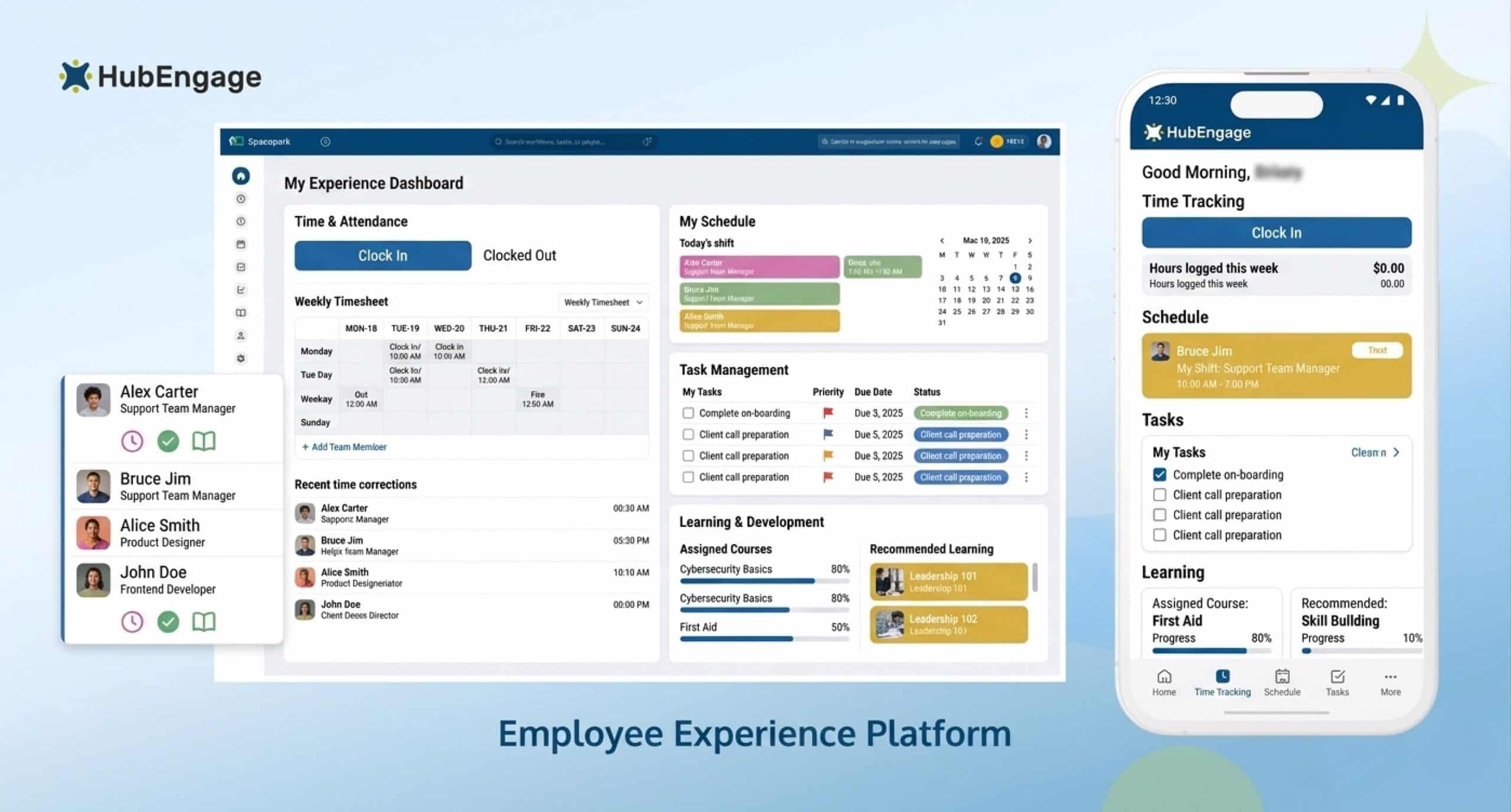
With mobile-first design and multi-channel communication, it reaches healthcare frontline staff such as nurses, security personnel, and administrative teams easily. Employees can stay informed, share ideas, and take part in engagement activities anytime.
The platform also follows strong security standards like ISO as well as industry compliances like HIPAA, and GDPR to keep employee data safe across all interactions globally.
Employee Engagement Plan Template For Healthcare Teams
A healthcare employee engagement plan template helps HR teams turn workforce challenges into clear, measurable actions. Use the template below as a starting point and customize it by department, location, role, or shift.
| Engagement Area | Employee Group | Action / Initiative | Owner | Timeline | Communication Channel | KPI |
| Communication | Night-shift nurses | Send targeted mobile updates | Comms Team | 90 days | Mobile app + push | Message reach |
| Recognition | Nurses and support staff | Launch peer recognition | HR + Managers | Monthly | Mobile + web | Recognition participation |
| Employee Feedback | All healthcare staff | Run short pulse surveys | HR | Quarterly | Mobile + email | Survey response rate |
| Learning | Clinical staff | Provide microlearning modules | HR + Managers | Monthly | Mobile learning | Completion rate |
| Well-being | Frontline employees | Run wellness challenges | HR | Quarterly | Mobile + signage | Participation rate |
| Team Connection | Multiple departments | Create employee communities | HR + Managers | Ongoing | Social hub | Active participation |
| Retention | High-turnover teams | Conduct feedback check-ins | HR + Managers | Quarterly | Survey + meetings | Turnover rate |
This template connects each engagement challenge with an action, owner, timeline, communication method, and KPI. Review the plan quarterly and use employee feedback and engagement data to adjust initiatives where needed.
Conclusion
A successful healthcare employee engagement plan turns employee feedback into continuous action. Once can improve engagement by improving communication, recognizing contributions, providing learning opportunities, listening regularly, and measuring results across different employee groups.
The key is consistency instead of conducting an annual survey. Using employee experience platforms like HubEngage can improve healthcare employee engagement across your organization and enhance workforce experience. Explore more about our platform by taking up a demo.
FAQs About Employee Engagement Plan For Healthcare
What is an employee engagement survey action plan?
An employee engagement survey action plan converts survey findings into specific improvements. It identifies priority problems, defines actions and owners, establishes timelines, tracks results, and communicates progress back to employees.
How often should healthcare organizations measure employee engagement?
Healthcare organizations can combine annual or periodic engagement surveys with shorter pulse surveys throughout the year. Continuous measurement helps leaders identify changes across departments, locations, roles, and shifts.
How can technology support healthcare employee engagement?
Having unified employee experience platforms can centralize communication, surveys, recognition, learning, feedback, and analytics. Also, using ai in employee engagement strategies, organizations can gain deeper insights and deliver more personalized engagement activities tailored to teams, roles, and locations.
How does gamification improve employee engagement in healthcare?
Gamification boosts healthcare engagement by adding points, badges, leaderboards, challenges, and rewards to training, surveys, safety, and wellness activities, increasing participation, encouraging learning, improving compliance, and making recognition more consistent and visible across teams.
What are common examples of teamwork in healthcare?
Interdisciplinary care rounds, shift handovers, emergency response teams, and cross-department coordination are common examples of healthcare teamwork. They ensure safe, timely, and effective patient care delivery.
Related Links
employee engagement program | social hub | how gamification boosts employee engagement | employee engagement ideas | ai in employee engagement