Intranet pricing catches a lot of HR and IT leaders off guard. What looks like a straightforward software purchase quickly reveals itself as a layered decision involving per-user fees, module add-ons, implementation costs, and enterprise negotiations.
If you are evaluating intranet platforms to improve employee engagement including tools for your staff engagement survey, workplace engagement survey, or broader employee communications then, understanding how intranet pricing actually works will save you from budget surprises and misaligned vendor conversations.
Our article will breaks down everything about intranet pricing, various intranet pricing models, factors impacting intranet pricing, and selection checklist.
Key Takeaways
- Intranet pricing varies by vendor and usually follows four pricing models models i.e. per-user, flat-rate, module-based, and custom enterprise pricing.
- Most intranet platforms charge extra for features like employee engagement surveys, mobile apps, analytics, integrations, and workflow automation.
- The real cost of an intranet includes implementation, training, integrations, migration, and ongoing administration not just the software license fee.
- Modern intranets help improve communication, increase survey participation, reduce turnover, and support better workforce decisions.
- Mid-sized and enterprise organizations can negotiate intranet pricing based on user count, contract length, support needs, and feature requirements.


Intranet Pricing Models
Intranet pricing does not follow a single standard structure. Vendors package their offerings in fundamentally different ways, and comparing quotes without understanding the underlying model is like comparing apples to engine parts. Here are the four primary intranet pricing models you will encounter:
| Pricing Model | Best For | Predictability | Risk |
|---|---|---|---|
| Per-user, per-month | Growing organizations | Medium | Costs rise with headcount |
| Flat-rate tiered | Stable headcount | High | Overpaying if usage is low |
| Module-based | Feature-specific needs | Low | Add-on costs compound fast |
| Enterprise custom | 1,000+ employees | High (once set) | Requires negotiation expertise |
The model you choose shapes every other intranet pricing conversation. Get clear on which model a vendor uses before you evaluate their feature list.
What factors impact Intranet Pricing?
Here are the major key elements that are responsible for different intranet pricing options:
1. Number of users
More employees increase pricing because vendors charge per active user, raising total subscription costs.
2. Feature requirements
Advanced features like analytics, surveys, and automation increase pricing due to added functionality and complexity.
3. Pricing model type
Different pricing models affect cost predictability, scalability, and how expenses grow with usage changes.
4. Implementation complexity
Complex setups, integrations, and migrations increase upfront costs due to additional time and technical resources.
5. Integration needs
Integrating with existing systems requires development effort, increasing costs through customization and ongoing maintenance.
6. Support and service level
Higher support levels increase pricing by offering faster responses, dedicated managers, and enhanced service reliability.
7. Contract length
Longer contracts reduce monthly pricing through discounts, while shorter terms often result in higher overall costs.
8. Organization size
Larger organizations may receive discounts but incur higher costs due to broader feature and scalability needs.
9. Customization requirements
Custom features and workflows increase pricing due to additional development, testing, and ongoing maintenance efforts.
10. Mobile and frontline access
Providing mobile access increases pricing due to additional licensing, development, and support for diverse user environments.
Choose the right Intranet by matching features, needs, and budget
Now that you know what drives intranet pricing, the next step is to find the sweet spot between functionality and cost for your organization. Follow below options:
1. Set your budget by finding the Total Cost of Ownership (TCO)
Many companies focus solely on monthly subscription costs and ignore the complete financial picture. To plan properly, estimate your total cost of ownership over a three-year period, including both upfront investments and ongoing expenses.
Year 1 includes setup costs like licensing, deployment, training, and integrations, making it the most expensive phase, often 2–3 times higher than the annual license fee, while Years 2–3 focus on ongoing costs like licensing, support, maintenance, and scaling.
You can use this TCO worksheet to compare vendors:
| Cost Category | Vendor A | Vendor B | Vendor C |
|---|---|---|---|
| License Fees (Annual) | |||
| Implementation & Setup | |||
| Data Migration | |||
| Integrations (HRIS, SSO, etc.) | |||
| Training & Change Management | |||
| Ongoing Administration (Annual) | |||
| Support & Maintenance | |||
| Add-on Modules | |||
| Contract Length (Years) | |||
| Estimated 3-Year Total Cost |
2. Match essential features with business priorities
Many organizations choose intranets by looking at features instead of real needs. First, list your main problems, like poor communication or hard-to-find documents.
Next, is to match features to these issues, so the intranet helps solve real challenges and improves daily work.
Also, you can create a simple priority matrix to make better decisions:

Using this, you can remove unnecessary add-ons, manage costs, and ensure the intranet fits your needs.
3. Use live demos to confirm value
Vendors often present polished demos with ideal data and simplified scenarios. While curated, these sessions can still provide valuable insights if approached correctly. Also, watch for warning signs that may indicate hidden costs or challenges:
- Statements like customization needed often mean extra fees later
- Skipping admin or setup screens may show hidden complexity
- Saying feature is on roadmap may mean delays ahead
- Avoiding mobile or integrations demo may show incomplete features
While demos introduce the platform, deeper validation comes from trials and customer references.
4. Ask for a comprehensive, and transparent quote
Ensure all pricing details are documented before making a decision, and avoid relying on estimates or verbal assurances. Your quote should clearly outline:
- Subscription pricing with defined user tiers
- Onboarding and launch support costs (if separate)
- Implementation timelines and any fast-track fees
- Included vs. paid integrations (Slack, Google Workspace)
- Mobile app access and related costs
- Pricing for AI features (search, recommendations, tagging)
- Storage limits and overage charges
- Training options for admins and users
- Support levels and response times
- Contract terms (monthly vs. annual)
Be careful with unclear terms like configuration support or implementation help, as they can differ in cost and scope.
5. Evaluate vendor transparency and long-term partnership value
A reliable partner should align with your long-term goals. Ask vendors clear questions about pricing breakdowns, renewal terms, support SLAs, data ownership, and implementation timelines. Consider asking:
- What is included in the base price versus add-on modules
- How does costs change with increases in the user counts ?
- Level of support included, and what are the response times defined in your SLAs?
- Who owns the data stored in the intranet, and how is it handled during migration or contract termination?
Explore our blog on intranet vendors to learn the key questions to ask before choosing.
HubEngage Modern Intranet: Your Right Investment
Our AI-driven modern intranet platform centralizes employee communication, engagement surveys, and workplace tools, enabling quick access to news, policies, documents, and resources, While gamification boosts participation, AI enhances content creation, translation, search, and analytics helping you measure communication effectiveness and identify improvement opportunities.
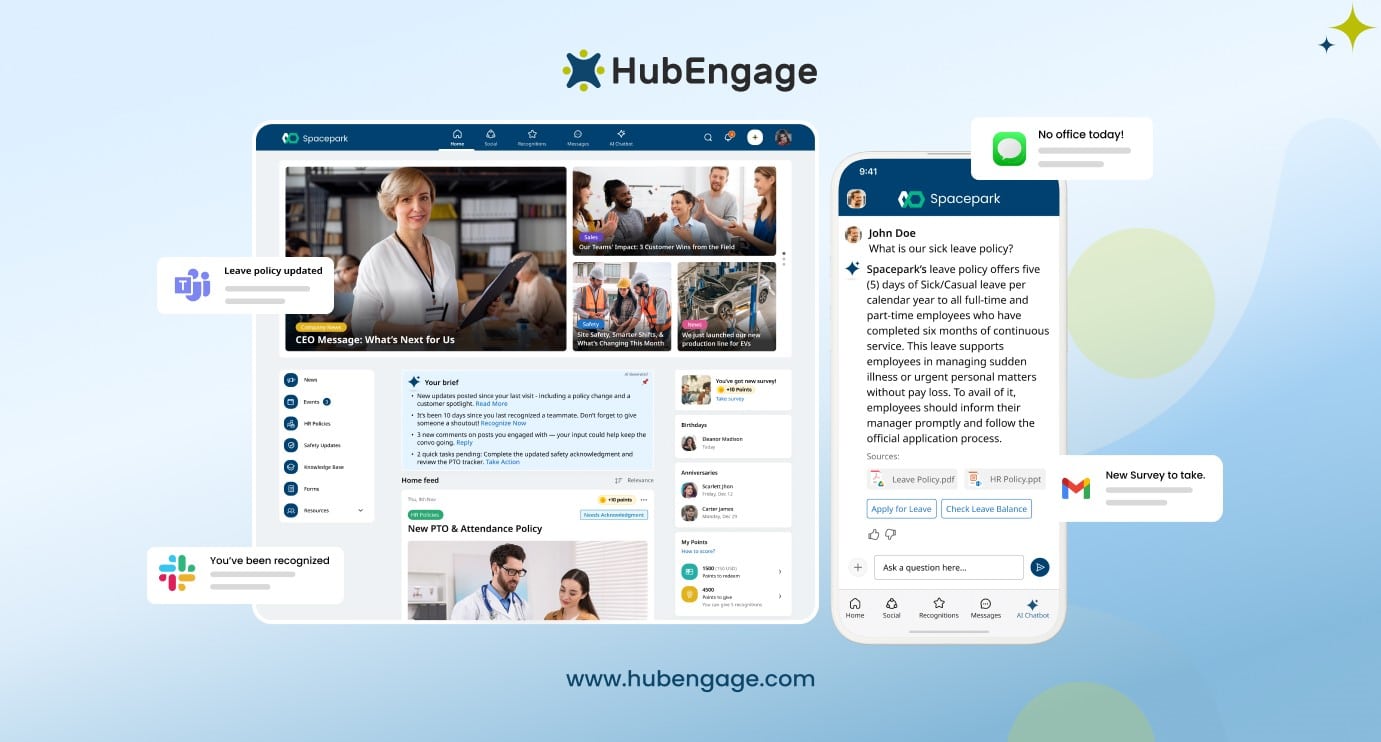
Unlike traditional intranets that are rigid and hard to maintain, HubEngage operates in the cloud, is fully customizable to reflect your brand, and is built for rapid deployment so organizations can achieve results within weeks.
Key Features:
- Modern and engaging experience: HubEngage turns internal communications into a gamified platform with social feeds, recognition, chatbot, surveys, updates.
- Custom quote based: Pricing depends on organization size and selected modules like intranet, communications, recognition, surveys, messaging.
- Easy to deploy: Cloud-hosted intranet launches quickly without heavy IT support, making it accessible for organizations of all sizes.
- Multi-channel reach: Share updates across web intranet, mobile apps, email, SMS, and digital signage for maximum visibility.
- Secure and compliant: Provides enterprise security with single sign-on, multi-factor authentication, and compliance with SOC 2, ISO-27001, GDPR, HIPAA.
- Unified and customizable: Select needed modules like communications, recognition, surveys, messaging, collaboration, or chatbot within one platform.
Pricing:
Our plans starts at $1 per user per year when averaged across modules. Vendor quote offers the most accurate pricing.
Conclusion
Intranet pricing rewards organizations that do their homework before entering vendor conversations.
Know your model, understand what implementation actually costs, and build your ROI case around retention as well as engagement data.
A clear understanding of pricing structures and feature requirements helps avoid surprises and ensures long-term value.
To see how these capabilities come together, book a personalized demo and explore our Employee Experience Platform that will fit your organization’s needs.
Intranet Pricing FAQs
How much does an intranet platform typically cost per user per month?
Intranet platforms usually cost between $1 and $15 per user per month. Pricing depends on features, number of users, contract length, and whether advanced tools like analytics or mobile apps are included.
Is intranet pricing different for frontline workers versus desk-based employees?
Yes, some intranet platforms offer lower pricing for frontline or deskless workers. These users often access limited features via mobile, helping organizations reduce overall costs for large frontline teams.
What is typically not included in intranet pricing quotes?
Intranet pricing quotes often exclude setup, data migration, integrations, training, and ongoing support. Always ask for total cost details to understand the full investment beyond the basic subscription fee.
How does intranet pricing relate to employee engagement survey tools?
Many intranet platforms include employee engagement survey tools in higher pricing tiers. Using built-in surveys helps reduce extra software costs and keeps employee feedback data centralized and easier to manage.
Can you negotiate intranet pricing even if you are not an enterprise organization?
Yes, even mid-sized companies can negotiate intranet pricing. Discounts may be available based on contract length, user count, or bundled services, especially when comparing multiple vendors before making a decision.