Employee and customer surveys help businesses understand satisfaction, identify problems, and make better decisions. However, collecting meaningful feedback becomes difficult when only a small percentage of people respond. A low survey response rate can leave business leaders and HR managers with incomplete information, making it harder to understand employee needs or customer expectations. For small and medium-sized businesses, improving participation does not always require bigger budgets or complicated processes. Simple changes to survey design, timing, communication, and follow-ups can make a difference. In this blog, we explain why survey response rates drop, how to improve participation in employee engagement surveys, and which strategies help businesses collect more useful feedback.
Key Takeaways
- Survey response rate measures the percentage of invited participants who complete a survey, helping businesses track feedback participation.
- Low survey participation can increase non-response bias, limit representative feedback, and affect the reliability of business decisions.
- Businesses can improve survey response rates through short, mobile-friendly surveys, multichannel distribution, and convenient scheduling.
- Automated reminders, meaningful incentives, and clear communication help encourage employees and customers to complete surveys.
- Real-time analytics and AI-powered feedback analysis help businesses identify concerns, track participation, and make informed improvements.

Why Does the Survey Response Rate Drop?
Survey participation often decreases when respondents find surveys inconvenient, irrelevant, or difficult to trust. Here are four common reasons.
1. Long and Complicated Surveys
Surveys containing too many questions require additional time and effort. Employees and customers may abandon them before completing the process.
2. Poor Timing and Frequent Requests
Sending surveys during busy work hours, holidays, or peak business periods reduces participation. Repeated requests can also cause survey fatigue.
3. Limited Accessibility
Surveys available only through email or desktop devices may exclude frontline employees, shift workers, and people who primarily use mobile devices.
4. Lack of Trust and Follow-Up
People may avoid sharing feedback when they question confidentiality or believe their opinions will not lead to meaningful improvements.
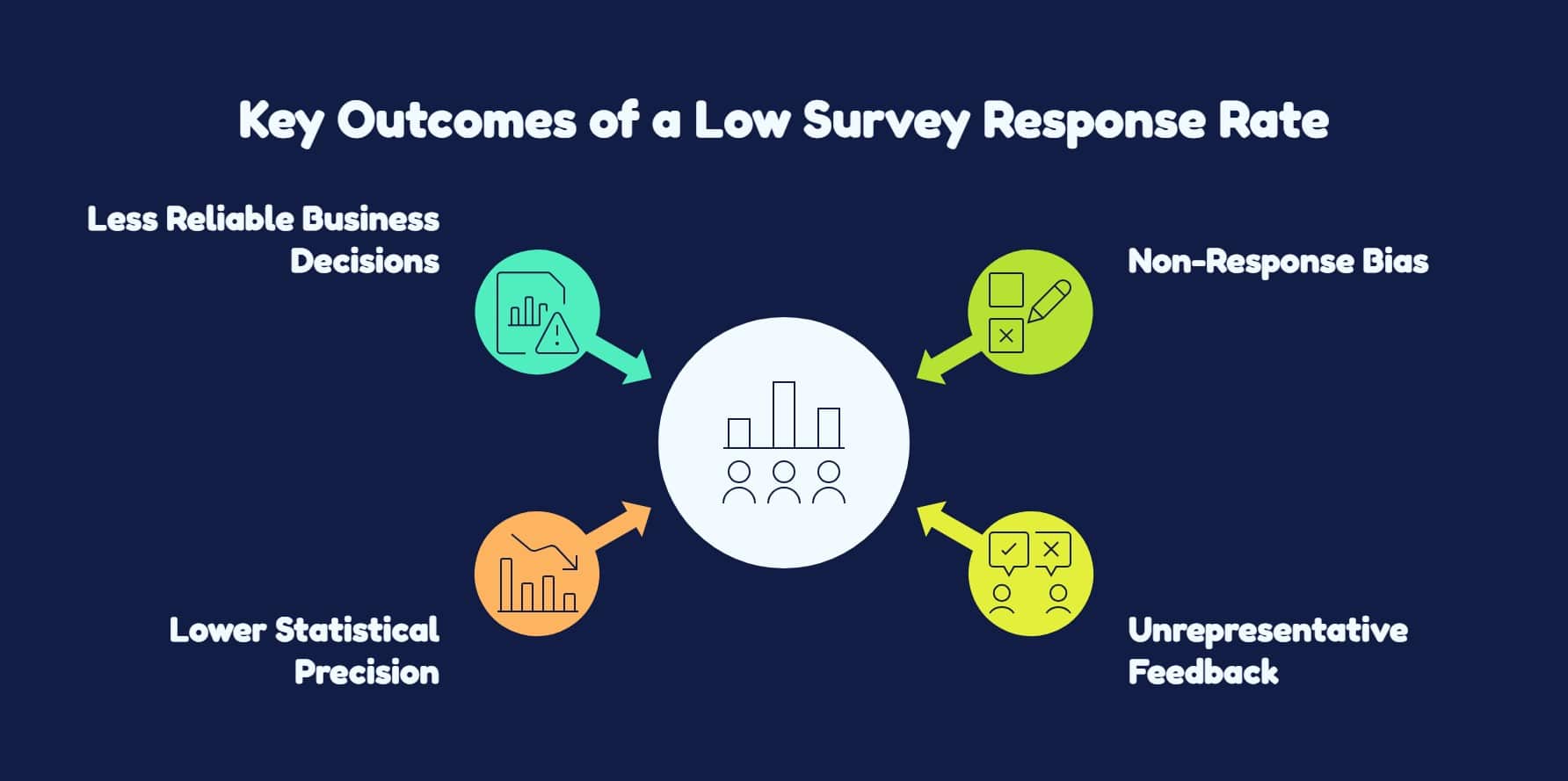
Key Outcomes of a Low Survey Response Rate
Low survey participation can affect the quality of feedback and the employee listening strategy that businesses make using that information.
1. Non-Response Bias
Non-response bias occurs when respondents have different experiences or opinions from non-respondents. For example, highly satisfied or dissatisfied employees may participate more frequently than others.
2. Unrepresentative Feedback
When certain departments, locations, or employee groups rarely respond, survey findings may fail to represent the broader workforce or customer base.
3. Lower Statistical Precision
Fewer completed surveys can reduce statistical precision and make meaningful patterns harder to detect, particularly when comparing small employee groups.
4. Less Reliable Business Decisions
Incomplete feedback can cause leaders to overlook workplace concerns, misunderstand customer expectations, or prioritize improvements that do not address broader needs.
However, according to the American Association for Public Opinion Research, a low response rate alone does not prove survey results are biased. Representation and survey design also matter.
What Factors Affect Survey Response Rate?
Several factors influence a survey rate whether someone opens, completes, or ignores a survey. Understanding below factors helps business leaders identify why participation is low and where improvements are needed.
| Factor | What Influences Participation |
| Survey design | Length, question clarity, format, navigation, and mobile accessibility |
| Respondent motivation | Interest, relevance, previous experiences, and perceived value |
| Distribution channels | Email, SMS, mobile applications, web links, and workplace communication platforms |
| Timing and frequency | Work schedules, deadlines, survey frequency, and reminder timing |
| Trust and incentives | Confidentiality, sender credibility, rewards, and visible follow-up actions |
Strategies to improve survey response rate?
Improving survey response rates requires making surveys easier to access, faster to complete, and more valuable to respondents. Here are some pulse survey best practices to boost survey response rates:
1. Create Customized Surveys Easily
Create surveys around clear business goals using customizable templates for engagement, onboarding, or employee satisfaction. Combine rating scales, multiple-choice questions, and short responses while keeping questions relevant, simple, and quick to complete.
2. Make Surveys Mobile-Friendly and Accessible
Make surveys easy to complete on smartphones and other devices. Share links through SMS, email, mobile apps, intranet portals, or QR codes, and offer clear navigation and language options for distributed employees.
3. Automate Survey Distribution
Schedule pulse, engagement, and lifecycle surveys automatically to reduce manual work. Target invitations by department, location, or role, and choose convenient delivery times that match employee schedules and encourage higher participation.
4. Send Automated Reminders
Use automated email, SMS, or push notifications to remind employees who have not responded. Send one or two reminders at reasonable intervals, avoiding excessive messages that could frustrate employees or reduce engagement.
5. Offer Meaningful Participation Incentives
Encourage survey participation with meaningful incentives such as recognition points, gift cards, or small rewards. Keep participation voluntary, reward completion rather than favorable answers, and protect confidentiality when collecting anonymous employee feedback.
6. Use Real-Time Analytics and Act on Feedback
Track response rates and participation patterns through survey dashboards. After that use AI-assisted analysis to identify recurring concerns. Share key findings and planned actions so employees see that their feedback leads to meaningful improvements.
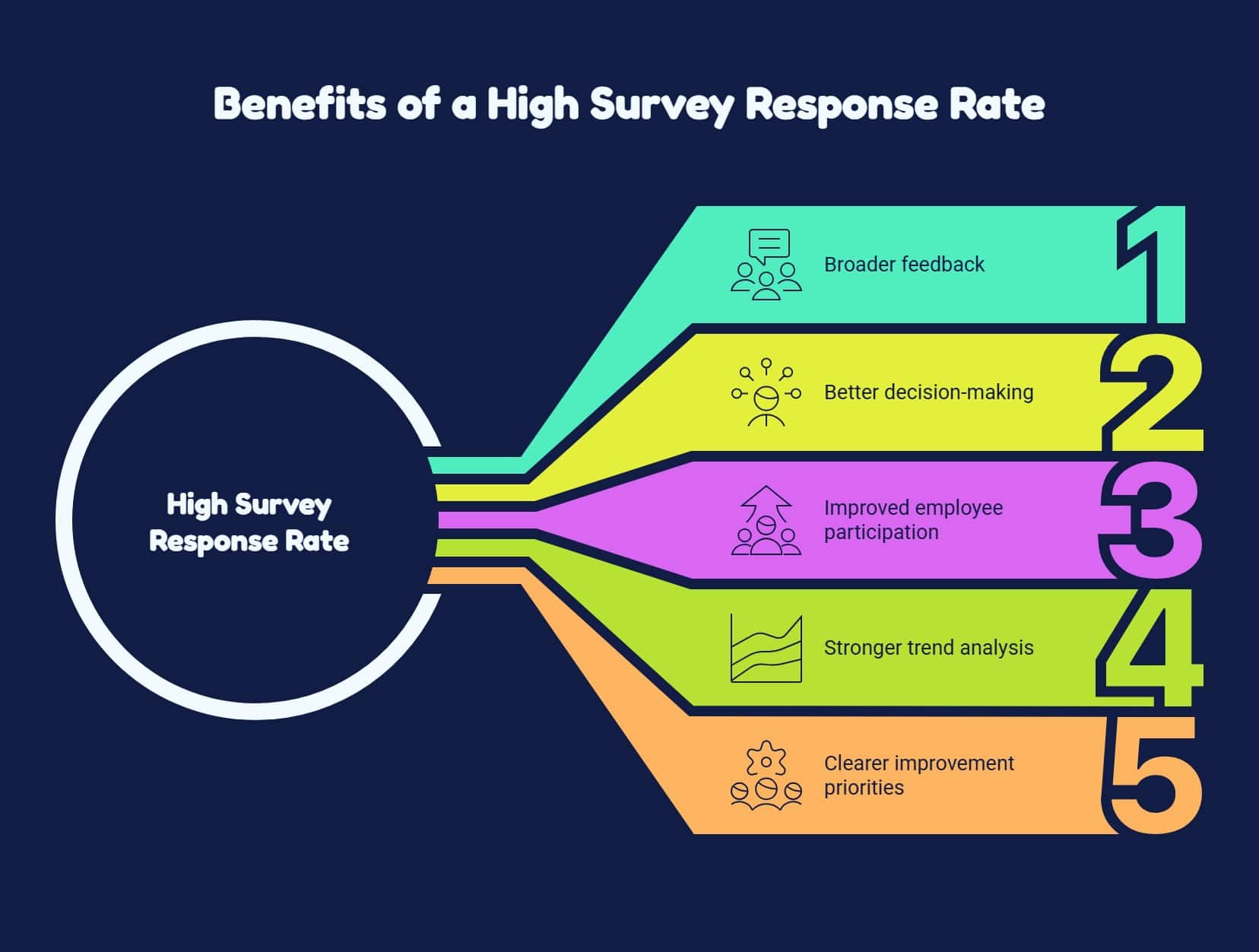
What are the benefits of a high response rate?
A higher survey response rate can help businesses on how to measure employee satisfaction by collecting more feedback. Here are some of the key benefits:
- Broader feedback: Hear from more employees, departments, and customer groups.
- Better decision-making: Use more complete information to identify operational and engagement challenges.
- Improved employee participation: Encourage employees to contribute ideas and workplace feedback.
- Stronger trend analysis: Compare feedback across survey periods and identify changes.
- Clearer improvement priorities: Understand common concerns and allocate resources more effectively.
Get Higher Survey Response Rate With HubEngage
As an important part of our Employee Experience Platform, we offer an AI-powered survey tool that helps you collect feedback, improve survey response rates, and measure employee satisfaction. Businesses can create pulse, engagement, lifecycle, and anonymous surveys using customizable templates.
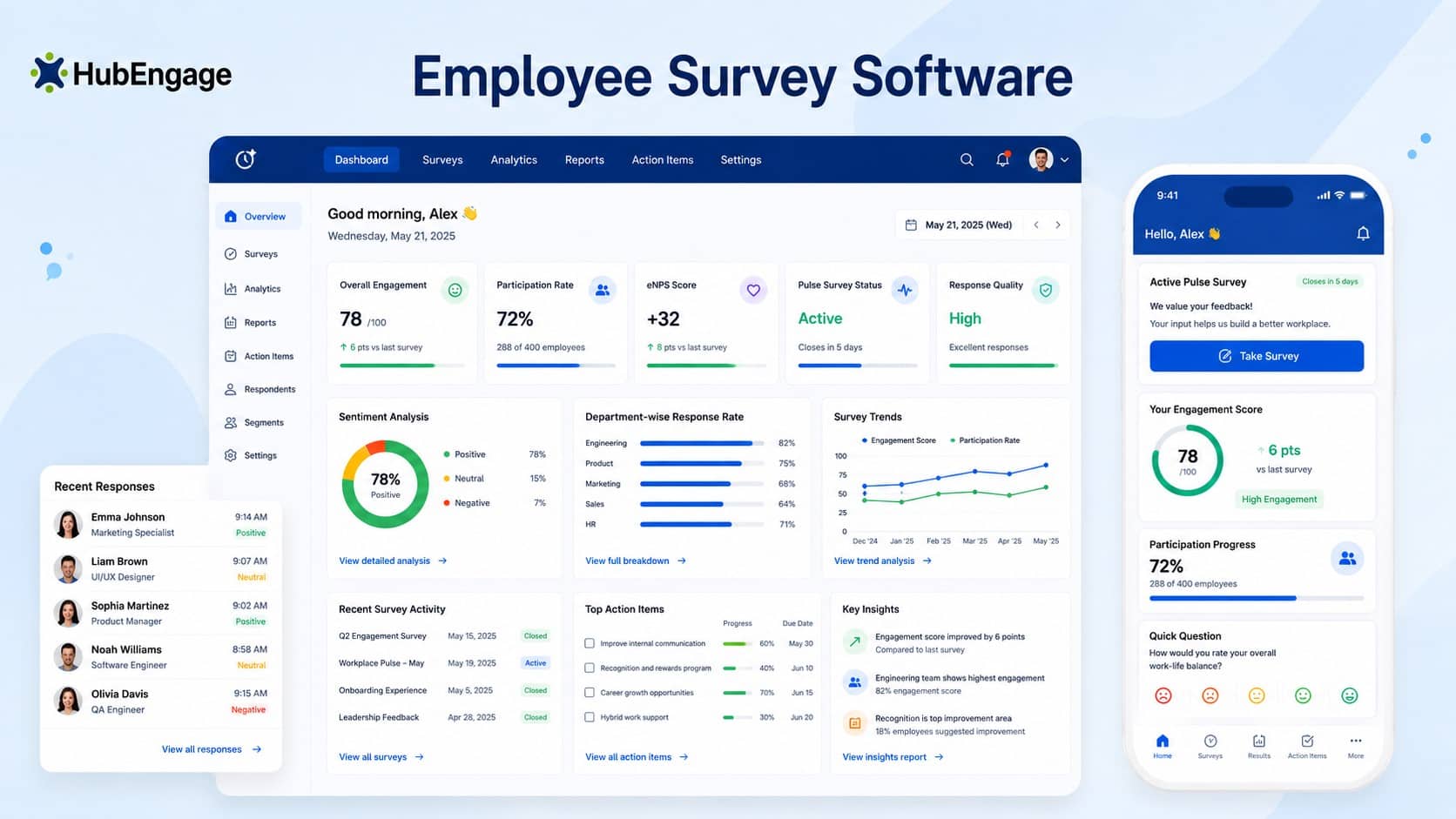
Multichannel distribution across mobile apps, SMS, email, intranet, and digital signage helps reach distributed employees. AI-driven sentiment and thematic analysis helps identify key feedback trends. With automated reminders, support for 30+ languages, and real-time analytics, HubEngage helps businesses turn employee feedback into meaningful workplace improvements.
Conclusion
Improving your survey response rate starts with making feedback easy, accessible, and worthwhile. Keep surveys short, use convenient channels, send timely reminders, and show employees how their input drives change. These steps help businesses capture insights and make informed decisions. Ready to hear from more employees? Explore our employee experience platform by taking a demo to see it in action.
FAQs On Survey Response Rate
1. What is a survey response rate?
A survey response rate is the percentage of invited people who complete and submit a survey. It helps businesses measure participation in employee feedback, customer satisfaction, and market research surveys. It could be anywhere from 0% to 100%, although it’s almost unheard of to get a 100% response rate.
2. Do Incentives Actually Increase Survey Participation?
Yes, meaningful incentives such as gift cards or reward points can improve participation. However, businesses should ensure rewards do not influence answers or compromise survey anonymity.
3. What Is a Good Survey Response Rate?
A good survey response rate depends on the audience, survey type, and distribution channel. Average response rates typically range from 10% to 30%, depending on audience engagement.
4. How to calculate survey response rate?
To work out your survey response rate, you can use the following formula:
Response rate = Number of people who completed the survey / total number of people you sent it to x 100
This will give you your response rate as a percentage.
5. What Are the Best Channels for Promoting a Survey?
Email, SMS, mobile applications, and intranet notifications are useful survey channels. The best choice depends on employee accessibility, communication preferences, and workplace arrangements.
Related Links
employee engagement surveys | employee listening strategy | how to measure employee satisfaction | pulse survey best practices