Skip to content

8 Top Pulse Survey Examples To Boost Engagement

pulse survey examples in a tablet

Why Quick Employee Feedback Is Your New Competitive Edge?

Organizations with highly engaged teams are more profitable, yet many leaders still rely on annual surveys that surface problems long after they’ve hardened into turnover, burnout, or distrust. That’s the core weakness of traditional listening programs. They’re too slow for modern workplaces, especially when teams are distributed, frontline-heavy, or changing fast.

Employee pulse surveys fix that by capturing feedback in the moment. A short monthly check-in, a shift-end question, or a quick onboarding survey tells you what employees are experiencing now, not what they were feeling last quarter. That speed matters because action matters. If you want a broader foundation for engagement work, start with our pillar guide and related thinking on building effective distributed team systems.

This guide gives you practical pulse survey examples you can put to work right away. It also covers two pieces many teams miss: using AI Surveys to automate distribution and analysis, and using incentives like points, leaderboards, and gift card redemption to improve participation. When done well, pulse surveys become more than a question set. They become an operating system for a more responsive workplace.

Key Takeaways

  • Most pulse surveys work best when they stay tightly focused on one topic or one moment in the employee journey.
  • Trigger surveys by schedule, hire date, shift end, or event completion so HR isn’t chasing sends manually.
  • AI can sort comments into themes like satisfaction, work environment, manager support, and career growth much faster than manual review.
  • Points, badges, leaderboards, and gift card redemption can improve response rates when the rewards feel fair and attainable.
  • If employees don’t see visible action, even the best pulse survey examples lose credibility.

Best Pulse Survey Examples

1. Monthly Employee Satisfaction Pulse Survey

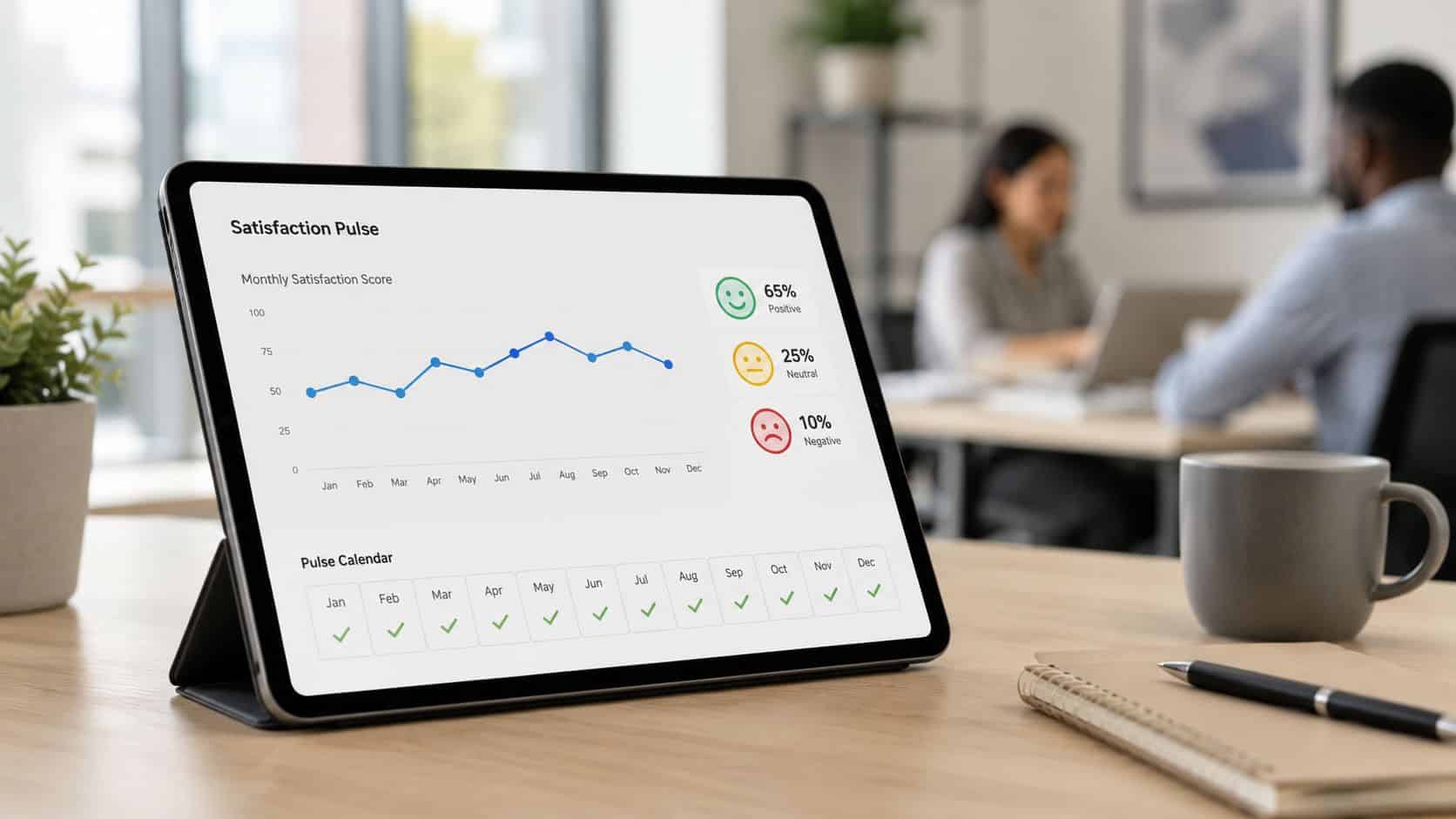
A monthly satisfaction pulse is the workhorse of a listening strategy. It gives you a stable rhythm for checking how employees feel about their role, manager support, team climate, workload, and company experience. If you only run one recurring pulse, this is usually the one to start with.

Teams in tech often use it to monitor remote employee sentiment. Retail operators use it after intense campaign periods. Healthcare leaders use it to spot morale issues before they become staffing problems. The common thread is consistency. You need a few core questions that stay the same month to month, plus a rotating question or two for current priorities.

A digital tablet displaying a satisfaction pulse survey dashboard with a line graph and calendar checklist.

What to ask each month?

Use a compact set of recurring questions such as:

  • Overall satisfaction: How satisfied are you with your work experience this month?
  • Manager support: Do you feel supported by your direct manager?
  • Work environment: Do you have what you need to do your job effectively?
  • Open comment: What most improved or hurt your experience this month?

If you want a deeper bank of satisfaction-focused question ideas, HubEngage’s guide to employee satisfaction surveys is a useful companion.

What works and fails?

What works is discipline. Keep your benchmark questions unchanged, send the pulse on a predictable cadence, and publish actions quickly. AI Surveys help by sending automatically on schedule and then grouping open-ended feedback into themes such as work environment, employee satisfaction, and leadership support.

What fails is overloading the survey with too many priorities at once. I’ve seen HR teams turn a monthly pulse into a mini annual survey. Response quality drops fast when employees feel they’re doing homework instead of giving feedback.

Participation also improves when completion earns points. Those points can feed leaderboards or accumulate toward gift cards. The incentive alone won’t save a weak survey, but paired with visible action, it turns a routine check-in into a habit.

2. Onboarding Experience Pulse Survey

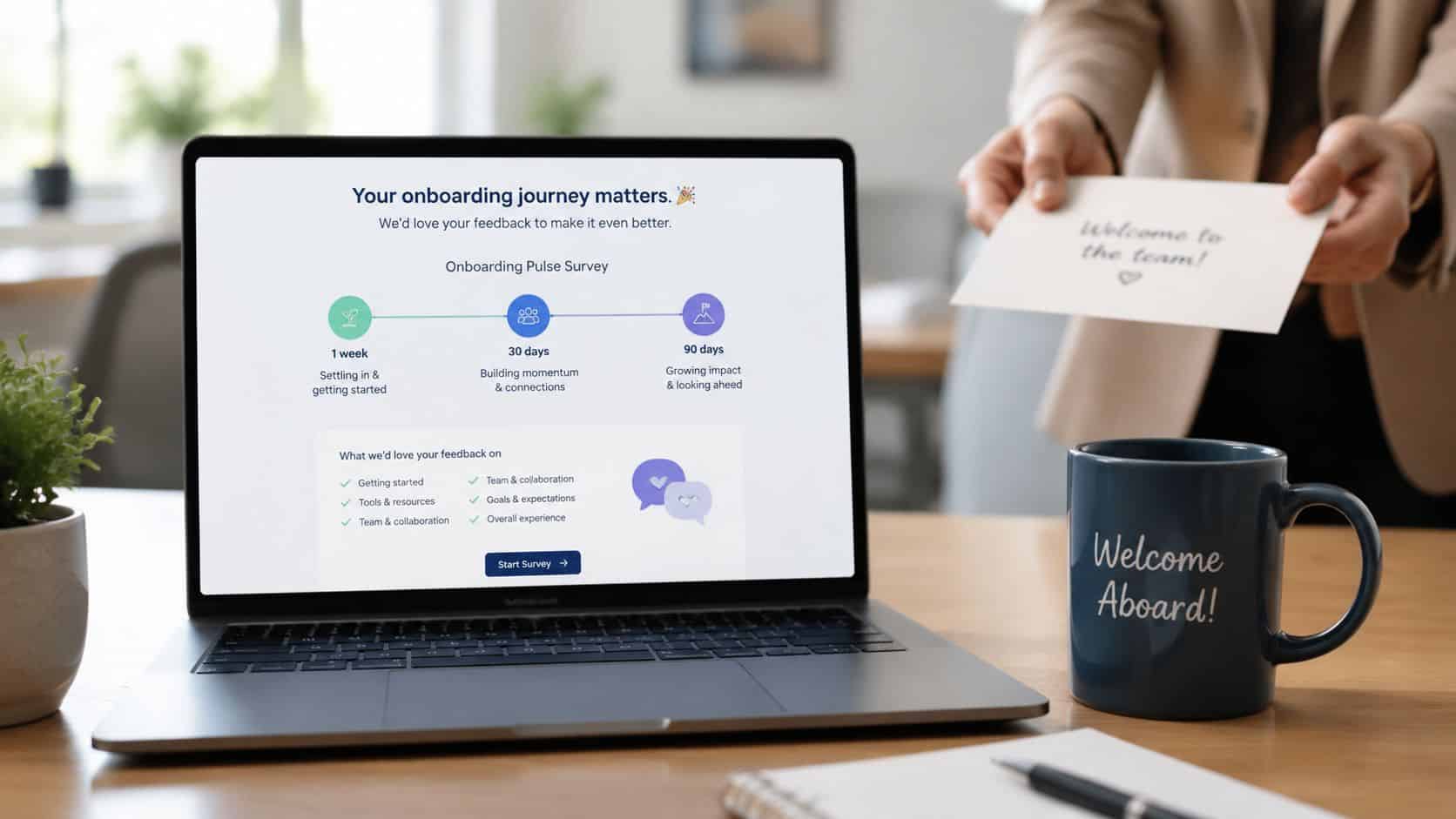
New hires notice gaps that long-tenured employees have stopped seeing. That makes onboarding one of the best pulse survey moments in the entire employee lifecycle. The strongest approach is to trigger short surveys at milestone points such as early orientation, the first month, and the first quarter.

This survey is especially valuable in financial services, manufacturing, and SaaS environments where role clarity, training quality, and manager access shape early retention. A frontline employee might need to flag unclear scheduling expectations. A software hire might need better product training. A corporate employee might need a stronger sense of where to find answers.

A laptop screen displaying an onboarding pulse survey designed to gather employee feedback after ninety days.

Questions that surface early friction

Keep it tight and practical:

  • Role clarity: Do you understand what success looks like in your role?
  • Team integration: Do you feel welcomed and supported by your team?
  • Manager check-ins: Are you getting the guidance you need from your manager?
  • Open text: What’s been your biggest challenge so far?

That last question is where AI Surveys shine. Instead of HR reading every comment manually, AI can sort responses into themes like training, access, tools, communication, and confidence.

Best way to deploy it

Automation matters here. Tie the send to the HRIS hire date so the survey goes out without HR managing a spreadsheet. That’s cleaner, more reliable, and easier to scale across locations and worker types. HubEngage’s overview of employee onboarding best practices aligns well with this lifecycle-based approach.

A good onboarding pulse should feel lightweight. New employees are already absorbing policies, systems, and names. Long surveys at this stage create fatigue and usually tell you less, not more.

Ask for feedback when the experience is still fresh. Waiting too long turns onboarding feedback into general engagement feedback.

One practical participation tactic is to award immediate points for completion. New hires understand quickly that feedback is part of the culture, and those points can count toward rewards or leaderboard visibility from day one.

3. Post-Event or Post-Shift Pulse Survey

Some of the best pulse survey examples are tied to moments, not calendars. A post-shift or post-event survey works because it captures feedback while the details are still sharp. If you wait until the end of the month, people forget what happened, soften the problem, or move on.

This format is especially effective in retail after a major sale, in healthcare after a difficult shift, in hospitality after a large event, and in manufacturing after a production run. The goal isn’t broad culture insight. It’s operational intelligence.

Keep it to a few questions

Employees at the end of a shift don’t want a long survey. They want to tap, type a short answer, and move on. Good prompts include:

  • Operational support: Did you have the staffing and tools you needed today?
  • Safety and conditions: Did anything create unnecessary risk or friction this shift?
  • Open comment: What should we fix before the next shift or event?

Mobile delivery matters more than email in this case. A shift-end text or app notification gets better immediacy than an inbox message that’s opened later, if at all.

Where AI adds real value

This is one of the clearest use cases for AI analysis. If dozens or hundreds of employees submit short comments after a shift, AI can quickly identify patterns around staffing gaps, equipment issues, safety concerns, customer volume, or communication breakdowns. That gives managers something they can act on before the next cycle begins.

A retail example is straightforward. After a major promotional event, one store’s comments might cluster around line management and break coverage, while another location’s comments point to device failures. Both stores had a rough day, but the fixes are completely different. AI helps separate those threads fast.

Use incentives here too, but tailor them to the moment. Many teams get stronger participation when post-event surveys award bonus points because the request comes outside normal routines. Team-based leaderboards can also work well for frontline groups, especially when the competition stays friendly and the reward feels achievable.

4. Career Development and Growth Pulse Survey

If employees don’t see a future with your company, engagement eventually flattens. That’s why a growth-focused pulse deserves its own lane instead of being buried inside a general engagement survey. Career conversations, learning access, internal mobility, and mentorship are specific enough that they need direct listening.

This survey works well on a quarterly cadence. That gives leaders enough time to act between pulses and enough frequency to catch frustration before it hardens into resignation. It’s useful in technical teams, professional services, healthcare, and any environment where advancement paths can feel opaque.

Better questions than “Are you happy with growth?”

Generic growth questions don’t tell you what to fix. Stronger prompts are:

  • Path clarity: Do you understand what growth looks like in your role?
  • Development support: Are you getting useful feedback that helps you improve?
  • Opportunity access: Do you have access to learning or stretch opportunities that matter to you?
  • Open text: What skills do you want to develop next?

That final question can power more than reporting. AI can group responses by skill interest, making it easier to shape learning recommendations, mentorship matching, or internal mobility paths.

Trade-offs to manage

One mistake HR teams make is asking about development, then routing the results into a dashboard no manager ever uses. Growth is personal. Employees expect a response that shows up in conversations, learning options, or role design.

A useful scenario is a professional services team where employees consistently mention client-facing presentation skills, but the formal training catalog is heavy on technical compliance. The survey didn’t just reveal dissatisfaction. It exposed a mismatch between employee demand and development supply.

You can also tie incentives to development itself. Points earned from completing the survey can count toward recognition, leaderboard standing, or rewards, and some organizations use that mechanism to reinforce participation in a broader learning culture.

5. Work Environment and Wellness Pulse Survey

Work environment is no longer one thing. For one employee it means ergonomics and equipment at a plant. For another it means hybrid coordination, home office tools, and meeting load. For another it means psychological safety and whether they can recover from a demanding week. That’s why this pulse should be segmented by work model and role type.

A semi-annual cadence usually works well because workplace conditions don’t need daily measurement, but they do need regular review. It’s particularly useful when organizations are managing office redesigns, hybrid policy shifts, frontline safety concerns, or rising signs of burnout.

Questions that get beyond surface-level wellness talk

Ask about the conditions around performance, not just mood:

  • Tools and resources: Do you have the equipment and support you need to work effectively?
  • Workload sustainability: Has your workload felt manageable recently?
  • Safety and well-being: Do you feel physically and psychologically safe in your work environment?
  • Open text: What one change would most improve your day-to-day work environment?

If wellness is part of your broader employee experience strategy, HubEngage’s webinar on mental wellness in the workplace adds helpful context.

What to do with the responses?

Segment the findings. Remote employees, office employees, and frontline workers rarely have the same issues. If you blend everything together, you end up with vague conclusions and weak action plans.

AI sentiment analysis is especially useful when comments signal urgency. If employees start mentioning stress, unsafe conditions, broken tools, or poor break coverage, AI can flag those themes quickly so HR, operations, facilities, or IT can respond.

A practical example is a hybrid organization where office employees ask for quieter collaboration spaces while remote workers flag meeting overload and unclear expectations. Both groups are describing “environment” problems, but each needs a different intervention. Without segmentation, leaders often launch a generic wellness campaign and solve neither.

6. Manager Effectiveness and Direct Report Relationship Pulse Survey

Employees may like the company and still leave the manager. That’s why manager effectiveness deserves direct measurement, even though it’s one of the more sensitive pulse formats to run. When done well, it helps identify communication gaps, inconsistent coaching, and teams that need support long before attrition data tells the story.

Run this pulse carefully. Employees need confidence that their responses won’t be traced back to them in a way that creates risk. Managers need results delivered in a way that supports improvement, not defensiveness.

Questions that produce useful coaching data

Avoid vague popularity questions. Ask about behaviors employees experience directly:

  • Communication: Does your manager communicate clearly and consistently?
  • Support: Do you feel your manager helps remove obstacles to your work?
  • Development: Does your manager provide feedback that helps you grow?
  • Open text: What would help your manager better support you?

These questions work because they point toward coachable actions. If employees say expectations are unclear, the intervention is different than if they say feedback only appears when something goes wrong.

Make anonymity real

This pulse can backfire if employees think comments will be read as-is by a manager with a very small team. Use anonymity thresholds and aggregate reporting. AI can help by clustering comments into themes and reducing the focus on individual wording.

HubEngage’s article on engagement mistakes managers make and how to fix them fits naturally with this survey type because the primary value is in the follow-up coaching.

A real-world pattern I’ve seen is this: one manager gets low marks not because they’re unsupportive, but because they’re absent in moments that matter. Employees don’t need constant contact. They need predictable check-ins, clearer priorities, and timely feedback. A focused pulse can reveal that distinction quickly.

Because of the sensitivity, participation incentives can help here. Higher-value points for completion can increase response volume, which improves anonymity and confidence in the results.

7. Company Culture and Values Alignment Pulse Survey

Culture gets talked about broadly and measured poorly. A strong culture pulse doesn’t ask whether employees “like the culture.” It tests whether they understand the values, see them modeled by leaders, and experience them in daily decisions.

This pulse is especially useful during mergers, strategy shifts, return-to-office transitions, or any period when leaders say the culture matters more than ever. If employees can’t connect stated values to observed behavior, culture messaging starts to sound cosmetic.

Ask about lived values

The best questions name behaviors:

  • Values clarity: Do you understand what our core values mean in practice?
  • Leadership alignment: Do you see leaders acting in ways that reflect those values?
  • Belonging and connection: Do you feel connected to the culture of the organization?
  • Open text: Where do we live our values well, and where do we fall short?

That last question can produce far richer insight than a generic culture score. AI can scan those comments for recurring themes such as transparency, accountability, inclusion, recognition, or disconnect between messaging and action.

A practical scenario

A remote-first company may say collaboration is a core value, yet employees describe siloed teams, unclear ownership, and little contact outside immediate work groups. The pulse then reveals a culture gap, not because the value is wrong, but because systems and habits aren’t supporting it.

Tenure cuts matter here. New hires often experience culture through onboarding and team behavior, while long-tenured employees compare current reality against past norms. Segmenting by tenure can show whether culture is drifting or being interpreted differently across groups.

This is also a good place to connect survey findings to recognition. If employees identify behaviors that reflect company values, those patterns can feed peer recognition programs and spotlight stories that reinforce the culture you want.

8. Engagement and Belonging Pulse Survey with Gamification Incentives

If your goal is high-frequency listening with strong participation, this is one of the most effective pulse survey examples to deploy. The format is short, often just a few questions, and the design leans hard into gamification. Employees earn points for responding, teams compete on leaderboards, and rewards stay visible enough to matter.

This model works well in startups, retail, hospitality, manufacturing, and call centers where leaders want a fast read on motivation, connection, and daily work experience. It also suits organizations that already use recognition and rewards as part of the employee experience.

Keep it ultra-brief

A practical version looks like this:

  • Engagement check: How engaged do you feel at work today?
  • Belonging check: Do you feel connected to your team?
  • Open text: What would improve your experience today?

That final question is deceptively powerful. AI can detect recurring themes across short responses, from schedule fairness to workspace issues to recognition gaps. A simple prompt like “How do you feel?” can also work well when AI is handling the sentiment and theme extraction.

Gamification that actually helps

Bad gamification feels manipulative. Good gamification makes participation easy, visible, and worthwhile. The strongest setups usually include:

  • Submission points: Employees earn points just for completing the pulse.
  • Response quality boosts: More thoughtful open-ended responses can earn extra points.
  • Leaderboards: Teams or departments can see participation standings.
  • Reward redemption: Points can be exchanged for gift cards or other rewards.
  • Recognition loops: Badges or milestone markers reinforce the habit.

HubEngage’s guide to employee engagement gamification is especially relevant for building this model without overcomplicating it.

One caution: don’t let the incentive overshadow the trust. Employees should never feel pushed to perform positivity. The purpose is honest participation. The reward should make responding easier to prioritize, not pressure people into giving favorable answers.

Pulse Survey Examples: Quick Comparison

Survey Implementation complexity Resource requirements Expected outcomes Ideal use cases Key advantages / Impact
Monthly Employee Satisfaction Pulse Survey Low, standard monthly template, simple automation Low, minimal admin; AI analysis reduces manual work High for trend detection and early warning; smaller per-wave samples Continuous org-wide monitoring (remote, retail, healthcare) Regular benchmarking and fast insight-to-action cycle
Onboarding Experience Pulse Survey Medium, lifecycle triggers tied to HRIS Low, short surveys; needs HR/manager follow-up High impact on early retention and onboarding quality New-hire cohorts across functions and shift-based hires Timely detection of onboarding gaps; enables targeted interventions
Post-Event or Post-Shift Pulse Survey Medium, requires reliable event/shift triggers and mobile delivery Low, quick responses but needs trigger integrations and rapid response handling High for operational fixes and immediate adjustments; may be reactive Frontline operations, retail events, healthcare shifts, manufacturing runs Real-time operational insights and fast corrective action
Career Development and Growth Pulse Survey Medium–High, quarterly cadence, segmentation and follow-up plans High, L&D, coaching, and succession planning resources required High for retention of high potentials and identifying skill gaps Organizations focused on talent development (tech, professional services) Systematic ID of training needs; supports succession and mobility
Work Environment and Wellness Pulse Survey Medium–High, cross-functional coordination (Facilities, IT, Safety) High, may require capital investment and multi-dept action High for uncovering safety, ergonomic, and wellbeing issues Hybrid/distributed workforces, manufacturing, healthcare, call centers Informs workspace improvements, safety fixes, and flexibility policy
Manager Effectiveness and Direct Report Relationship Pulse Survey High, confidentiality, aggregation, and sensitive HR workflows High, requires HR coaching, secure reporting and change management High for improving engagement when paired with constructive follow-up Large enterprises, high-turnover teams, leadership development programs Identifies manager development needs; increases accountability
Company Culture and Values Alignment Pulse Survey Medium, careful question design and longitudinal tracking Medium, needs leadership communication and culture programs Medium–High for measuring alignment and exposing value gaps Organizations undergoing transformation or scaling culture (remote-first) Reveals misalignments; informs messaging and culture initiatives
Engagement and Belonging Pulse Survey with Gamification Incentives Medium, gamification platform and frequent cadence management Medium–High, rewards budget, platform maintenance, analytics Very high participation and continuous sentiment data; risk of reward-driven noise Startups, retail/hospitality, call centers, frontline teams with mobile access Dramatically higher response rates, habit-building, real-time leaderboards and recognition

From Feedback to Action Building a Responsive Culture

Pulse surveys work because they shorten the distance between employee experience and leadership response. This is their key benefit. You’re not waiting for an annual review cycle to find out that new hires feel lost, that one shift keeps running understaffed, or that employees don’t see a future with the organization. You’re hearing it while there’s still time to act.

The strongest programs don’t treat pulse surveys as isolated forms. They build a system around them. One survey runs monthly. Another triggers automatically after onboarding milestones. Another appears after a major event or a shift. Together, they create a practical listening rhythm across the employee lifecycle.

AI makes that rhythm sustainable. Instead of relying on HR teams to manually launch every survey, AI Surveys can automate distribution based on cadence, hire date, or workforce events. Once responses come in, AI can analyze open text for sentiment and themes such as work environment, employee satisfaction, manager support, and career growth. That speed matters because it lets leaders move while the issue is still current.

In practice, that means less time sorting spreadsheets and more time deciding what to do next. A comments feed that once took days to review can become a clear theme summary for HR, managers, operations, and executives. For organizations with distributed or frontline teams, that efficiency isn’t just convenient. It’s what makes continuous listening realistic.

Gamification solves another persistent problem, which is participation. Many organizations don’t have a survey problem. They have a response problem. Employees are busy, skeptical, or both. Points for submissions, leaderboard competition, badges, and gift card redemption can create enough momentum to make pulse surveys part of the employee routine. The key is pairing incentives with credibility. If employees see action, they keep responding. If they only see reminders and rewards, trust fades.

That’s why closing the loop is the essential step. Share what you heard. Name what’s changing. Be honest about what won’t change yet. Employees don’t expect every comment to trigger a policy shift, but they do expect evidence that someone listened.

Organizations that get this right build a more responsive culture. Managers gain better visibility into team needs. HR spends less time chasing feedback and more time shaping interventions. Employees learn that their voice affects the workplace they experience every day. That’s the core value behind these pulse survey examples, and it’s why modern listening strategies increasingly pair automation with AI-driven data insights for businesses.

Conclusion

Pulse surveys help organizations stay connected to employee sentiment, identify issues early, and create a culture of continuous improvement.

Whether you are measuring satisfaction, onboarding experiences, manager effectiveness, and workplace well-being, the key is acting on feedback quickly and consistently.

When supported by automation, AI-driven insights, and meaningful participation strategies, pulse surveys become a powerful tool for strengthening engagement and retention.

To see how this can work in practice, explore the HubEngage Employee Experience Platform and schedule a demo to learn more.

FAQs on Pulse Survey Examples

What are pulse survey examples for employees?

Pulse survey examples for employees include short recurring surveys such as monthly satisfaction checks, onboarding feedback surveys, post-shift surveys, manager effectiveness surveys, wellness pulses, culture alignment surveys, and engagement or belonging check-ins. Each one focuses on a specific moment or theme instead of trying to measure everything at once.

How many questions should an employee pulse survey have?

Most employee pulse surveys should stay short. In practice, that often means a handful of focused questions and one open-ended prompt. Post-shift and engagement pulses usually need to be even shorter so employees can complete them quickly.

How often should companies send pulse surveys?

The right cadence depends on the topic and your capacity to act. Monthly works well for general satisfaction. Lifecycle-based surveys fit onboarding. Immediate surveys work best after shifts or events. A company shouldn’t send surveys more often than it can review, communicate, and act on the feedback.

What are good questions to include in a pulse survey?

Good pulse survey questions are specific, easy to answer, and tied to action. Examples include whether employees feel supported by their manager, whether they have the tools to do their job well, whether workload feels manageable, whether they understand growth opportunities, and what one change would improve their experience.

Can AI automate employee pulse surveys?

Yes. AI can automate survey scheduling and distribution based on cadence or employee lifecycle events. It can also analyze open-ended responses for sentiment and recurring themes such as work environment, employee satisfaction, manager support, communication, and career growth.

How does AI help analyze pulse survey responses?

AI helps by sorting comments into clear themes, identifying positive and negative sentiment, flagging urgent issues, and summarizing large volumes of feedback quickly. That reduces manual review time and helps leaders act faster.

Do incentives improve pulse survey participation?

They often do when they’re used well. Points for submissions, leaderboard visibility, badges, and rewards such as gift card redemption can encourage employees to participate consistently. The incentive works best when employees also see visible follow-through on the feedback.

What’s the biggest mistake companies make with pulse surveys?

The biggest mistake is collecting feedback without closing the loop. If employees keep answering surveys but never hear what changed, participation and trust decline. Short surveys only create value when leaders respond clearly and consistently.

Related Links

employee engagement surveys

Get Insights

Subscribe to our weekly newsletter to get more tips on effective employee engagement and communications!

Join Our Community

Join Turn On Engagement (TOE) to interact with other employee engagement and people experience professionals. Share and get new ideas!

An expert content writer specializing in creating comprehensive, insight-driven content for technology and SaaS products. With more than three years of hands-on experience working closely with HR, internal communications, and leadership teams, he helps organizations turn employee engagement challenges into measurable outcomes. His writing is grounded in real customer experiences and focuses on practical strategies that boost productivity, improve communication, and strengthen workplace culture. Known for his ability to simplify complex technology concepts, he translates them into clear, actionable insights that resonate with HR professionals, talent acquisition leaders, and business owners alike. His work consistently reflects a strong commitment to trust, credibility, and people-first innovation, supporting organizations as they navigate employee experience, digital workplace transformation, and modern workforce engagement strategies.

Other posts you might enjoy

Back To Top