Most employees get maybe one or two real opportunities each year to speak directly with their CEO such as a town hall, a skip-level meeting, or an all-hands session. Wasting that window on vague pleasantries is a missed opportunity that costs you more than you realize.
Knowing the right questions to ask CEO-level leaders can shape your career trajectory, deepen your understanding of where the company is heading, and signal that you are someone who thinks beyond your immediate role.
Strong employee engagement programs also play an important role in creating open communication cultures where employees feel more confident participating in leadership conversations and sharing feedback.
Our guide gives you a proper as well as ready-to-use list of questions to ask CEO. We have organized them category wise along with guidance on how to ask them effectively.
Key Takeaways
- Asking thoughtful CEO questions helps employees better understand company strategy, leadership priorities, and business goals.
- The best questions to ask a CEO focus on company growth, employee development, culture, and future plans.
- Strategic and open-ended questions create more meaningful conversations with leadership.
- Employees who understand leadership vision are more likely to contribute to business success.
- Good CEO questions can improve career growth, visibility, and leadership potential within the organization.
- Strong employee experience platforms help organizations build better connections between employees and leadership.
Best Questions to Ask Your CEO About Company Strategy
Strategy questions are the most valuable questions to ask CEO leaders because they reveal how the organization thinks about its future.
When you ask about strategy, you demonstrate that you are invested in the company’s direction and not just your own paycheck.
These are not questions about quarterly numbers. They are questions about the logic behind decisions, the trade-offs the leadership team is making, and where the organization is placing its bets.
Strategy questions worth asking
- What does winning look like for us in the next three years? This question forces a concrete answer. Vague responses tell you something important: leadership may not have a well-defined picture of success.
- Which market or customer segment are we most focused on right now, and why? For teams in manufacturing, healthcare, or hospitality, this question reveals whether your segment is a priority or an afterthought.
- What is the one strategic decision we made in the past year that you would make differently? This is one of the best questions to ask CEO leaders because it reveals self-awareness and organizational learning culture.
- How do we differentiate ourselves from competitors who are doing something similar? The answer tells you whether leadership has a defensible position or is operating on hope.
- What assumptions is our strategy built on, and what would have to change to invalidate those assumptions? Sophisticated leaders appreciate this question. It shows you understand that strategy is a bet, not a guarantee.
According to research published by Harvard Business Review on strategic planning, organizations where employees understand the company’s strategic priorities outperform those where strategy is treated as a leadership-only concern. Asking these questions is not just good for your career but it is good for the organization.
Questions About Leadership Vision and Direction
Vision questions are different from strategy questions. Strategy is the plan. Vision is the belief system that drives the plan.
Questions to ask CEO leaders about vision reveal what they actually care about and whether the organization’s stated values match the decisions being made at the top.
These questions work especially well in smaller group settings or direct conversations, where the CEO has room to be candid.
Questions that reveal leadership thinking
- What kind of company do you want us to be in ten years not just in size, but in character? This invites a genuine answer rather than a rehearsed one.
- Who are the leaders, inside or outside the company that influence how you think about your role? The answer tells you a great deal about the CEO’s intellectual framework.
- What is the hardest leadership decision you have made in the past year? Asking about difficulty rather than success gets you a more honest response.
- How do you want employees to feel about coming to work here? For organizations using an employee engagement platform, this question directly connects leadership intent to the employee experience systems the company invests in.
- Where do you think our leadership team has the most room to grow? This takes courage to ask, but it signals that you are thinking about organizational health, not just your own position.
Questions About Employee Development and Career Growth
Questions to ask CEO leaders about development signal ambition and organizational investment simultaneously.
CEOs who take these questions seriously tend to lead companies where employee benefits and growth opportunities are genuine, not performative.
This category matters especially in industries like healthcare and hospitality, where retention is a persistent challenge and career pathways are not always clearly defined.
Development questions that get real answers
- What does the path to senior leadership look like here for someone who is not in a traditional track? This surfaces whether the company has structured mobility or whether advancement is informal and relationship-dependent.
- How do you personally identify and invest in high-potential employees? The answer reveals whether talent development is systematic or ad hoc.
- What skills do you think will be most critical for our workforce in the next five years? This is one of the most practical questions to ask CEO conversations because the answer directly informs your own development priorities.
- Are there areas of the business where you wish you had more internal talent to promote? This question identifies opportunity gaps you might position yourself to fill.
- How do you think about the relationship between employee self-service tools and manager development? For companies using employee self service platforms, this question connects operational tools to the broader development philosophy.
What do good answers look like?
Good CEO answers are usually specific, transparent, and action-oriented. Strong responses include clear examples, measurable goals, and honest insights, while weak answers tend to be vague, generic, or avoid direct details.
| Question Type | Strong CEO Response | Weak CEO Response |
| Career pathways | Names specific programs, timelines, examples of internal promotions | Vague reference to “opportunities available” |
| Skill priorities | Identifies 2-3 specific capabilities with rationale | Generic mention of “leadership” or “communication” |
| Talent identification | Describes a structured process with clear criteria | “We know talent when we see it” |
| Internal promotion | Points to specific roles or gaps with urgency | Deflects or gives a non-answer |
Questions About Company Culture and Values
Culture questions are among the most important as well as revealing questions to ask CEO leaders. The gap between what a CEO says about culture and what employees actually experience is one of the most common sources of disengagement in organizations.
Questions that test the authenticity of culture claims
- How do you know when our stated values are actually being lived and not just posted on the wall? This question asks for evidence, not belief.
- What happens when a high performer violates a core value? The answer to this question tells you more about real culture than any values document ever could.
- How do you gather honest feedback from employees who may not feel safe speaking up? For organizations that use an engage employee portal or internal communication platform, this question connects technology to psychological safety.
- What is one aspect of our culture that you are actively working to change? This surfaces humility and self-awareness. A CEO who cannot name anything is either not paying attention or not being honest.
- How do you personally model the values you expect from the rest of the organization? This is a direct question, and it deserves a direct answer.
The Benefits of a Company Intranet extend beyond information sharing meaning, they create a record of culture in action. Asking the CEO how digital communication tools reinforce cultural values is a sophisticated question that connects operations to identity.
Questions About Business Performance and Goals
Performance questions are the most common type of questions to ask CEO forums, but most employees ask them too broadly. “How is the company doing?” is not a useful question. Specific, grounded questions about performance demonstrate financial literacy and organizational awareness.
Performance questions with real depth
- What are the two or three metrics you watch most closely to know whether we are on track? This reveals what leadership actually prioritizes, which is often different from what is communicated publicly.
- Where are we ahead of plan, and where are we behind and what is driving each? This question asks for specifics and shows you can handle nuanced information.
- How do macroeconomic conditions affect our business specifically and how are we managing that exposure? For manufacturing and healthcare organizations in particular, this question shows sector awareness.
- What does our competitive position look like today compared to two years ago? Trajectory matters more than absolute position.
- What do we think about the relationship between employee experience and business performance? This connects the people’s side of the business to outcomes. It is a question that resonates with any organization investing in an employee engagement platform.
The best questions to ask CEO leaders about performance are not about the numbers themselves. They are about the decisions behind the numbers and the assumptions underneath those decisions.
Questions About Organizational Changes and Future Plans
Change is constant in most organizations. Questions to ask CEO leaders about change are valuable because they give employees context that helps them adapt, contribute, and avoid being caught off guard.
Change Management Principles suggest that employees who understand the rationale behind organizational changes are significantly more likely to support those changes actively rather than resist them passively.
Questions that surface change context
- What organizational changes are you anticipating in the next 12 months that employees should be thinking about? This is a direct question that respects the employee’s need to plan.
- How do you decide when to communicate changes early versus waiting until plans are finalized? The answer reveals the leadership team’s philosophy on transparency.
- What is the biggest structural challenge our organization needs to solve in the next two years? This surfaces problems that may not be visible at the team level.
- How are you thinking about the role of technology in changing how we work specifically for frontline or field-based employees? For manufacturing, healthcare, and hospitality teams, this question directly addresses the operational reality of distributed workforces.
- What would have to be true for us to significantly change our business model? This question tests strategic flexibility and scenario thinking.
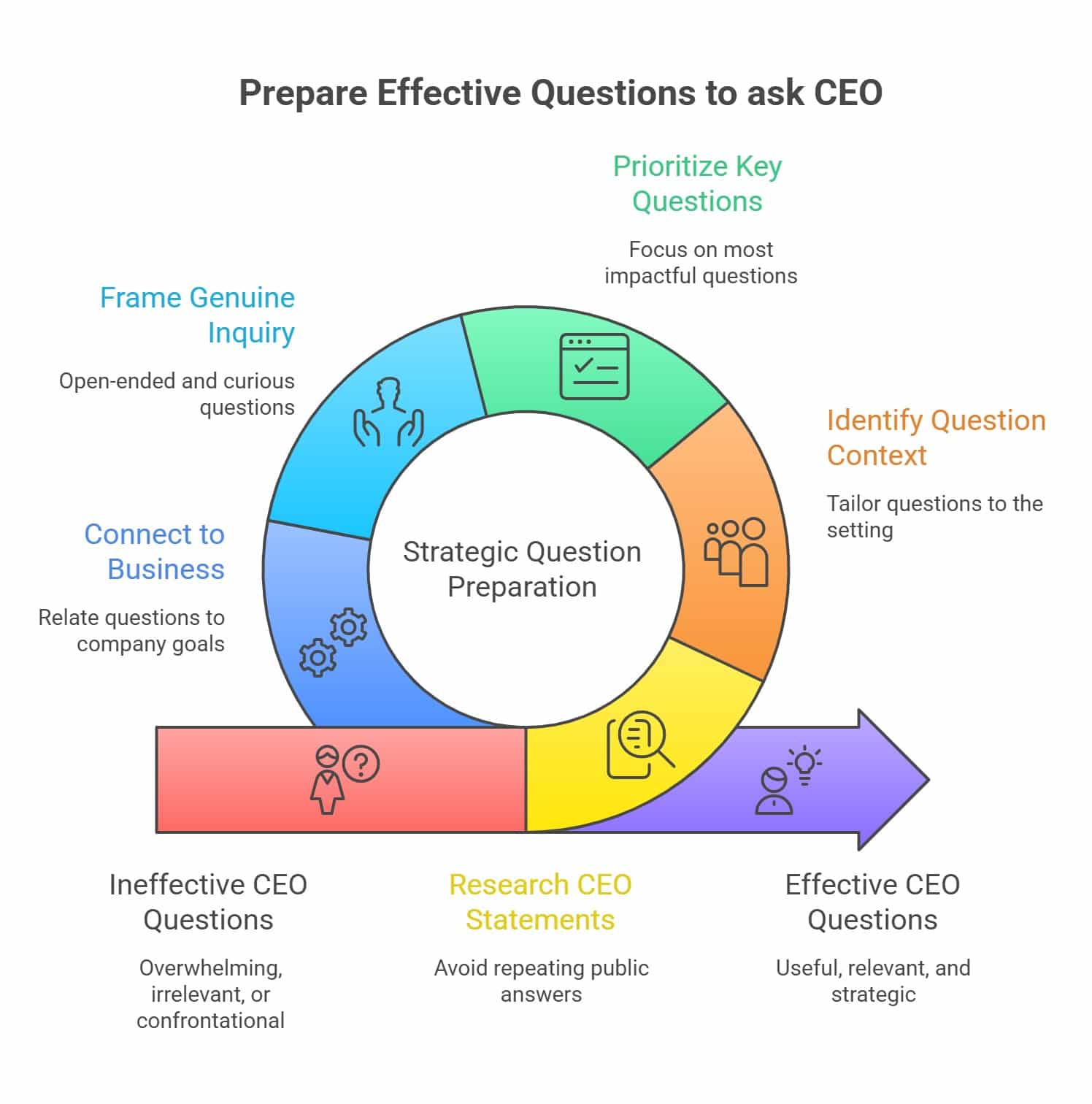
How to prepare effective questions to ask CEO?
Knowing the right questions to ask CEO conversations is only half the equation. How you ask matters as much as what you ask.
A well-framed question in the wrong context can fall flat and even signal poor judgment. Before the conversation you can keep these things in mind.
- Research the CEO’s recent public statements. Review any recent interviews, earnings calls, or internal communications. Asking a question the CEO answered publicly last week signals that you have not done your homework.
- Identify the context. Questions to ask CEO in a town hall setting are different from questions in a small group or one-on-one. Town halls favor strategic and cultural questions. Small groups allow more personal and candid questions.
- Prioritize one or two questions. Bringing a list of six questions to a town hall is not strategic it is overwhelming. Choose the one or two questions to ask CEO that will generate the most useful answer for your specific situation.
- Frame questions as genuine inquiry. The best questions to ask CEO are open-ended and curious, not leading or confrontational. “What is your view on…” works better than “Do you agree that…”
- Connect your question to the business. Questions that reference company goals, market conditions, or organizational priorities land better than purely personal questions about career advancement.
| Conversation Stage | Best Practice | Why It Matters |
| Before Asking | Research the CEO and company updates | Shows preparation and business awareness |
| During the Conversation | Listen carefully and ask respectful follow-ups | Helps you gain more meaningful insights |
| After the Conversation | Act on the advice or feedback received | Demonstrates initiative and leadership potential |
Conclusion
The most effective questions to ask CEO conversations are specific, grounded in business context, and genuinely curious. No matter which industry you work for, asking the right questions signals leadership potential and deepens your understanding of the organization you work in.
Creating meaningful leadership conversations requires more than occasional town halls or all-hands meetings. Organizations that invest in a connected employee experience platforms like HubEngage make it easier for employees to stay informed, engaged, and connected with leadership at every level.
Book a personalized demo session to explore how HubEngage platform helps organizations improve employee engagement, strengthen internal communication, and create better connections between employees and leadership.
FAQs on Questions to ask CEO
What is the best question to ask a CEO in a job interview?
The strongest question to ask a CEO during a job interview is: “What does success look like for the person in this role in the first 90 days?” This question shows results-orientation, respects the CEO’s time, and gives you concrete information for evaluating whether the role is right for you. It is also one of the questions to ask CEO conversations that almost always generates a specific, useful answer.
How do you ask a CEO a tough question without seeming confrontational?
Frame the question around curiosity rather than challenge. Instead of “Why did you make that decision?”, ask “What was the thinking behind that decision?” The substance is identical. The framing signals that you want to understand, not critique. Questions to ask CEO leaders about difficult decisions land best when they are positioned as learning questions.
How many questions should you ask a CEO in a town hall?
One question. Possibly two if the session is small and the CEO has specifically invited ongoing dialogue. Asking multiple questions in a town hall setting takes time from other employees and can read as self-promotional. Choose the single most important question to ask CEO-level leaders and make it count.
Should you ask a CEO about employee benefits directly?
Yes, but make sure you frame it strategically. Rather than asking “What are our benefits?”, ask “How does our employee benefits philosophy reflect the kind of employer you want us to be?” This reframes a transactional question into a values question, which is far more likely to generate a meaningful answer and signal your organizational thinking.
What questions to ask CEO if you want to stand out?
Questions that connect the macro to the specific stand out most. “Given the consolidation happening in our industry, how are we positioning ourselves to attract the talent we will need to compete?” is a question that demonstrates industry awareness, strategic thinking, and genuine investment in the company’s future, all at once. Questions to ask CEO that integrate external context with internal priorities consistently make the strongest impression.