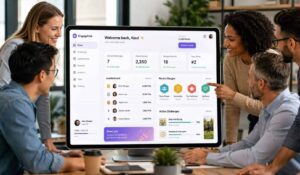
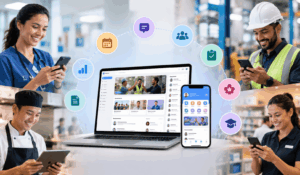
Employee gamification platforms are becoming an important part of modern workplace engagement strategies. Instead of treating gamification as a collection of points, badges, and leaderboards, organizations are using it to encourage meaningful behaviors such as learning, recognition, onboarding completion, communication, and operational participation.
The global gamification market reached $19.42 billion in 2025 and is projected to reach $92.5 billion by 2030, while 70% of Forbes Global 2000 companies use gamified platforms to improve areas such as engagement, retention, and revenue, according to Open Loyalty’s gamification statistics, according to Open Loyalty’s gamification market roundup..
For organizations, the real opportunity is not making work feel like a game. It is using game mechanics to make progress visible, reinforce desired behaviors, and improve measurable employee outcomes.


Key Takeaways
- An employee gamification platform uses points, badges, challenges, rewards, and progress tracking to reinforce meaningful workplace behaviors.
- Workplace gamification can support employee engagement, learning, recognition, onboarding, communication, and operational participation.
- Effective gamification strategies connect every mechanic to a specific business objective and measurable KPI.
- Modern gamification platforms should offer analytics, automation, integrations, mobile access, recognition, and reward management.
- Successful programs focus on meaningful behavior change and inclusion, rather than competition alone.
What Is an Employee Gamification Platform?
An employee gamification platform is software that uses game-inspired mechanics such as points, badges, challenges, progress tracking, rewards, and leaderboards to encourage specific behaviors within an organization.

Unlike consumer gamification, which often focuses on increasing repeat usage, workplace gamification should support real organizational goals. For example, employees might earn recognition or rewards for:
- Completing onboarding activities
- Finishing required training
- Participating in employee surveys
- Recognizing colleagues
- Completing operational tasks
- Taking part in company campaigns
- Demonstrating company values
The key distinction is that effective gamification rewards meaningful actions, rather than simply rewarding clicks, logins, or app activity.
Employee Gamification vs. Traditional Rewards
Traditional rewards programs typically provide an incentive after an employee achieves a specific result. Gamification can create a more continuous experience by showing progress, establishing milestones, encouraging participation, and reinforcing behaviors throughout the journey.
For example, instead of rewarding an employee only after completing an entire training program, a gamified learning journey could provide progress milestones, achievement badges, and recognition as the employee completes each stage.
This makes progress more visible and gives employees additional motivation to continue.
How Workplace Gamification Improves Employee Engagement
The business case for gamification depends on whether it changes behaviors that matter to the organization.
Research summarized by AmplifAI suggests that gamification can improve employee engagement and productivity when implemented effectively. However, results depend on program design, the behaviors being reinforced, and the needs of the workforce.
Common applications include:
| Business objective | Gamification approach | KPI to track |
|---|---|---|
| Faster onboarding | Missions, milestones and badges | Onboarding completion |
| Learning participation | Quests, progress levels and rewards | Course completion |
| Stronger recognition | Peer awards and achievement badges | Recognition participation |
| Better communication | Campaign challenges and acknowledgments | Content participation |
| Operational consistency | Task-based challenges | Task completion |
The principle is simple:
Every gamification mechanic should connect to a behavior the organization actually wants to increase.
If employees receive points for opening an app but the organization wants employees to complete training, the program is measuring the wrong behavior.
Essential Features of an Employee Gamification Platform
A modern gamification platform should provide more than points and leaderboards. Organizations should evaluate capabilities across four areas.

1. Points, Badges and Challenges
These are the core mechanics employees interact with.
- Points: Reward specific actions or achievements.
- Badges: Recognize milestones, skills, certifications, or values-based behaviors.
- Challenges: Encourage employees to complete specific activities or sequences of actions.
- Leaderboards: Create visibility around performance or participation where competition is appropriate.
- Progress tracking: Help employees see how close they are to completing a goal.
For enterprise use, administrators should ideally be able to configure these mechanics by employee group, role, location, or campaign.
2. Recognition and Social Engagement
Gamification becomes more meaningful when employees can see and celebrate contributions.
Important capabilities can include:
- Peer-to-peer recognition
- Manager recognition
- Social feeds
- Achievement announcements
- Team-based challenges
- Reward redemption
- Values-based badges
Recognition also helps connect gamification with organizational culture instead of relying entirely on monetary incentives.
3. Integrations and Automation
A strong employee gamification platform should connect with the systems employees already use.
Integrations can allow organizations to trigger rewards or recognize actions based on information from HR, learning, communication, or operational systems.
This reduces manual administration and helps make gamification part of the employee experience instead of creating another isolated tool.
4. Analytics and Reporting
Analytics should go beyond measuring logins and clicks.
Organizations should be able to understand:
| Capability | Why it matters |
| Behavioral dashboards | Shows whether target behaviors are increasing |
| Employee segmentation | Identifies differences across workforce groups |
| Real-time triggers | Enables immediate feedback and rewards |
| Campaign reporting | Measures individual program performance |
| Auditability | Supports governance and fairness |
The most useful analytics connect employee activity with outcomes such as learning completion, recognition, participation, and operational performance.
How to Build an Effective Employee Gamification Strategy
A successful employee gamification strategy starts with the behavior an organization wants to change, not the game mechanic it wants to use.
Instead of asking, “Where can we add points?”, ask:
“What employee behavior would create a measurable business improvement?”
1. Define the Business Objective
Start with one clear objective, such as:
- Increase onboarding completion
- Improve training participation
- Increase peer recognition
- Improve safety participation
- Encourage employee survey responses
- Increase engagement with important communications
2. Identify the Desired Behavior
Define the exact employee action needed to achieve the objective.
For example:
Objective: Improve onboarding
Behavior: Complete required onboarding activities within the first week
Mechanic: Progress milestones and completion badges
KPI: Time to completion and onboarding completion rate
This creates a direct connection between gamification and business performance.
3. Choose the Right Mechanics
Not every program needs a leaderboard.
Use:
- Badges for achievements and milestones
- Points for repeated behaviors
- Challenges for campaigns
- Progress tracking for learning and employee journeys
- Team competitions where collaboration is appropriate
- Recognition when cultural reinforcement is the goal
4. Design for Different Employee Groups
An effective workplace gamification strategy should work across the entire workforce.
| Employee group | Useful approach |
| Frontline employees | Mobile-first challenges and quick recognition |
| Desk-based employees | Learning paths, dashboards and collaborative challenges |
| Managers | Team participation and recognition goals |
| New hires | Guided onboarding missions and milestones |
This is especially important for organizations with deskless, distributed, multilingual, or geographically diverse employees.
For more on how gamification can support employee engagement, explore HubEngage’s guide on why gamification is an effective employee engagement strategy.
Common Workplace Gamification Mistakes to Avoid
Gamification can lose its impact when organizations focus too heavily on competition or platform activity.
Rewarding meaningless activity
If employees receive points simply for opening content rather than understanding or acting on it, the metric becomes misleading.
Overusing leaderboards
Leaderboards can motivate some employees but discourage others. Personal progress, team challenges, and recognition can provide alternatives to winner-take-all competition.
Making rewards the entire strategy
Rewards can encourage initial participation, but long-term engagement also depends on recognition, progress, purpose, autonomy, and connection.
Ignoring employee differences
Different teams respond to different mechanics. A sales competition may work well for one group but be inappropriate for another.
Measuring activity instead of outcomes
A dashboard full of clicks does not prove that employee engagement improved.
Organizations should measure whether the target behavior actually changed.
Employee Gamification Use Cases
The strongest workplace gamification programs are connected to real employee workflows.
Onboarding
Organizations can turn onboarding into a structured journey with milestones for completing forms, reviewing policies, attending orientation, meeting team members, and finishing initial training.
Employee Recognition
Employees can recognize colleagues for demonstrating company values, supporting teammates, delivering strong customer service, or contributing to workplace initiatives.
Learning and Development
Training programs can use progress levels, challenges, completion badges, and rewards to encourage employees to complete required or optional learning.
Internal Communications
Organizations can use gamification to encourage participation in campaigns, surveys, important announcements, and culture initiatives.
Frontline Operations
Gamification can support safety participation, task completion, quality routines, operational consistency, and team-based improvement programs.
For frontline employees, accessibility is particularly important. If participation requires too many steps or is designed primarily for desktop users, adoption can suffer.
Employee Gamification Platform Implementation Roadmap
A successful rollout should start small and expand based on evidence.
Phase 1: Define
Identify the business objective, target employee behavior, audience, and success metrics.
Phase 2: Design
Select the appropriate points, badges, challenges, recognition, and reward mechanisms.
Phase 3: Pilot
Test the program with one department, location, region, or employee segment.
Monitor:
- Access issues
- Participation
- Rule clarity
- Manager involvement
- Data quality
- Employee feedback
Phase 4: Launch
Use internal communications and manager enablement to explain:
- Why the program exists
- How employees participate
- How rewards are earned
- What behaviors are recognized
- How progress is measured
Phase 5: Optimize
Review performance regularly and adjust the mechanics based on employee behavior and business outcomes.
The program should evolve without constantly changing its rules. Employees need consistency to understand how the system works and trust the process.
How HubEngage Supports Employee Gamification
An effective employee gamification strategy often requires more than a standalone rewards application. Gamification becomes more useful when it connects with employee communication, recognition, learning, and everyday workplace activities.
HubEngage’s employee engagement platform brings together communication, engagement, recognition, operations, and continuous learning in a unified environment.
For gamification, this approach can help organizations connect points, badges, rewards, challenges, and recognition with the channels employees already use.
Key advantages include:
- Unified employee experience: Gamification can sit alongside communication, recognition, learning, and engagement activities.
- Multi-channel access: Employees can engage through mobile, web, email, SMS, digital signage, Microsoft Teams, and Slack.
- Recognition and engagement: Gamified mechanics can connect with employee recognition and social engagement.
- Analytics: Organizations can monitor participation and engagement patterns.
- Workforce reach: A broader employee experience environment can support both desk-based and frontline employees.
The key advantage of a unified approach is that gamification does not have to operate as a separate campaign.
Instead, it can become part of the employee experience.
Measuring the Success of Employee Gamification
The success of a gamification program should be measured across three levels:
| Measurement area | Metrics |
| Participation | Adoption, active users, challenge completion |
| Behavior | Training completion, recognition, task completion |
| Business impact | Productivity, retention, compliance, engagement |
A useful review process should ask:
- Are employees participating?
- Are the target behaviors changing?
- Is the change improving a business outcome?
If the answer to the third question is unclear, the program needs better measurement rather than more badges.
Conclusion
An employee gamification platform can help organizations make workplace behaviors more visible, measurable, and rewarding. But effective workplace gamification is not simply about adding points, badges, or leaderboards.
The strongest strategies begin with a business objective, identify the behavior that needs to change, select appropriate mechanics, design for different employee groups, and continuously measure outcomes.
When gamification is connected to communication, recognition, learning, and everyday workflows, it can become a meaningful part of the employee experience rather than another short-term engagement campaign.
Organizations looking to build a more connected employee engagement strategy can explore the HubEngage Employee Experience Platform and see how communication, recognition, learning, and gamification can work together.
FAQs About Employee Gamification
What is an employee gamification platform?
An employee gamification platform is software that uses game mechanics such as points, badges, challenges, and rewards to encourage desired workplace behaviors such as training, onboarding, recognition, and employee participation.
How does employee gamification improve engagement?
Employee gamification can improve engagement by making progress visible, recognizing positive behaviors, and encouraging participation in activities such as learning, communication, collaboration, and recognition.
What are examples of gamification in the workplace?
Common examples include onboarding missions, training badges, sales challenges, peer recognition points, safety challenges, and employee engagement campaigns.
What features should a gamification platform have?
A strong gamification platform should include points, badges, challenges, progress tracking, employee recognition, analytics, integrations, reward management, and mobile accessibility.
Is gamification effective for employee engagement?
Gamification can be effective when it focuses on meaningful workplace behaviors rather than superficial actions such as clicks or logins. Its success should be measured against specific employee and business outcomes.
What is the difference between gamification and employee rewards?
Rewards generally provide incentives after an employee achieves a result. Gamification creates a more continuous experience through progress, challenges, recognition, and achievement tracking.
How do you implement an employee gamification strategy?
Start by defining a business objective and desired employee behavior. Then select appropriate mechanics, pilot the program with a specific workforce group, measure results, and optimize the program based on employee and business outcomes.
Related Links