Managing compliance can quickly become challenging for small-business HR leaders. Federal laws, state requirements, workplace safety rules, company policies, and industry regulations all need attention. HR compliance training for employees helps turn these requirements into practical guidance employees can understand and follow. Effective training can cover safety, harassment prevention, wage and hour rules, cybersecurity, privacy, ethics, and other workplace risks. For small HR teams, the focus should be on identifying key compliance needs, training the right employees, tracking completion, and keeping content current. Our blog explains the essential topics, benefits, challenges, steps to create a training program for employees, and best practices HR leaders must do.
Key Takeaways
- HR compliance training helps employees understand workplace laws, company policies, safety requirements, and ethical responsibilities.
- Small businesses should determine which federal, state, local, and industry-specific training requirements apply before building courses.
- Training should be customized by employee role instead of assigning every course to every worker.
- An LMS or employee training platform can automate assignments, reminders, completion tracking, and training records.
- Compliance programs should be reviewed regularly because laws, policies, workplace risks, and business operations change.
- Short courses, realistic examples, quizzes, mobile learning, and ongoing communication can make compliance training easier for employees to understand.

Why HR Compliance Training Matters?
With employment laws and training requirements continue to change across federal, state, local, and industry levels, HR compliance training for employees needs to be created accordingly. The FLSA covers areas such as minimum wage, overtime, and recordkeeping, while states may add further protections. For example, harassment training requirements differ between New York and California. For small-business HR leaders, a structured compliance training program helps employees stay informed and reduces compliance risks as requirements evolve.
HR Compliance Training for Employees Advantages
Explore the key advantages compliance training brings to employees and growing businesses.
1. Reduces Legal and Financial Risks
Reduces costly compliance mistakes, penalties, disputes, and legal exposure.
2. Promotes a Safe and Respectful Workplace
Sets clear behavior standards and supports safer, respectful workplaces.
3. Improves Employee Confidence
Helps employees understand rules and act with greater confidence.
4. Protects Company Reputation
Reinforces responsible behavior that protects trust and brand reputation.
5. Encourages Ethical Decision-Making
Guides employees through ethical choices and difficult workplace situations.
10 Essential HR Compliance Training Topics
Cover these core topics to build a practical, role-relevant employee compliance program.
1. Diversity, Equity, Inclusion, and Respectful Workplace Training
Teach employees about respectful conduct, fair workplace practices, inclusion, and bias awareness. HR should align training with applicable employment laws, internal policies, and real workplace situations rather than generic examples.
2. Anti-Harassment and Anti-Discrimination Training
Teach employees how to recognize prohibited conduct, report concerns, understand retaliation protections, and maintain respectful behavior. Managers should also learn how to receive complaints, escalate issues, and respond appropriately.
3. Data Privacy and Protection Training
Help employees understand how to access, store, share, and protect sensitive information. Training should also explain password security, data handling expectations, privacy responsibilities, and how to report suspected incidents.
4. OSHA Health and Safety Training
Train employees on workplace hazards, PPE, emergency procedures, equipment safety, chemicals, ergonomics, and fall prevention. Content should reflect about workplace health and safety regulatory compliance to help employees follow required safety procedures correctly.
5. Cybersecurity Awareness Training
Prepare employees to identify phishing emails, suspicious links, malware, impersonation, password threats, and social engineering. Training should explain how to respond quickly when employees suspect a cybersecurity or data incident.
6. Ethics and Code of Conduct Training
Explain company expectations around conflicts of interest, gifts, confidentiality, fraud, bribery, vendor relationships, and ethical decisions. Use realistic workplace scenarios so employees can apply the code of conduct effectively.
7. Workplace Violence Prevention
Teach employees to recognize warning signs, report concerns, follow emergency procedures, and respond to threatening situations. Training should reflect workplace security policies and any applicable state-specific violence prevention requirements.
8. HIPAA Training for Applicable Healthcare Organizations
Train applicable healthcare employees on protecting patient information, maintaining confidentiality, preventing unauthorized access, and handling protected health information appropriately. Employees should also understand relevant privacy, security, and incident-reporting procedures.
9. Intellectual Property Protection
Explain how employees should protect trade secrets, designs, software, research, customer information, and other intellectual property. Training should cover confidentiality expectations, appropriate sharing, and risks related to unauthorized disclosure.
10. Wage and Hour Compliance
Train managers and employees on timekeeping, overtime, scheduling, meal breaks, off-the-clock work, and recordkeeping. Clear guidance helps reduce payroll errors and supports compliance with applicable wage and hour requirements.
How to Implement an HR Compliance Training Program?
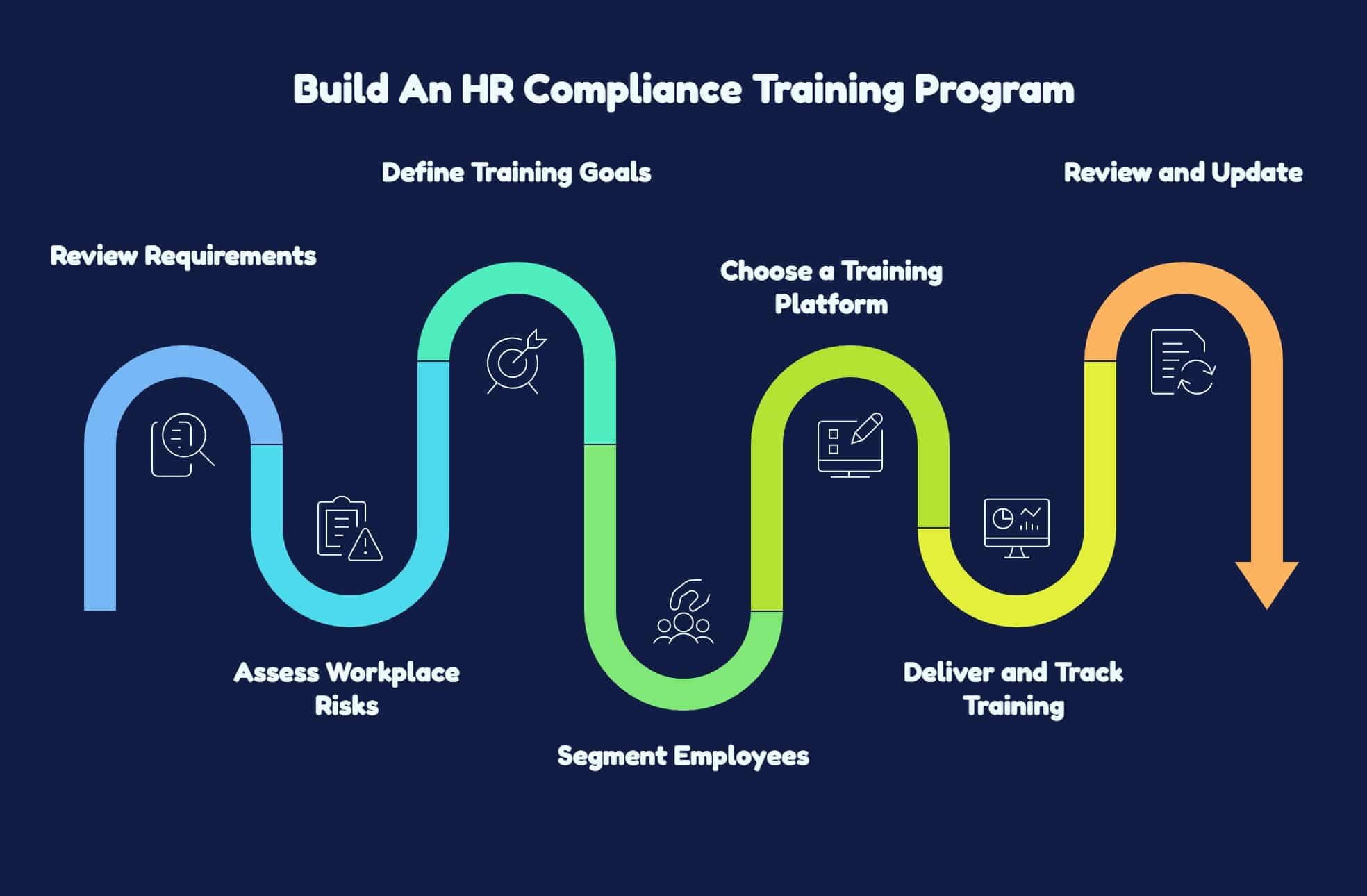
A clear implementation process helps small businesses deliver the right compliance training, track completion, and keep employees updated as requirements change. Start with these steps:
1. Review Requirements
Identify federal, state, local, and industry compliance requirements relevant to your business.
2. Assess Workplace Risks
Identify safety, legal, privacy, financial, and operational risks employees may face at work.
3. Define Training Goals
Decide what employees should understand, follow, or complete after each compliance training course.
4. Segment Employees
Group employees by roles, locations, responsibilities, and risks to deliver relevant training.
5. Choose a Training Platform
Select a platform with an internal knowledge base, reminders, quizzes, reporting, and completion tracking.
6. Deliver and Track Training
Assign courses, set deadlines, automate reminders, and monitor employee completion and assessment results.
7. Review and Update
Regularly review training results and update content when laws, policies, or risks change.
Common Compliance Training Challenges
Understand the following challenges that can decrease the effectiveness of hr compliance training for employees:
1. Keeping Employees Engaged
Lengthy, legal-heavy training can lose employee attention, reducing understanding, retention, and meaningful participation in compliance programs.
2. Tracking Multiple Requirements
Different states, roles, and industries may require different courses, deadlines, documentation, and retraining schedules for employees.
3. Reaching Frontline and Deskless Employees
Frontline and deskless employees may struggle with desktop-based training, making mobile access and flexible learning formats essential.
4. Keeping Content Updated
Changing laws and company policies can quickly make training outdated, increasing compliance risks and employee confusion.
Employee Compliance Training Best Practices
Follow these best practices to make compliance training easier to manage, complete, and improve.
1. Add Gamification Features
Use quizzes, badges, points, milestones, and recognition to make compliance learning more interactive. Having employee engagement gamification can support participation and motivation, but understanding course content should remain the main priority for employees.
2. Measure the effectiveness of HR Compliance Training
Small-business HR leaders should monitor more than course completion, help HR identify gaps, measure understanding, and improve future compliance training programs more effectively. Useful metrics include:
| Metric | Function |
| Training Completion Rate | Shows if employees finish required training. |
| Overdue Training Rate | Identifies missed training deadlines. |
| Assessment or Quiz Scores | Measures employee understanding and retention. |
| Policy Acknowledgment Rate | Confirms employees reviewed key policies. |
| Training Administration Time | Shows HR workload and efficiency. |
| Completion by Employee Group | Reveals training gaps across teams. |
3. Create Role-Based Training
Assign training based on employee roles, responsibilities, and workplace risks. Managers, healthcare staff, warehouse teams, and other groups may need different courses to keep compliance learning relevant, practical, and useful.
4. Use Microlearning
Break complex compliance topics into short, focused lessons employees can complete quickly. Microlearning makes information easier to understand, revisit, and remember while reducing dependence on long annual training sessions overall.
5. Automate Compliance Tracking and Reminders
Automate course assignments, deadline alerts, overdue reminders, and completion reports to reduce manual work. This helps HR track progress, identify missed training, and keep compliance tasks organized efficiently across teams.
Streamline Compliance Training With HubEngage
We help you simplify hr compliance training for employees through a centralized employee experience platform. HR teams can deliver bite-sized or microlearning for employees content which makes learning easy.
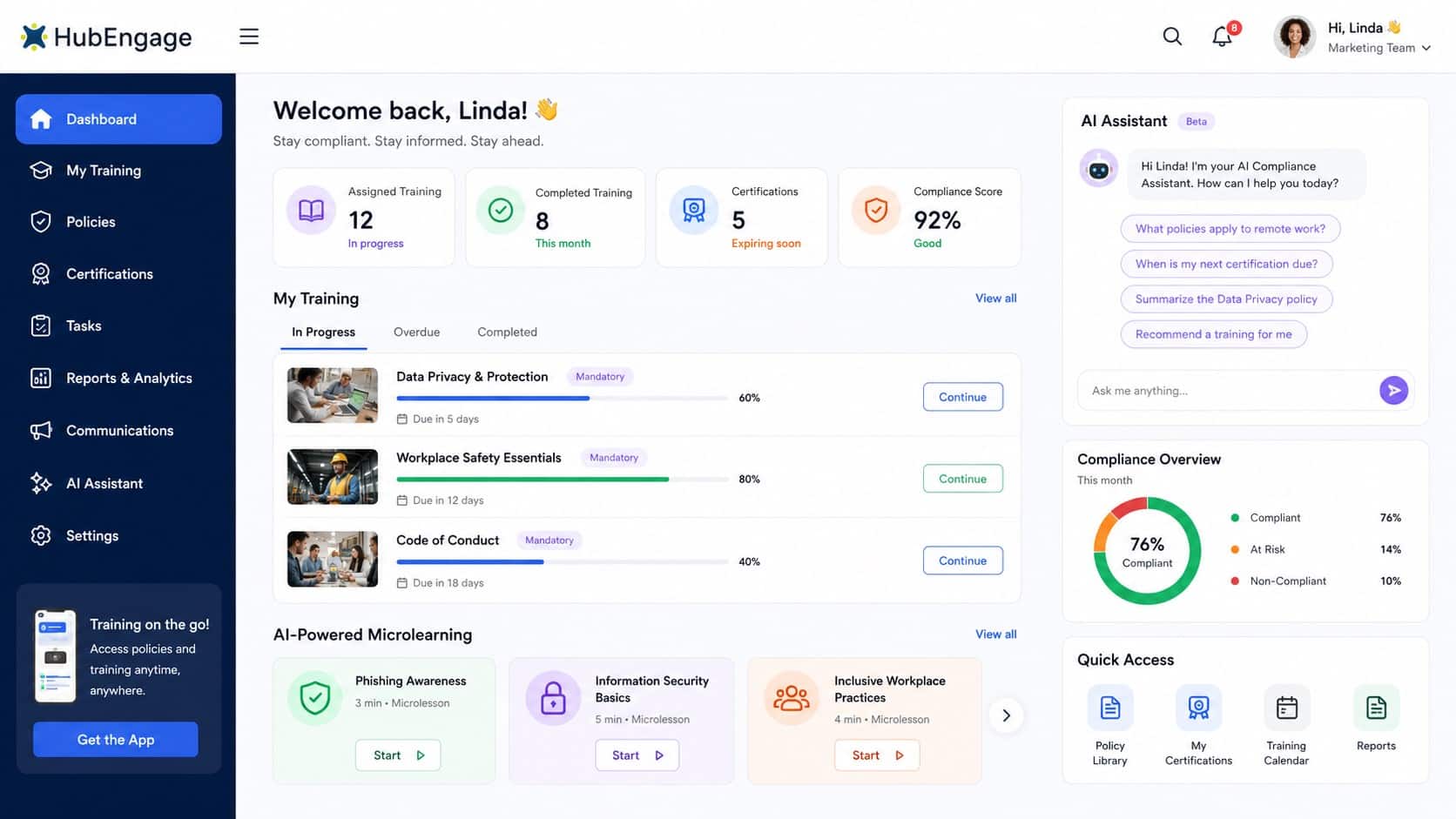
The platform comes with AI chatbot for quick employee support, and decreasing dependency on HR teams. Also, by having rewards and gamification features, it becomes easy to improve employee participation.
Our platform offers mobile first access which is very helpful for frontline, remote, and office teams to complete required courses anytime. This helps businesses make compliance training more accessible, engaging, consistent, and easier to manage across the entire workforce.
Conclusion
HR compliance training for employees helps small businesses reduce risk, support safer workplaces, and keep employees informed about important policies and legal responsibilities. A practical program should focus on relevant topics, clear communication, regular updates, and easy tracking.
Using the right training platform can also simplify assignments, reminders, completion records, and reporting as your workforce grows. To make compliance learning easier to manage and more accessible, explore our employee experience platform by taking up a demo.
FAQs About HR Compliance Training for Employees
1. What is HR compliance training for employees?
HR compliance training teaches employees how to follow workplace laws, company policies, safety rules, ethical standards, and reporting procedures, helping businesses reduce risk and maintain a compliant workplace culture overall.
2. Can compliance training be customized for different industries?
Yes. Compliance training can be customized by industry, role, location, and workplace risk. Healthcare may require HIPAA training, while construction, manufacturing, or field teams may need specialized safety training requirements.
3. How do you engage employees in hr compliance training?
Engage employees with short modules, real workplace scenarios, quizzes, videos, microlearning, and role-specific examples. Interactive, relevant training improves attention, understanding, knowledge retention, and application during everyday work situations more effectively.
4. What are the four main types of employee training?
Four main employee training types are compliance training, onboarding training, job or skills training, and professional development, each supporting legal awareness, role readiness, performance, employee growth, and career mobility opportunities.
5. How often should hr compliance training for employees be updated?
Compliance training should be reviewed regularly and updated whenever laws, company policies, workplace risks, technology, or job responsibilities change. Some regulations also require training at specific intervals or frequencies annually.
6. Why should small businesses use an LMS for compliance training?
Small businesses should use an LMS to assign courses, automate reminders, track deadlines, record completions, deliver assessments, and maintain training records, especially for employees working across multiple locations or schedules.
Related Links
steps to create a training program for employees | workplace health and safety regulatory compliance | internal knowledge base | employee engagement gamification | microlearning for employees