Many HR and internal communications teams deal with disconnected messaging, recognition that happens sporadically, and feedback surveys that seem to go nowhere. Employees fill out a survey, nothing visibly changes, and trust erodes.
The numbers back this up. Only 31% of US employees were engaged in 2024, the lowest level in a decade, while 17% reported being actively disengaged, according to Gallup's 2025 report.
Employee engagement software exists to close these gaps: listening to employees, communicating consistently, recognizing contributions, supporting learning, and tying engagement activity back to business priorities. This guide compares five leading platforms, points out which workforce needs each one fits best, and walks through how to evaluate features, integrations, privacy, adoption, scalability, and cost.
Key Takeaways
- Match the platform to your primary goal: listening, recognition, performance, communications, or frontline reach
- Prioritize reach over feature count across mobile, web, email, SMS, Teams, Slack, and digital signage
- Pick tools that turn survey data into action plans, recognition, and closed feedback loops
- HubEngage fits teams that need a modular all-in-one employee experience platform with built-in AI and gamification
Overview of Employee Engagement Software in the US Market
Employee engagement software is a category of platforms built to help organizations measure, improve, and sustain how connected, motivated, and recognized their people feel. Most products fall into one of several buckets:
- Survey and continuous-listening platforms – pulse surveys, lifecycle feedback, sentiment analysis
- Recognition and rewards tools – peer-to-peer appreciation, milestone celebrations, redeemable rewards
- Performance and feedback systems – manager check-ins, goal tracking, review workflows
- Internal communication platforms – announcements, newsletters, mobile alerts
- Broader employee experience suites – combine several of the above into one hub
The US market is shifting in a few clear directions:
- AI-assisted people insights
- Always-on feedback instead of annual surveys
- Better frontline accessibility
- Tighter integration with HRIS and collaboration tools like Microsoft Teams and Slack
Vendors are also investing in turning raw feedback into action plans managers can actually execute, rather than dashboards nobody opens.
None of this means the product with the longest feature list wins. The right choice reflects your workforce composition, how your people already communicate, how mature your engagement program is, your existing tech stack, privacy requirements, and the outcomes you need to improve.

The five platforms below represent different strengths and use cases. None is a universal "best." The right one depends on what you're solving for.
Top Employee Engagement Software in the US
Each platform here is evaluated on employee reach, engagement functionality, usability, integrations, analytics, actionability, scalability, and fit for different US workforce models.
For every platform, we cover what it's best for, core capabilities, strengths, limitations, implementation fit, and pricing where publicly verified. Confirm current details on official product pages before buying, since pricing and features change often.
HubEngage
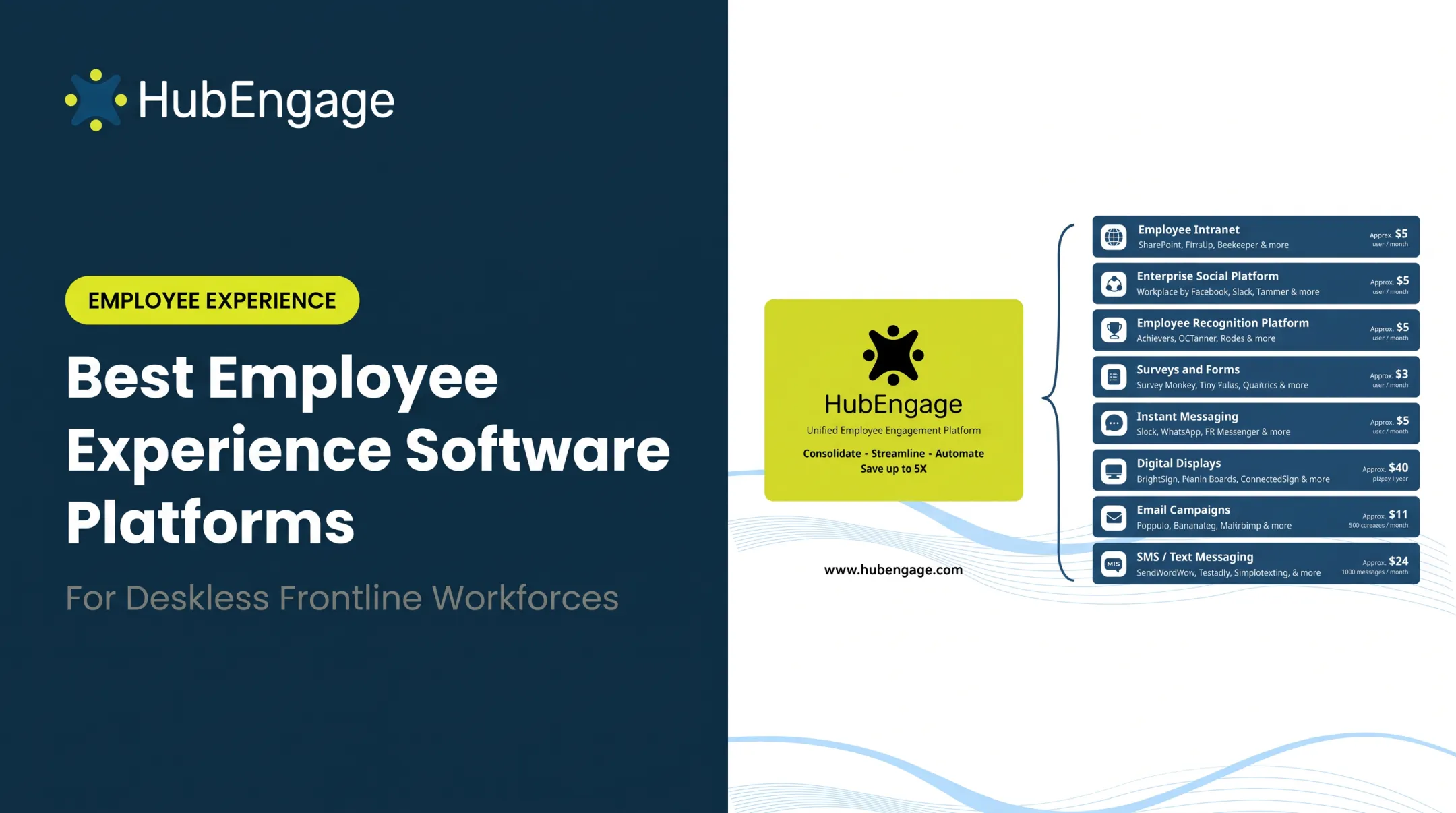
HubEngage is an all-in-one employee experience platform that unifies communications, recognition, engagement, operations, and learning in a single digital hub rather than spreading those jobs across five different tools.
That matters most for organizations with frontline, deskless, remote, and hybrid employees working side by side.
HubEngage delivers content through mobile apps, a web intranet, email, SMS, Microsoft Teams, Slack, and digital signage. One-click distribution auto-formats each message for its destination channel.
Best for: organizations wanting to consolidate communications, recognition, surveys, and learning into one platform, especially those with large frontline or distributed workforces in healthcare, retail, manufacturing, hospitality, and financial services.
Core capabilities:
- Communications Hub for direct company announcements and location- or team-specific messaging
- Recognition Hub supporting peer-to-peer, manager, and bottom-up recognition with automated milestone messages
- Surveys/Forms Hub for pulse surveys and feedback forms
- Instant Messaging and Social Hub for real-time chat and employee-generated content
- Micro-Learning Modules for training and skill development
- AI Assistant and AI search for instant answers, plus AI-supported content and email creation
A standout feature is gamification applied across the whole platform. Points, badges, and leaderboards show up in communications, surveys, social engagement, and learning activities, which helps drive adoption.
Graham Packaging, a global manufacturer, selected HubEngage for direct and location-specific communications alongside peer-to-peer and top-down recognition with rewards. Executive VP of HR Lisa Santin said the platform would strengthen company culture across its operations.
Considerations: As a modular platform, organizations get the most value by activating multiple Hubs rather than one in isolation. Confirm integrations, security controls, and current pricing directly with HubEngage, since packaging varies by organization size and selected modules.
HubEngage has more than two decades of experience building workplace technology and is an official SHRM and HRCI Recertification Provider for HR professionals, a credential tied to continuing education rather than a certification of the software itself.
Workhuman
Workhuman is a recognition-first platform designed to make appreciation part of everyday work.
Best for: organizations wanting peer and manager recognition, rewards, and culture visibility to become part of everyday work, particularly global companies with large workforces.
Core capabilities:
- Social Recognition for peer-to-peer and manager recognition throughout the employee lifecycle
- Culture Hub, a personalized recognition feed
- Rewards marketplace with in-country fulfillment, 150+ localized catalogs, and multi-currency redemption for goods, gift cards, experiences, and donations
- Life Events feature for celebrating milestones like a new home or new baby
- Workhuman iQ analytics for recognition-spend visibility, equity metrics, and sentiment signals, including the 2025 AI-powered Human Intelligence release
Workhuman supports deployment in more than 30 languages and operates in 180+ countries, which suits multinational organizations more than single-site employers.
Considerations: Workhuman is recognition-led rather than a full survey or communications suite, so teams needing deep pulse-survey functionality may need a complementary tool. Workhuman does not publicly disclose pricing, so request a quote based on headcount and modules.
Culture Amp
Culture Amp is a people-science platform built for HR teams that want rigorous, research-backed engagement surveys and a clear path from feedback to action.
Best for: survey-led engagement programs and organizations that want engagement data connected to performance conversations.
Core capabilities:
- 40+ research-backed survey templates for engagement, pulse, and deep-dive surveys
- Benchmarking against real company data, refreshed each January and July (industry cuts need at least 20 companies and 20,000 respondents)
- Action Framework: teams pick focus questions, assign owners, set due dates, and track progress to completion
- Perform module for continuous feedback, reviews, calibration, 1-on-1s, and goal management
- Integrations with HRIS, Slack, and Microsoft Teams
Considerations: Pricing depends on employee count, product selection, and service tier, billed annually with quote-based plans for Engage and Perform.
One verified G2 reviewer in nonprofit management praised interpretable results but noted that private Anytime Feedback can't be reported on. Test that during a trial if reporting on informal feedback matters for your workflow.
Qualtrics Employee Experience
Qualtrics Employee Experience targets enterprises running complex listening programs across multiple employee populations.
Best for: large organizations needing enterprise-grade analytics, flexible segmentation, and advanced survey design.
Core capabilities:
- Engagement, Lifecycle, and Ad Hoc Employee Research project types
- Organizational hierarchy support for level-based, parent-child, and ad-hoc structures
- Text iQ for topic tagging and sentiment analysis, with Basic and Advanced tiers
- Dashboards with dashboard-wide and widget-level filtering
- Benchmarking data from more than 1,300 companies globally, covering 2023-2025, cut by industry, country, and company size
- Platform-level security including ISO 27001 and SOC 2 Type 2 certifications
Considerations: Depth comes with complexity. Implementation often involves Qualtrics' XM Services for program design and integrations, and total cost of ownership can run higher than simpler survey tools.
This suits organizations that already have research or experience-management infrastructure in place.
Microsoft Viva Glint
Viva Glint is the logical choice for organizations already deep in the Microsoft ecosystem.
Best for: Microsoft 365-centered organizations running enterprise engagement programs.
Core capabilities:
- Customizable surveys for engagement, onboarding, exit, DEI, and change management
- Heat maps breaking down scores by team, location, or tenure
- Manager Concierge, a guided four-step workflow: review feedback, interpret results, discuss with the team, and commit to next steps
- Copilot-generated comment summaries for recurring and ad-hoc survey programs
- Teams integration for survey invitations, reminders, and results notifications
Confidentiality thresholds default to 5 responses for rated scores and 10 responses for comments, though these are configurable controls rather than an absolute anonymity guarantee.
Licensing is per user, per month, paid yearly:
| Offering | US Price (per user/month) | Includes Glint |
|---|---|---|
| Viva Glint (standalone) | $2 | Yes |
| Viva Workplace Analytics and Employee Feedback | $6 | Yes |
| Viva Suite | $12 | Yes |

Considerations: Viva Glint requires a 50-seat minimum and an existing Microsoft 365 enterprise subscription. Always-On survey programs don't support Teams or email notifications, so check which survey type your use case needs before buying.
How We Chose the Best Employee Engagement Software
Picking an engagement platform based on feature count alone leads to mismatched tools. The most common mistake: buying a survey tool when the real problem is fragmented communication, inconsistent recognition, or frontline employees who can't access company systems at all.
Here's what we weighed instead.
Core engagement capabilities. We looked for pulse and lifecycle surveys, anonymous feedback options, recognition and rewards, social interaction, learning content, performance conversations, action planning, and internal communications, not just one or two of these in isolation.
Reach and accessibility. A platform that only works on desktop fails deskless and frontline teams. We checked for mobile apps, web access, email, SMS, digital signage, kiosk support, multiple languages, and integrations with Microsoft Teams, Slack, HRIS, and SSO systems.
Analytics and actionability. Collecting feedback is the easy part. We prioritized platforms with dashboards, trend analysis, segmentation, AI-assisted comment analysis, manager recommendations, and clear ways to show employees their input influenced a decision. Forrester's 2025 analysis of employee experience platforms makes a similar point: surveys alone aren't enough, and manager guidance, nudges, and recognition are what connect listening to real action.
Trust, privacy, and security. Anonymity protections, role-based permissions, data retention policies, and certifications like SOC 2 or ISO 27001 matter more as organizations scale. We relied on current vendor documentation rather than assumptions, since these details change.
Implementation and ongoing value. Finally, we considered onboarding support, administrator workload, manager training, how adoption gets measured, and whether a platform can scale and consolidate overlapping tools over time. Even the strongest platform still needs leadership buy-in and clear processes to deliver results.

Conclusion
The best employee engagement platform is the one that fits your workforce, how your people already communicate, your culture goals, your existing tech stack, and your ability to act on what employees tell you.
Start by naming your primary use case:
- Continuous listening and people analytics → Culture Amp or Qualtrics
- Recognition-led culture building → Workhuman
- Microsoft 365 alignment → Viva Glint
- An all-in-one experience for frontline, deskless, and distributed teams → HubEngage
From there, request demos and test real employee workflows before signing anything. Have a frontline manager try submitting a survey from a phone. Have HR draft a recognition message and send it across channels. The tools that feel effortless in a demo are the ones employees will actually use.
If your organization is juggling separate apps for communications, recognition, surveys, and learning, HubEngage brings those into one modular hub with AI and gamification built into the experience. Reach out to HubEngage to see how a demo fits your workforce.
Frequently Asked Questions
What is the best employee engagement platform?
It depends on your workforce structure, goals, channels, integrations, analytics needs, and budget. Survey-led teams often choose Culture Amp or Qualtrics, recognition-focused teams lean toward Workhuman, Microsoft shops consider Viva Glint, and frontline or distributed teams often pick HubEngage.
What are some solutions for improving employee engagement?
Effective approaches combine continuous listening, consistent recognition, honest manager feedback, transparent communication, learning opportunities, and visible action planning. Accessible, multi-channel software supports these efforts, but it doesn't replace strong management and a genuine culture of trust.
Why is employee engagement important for a company?
Engaged employees show more discretionary effort, stay longer, and communicate better with their teams. Gallup's Q12 meta-analysis found an 18% difference in sales productivity between top- and bottom-quartile units across 180,000+ teams (Gallup).
What are the three levels of employee engagement?
Using Gallup's framework, employees fall into three groups: engaged (highly involved and enthusiastic), not engaged (psychologically checked out but still showing up), and actively disengaged (resentful and acting out their dissatisfaction).