Introduction
Your frontline staff just finished a double shift. Your corporate team sent three company-wide emails today. Guess how many the warehouse crew actually saw?
This is the daily reality for US organizations juggling hybrid offices, remote staff, and deskless frontline teams. Email gets ignored. Slack channels become noise. Printed flyers in the break room go stale within hours.
The cost of getting this wrong is steep. According to Gallup's 2025 report, only 31% of US employees were engaged in 2024, while 17% were actively disengaged—the lowest engagement reading in a decade.
Dedicated employee communication platforms close this gap. Unlike email or ad-hoc chat tools, they deliver content across mobile, web, SMS, and digital signage simultaneously, reaching people wherever they actually work.
This guide breaks down the top platforms on the market and how to pick the right one for your workforce.
Key Takeaways
- Multi-channel delivery, not just messaging, reaches deskless and hybrid staff
- Mobile access, AI automation, and analytics separate leaders from basic chat tools
- HubEngage, Connecteam, Workvivo, Staffbase, and Blink fit different workforce models and sizes
- Frontline usability and HRIS integration outweigh brand recognition in evaluations
- Trial adoption rates predict success better than feature checklists
Overview of Employee Communication Platforms in the Modern Workplace
An employee communication platform is purpose-built software that connects leadership, managers, and staff, regardless of whether someone sits at a desk or stands on a factory floor. It replaces the patchwork of email threads, printed memos, and personal texting that most organizations default to.
The need for these tools has never been more urgent. McKinsey's frontline report found that roughly 70% of the US workforce (about 112 million workers) holds frontline jobs: retail associates, nurses, cooks, and store managers who rarely touch a corporate inbox.
Why Email and Intranets Fall Short
Traditional corporate intranets were built for desk-based employees logging in from a company laptop. That model breaks down fast when:
- Warehouse drivers are on the road when updates go out
- Manufacturing staff never receive a company email address
- Hospital shift workers rotate through three different schedules weekly
- Cleaning crews and field technicians have no shared physical location
HR Dive's survey found that more than 1 in 4 frontline employees lack a reliable "go-to" channel for important updates, and 32% say their current channel simply doesn't fit their role.

The next section reviews the platforms built to solve exactly this problem.
Top Employee Communication Platforms for Modern Workforces
We evaluated each platform against five criteria: multichannel reach, frontline usability, automation capabilities, analytics depth, and real-world user adoption. Here's how the leading options stack up.
HubEngage
HubEngage is an AI-powered employee experience platform built to reach every employee (mobile, web, SMS, email, and digital signage) from one unified dashboard. Unlike point solutions that handle only messaging, HubEngage layers recognition, surveys, and continuous learning into the same system.
What sets it apart is platform-wide gamification. Points, badges, and leaderboards apply across communications, recognition, surveys, and learning modules, not just a single feature bolted on for show. The AI Assistant also handles content creation and answers employee questions instantly, reducing the manual workload on internal comms teams.
| Category | Details |
|---|---|
| Core Features & Channels | Mobile apps (iOS/Android), modern intranet, SMS text, email broadcasts, digital signage, pulse surveys, recognition, continuous learning |
| Standout Strengths | Enterprise-wide gamification, AI-assisted content distribution, role-based segmentation, SHRM/HRCI recertification provider status |
| Best For | Distributed, hybrid, or deskless frontline teams consolidating communication, recognition, and engagement into one hub |
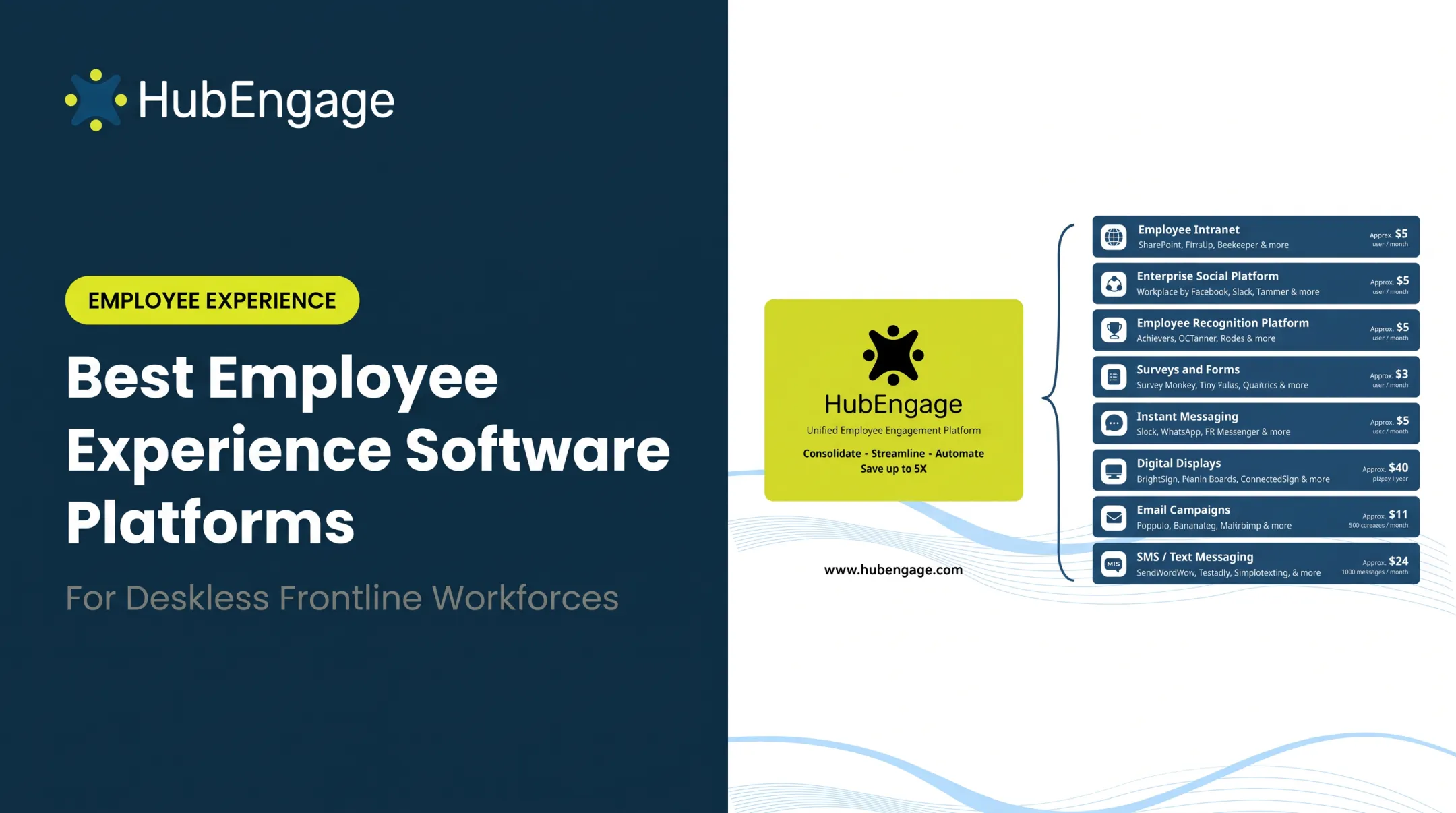
Graham Packaging, one of HubEngage's customers, uses the platform to deliver location- and team-specific updates separately to corporate staff, plant workers, and international teams without flooding any group with irrelevant messages. For organizations spending an average of $40 per user across fragmented tools, that kind of consolidation adds up fast.
Connecteam
Connecteam built its reputation on operations, not just chat. It's designed for shift-based and deskless teams who need scheduling, time tracking, and communication in a single mobile app.
| Category | Details |
|---|---|
| Core Features & Channels | Mobile news feeds, team chat, push notifications, digital checklists, shift scheduling, GPS time tracking |
| Standout Strengths | Strong frontline operations integration, fast mobile onboarding, direct shift-related task communication |
| Best For | Small-to-midsize businesses in retail, construction, and hospitality needing combined comms and shift management |
If your biggest pain point is coordinating shift swaps alongside daily announcements, Connecteam's operational focus is hard to beat.
Workvivo
Now part of Zoom following its April 2023 acquisition, Workvivo leans into social-style engagement. It works like an internal social network: employees scroll a feed, leave shoutouts, and watch executive livestreams instead of reading static memos.
| Category | Details |
|---|---|
| Core Features & Channels | Social activity feed, recognition badges, livestream broadcasting, surveys, modern intranet |
| Standout Strengths | High social engagement interface, strong leadership visibility, deep Zoom ecosystem integration |
| Best For | Mid-market and enterprise organizations building culture and peer recognition among hybrid and desk-based staff |
Workvivo shines when culture-building is the priority over operational workflows.
Staffbase
Staffbase targets large, decentralized enterprises with dedicated comms teams. Its strength lies in editorial discipline—think structured newsletters, approval workflows, and audience governance at global scale.
| Category | Details |
|---|---|
| Core Features & Channels | Branded mobile apps, personalized intranet, email newsletter designer, campaign analytics dashboard |
| Standout Strengths | Robust editorial calendars, complex audience governance, deep Microsoft 365/SharePoint integration |
| Best For | Large global enterprises requiring structured editorial workflows and compliance governance |
Staffbase's email tool tracks opens, clicks, and reads segmented by role and location—useful for comms teams proving ROI to leadership.
Blink
Blink solves a specific problem: reaching frontline employees who don't have a corporate email address at all. Onboarding happens via phone number or QR code, removing the biggest barrier to adoption.
| Category | Details |
|---|---|
| Core Features & Channels | Mobile-first news feed, secure team chat, mandatory read confirmations, digital form access, pulse surveys |
| Standout Strengths | Frictionless QR/phone login, high adoption among non-desk workers, unified access to workplace links |
| Best For | Transit, healthcare, logistics, and retail organizations needing a lightweight mobile hub |
Blink's single sign-on to external tools means employees aren't juggling five different logins just to clock in and check a schedule.

How We Chose the Best Employee Communication Platforms
Buyers make the same two mistakes repeatedly: picking a tool designed for desktop users when half their workforce is deskless, and over-indexing on messaging features while ignoring governance and measurement.
Before committing to a platform, evaluate it against these dimensions:
- Frontline mobile usability - Can employees without a company email log in easily, and does the app work on low-bandwidth connections?
- Multi-channel publishing reach - Does one piece of content auto-format for mobile, SMS, and digital signage, or does your team rebuild it manually for each channel?
- HRIS integration - Does the platform sync employee data automatically, or will your team maintain duplicate records?
- Security certifications - Look for documented compliance frameworks like ISO 27001 or SOC 2 before handling sensitive employee data.
- Measurable KPI impact - Can the platform show reach, read rates, and sentiment trends, or just raw message counts?
G2's employee communications category framework backs this up, requiring audience segmentation, engagement mechanisms, analytics, and multichannel distribution as baseline expectations, not optional extras.

Conclusion
There's no universal "best" platform here. The right choice depends on your workforce demographics and daily operational workflows, not which brand has the flashiest marketing page.
Before signing a contract:
- Run a trial with actual frontline staff, not just corporate testers
- Confirm channel coverage matches where your employees actually spend time
- Calculate total cost of ownership, including the tools you'll retire
If you need one platform that unifies AI-powered content creation, gamified engagement, and multichannel reach across mobile, web, SMS, email, and digital signage, HubEngage was built for that.
See how it fits your workforce before your next budget cycle closes.
Frequently Asked Questions
What are the best employee communication platforms?
HubEngage, Connecteam, Workvivo, and Staffbase lead the market, each with distinct strengths. The right pick depends on whether you prioritize frontline reach, cultural engagement, or structured editorial workflows.
How can I improve employee communication?
Establish multi-channel delivery so messages reach mobile, email, and in-person channels simultaneously. Segment content by role to cut noise, adopt mobile-first tools for deskless staff, and build regular two-way feedback loops.
What is employee communication?
Employee communication is the exchange of information, ideas, and feedback between leadership, managers, and staff across an organization. It covers everything from policy updates to day-to-day operational instructions.
What is a workplace platform?
A workplace platform is digital software that centralizes communication, operational resources, engagement tools, and workflows in one place. It replaces scattered tools like email, printed notices, and personal messaging apps.
What are the 5 methods of communication in the workplace?
The five primary methods are verbal/in-person, written/digital messaging, non-verbal, visual (digital signage or video), and listening/feedback channels. Each serves a different purpose depending on urgency and audience.
What is corporate communication?
Corporate communication is the strategic management of internal and external messaging to maintain brand consistency and align stakeholders. It covers how a company communicates its mission, policies, and direction to both employees and the public.